






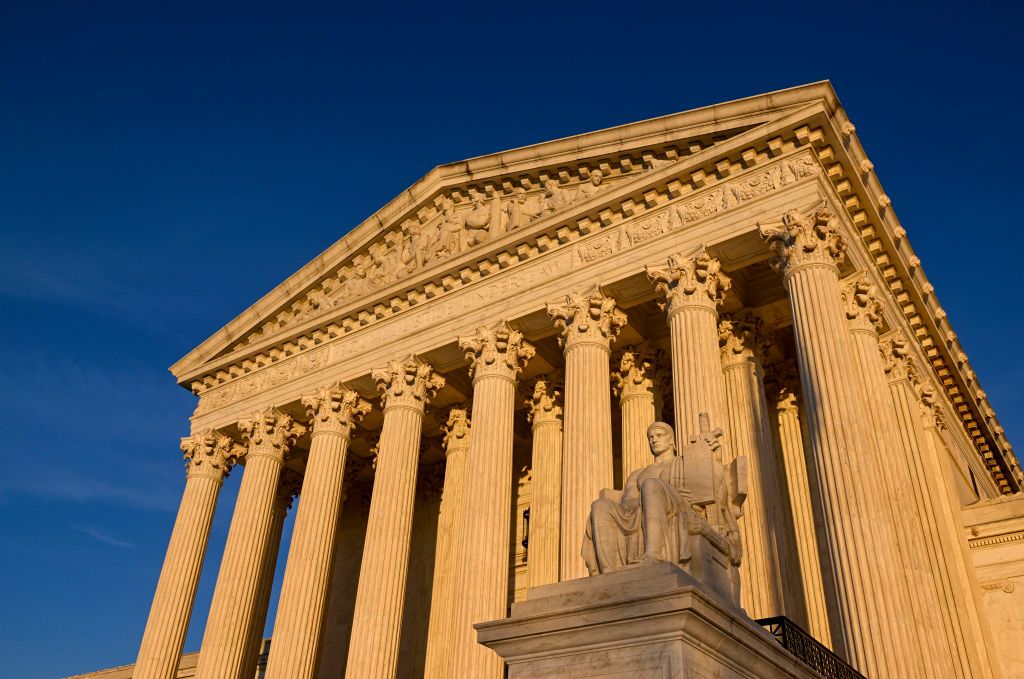
Last week, the Supreme Court, without a word of explanation, allowed the Trump administration to send immigrants to countries where they have no prior contact, where they do not speak the language, and where they could face torture and death. In doing so, the court repeated what it had done 15 months earlier, despite findings by a district court that this practice was illegal and risked great harm. And although the court granted certiorari and said that it will hear the case in December, in the meantime and likely until a decision months later, the Trump administration is allowed to continue this inhumane practice.
Department of Homeland Security v. D.V.D. I
The issue of the Trump administration deporting individuals to countries where they had no prior contact first came to the court on its emergency docket in spring 2025. A federal district court in Boston had issued a preliminary injunction stopping this. The case involved deporting individuals from such countries as Venezuela and Honduras to others such as Guatemala and South Sudan.
Federal law is quite specific as to where a person can be deported to. Specifically, 8 U.S.C. § 1231(b)(2)(E), lists where a noncitizen can be taken, such as the country from which the alien was admitted to the United States, the country where the person is a citizen, the country where the person was born, and so on. The federal statutory provision concludes that only “f impracticable, inadvisable, or impossible to remove the alien to each country described in a previous clause of this subparagraph,” may the person be sent to “another country whose government will accept the alien into that country.” From this, it is clear that the final category is meant to be a last resort. Taking people who are from Venezuela and Honduras to a prison in South Sudan – a country where they have no prior connections and cannot speak the language – violates this law. Also, international law, such as the Convention Against Torture, or CAT, would require that individuals have notice of where they are being sent and the opportunity to argue why it would endanger them.
Federal Judge Brian E. Murphy issued a preliminary injunction preventing the government from removing any non-citizen to a “country not explicitly provided for on the alien’s order of removal” without following procedures such as providing written notice and “meaningful opportunity for the alien to raise a fear of return for eligibility for CAT protections.” The United States Court of Appeals for the 1st Circuit upheld the preliminary injunction.
But on June 23, 2025, in a ruling on its emergency docket, the court in Department of Homeland Security v. D.V.D. stayed the preliminary injunction. There was no opinion from the court or any justice in the majority.
Sotomayor wrote a blistering dissent, joined by Justices Elena Kagan and Ketanji Brown Jackson. She began her opinion:
Sotomayor then explained that the administration and the majority of the court ignored that these individuals could face torture or death in these countries. She concluded:
Department of Homeland Security v. D.V.D. II
After the Supreme Court issued this ruling, the district court, on June 23, 2025, said that its earlier order remained in effect that six individuals not be deported until they had a chance to raise their claims against removal. The United States then filed a “motion for clarification” in the Supreme Court.
On July 3, the court granted the government’s motion and said that the district court’s earlier “remedial order cannot now be used to enforce an injunction that our stay rendered unenforceable.” Kagan wrote a short concurrence saying that she disagreed with the court’s earlier ruling, but in light of it, the district court could not enforce its order limiting such removal to third countries.
Sotomayor again wrote a scathing dissent, which was joined by Jackson. She wrote:
She powerfully concluded her dissent: “Today’s order clarifies only one thing: Other litigants must follow the rules, but the administration has the Supreme Court on speed dial.”
The individuals were then deported to South Sudan, a country where they had no prior contacts. The Trump administration subsequently has used this power to deport people with no prior connections to nations such as South Sudan, Eswatini, Uganda, Rwanda, Equatorial Guinea, Liberia, Central African Republic, Cameroon, Burundi, and Sierra Leone.
Department of Homeland Security v. D.V.D. III
The issue returned to the federal district court in Boston. Judge Murphy dissolved the preliminary injunction and granted summary judgment in favor of the challengers to the Trump administration policy. The court concluded that the Department of Homeland Security’s third-country removal guidance violated statutory requirements for removal destinations and failed to provide required notice and hearings for fear-based claims under the Convention Against Torture.
The district court issued a declaratory judgment that federal law requires that the federal government in effecting removal of a class member “to first seek removal to that class member’s designated country of removal or specified alternative country or countries of removal, as provided in that class member’s final order of removal.” The district court also declared that “class members have the right to meaningful notice before removal to any third country” and that they “have the right to a meaningful opportunity to raise a country-specific claim against removal before removal to any third country.” Murphy vacated memos from DHS and ICE that provided for third-country removals.
On Sept. 18, 2026, the United States Court of Appeals for the 1st Circuit affirmed the district court’s order, except for the obligation to first seek removal to non-third-party countries.
The United States went to the Supreme Court for an emergency stay of the district court’s order. On Sept. 29, the court granted the stay, over the dissents of Sotomayor, Kagan, and Jackson. The court also granted certiorari and instructed that the case be heard in December.The court asked for briefing and arguments on the following questions:
The final question is quite unusual in allowing the government to add any other questions it wants the court to hear and decide.
The problems with the emergency docket
I believe the court did the right thing in granting certiorari and choosing to decide on the merits the power of the government to send individuals to third countries where they have no prior contact and could face great danger. But it is deeply disturbing as to how the six conservative justices have handled this matter on this docket.
In both its June 23, 2025, order and its Sept. 29, 2026, order, the court gave no explanation for its rulings. Not a word. The district court and the court of appeals had issued detailed opinions. As Sotomayor said in her dissent, this potentially involved a matter of life and death for those being deported. Yet, the court offered no explanation for staying the lower courts’ decisions. Judicial opinions matter. “Because I said so” is never persuasive.
The Supreme Court has declared that it “will grant a stay pending appeal only under extraordinary circumstances.” Inevitably, this involves a balance of competing considerations. On the one hand, there is the right of individuals under federal and international law to not be deported to countries without notice and the opportunity to explain why it would put them in danger. The district court had found that deporting these individuals to South Sudan could lead to their torture and death. On the other hand, there is the interest of the Trump administration in claiming a right to deport anyone to those places it chooses. To me, the balance of equities seems clear that it makes sense to pause these deportations to third counties until the courts can decide whether it is lawful: Deportations can lead to irreversible harm, while delaying the deportations to these countries just means that they will remain in detention in the United States or sent to places where their deportation is legally permissible.
What next?
The court will hear the case in December and weeks or months later will issue its ruling. My hope is that the court will uphold the district court order and stop the illegal and inhumane practice of sending individuals to countries where they have no prior contact. But at least until then, the court has effectively empowered the Trump administration to do this.
Continue reading...
[ H/T SCOTUSblog ]