


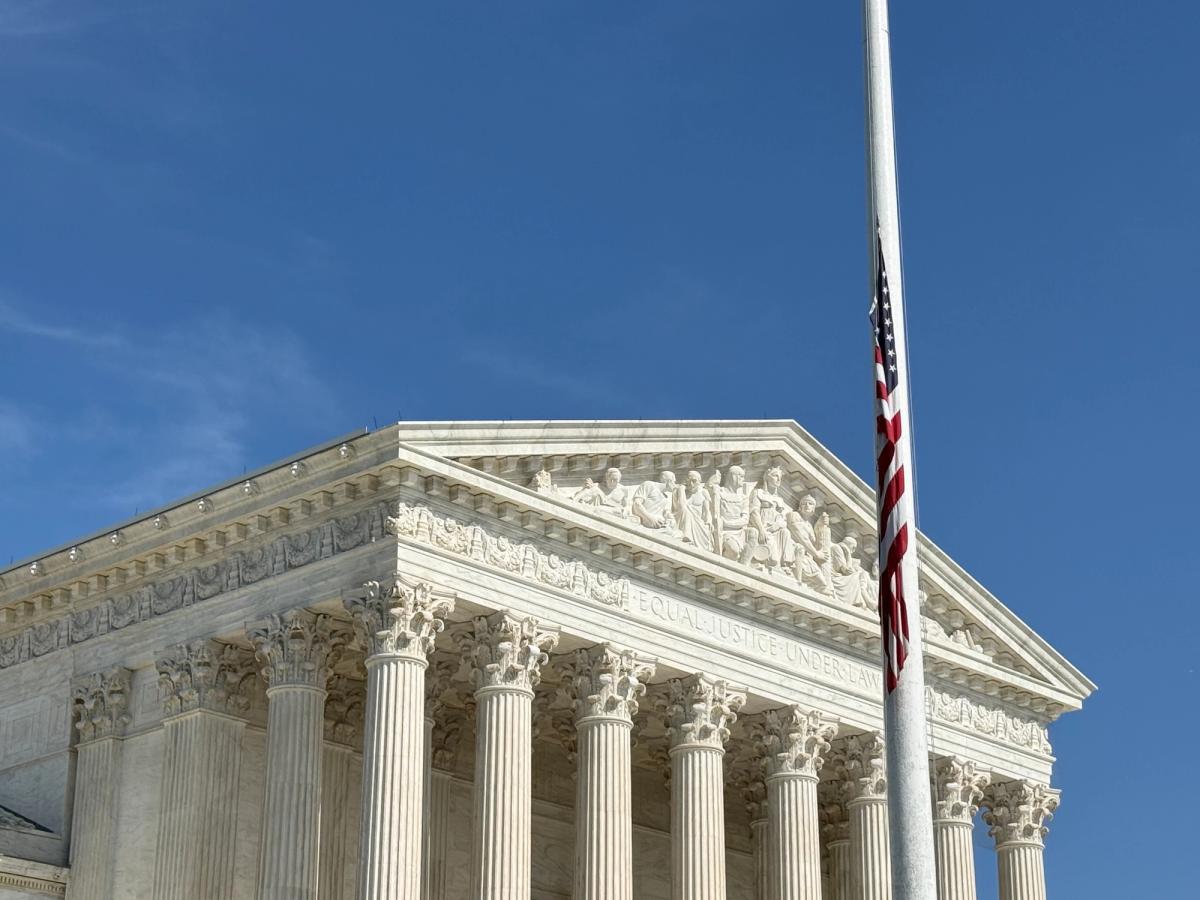
On the 40th anniversary of Justice Antonin Scalia’s swearing-in, I wanted to reflect on one major aspect of his legacy to the American people. As many SCOTUSblog readers are undoubtedly aware, Justice Scalia led the way to an astounding revival of textualism and originalism, which had been dead since the legal realist revolution of the 1920’s.
But that’s widely known. In this article, I want to tell the story of how I personally saw Justice Scalia actually set out to revive originalism, and in particular a specific version of it, by giving what was at the time a risky lunch keynote address at Attorney General Ed Meese’s Conference on Economic Liberties on Saturday, June 14th, 1986. One day before then-Judge Scalia’s speech, Attorney General Ed Meese had invited him to meet with President Ronald Reagan for what was (obviously) a job interview for a Supreme Court appointment. To put it mildly, Judge Scalia’s speech had high stakes for his future career.
Given this, most lawyers would say something mild, uncontroversial, and ingratiating toward the attorney general. But Judge Antonin Scalia was not a normal, cautious lawyer. Indeed, as a law professor, he liked to teach against the views of his class and tell them things that they did not ordinarily want to hear. Or to make a more historical reference, Justice Scalia was the type of person who would speak to King Henry VIII as if he were St. Thomas More. He was temperamentally unable to flatter or to say something that he did not believe to be true.
As background, it’s important to know that Attorney General Meese had staked his reputation in the year prior to Judge Scalia’s Keynote Address on arguing for what is called a jurisprudence of original intent for all federal and state judges to follow. Specifically, Meese advocated in perhaps a dozen speeches prior to June of 1986 that judges should follow the original intent of the Framers. Judge Robert H. Bork, Scalia’s rival for a Supreme Court nomination, had also expressed support for this view.
Not Judge Scalia. His June 14th keynote address was entitled “Original Meaning,” and its central theme was that Attorney General Meese was wrong to argue for original intent. Instead, Scalia contended that one should really be arguing for judges to follow the original public meaning of legal texts; that is, what people at the time of the text’s ratification would have understood it to mean as opposed to what those who drafted the text intended it to mean.
He advocated this alternative approach for several reasons. First, legislative history – which those advocating original intent would seemingly look to – was often contradictory and incoherent. Second, Judge Scalia went so far as to say, quite correctly, that the original intent of the Framers of the Constitution was for judges to follow the original public meaning the Constitution’s words had to the state ratifying conventions. (For Judge Scalia, dictionaries were far more probative of original public meaning than were such things as The Federalist Papers because they were read and followed by many more people at the time of the Founding.)
He was entirely right to correct Attorney General Meese on these points – and today the vast majority of legal scholars, judges, and justices agree with him. But, at the time, Judge Scalia had some real chutzpah to criticize Attorney General Meese, at Meese’s own conference, two days before a job interview with Ed Meese’s close friend Ronald Reagan.
I shared Judge Scalia’s fondness for textualism and originalism, but even I perked up with attention to see how Attorney General Ed Meese, the lion, would react to being bearded in his own den.
Ken Cribb, who was then Ed Meese’s counselor and chief of staff, cleverly took a name tent card from his table, folded it inside out, wrote “Stipulated” on it, and showed it to Attorney General Meese. Attorney General Meese nodded approvingly, and Cribb put the tent card saying “Stipulated” on the podium in front of Judge Scalia before the judge had even finished speaking.
Two days later, on Monday, June 16, Judge Scalia interviewed with President Reagan, and on Tuesday the 17th, President Reagan publicly nominated Judge Scalia to a seat on the Supreme Court. The Senate confirmed Scalia by a vote of 98 to 0 (rather hard to believe in this day and age).
Attorney General Meese told me this week that Justice Scalia was a good friend who completely fulfilled Ronald Reagan’s greatest and highest hopes during his tenure on the Supreme Court. Indeed, Justice Scalia loudly argued for a jurisprudence of original public meaning for all his nearly 30 years there, and the doctrine of judges following the original public meaning of the text, and not the intent of the Framers, took hold.
Whether one agrees with their views or not, I believe this story shows how open-minded and humble Attorney General Ed Meese was, and how gutsy and principled Judge Antonin Scalia was. That’s something worth reflecting on four decades later.
Continue reading...
[ H/T SCOTUSblog ]