

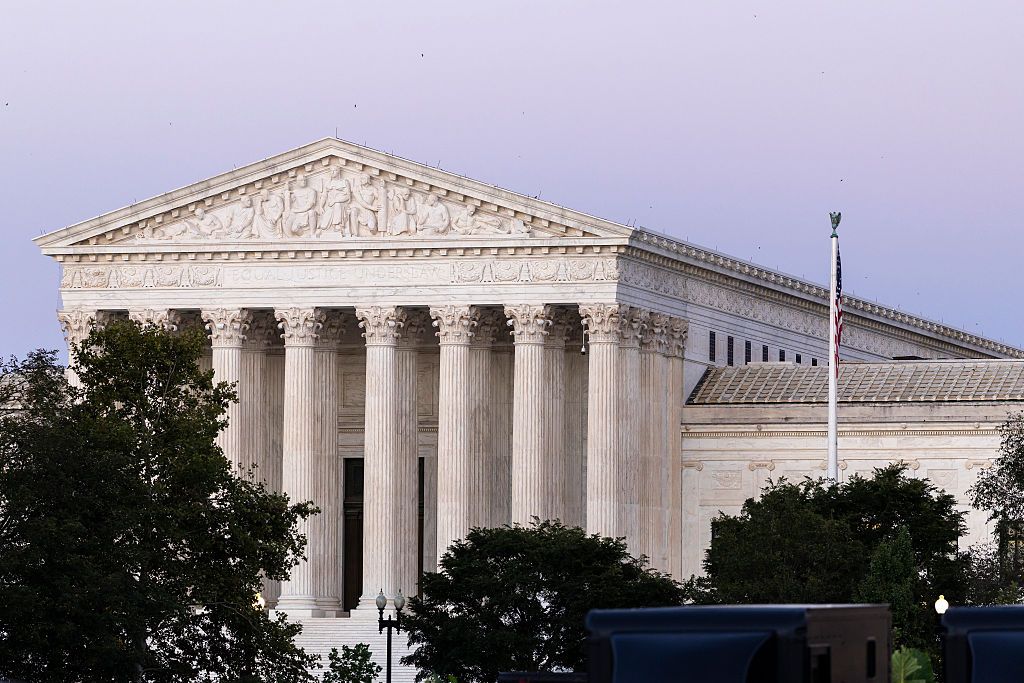
Before the justices took the bench on Monday for the first oral arguments of the 2026-27 term, the Supreme Court issued a list of orders from the justices’ private conference on Sept. 28, where they considered petitions for review that built up during the summer recess. As it does each year, that “long conference” produced a lengthy list of denied petitions. The justices denied review in hundreds of cases, including a high-profile dispute over whether schools may bar students from wearing sweatshirts printed with the phrase “Let’s Go Brandon,” a clash over the Second Amendment rights of convicted felons, and two battles over COVID-19 vaccine mandates.
In Monday’s order list, the justices also asked the United States solicitor general to share the government’s views on several cases and sent several others back to the lower courts for reconsideration in light of rulings from last term. For example, in Mullin v. National TPS Alliance, the Supreme Court ordered a federal appeals court to take another look at its decision on Venezuelans’ and Haitians’ participation in a program that allows foreign nationals to remain in the U.S. and work here when they cannot safely return home after the court held in June that the federal law creating the Temporary Protected Status program generally bars courts from reviewing the administration’s program-related decisions.
“Let’s Go Brandon”
In the “Let’s Go Brandon” case, D.A. ex rel. B.A. v. Tri County Area Schools, the court had been asked to address the constitutionality of a school’s ban on clothing bearing the phrase, which is used as a substitute for an expletive against former President Joe Biden.
The dispute began in 2022, when two brothers wore the “Let’s Go Brandon” sweatshirts, which they had received from their mother for Christmas, to Tri County Middle School in Howard City, Michigan, where they were in sixth and eighth grade. After school administrators required the boys to remove the sweatshirts, they filed a lawsuit against the school district, arguing that it violated their First Amendment rights when it barred them from wearing the sweatshirts.
A federal district court threw out the brothers’ claims, and a divided three-judge panel of the U.S. Court of Appeals for the 6th Circuit upheld that ruling. Writing for the majority, Judge John Nalbandian explained that, as a general rule, courts should give “some deference” to a school district’s decisions about what student speech is vulgar. “And here the uncontroverted origin of the slogan shows a plainly vulgar meaning,” Nalbandian stated. That vulgar meaning, Nalbandian continued, “trumps politics. And the protection for political speech doesn’t give a student carte blanche to use vulgarity at school—even when that vulgarity is cloaked in innuendo or euphemism.”
The brothers came to the Supreme Court in March, asking the justices to take up their case. They argued that the lower court’s decision “poses a stark threat to the First Amendment rights of millions of public school students. It licenses individual teachers and administrators to banish nondisruptive political speech containing sanitized expressions if it clashes with their personal notion of ‘vulgarity.’”
The pair pointed to the court’s 1986 decision in Bethel School District v. Fraser, in which the court held that the First Amendment does not bar a school from disciplining a high school student for giving a speech at a school assembly in which he referred to another student whom he was nominating for a student office “in terms of an elaborate, graphic, and explicit sexual metaphor.” The First Amendment, the court said, allows school officials to conclude that “to permit a vulgar and lewd speech such as” the student’s “would undermine the school’s basic educational mission.”
The courts of appeals, the brothers contended in their petition to the court, have reached “diametrically opposed results” on how Fraser applies to student speech. According to them, two circuits – the 3rd and the 9th – “interpret Fraser to cover ‘plainly’ profane and sexual speech,” while the 6th Circuit in this case “embraced a far more expansive reading, allowing censorship of nondiscriminatory political speech that any single teacher or administrator ‘reasonably understands’ as vulgar.”
The school district countered that although the students characterize “public schools as ‘nurseries of democracy,’” their “approach would transform those nurseries of democracy into nurseries of debauchery.”
The lower court’s decision, the school district argued, is consistent with Fraser. That case, the district said, “holds that school administrators can restrict speech touching on political topics when that speech is vulgar, profane, or lewd—even when expressed in euphemisms.”
By denying review, the Supreme Court left the 6th Circuit’s ruling in favor of the school district in place.
Felony convictions and the Second Amendment
In June, the Supreme Court ruled in United States v. Hemani that a federal law barring “habitual” drug users from having guns violates the Second Amendment, at least as it applied to a Texas man who said that he uses marijuana a few times a week. In his opinion for the court in Hemani, Justice Neil Gorsuch emphasized that “n many respects, this case is a narrow one.” Among other things, Gorsuch noted, the court was not addressing the federal law “disarming individuals convicted of felonies (often including drug-related ones).”
On Monday, the Supreme Court announced that it had passed on an opportunity to take up a Second Amendment challenge to that “felon in possession” statute, denying review in United States v. Hembree.
That case involved Charles Hembree, who in 2018 was convicted of possession of methamphetamine. Four years later, he was charged with, and eventually pleaded guilty to, being a convicted felon in possession of a gun. He was sentenced to six months in prison and three years of supervised release.
On appeal, Hembree argued – and the U.S. Court of Appeals for the 5th Circuit agreed – that (at least as applied to him) the federal law barring individuals who have been convicted of felonies from having a gun violates the Second Amendment because the government cannot show, as the Supreme Court’s precedents require, that there was a historical tradition of disarming people based on their convictions for simple drug possession.
The federal government came to the Supreme Court in April of this year. It asked the court to hold Hembree’s case until it issued its decision in Hemani and then, “if appropriate,” send the case back to the lower court for another look in light of that ruling.
After the Supreme Court handed down its Hemani decision on June 18, Hembree urged the justices to leave the 5th Circuit’s ruling in place. “The decision in Hemani does not affect the outcome here,” he wrote, because it “says nothing about nonviolent felons being categorically and permanently disarmed.”
COVID-19 vaccine mandates
Federal law prohibits employers from discriminating against workers for practicing their religion unless the employer can show that the worker’s religious practice cannot “reasonably” be accommodated without “undue hardship.” Three years ago, in Groff v. DeJoy, the Supreme Court ruled an “undue hardship” is one that imposes a “substantial” burden “in the overall context of an employer’s business.” On Monday, the Supreme Court denied review in Petersen v. Snohomish Regional Fire and Rescue, a dispute over the standard that employers must meet to justify denying an employee’s request for a religious accommodation.
The case stems from the mandate, imposed by Washington state in 2021, that healthcare workers be vaccinated for COVID-19. The plaintiffs, eight firefighters for Snohomish Regional Fire and Rescue, requested an accommodation from that requirement based on their religious beliefs, but the department determined that it could not provide the accommodation.
The firefighters went to federal court in Seattle, where they argued that the department’s failure to accommodate their religious beliefs violated federal and state anti-discrimination laws. A federal judge ruled for the department, and the U.S. Court of Appeals for the 9th Circuit upheld that decision. A three-judge panel agreed that the fire department would have faced an “undue hardship” if it were required to accommodate the firefighters’ request for an exemption from the vaccine requirement. “The objective, unrebutted medical evidence shows that SRFR would have faced significant health and safety costs by allowing unvaccinated firefighters to continue working, even with accommodations,” the panel wrote. And “SRFR,” the panel continued, “could not afford to have substantial numbers of its firefighters on sick leave.”
The firefighters came to the Supreme Court in April, asking the justices to weigh in. They framed the question presented by the case as whether the employer must show that the undue hardships are “real or whether good-faith but mistaken fears of such hardships” are enough. In this case, they say, they had contested the fire department’s claim that accommodating their religious beliefs with an exemption from the vaccine requirement would cause undue hardship. Among other things, they had “pointed out that SRFR did not experience any hardship either before or after the brief period in which it enforced its vaccine mandate”; moreover, they added, neighboring fire departments had provided an exemption from the vaccine mandate without any problems.
The 9th Circuit, the firefighters said, along with two other circuits (the 1st and the 6th), only requires an employer to show “a ‘reasonable concern’ of an undue hardship to justify denying a religious accommodation.” By contrast, the firefighters argued, three other courts of appeals – the 3rd, 7th, and 8th – hold that the employer must actually “prove undue hardship arising from the accommodation.”
The fire department urged the justices to deny review. It told the court that the firefighters’ contention that the courts of appeals are divided over the question presented by their petition for review is overblown.
The department also contended that this would not be a good case to consider the question presented because the evidence that the firefighters “say the Ninth Circuit should have considered under a proper application of Groff is inadmissible because it was not based on [their] personal knowledge, consisted of hearsay, and offered medical opinions [they] were not qualified to assert.”
The justices also denied review in Roberts v. Ferguson, a separate dispute on COVID-19 vaccine rules in Washington state. In their petition for review, former employees of Shriners Hospitals for Children had urged the Supreme Court to take up their case and hold that the state and health system violated the 14th Amendment when they required health care workers to be vaccinated against COVID-19 because the mandate “required consent under coercion” and involved vaccines that had not been fully reviewed and approved by the FDA.
Monday’s denial leaves in place a 9th Circuit ruling dismissing the former employees’ case.
Other notable denials
Other notable denials of review on Monday included:
- Thompson v. Wilson, in which a lobsterman in Maine, Frank Thompson, had asked the justices to hold that a state rule requiring federally permitted lobstermen to carry a tracking device on their vessels that collects location data once per minute anytime the vessels are in use, violates the Fourth Amendment’s ban on “unreasonable searches and seizures.”
- Reel v. North Carolina, on whether “knock and talk” visits – during which investigators visit a potential suspect’s home and knock on the door, hoping to draw the individual into a revealing conversation or be invited inside – constitute a search within the meaning of the Fourth Amendment.
- N.R. v. Ellison, in which the former foster parents for Indian fraternal twins challenged the constitutionality of the Indian Child Welfare Act and Minnesota Indian Family Preservation Act.
- Balwani v. United States, involving Elizabeth Holmes’ co-defendant and former romantic partner, Ramesh Sunny Balwani. Balwani urged the court to review a federal appeals court’s handling of his claims that his trial involved false testimony and that the trial court failed to guard against prosecutors’ reliance on false testimony.
- Roof v. U.S. District Court for the District of South Carolina, in which Dylann Roof, who was convicted of killing nine Black churchgoers during a mass shooting at Emanuel African Methodist Episcopal Church in 2015, contended that the federal district judge that presided over the proceedings in his case had not acted impartially.
- Moore v. Senate Majority PAC, in which Roy Moore, the former chief justice of the Alabama Supreme Court, appealed a ruling from the U.S. Court of Appeals for the 11th Circuit that prevented him from collecting a $8.2 million jury award in his defamation case against Senate Majority PAC over a campaign ad that said he had “solicit[ed] sex from young girls.”
- Mulkey v. Alabama, involving Steven Richard Mulkey, who is on death row in Alabama. Mulkey asked the court to take up his case and hold that the trial court judge had violated his right to an impartial jury by publicly sanctioning a prospective juror in front of other prospective jurors. Justice Sonia Sotomayor wrote a statement respecting the denial, in which she concurred in the denial but emphasized that “judges should limit exposing a jury to collateral proceedings, particularly when those proceedings might frighten or intimidate the jury.”
Continue reading...
[ H/T SCOTUSblog ]