





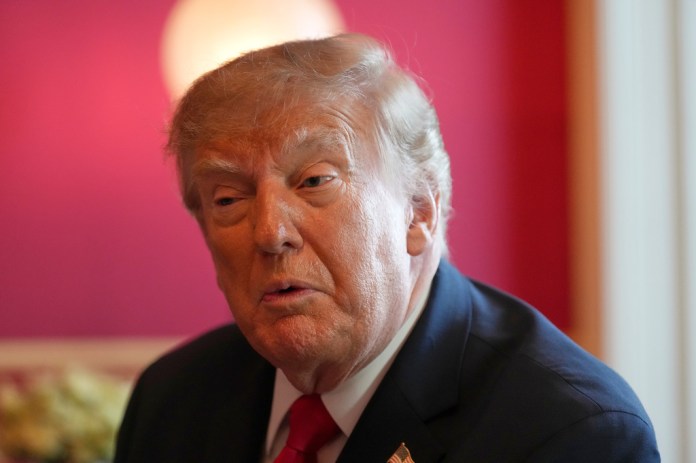
A little more than a month before Nov. 3’s midterm elections, President Donald Trump’s time has become more important as he and his aides seek to change souring public opinion of his second administration in crucial swing states and congressional districts.
But he’ll spend parts of next week in states he carried three times by double digits.
This weekend, Trump is traveling to Knoxville, Tennessee, on Saturday for the University of Tennessee’s game against the Texas Longhorns.
That precedes two campaign rallies the president is headlining next week for the Republican National Committee in the ruby red states of Oklahoma and Alabama.
There are no competitive races in any of those three states, but race raters are increasingly predicting a difficult midterm cycle for Republicans. The Cook Political Report this week updated its ratings for the Georgia Senate race to be “likely” Democrat, the Kansas Senate race to “lean” Republican, and the South Carolina Senate race to “likely” Republican.
Then, on Friday, the election prognosticator updated 15 House races in favor of Democrats.
That is in a political environment where Trump’s average approval rating is 21 percentage points underwater, according to RealClearPolitics, likely a factor in why multiple Republicans have distanced themselves from the president in recent weeks. Rep. Maria Elvira Salazar (R-FL) released an ad criticizing the president’s immigration policies, lawmakers and nominees have increasingly scrutinized the Iran war, and Sen. John Curtis (R-UT) called for an investigation into Donald Trump Jr.’s wedding gift from a Russian oligarch.
That is on top of Rep. Byron Donalds (R-FL) removing any reference to Trump from the website for his gubernatorial campaign, as have Rep. Andy Barr (R-KY) and Rep. Young Kim (R-CA) from the online sites for their respective bids.
Some Republicans say Trump knows he may not be an asset in battleground states, hence his travels to more comfortable territory.
“Battleground members may not want him, but if POTUS wanted to go there, they’d welcome him,” one Republican strategist told the Washington Examiner. “I’d take it as maybe his team knows he may not be the most helpful presence right now.”
But a source familiar with Trump’s decision told the Washington Examiner that the president’s travel to Alabama and Oklahoma next week is not indicative of Republican concerns about those states.
The two states were strategically chosen as areas where Trump can multitask, the source said, and boost candidates in nearby competitive races.
“Durant, Oklahoma, is right on the border of Texas, so you can hit both media markets. Push first-time candidates. Same thing with Alabama. Mobile is right near the Panhandle,” the person added of Florida’s northwestern strip.
But Trump is still expected to barnstorm competitive areas in the closing weeks of the midterm elections. He has told voters to pretend he is on the ballot in an effort to boost turnout.
In the coming weeks, Trump “will be out there in battleground places. He will be going to Florida, and Texas, and Ohio, and Michigan,” the source said. “The vice president will also be out on the trail as well, hitting battleground states. And in addition to the in-person rallies, the president is doing dozens of tele-rallies, simultaneously. It’s all hands on deck effort.”
To that end, Vice President JD Vance has been on the stump with Trump’s super PAC MAGA Inc. and the RNC, starting last month with Michigan Republican Senate nominee Mike Rogers, who is in a toss-up race, and this week for North Carolina Senate nominee Michael Whatley and the GOP congressional candidate trying to replace embattled Rep. Chuck Edwards (R-NC) in the House, Jennifer Balkcom.
But Vance also rallied this month for Sen. Roger Marshall (R-KS), who is underperforming in the polls in another deep-red state after the New York Times reported this month that the obstetrician’s former OB-GYN practice sued more than 700 patients for unpaid bills, 81 of whom were arrested.
Vance’s trip to Kansas precipitated Senate Majority PAC president JB Poersch to tell Politico on Friday that his Democratic leadership-aligned group is “actively thinking” about spending money on the Kansas race and in other red states as the political environment appears to be in their favor.
“There’s some good arguments out in not just Kansas, in four or five other places,” Poersch told the news outlet. “And we’re not just watching — we’re thinking about ways we might get involved if they stay earnestly competitive.”
Notably, Vance’s campaign swing through Iowa last week for the Republican gubernatorial nominee Zach Lahn was not attended by the GOP’s Senate candidate, Rep. Ashley Hinson (R-IA), and Reps. Mariannette Miller-Meeks and Zach Nunn (R-IA), all of whom are in toss-up races.
“For what it’s worth, folks are concerned about Iowa, more so than I’ve seen in some time,” a party strategist told the Washington Examiner.
Some Republican nominees in competitive races, however, have embraced Trump, including Reps. Juan Ciscomani (R-AZ), Ryan Mackenzie (R-PA), and Mike Lawler (R-NY).
“He’s president of the United States, and whether people want to say yay or nay, the fact is he’s the president,” Lawler told the Washington Examiner at this month’s midterm Republican convention. “This is an opportunity to talk about what we’ve actually done, and my speech is going to focus on what I’ve delivered for my district, and in fact, standing up to the president to do it.”
Regardless, the source familiar with Trump’s decision to travel to the red states next week expressed confidence about Republicans’ prospects this November, particularly if the GOP can encourage low propensity voters who took part in the 2024 election to cast another ballot this cycle.
TRUMP TRIES TO PUT OUT POLITICAL FIRES BUT SPARKS OTHERS
“It’s just a matter of getting them energized and excited, really highlighting the contrast between the Democrats and Republicans this cycle, and emphasizing how important it is for them to get to the polls,” the source said.
Meanwhile, the White House is attempting to stem the political bloodletting, particularly in these red states, amid discussions regarding diesel export restrictions after a beef tariff suspension announcement in August.
Continue reading...
[ H/T Washington Examiner ]