









In this first part: A nation’s rise begins in factories but ends on Wall Street. Over the past 500 years, four great powers followed a similar path. In part 2: Is this something China can avoid?
Protect & SurviveThe Financial Jigsaw Part 2 (Episode 95): In this first part I examine the history of how financialisation is the inevitable end-result of a capitalist system. In the next part I will highlight the risks that China is facing during its design of a system to obtain the benefits of its Economic Democracy whilst avoiding the financialisation trap into which others have fallen. US sanctions on Iranian aviation are of far greater strategic significance than mere economic impact. They do not expect to completely sever Iran’s international aviation links; as long as China continues to accept Iranian flights, that goal cannot be achieved
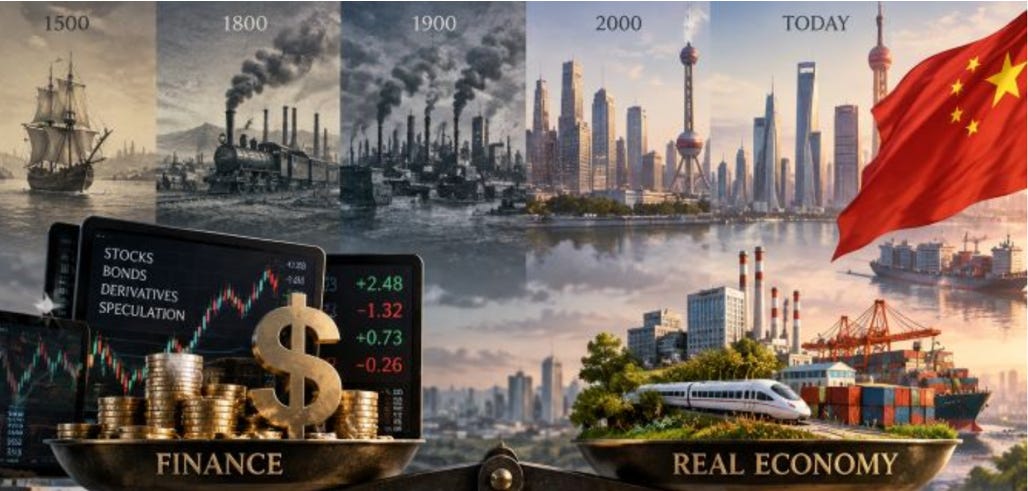
Over the past five centuries of industrialisation, the Western powers that rose to global dominance have followed a seemingly inevitable historical cycle: from commercial prosperity, to manufacturing prosperity, to financial expansion, to the detachment of finance from the real economy, to the hollowing out of manufacturing, and ultimately to national decline.
Venice, the Netherlands, Britain, and the United States; the four economies that successively dominated the world followed remarkably similar trajectories, completing almost identical cycles from rise to decline. Ray Dalio encapsulates these cycles in a 50-minute animated video: ‘Principles for Dealing with the Changing World Order’. In the first 18-minutes, you’ll get the gist of what drives the “Big Cycle” of rise and decline of nations through time and where we now are in that cycle; 20-minutes more and watch the rest:
Austrian’s Newsletter is a reader-supported publication. To receive new posts and support my work, consider becoming a free or paid subscriber.
The method: Commercial prosperity stimulates demand for transportation, metallurgy, shipbuilding, and other means of production. The primitive capital accumulated through trade then provides the foundation for the emergence of manufacturing. The further expansion of commerce and industry creates demand for credit and long-distance payment mechanisms, giving rise to the financial sector. At this stage, these three: commerce, manufacturing, and finance exist in a mutually reinforcing relationship.
Yet once finance becomes sufficiently powerful, it begins to detach itself from trade and manufacturing and develop independently, creating financial monopolies and financial oligarchies. In turn, it crowds out manufacturing, hollowing out the productive economy and eventually contributing to national decline.
To understand the underlying mechanism of this cycle, it must first be understood that the origins of finance, and the logic behind its transformation, are the driving force behind the world today. Finance began with the most basic form of economic activity: lending. Industrial capital seeks profits through production, while financial capital (Rentiers) earns returns through interest, serving as leverage for industrial development and the lifeblood of the real economy. Yet the inherent drive of capital to maximise profit inevitably pushes finance toward distortion.
Karl Marx precisely summarised this evolutionary path. It begins with simple commodity circulation (commodity–money–commodity), in which money merely serves as a medium of exchange. It then evolves into the circulation of industrial capital (money–commodity–more money), where capital expands through production. Finally, it transforms into interest-bearing capital (money makes more money), completely bypassing production and commodities to achieve the ultimate illusion of money creating ‘wealth’.
This represents the most abstract, deceptive, and potentially predatory form of capitalism. Consistent with this theoretical framework, finance in the real world has also undergone a gradual process of “dematerialisation”: from lending (where finance provides lending for industry), to investment and securitisation (where capital pursues rising asset values), and finally to a self-referential system in which everything can be securitised. Financial assets are repeatedly packaged, divided, and repackaged until no one can clearly identify the underlying assets. The 2008 subprime mortgage crisis was an extreme manifestation of this logic.
The essence of finance lies in the time-value of money. But when this logic is pushed to its extreme, profit becomes the sole objective, and whether there is any actual physical output becomes irrelevant because money can always be used to buy goods. Yet when money itself can no longer buy goods, the entire system collapses. Finance rests on currency, and the essence of currency is its ability to function as a general equivalent that can purchase goods. A currency that cannot buy anything is merely an illusion printed on paper or digits in a computer.
Historically, when manufacturing prosperity reaches its peak, the speculative nature of finance often begins to emerge unchecked. Financial bubbles drive up the costs of goods, land, and labour, creating opportunities for other countries to hollow out a nation’s manufacturing base. More dangerously, without effective national regulation, financial capital can separate itself from trade and industry, becoming an independent economic and political force with monopolistic power.
The result is ultimately the principle of “privatising gains while socialising losses”: financial crises are paid for by the public, while financial oligarchs use bailout funds to preserve and expand their own ‘wealth’. A thousand years before Wall Street, China created money out of nothing and unleashed the first financial revolution in history. This is the hidden story of how paper money was born, how it collapsed, and how it changed the world forever.
Venice was the first example of this modern historical cycle. In the Middle Ages, Venice had virtually no manufacturing industry. Through trade with the East, it accumulated its initial capital, then developed handicraft industries such as wool textiles, glassmaking, and leather goods. Finance rose alongside these industries. Yet the discovery of the Cape of Good Hope route in the 16th century undermined Venice’s position as the centre of global trade. The excessive expansion of finance drove up wages and production costs, while wealthy merchants diverted their capital away from manufacturing and into real estate, government bonds, financial instruments, and foreign lending.
As Charles Kindleberger recorded: “Bankers and rentiers lent less and less to domestic manufacturing, and increasingly to foreign borrowers.” Manufacturing declined, shipbuilding withered, and Venice gradually disappeared from the centre of European power.
The Netherlands was the second case. The 17th-century “carrier of the seas” possessed the world’s most powerful navy, ocean-going fleet, and financial system. Its national income exceeded the combined income of England, Scotland, and Wales by 30/40%. Dutch shipbuilding was the finest in the world; even sugar, tobacco, and diamonds imported by Britain were often sent to the Netherlands for processing.
Yet it was no accident that the first financial bubble in human history; the Tulip Mania of 1636 emerged in the Netherlands. Even herring could be traded through futures contracts before being caught, a practice known as “trading in the wind.” Gambling flourished, and large amounts of capital flowed abroad. The Dutch government attempted to correct the trend by issuing regulations requiring futures contracts to involve physical delivery. But under lobbying pressure from financial monopoly capital, these regulations became little more than empty words.
This failed attempt at correction revealed a lesson to the world: reversing finance’s inherent tendency to crowd out manufacturing requires exceptionally strong state resolve and sustained institutional strength; precisely the political resources that have historically been the rarest. The great irony was that Dutch financial capital itself financed its future rival. Large amounts of Dutch money flowed into Britain, purchasing British government bonds and stocks.
Fernand Braudel lamented: “The continuous influx of Dutch capital gave vitality to British credit.” However, to the surprise of the Dutch, Britain eventually took up arms against it and struck it down. Montesquieu’s observation in 1729 captured the essence of the problem: “People invested their money in beautiful palaces rather than in fleets and nation-building.” Britain was the most complete example of this cycle. Like Venice and the Netherlands, Britain rose through trans-shipment trade centres.
But unlike its predecessors, Britain placed much greater emphasis on industrial policy. From the Tudor dynasty to the middle of the 19th century, nearly three centuries of mercantilist policy transformed Britain from a wool-exporting country into the “workshop of the world.” Friedrich List wrote: “Once Britain gained control of any industrial sector, it held on relentlessly… protecting it with the same care and caution one would devote to protecting a young seedling.” In 1815, British parliamentarian Henry Brougham openly stated: “To destroy foreign manufacturing in its infancy, it was worthwhile even to sacrifice British manufactured exports at a loss.”
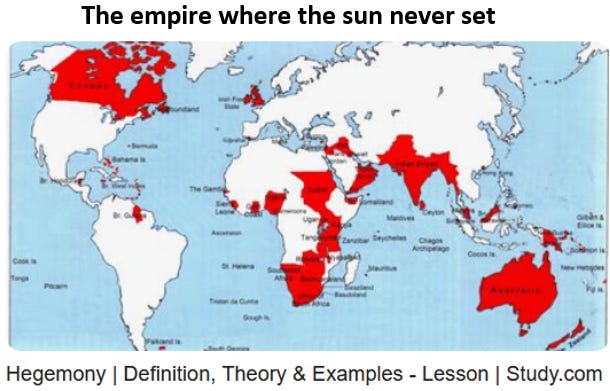
Britain became the global hegemon, excessive financial prosperity once again turned against manufacturing. Kindleberger precisely summarised this transformation: “Successful entrepreneurs and their descendants moved away from industry and into finance.” Running factories was full of difficulties, while financial operations generated enormous returns easily, with little effort or risk.
By the 19th century, apart from landowning aristocrats who inherited estates, Britain’s wealthiest groups were precisely those engaged in “commercial and financial professions.” Those who made great fortunes from manufacturing were increasingly rare. Between 1904-13, foreign securities markets attracted nearly half of Britain’s savings and 5% of its national income overseas.
The irony was profound: the country that had risen through mercantilism and protectionism became, after achieving dominance, the global promoter of laissez-faire economics. Faced with rising latecomers such as the United States, Germany, and Japan, countries that relied on state intervention to industrialise, Britain became trapped by its own path of dependence and watched helplessly as it was surpassed. https://austrianpeter.substack.com/p/the-financial-jigsaw-part-2-51-next?

The United States is now following the same path. From 19th-century high tariffs protecting infant industries to its manufacturing peak in 1953, when manufacturing value-added accounted for 28% of GDP, America’s rise was essentially a replication of the British model. But the turning point came in the 1970s. After the collapse of the Bretton Woods system, financial liberalisation accelerated, fundamentally reshaping the structure of profits.
Between 1965-80, manufacturing profits accounted for an average of 49% of total domestic profits. By 2000-2015, that figure had collapsed to 21%. During the same period, finance’s share of profits rose from 17% to 29%. Even more devastating was the transformation of corporate governance under the doctrine of “shareholder primacy. Between 2003-12, companies in the S&P 500 used 91% of their net profits for stock buybacks and dividends. Between 2007-16, that figure climbed further to 96%. By the third quarter of 2024, US manufacturing accounted for less than 10% of GDP.
Boeing’s decline is a most painful footnote. The company that once embodied American engineering excellence, creating the B-52 bomber, Apollo-era rockets, and the 747 jumbo jet, was transformed after its 1997 merger with McDonnell Douglas, when financial logic overcame Boeing’s pristine engineering culture, and it went down from there whilst Airbus expanded in its wake.
Parts of the 737 MAX software development were outsourced to newly graduated engineers in India earning $9/hr, while American engineers earned $35–40/hr. Two fatal crashes killed 346 people. A congressional investigation attributed the disasters to a corporate culture that placed “profits above safety.” Boeing’s transformation, from the pride of human engineering to a victim of financial engineering, stands as a mirror of a broader tragedy: when financial logic is allowed to dominate industrial logic, even an industrial giant can have its very soul destroyed.
An alternative path was followed by Japan and Germany. If Britain and the US trajectories confirmed the pattern that “financialisation leads to manufacturing decline,” Germany and Japan provided an alternative path: building national strength through manufacturing.

Germany developed the model of the “social market economy,” in which banks and companies maintained long-term relationships, allowing firms to avoid the pressure of constantly chasing quarterly earnings. More than 2,700 “hidden champions” are family-owned manufacturing companies that hold global leadership positions in specialised industries and remain private. They avoid pursuing short-term stock-price gains, and focus on perfecting a single technology or product to the highest possible standard.
The cooperative banking sector in Germany greatly assisted industrialisation. Several groups include: local cooperative banks (Volksbanken and Raiffeisenbanken); PSD-Banks; Sparda banks; specialised cooperative institutions serving professions such as church organisations and healthcare and DZ Bank, the central institution of the cooperative financial network.
Today, around 17.6 million members place their trust in local cooperative banks, underscoring the sector’s deep societal and economic relevance. While the number of institutions has steadily declined due to consolidation, the sector’s total assets have continued to grow, reflecting its resilience and strong position within Germany’s banking landscape.
Even amid the global wave of financialisation, Germany’s manufacturing sector maintained its share of around 20% of GDP. Japan, meanwhile, relied on its banking system and keiretsu networks of cross-shareholdings to shield companies from hostile takeovers and allow them to focus on long-term research and development. Toyota was able to spend decades refining its lean production system, while Sony continued investing in transistor technology and eventually re-shaped the global consumer electronics industry.
However, these two “firewalls” also began to show cracks after the 1990s. Germany’s system of patient bank ownership began to weaken, as an increasing number of small and medium-sized enterprises were acquired by private equity funds. Japan, meanwhile, experienced the weakening of its main bank system and the collapse of cross-shareholding arrangements after the bursting of its real estate bubble.
The pervasive reach of financial logic has posed a continuous challenge even to countries with the deepest manufacturing foundations. Institutional designs may be effective, but they require constant adaptation and maintenance; otherwise, financial logic will eventually find openings through which to penetrate. In a mega-economy, holding a smaller share of a growing economy is far better than holding a larger share of a shrinking one. No matter how dazzling and magnificent the exterior of the financial skyscraper may appear, without the solid foundation of manufacturing beneath it, this so-called prosperity will ultimately be nothing more than a mirage built upon shifting sands
To be continued: Part 2 – A Warning for China… Sources
- Edited extracts from https://thechinaacademy.org/chinas-lesson-from-the-u-s-finance-must-serve-not-rule/
- Washington played underhand tricks at the G20 Finance Ministers and Central Bank Governors Meeting. It tried to push the meeting into issuing a communiqué targeting China. It came away empty-handed. https://chinabeyondthewall.org/china-exposes-four-us-ploys-in-g20-statement/
- The “dangerous” half of the world borrows cheaply while the “safe” half pays through the nose…which is precisely backwards from everything you have been sold.

Insider Newsletter: Issue #336 https://substack.capitalistexploits...tm_medium=web&embedding_publication_id=762792
WARTIME SUMMARY UPDATE

Professor Robert Pape asks the question: Is this explosive [nuclear] gamble worth the catastrophic risk? The answer is self-evident to any rational mind. A tactical nuclear strike on Pickaxe Mountain cannot eliminate the Iranian nuclear threat, cannot secure American energy stability, cannot rescue the domestic economy, and cannot prevent the rise of a multipolar world.
“In criminological profiles of serial killers and mass shooters, there is a recurring inflection point: the failure of the grandiose persona. When the subject realizes that the public sees through the facade—that he is mocked, pitied, or viewed as a pathetic laughingstock, the psyche experiences acute narcissistic injury.”
The defence mechanism is instantaneous and homicidal: “If I cannot force you to admire me, I will force you to never forget me.“ In the twisted pathology of the psychopath, if the world refuses to bow to his genius, then the world must be made to burn for its insolence. Donald Trump has spent months thrashing against his own impotence. Sources

The Notoriety Impulse: Pickaxe Mountain, the “Tactical” Nuclear Trap, and the Pathology of the Ultimate Spectacle https://russiatruthdotcom.substack....tm_medium=web&embedding_publication_id=762792

Sergey Lavrov at UN Security Council
Lavrov: Europe has Pushed Ukraine into War with Russia – UN Security Council Sept 23, 2026 – Kathleen McCroskey https://kathleenmccroskey.substack....tm_medium=web&embedding_publication_id=762792
LATEST DAILY UPDATED SUMMARY – [Hat Tip to No1 saving me valuable editorial space]

Daily digest: 2026-09-26 https://no1sdailydigest.substack.co...tm_medium=web&embedding_publication_id=762792
(Saturday 9/26): The Hormuz de-escalation trade died overnight: Iran put a dated seven-day offer on the table, and hours later the WSJ reported Trump had already rejected it and told aides he expects to resume bombing after the November midterms.
Meanwhile the long bond kept going – the 30Y cleared 5.5% intraday for the first time since 2004, mortgages hit 7.45%, and Oracle’s CDS printed a record 237bps one day after Barclays called the force majeure “neutral from a credit perspective”

Tweet
Continue reading...
[ H/T The Burning Platform ]