




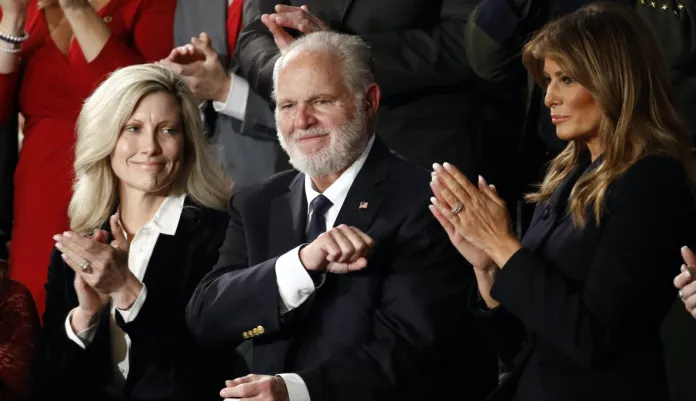
It’s hard to overstate what radio has meant to the conservative movement. You don’t have to look far to find a Republican who grew up listening to Rush Limbaugh. He inspired entire generations — elected officials and commentators, truck drivers and everyday people on their afternoon commutes.
Conservatives simply wouldn’t be where they are today without talk radio. It was a vital alternative in a media landscape long dominated by liberal media and left-leaning newspapers. Talk radio thrived despite heavy regulation by the Federal Communications Commission because it spoke to an audience mostly spurned by the cultural forces of New York and Hollywood.
But today’s marketplace looks nothing like the one Limbaugh operated in for most of his career. Mark Levin and Dan Bongino now compete for ears with a boundless universe of podcasters, streamers, satellite radio, and social media influencers.
Yet, the rulebook governing radio is stuck in the 1990s. Literally. While the FCC doesn’t limit how many podcasts Spotify can carry, or how many people can watch YouTube, its 30-year-old rules still cap a broadcaster at five stations in small markets and eight in the largest ones, even in markets with over 100 stations on the dial.
Without scale, radio struggles to compete with tech giants for local ad spending, and the numbers are stark. Digital platforms now capture more than 70% of local ad dollars. Broadcast radio earns less than 5%, and its total ad revenue has dropped 30% since 2007. Google and Meta’s estimated combined ad revenue this year, about $480 billion, is roughly 40 times the revenue of the entire American radio industry.
The rules were designed to protect competition and localism, but they now have the opposite effect. When FCC Chairman Brendan Carr visited Powell, Wyoming, a town of about 6,000, he found the local “station” was just a laptop piping in music from a big city. A few miles away in Cody, a real broadcaster wanted to buy the station and air new local programming, but the ownership rules prevented it.
Thankfully, relief may be on the way. Carr knows radio matters not just for viewpoint diversity but for the local news, high school sports, and emergency information stations provide, and that regulations should reflect market realities. Last month, the FCC voted to scrap the 39% national television ownership cap that stifled local TV broadcasters for two decades. Radio could see similar relief in the FCC’s pending review of its broadcast ownership rules, and the same 1996 law that set the caps requires the agency to repeal or modify rules that new competition has made unnecessary.
This should be a no-brainer, because local radio goes far beyond politics. More than two newspapers shutter each week, 213 counties have no local news source at all, and roughly 50 million Americans have little or none. For much of the country, broadcasting is the last bastion of localism.
When Hurricane Helene tore through western North Carolina in 2024, Asheville’s local radio stations dropped typical formats and went wall-to-wall with hurricane coverage for days. They pooled resources with sister stations to field calls from stranded residents and help locate dozens of missing families.
It’s an illustration of what scale makes possible. But it’s also a cautionary tale. Imagine if Asheville communities were stuck with laptops playing music instead of journalists saving lives.
WHEN THE GRID COLLAPSES, YOUR $1,000 IPHONE IS JUST A PAPERWEIGHT: LONG LIVE LOCAL RADIO
Conservatives are right to be wary of media consolidation, but reform doesn’t mean waving through every deal. The Justice Department still reviews broadcast deals for competitive harm, and the FCC would still review sales under its public interest standard. Today’s market power problem is not a Wyoming station group that wants to buy another station. It’s a handful of media companies and Silicon Valley platforms that dominate the ad market. Keeping the radio small only cements their position.
Conservatives should get behind Carr and give radio the lifeline it needs. Our movement was built on those airwaves. Our communities still depend on them.
Aiden Buzzetti is president of the Bull Moose Project.
Continue reading...
[ H/T Washington Examiner ]