







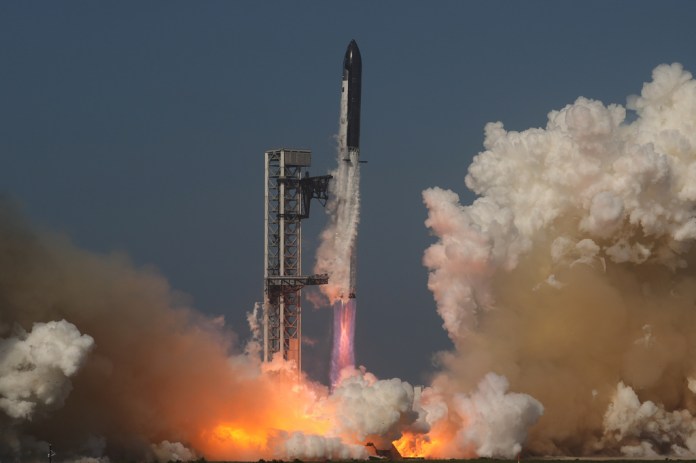
American rockets are launching more frequently than ever, yet getting a ride to orbit is becoming harder.
SpaceX broke the record for the shortest interval between two orbital launches in August, sending two Falcon 9 rockets into orbit only 38 minutes apart. But companies trying to put their own satellites into space are struggling to get a ride on Falcon 9 or its competitors. Reportedly, Falcon 9 is fully booked until 2028 or 2029.
This shortfall has implications far beyond the space industry. Well over 500 companies build spacecraft or operate satellites, representing roughly $50 billion in capital investment since 2000. Satellites provide broadband, GPS, weather data, imagery, and communications used every day by U.S. households, businesses, and military and intelligence operators.
To open up this bottleneck, Washington needs to treat launch capacity not as a niche interest or curiosity, but as essential infrastructure akin to the power grid or road networks. Federal and state governments should use public-private partnerships to expand launch pads and support infrastructure at existing spaceports, while also developing additional orbital launch sites. The administration’s new National Space Transportation Policy points in this direction, setting a goal of more than 1,000 launches and reentries annually by 2030 and directing agencies to “incentivize co-development” of infrastructure with industry. The challenge now is turning that target into actual capacity.
Amazon’s experience shows why the problem is becoming urgent. The company is expanding its satellite business, including an $11 billion acquisition of satellite operator Globalstar. But that deal does not solve one of Amazon’s biggest constraints: launch availability for the satellites that power Amazon Leo, the company’s space-based broadband network. By early July, Leo had 394 satellites in orbit out of a planned constellation of more than 3,200 and remained dependent on outside launch providers, including rival SpaceX.
Since it is reusable, SpaceX’s Falcon 9 rocket has made sending satellites into orbit routine, but the company increasingly reserves that capacity for itself: four out of five missions carry Starlink satellites. Scarcity is already reshaping the market. Companies that normally group many small satellites onto one shared rocket are now reserving entire Falcon 9 flights years in advance to guarantee launch dates and capacity for customers.
Rocket availability is one constraint. The infrastructure underneath those rockets is becoming another.
The Federal Aviation Administration says federal ranges are already strained and warns that the availability of launch and reentry sites could become a bottleneck as military, civil, and commercial demand grows. Air Force Secretary Troy Meink told Congress in May that launch bases and infrastructure are becoming a limitation on the country’s ability to expand commercial and national security missions.
The consequences became vivid in May, when Blue Origin, Jeff Bezos’s space company, suffered an explosion involving its New Glenn rocket during testing at Cape Canaveral. Blue Origin operates a launch complex at the federal installation. The accident damaged New Glenn’s only operational launch pad, reportedly causing a monthslong setback and scrambling Amazon’s plans to use the rocket to help deploy its Leo constellation.
Private capital is responding. SpaceX announced in August that it intends to invest $100 billion in Starbase Louisiana, a 125,000-acre complex designed to support Starship, its much larger next-generation reusable rocket, and eventually thousands of flights annually. Construction is expected to begin in 2027, with the first flight targeted for 2029. It is a substantial investment, but one company’s new spaceport cannot solve a nationwide capacity problem.
In addition, spaceports are not interchangeable. A launch pad built for one rocket cannot necessarily accommodate another because different rockets may require different fueling systems, flight paths, and support equipment. That is why the FAA’s roughly 20 commercial, federal, and private spaceport, launch, and reentry facilities do not translate into 20 viable alternatives for orbital launches, such as the Falcon 9 or New Glenn rockets.
AMERICA JUST ADMITTED IT HAS SPACE WEAPONS. NOW, ONE MISCALCULATED ORBIT COULD START WORLD WAR III
The United States has fostered the world’s leading commercial launch industry. SpaceX alone conducted 170 launches in 2025, nearly twice the 92 space-launch missions conducted by China. Keeping that edge will require pairing private investment with targeted federal and state support. Federal and state governments should work with industry to expand the pads, processing facilities, and launch sites that allow those rockets to fly.
American engineering sparked the reusable rocket revolution, overcoming production limits that once held back the space industry. Now we need to build out the infrastructure to keep the industry growing.
Rear Adm. Mark Montgomery (U.S. Navy, ret.) is a senior fellow at the Foundation for Defense of Democracies and served 32 years in the U.S. Navy, including as deputy director for plans, policy, and strategy (J5) at U.S. European Command. Emmerson Overell researches threats to U.S. and allied security in the Arctic, space, and cyberspace at FDD’s Center on Cyber and Technology Innovation.
Continue reading...
[ H/T Washington Examiner ]