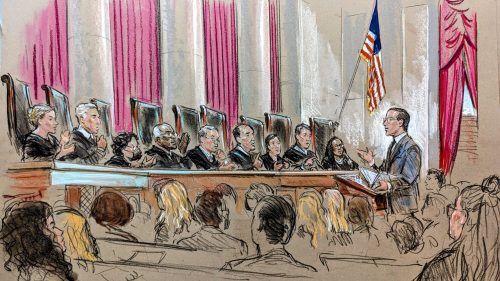


Younge v. Fulton Judicial Circuit District Attorney’s Office, Georgia, to be argued on Nov. 2, involves an issue that will quicken the pulse of civil procedure aficionados. No less than four different rules of the Federal Rules of Civil Procedure are in play: affirmative defenses under Rule 8, amending a pleading under Rule 15, pretrial management under Rule 16, and summary judgment under Rule 56.
The case raising this cornucopia of pretrial procedural rules comes out of a relatively typical civil rights suit in which the plaintiff asserts that she was improperly dismissed from her job and is now suing for damages. Jasmine Younge held a high-level position in the Fulton County District Attorney’s Office for about two months until she was fired in July 2019 by District Attorney Paul Howard. Younge says she was dismissed from her job about two weeks after telling Howard that she was pregnant. Later that year, Younge sued the Fulton County District Attorney’s Office for a number of civil rights violations, including the claim that termination because of her pregnancy violated Title VII of the Civil Rights Act of 1964.
The DA’s office answered the complaint, and pretrial proceedings ensued. Save for a few disputed matters, discovery closed in January 2022. About two months later, at a pretrial hearing on a discovery issue, the DA’s office informed the court and Younge that it intended to move for summary judgment, including on the basis of the personal-staff exemption defense, which it had not asserted in its answer. (Under Title VII, certain officials are exempted from the statutory definition of employee, including (1) members of an elected official’s “personal staff” and (2) “policymaking appointees.”) The DA’s office explained that it did not learn of the defense until its lawyer began drafting the summary judgment motion.
Soon after the March 2022 hearing, the DA’s office moved for summary judgment, citing its defenses based upon the statutory exemptions from Title VII in support of the motion. The DA never sought to amend its answer to add these defenses.
Younge objected to the motion, arguing as a procedural matter that it was too late for the DA’s office to assert new affirmative defenses. Her waiver argument regarding the personal-staff exemption was rejected several times in the lower courts, first by the federal magistrate judge who permitted the personal-staff defense to be asserted and recommended summary judgment in favor of the DA’s office predicated on that defense. The district court then agreed with this recommendation and entered judgment in favor of the DA. Next, the case was appealed to the United States Court of Appeals for the 11th Circuit.
The 11th Circuit (as had the lower courts) applied its reasoning in the 1988 case of Hassan v. U.S. Postal Service, in which it had employed a prejudice analysis to determine whether to allow the defendant to move for summary judgment based on an unpled affirmative defense. Here, the district court had determined that there was no prejudice to allowing the personal-staff defense. Significantly, in addition to finding that the DA’s office should prevail on the defense, the lower courts noted that Younge could not identify any additional discovery that she would have pursued had the defense been asserted earlier.
As the 11th Circuit summarized, “since Hassan, t had repeatedly reaffirmed that a district court may receive evidence of an unpleaded affirmative defense if the plaintiff was not ‘prejudiced’ by the defendant’s failure to plead the defense in its answer.” Furthermore, the circuit court explained that “the record contains copious discovery evidence concerning each of the six factors” relevant to “the personal staff exemption.” Accordingly, the 11th Circuit affirmed the district court, finding that “Younge had not suffered prejudice from the DA’s Office’s late assertion of the personal staff exemption” and that summary judgment had properly been entered in favor of the DA.
The justices agreed to hear the case in March to determine whether an affirmative defense may be asserted as a basis for summary judgment if not presented earlier in a pleading.
The parties’ positions
In seeking reversal of the judgment below, Younge argues that the court should take a textualist approach to reading the applicable rules. “Rule 8(c)(1) emphasizes” without exception “that a defendant must plead ‘any’ affirmative defenses,” she states. Since the DA did not do so, it should not have been allowed to seek summary judgment on the basis of such an unpled defense.
Younge further argues that allowing a summary judgment motion based upon an unpled affirmative defense permits a defendant to circumvent the requirements of Rule 15(a)(2) for amending a pleading and Rule 16(b)(4) for modifying a scheduling order. The former requires a court to analyze a number of factors, including “undue delay” on the part of the party seeking to amend, and is stricter than a mere prejudice standard. The latter requires “good cause,” considers due diligence, and, again, is more demanding than just showing prejudice. Younge would then have the court set aside the 11th Circuit’s prejudice standard and apply the “well-established standards and procedures of Rules 15(a)(2) and 16(b)(4).”
The DA, on the other hand, stands by the prejudice standard set out in Hassan and applied by the 11th Circuit. It asserts that this standard is correct given the interrelated purposes of the Federal Rules of Civil Procedure: to resolve cases on the merits and to avoid their resolution on the basis of technical or formalistic application of the rules themselves.
According to the DA, the text, structure, and historical development of the FRCP support this purposive reading of the rules. Regarding the text, the DA invokes Rule 61, the harmless error rule, which provides that “[a]t every stage of the proceeding, the court must disregard all errors and defects that do not affect any party’s substantial rights.” “Structurally,” the DA expresses that “the Rules impose limits on amending pleadings to import new factual issues … but not on raising legal arguments like the one the DA’s Office raised here.” And as for the history, the DA points out that “Rule 12 used to provide that a defendant waives all unpleaded defenses but no longer does.”
Overall, the purposive approach to interpreting the FRCP may prove especially appealing to the court: As the DA argues, the FRCP drew on and were influenced by the rules in the courts of equity, which aimed to simplify pleading rules and adopted a flexible approach to promote the resolution of cases on the merits. In pretrial matters such as pleadings and discovery, context – the underlying facts, the claims and defenses asserted, and the parties’ conduct, among other things – matters. Given this, although the court may not write broadly, I think it’s unlikely to find that the 11th Circuit’s prejudice standard was out of bounds.
Continue reading...
[ H/T SCOTUSblog ]