



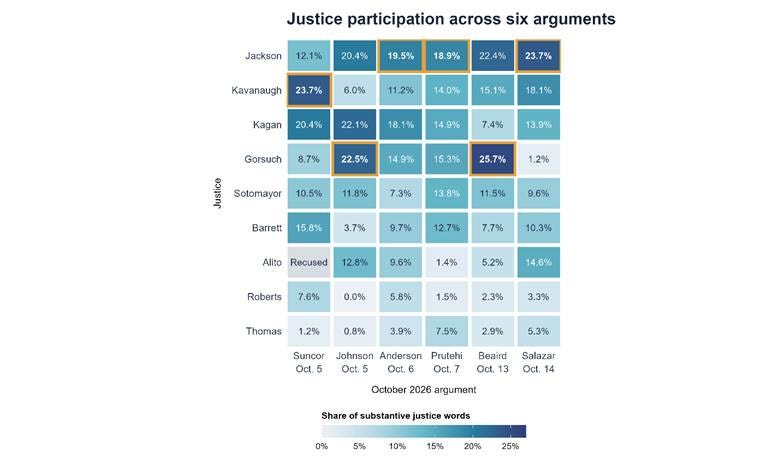
Justice Ketanji Brown Jackson – typically the court’s most frequent speaker at oral argument – began the term relatively quietly. In Suncor Energy v. Boulder County, the first argued case, she spoke the fourth-most among the participating justices, accounting for only 12.1% of the court’s words. But that relative silence did not last. Jackson led three of the next four arguments and finished the six-case sitting with 6,254 words, significantly more than any of her colleagues.
The arguments produced other patterns, some less predictable. Jackson and Justice Sonia Sotomayor repeatedly concentrated their attention on the same litigating side, but Justice Neil Gorsuch did so as well, despite the justices’ ideological differences. At the same time, their questions did not necessarily point toward identical legal outcomes.
The cases themselves – and how they were treated – revealed something more. Disputes concerning climate litigation, veterans’ constitutional claims, retirement-plan investments, and environmental review all raised questions about when, where, and under what conditions judicial intervention is available. Indeed, that essentially became the theme of the court’s October session.
Jackson’s dominance and some unexpected cross-ideological alignment
As described above, Jackson’s relatively limited involvement in Suncor initially appeared to vary from one of the Supreme Court’s most consistent recent patterns. During the 2025-26 term, she accounted for 22% of justices’ total speech and led in 41 of 58 oral arguments. Yet in the first argument of this term, her 829 words represented only 12.1% of substantive justice speech, placing her fourth among eight participating justices. Across the other five arguments, however, Jackson’s share averaged 21.0%. By the end of the sitting, Jackson had spoken 6,254 words, more than any colleague, and accounted for 19.3% of all substantive justice speech.
Jackson’s questioning also revealed a recurring alignment with Sotomayor and, more surprisingly, Gorsuch. Across several disputes, the three justices repeatedly directed a disproportionate amount of attention toward the same side.
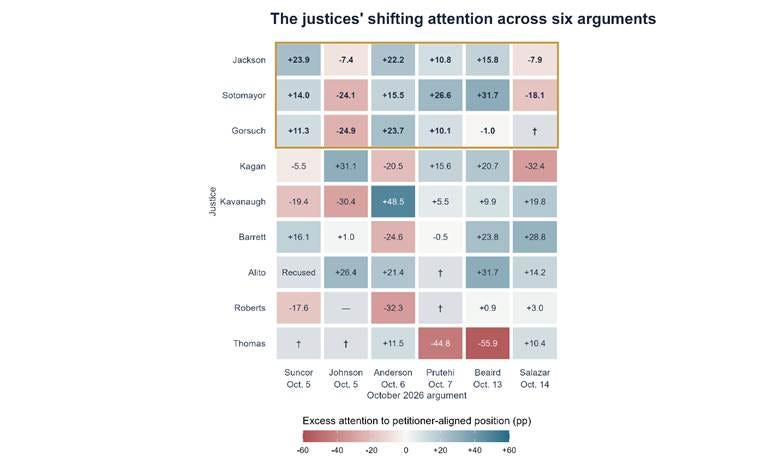
In Johnson v. United States Congress, for instance, Gorsuch questioned whether the veterans’ benefits system possessed the competence to adjudicate constitutional challenges, while Sotomayor emphasized the burden of forcing veterans through an administrative process prior to obtaining constitutional review. Jackson similarly challenged the government’s account of how constitutional questions were handled in practice. The three justices’ approaches differed, but all three explored weaknesses in the government’s proposed review scheme.
In Suncor, the justices’ shared focus covered up larger doctrinal disagreements. Jackson questioned whether the case was sufficiently developed for Supreme Court intervention. Sotomayor asked about the courts’ authority and whether specific arguments had been preserved. Gorsuch explored how the Clean Air Act affected federal common law and potential state-law restrictions.
These alignments should not be conflated with emerging voting coalitions, however. In Beaird v. United States, for example, a Federal Sentencing Guidelines case, Jackson and Gorsuch proved the argument’s two dominant speakers while developing substantially different accounts of the U.S. Sentencing Commission’s authority.
The lesson is this: The justices who identify pressure points in an argument do not always group along familiar ideological lines, and agreement about which position deserves examination need not produce agreement about the possible controlling rule.
Who dominated the arguments?
Jackson’s individual prominence did not translate into liberal dominance of the court’s collective conversation. Across the six arguments, conservative justices contributed 54.3% of substantive justice speech, compared with 45.7% from the three liberals. Conservatives supplied the majority of justices’ words in five of the six cases, with Johnson the exception. This represents a somewhat different balance (so far) from the 50.9% conservative–49.1% liberal division reported in a previous Legalytics analysis of the 2025-26 term.
Perhaps more revealing was the distribution of participation within those blocs. Justice Brett Kavanaugh finished second across the sitting with 5,031 words, followed closely by Justice Elena Kagan (4,998) and Gorsuch (4,920). Yet the three justices occupied markedly different positions from argument to argument. Kavanaugh supplied 23.7% of the justice’ speech in Suncor but only 6.0% in Johnson. Gorsuch ranged from 25.7% in Beaird to just 1.2% in Salazar v. Paramount Global. Kagan, who averaged 21.2% across the opening-day arguments, averaged only 13.6% across the next four.
Overall, the six arguments revealed neither the conservative or liberal bloc dominating the conversation. Instead, participation shifted substantially with the legal questions presented, often placing different justices at the forefront of particular disputes. Those changes become especially consequential when examining the competing theories of judicial review and interpretive authority developed throughout the individual arguments.
Four arguments about access to judicial review
Four of the court’s first six arguments presented different versions of a recurring question: what must happen before a federal court can intervene in a case? The doctrines varied considerably, from Supreme Court jurisdiction and veterans’ constitutional claims to pleading requirements and administrative finality. Nevertheless, each argument required the justices to consider how procedural and institutional/justiciable boundaries determine whether a legal challenge can proceed.
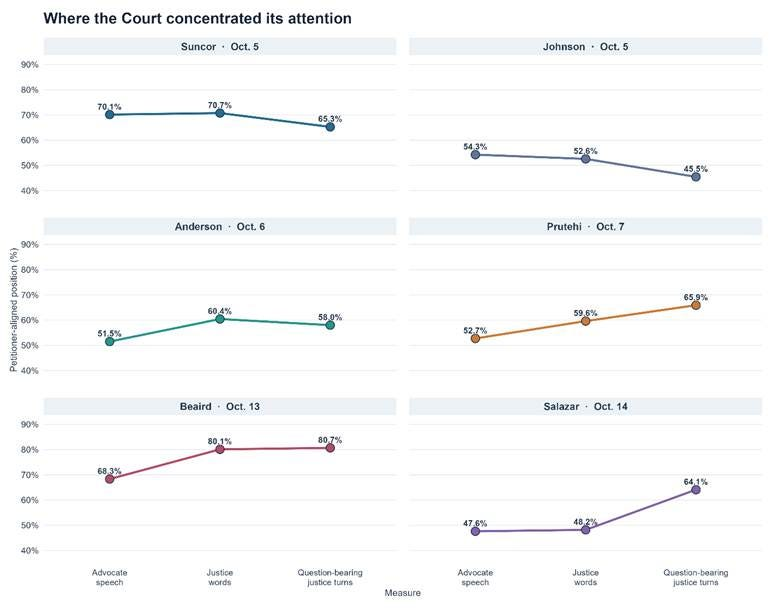
The sharpest illustration came in Department of the Air Force v. Prutehi Guåhan, where the justices examined whether the Air Force’s decision to seek a territorial hazardous-waste permit constituted final federal agency action, and how that determination interacted with environmental review under a federal statute. The government received 67% of explicit question marks but accounted for only 52.7% of advocate speech. Its counsel, Sopan Joshi, experienced a 60% cutoff rate, which was the highest among the 15 advocates appearing during the sitting.
The exchanges revealed different understandings of when an agency decision is settled enough to justify judicial intervention. Kagan questioned whether an agency’s completed deliberations could be rendered non-final simply because another regulator’s approval remained necessary. Jackson, typically on Kagan’s side, focused on the opposite possibility: if Guam’s permitting authority could impose conditions materially changing the Air Force’s project, perhaps the application remained a proposal rather than an operative federal commitment. Justices Clarence Thomas and Amy Coney Barrett called out the unusual institutional arrangement, with the federal government appearing as a regulated applicant rather than the permitting authority itself.
Gorsuch and Chief Justice John Roberts approached the problem from another angle, exploring whether postponing review could leave challengers without an effective opportunity to challengee the federal government’s environmental obligations. Kavanaugh explored the practical consequences of requiring successive rounds of review.
The relationship to the opening-day cases is telling. In Suncor, Thomas and Jackson questioned whether the dispute was sufficiently developed for Supreme Court review, particularly with other federal issues and several factual questions still unresolved below. In Johnson, the justices confronted a very different institutional barrier: whether constitutional challenges involving veterans’ benefits must proceed through the specialized administrative-review system rather than federal district court. Jackson, Sotomayor, and Gorsuch each tested aspects of the government’s proposed route, including whether it provided a practical means of resolving constitutional claims.
Anderson v. Intel Corporation Investment Policy Committee brought up a related yet distinct procedural issue. There, the question was what a retirement-plan plaintiff must allege to advance a claim that an ERISA fiduciary failed to use the requisite “care, skill, prudence, or diligence” under certain circumstances. Kavanaugh and Jackson distinguished underperforming investments from allegedly imprudent asset-allocation strategies, while Kagan and Barrett examined how rigorous a “meaningful investment benchmark” must be.
These cases do not rest on a particular judicial ideology. But they all deal with the availability of judicial review: whether the litigation has reached a proper point, the question of an adequate forum, the sufficiency of the allegations, and whether the court’s intervention is appropriate yet.
Beaird: competing theories of legal authority
No argument during the sitting generated more speech from the justices than Beaird v. United States. The justices contributed 7,791 words, more than twice their total in Anderson, with Gorsuch and Jackson accounting for 25.7% and 22.4% of these, respectively. Together, the two justices provided nearly half the court’s substantive speech. Yet their exchanges revealed a profound difference in how they understood the authority of the U.S. Sentencing Commission and the legal status of its commentary.
The dispute asks whether Stinson v. United States, the court’s 1993 decision requiring deference to Sentencing Guidelines commentary under specified conditions, continues to supply the governing rule. The case’s unusual alignment further distinguished the argument. Both Beaird and the United States supported vacating the judgment, and the court thus appointed a “friend of the court,” Anthony Dick, to defend Stinson. The petitioner-aligned advocates consequently accounted for 68.3% of advocate speech and received 80.1% of justice words. This imbalance partly reflects the unusual distribution of advocates rather than necessarily indicating hostility toward their position.
Jackson, who once served on the Sentencing Commission, began by challenging the premise that the Sentencing Guidelines and their commentary can meaningfully be separated. In her account, sentencing judges rely on both parts of the Guidelines Manual to calculate the recommended sentencing range. Commentary helps determine how provisions operate together as opposed to consisting of an unrelated agency interpretation. She returned to Congress’ decision to establish a sentencing framework intended to limit disparities among similarly situated defendants, questioning whether importing limitations from administrative deference doctrine would undermine that design.
Gorsuch’s questioning approached the problem from a very different institutional perspective. He examined where Congress expressly authorized binding commentary, why the Commission should be able to accomplish through commentary what it could instead accomplish through formal Guidelines amendments, and whether deference would weaken the procedural safeguards associated with that process. His concerns extended to the incentives created by allowing the Commission to make authoritative interpretations without necessarily following the same procedures applicable to the Guidelines themselves.
Other justices explored possible consequences of either approach. Kavanaugh repeatedly returned to the stability of a system operating under Stinson for more than three decades, questioning whether revisiting the doctrine might introduce new uncertainty into sentencing. Kagan examined whether Congress’ express recognition of policy statements complicated efforts to distinguish them from commentary, suggesting that differences in terminology might not fully resolve the question of authority.
The exchanges suggest several possible routes to a decision: reaffirming the current system, limiting the circumstances under which commentary receives controlling weight, or requiring a more explicit statutory basis for binding interpretations. They also illustrate a theme from earlier research on the relationship between oral argument and eventual opinions: The most revealing material may not be which advocate received the most questions, but the competing legal frameworks the justices developed as they questioned counsel.
The advocates’ contrasting experiences
The first six arguments also revealed substantial differences in how advocates were able to develop their answers. Across 982 advocate speaking turns, 420 ended in an explicitly identifiable cutoff by a justice, a rate of 42.8%. That figure was somewhat higher on the first day (45.2%) than during the four subsequent arguments (41.4%), but the variation among individual advocates was significantly larger.
Joshi, representing the Air Force in Prutehi, experienced the sitting’s highest cutoff rate at 60.0%, with 66 of his 110 turns ending that way. Kannon Shanmugam followed at 56.9% in Suncor, while Paul Clement was at 55.2% in Salazar. These were not merely differences between government and private counsel but arose in disputes involving separate statutes, procedural issues, and judicial argument coalitions.
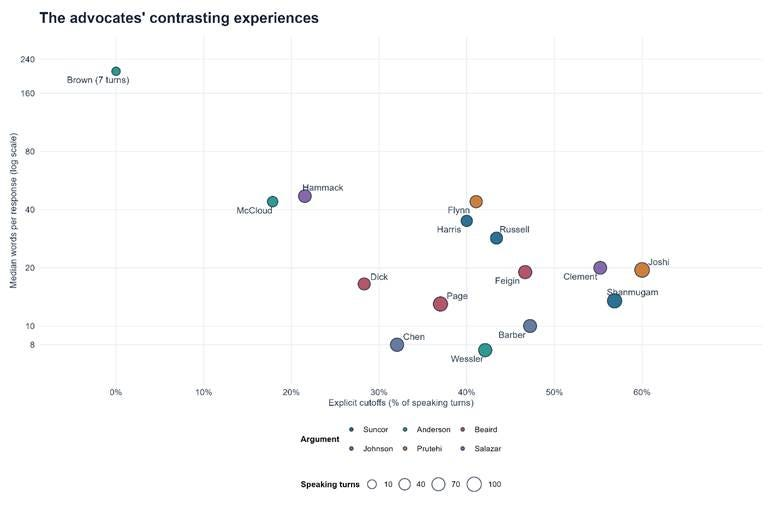
The clearest within-case contrast occurred in Salazar. Joshua Hammack received numerous questions about his interpretation of the Video Privacy Protection Act, yet only 21.5% of his turns ended in cutoffs. Clement, advocating the opposite position, was cut off in 55.2% of his turns. Similarly, in Prutehi, Caroline Flynn’s 41.1% cutoff rate (arguing on behalf of Prutehi Guåhan) was substantially below the government’s 60.0%, and her median response was more than twice as long.
Even advocates supporting the same position had different experiences. In Suncor, Shanmugam’s median response was 13.5 words, compared with 35 for Principal Deputy Solicitor General Sarah Harris, who supported the petitioner and experienced a 40.0% cutoff rate.
The differences illustrate how much the structure and subject of individual exchanges can shape an advocate’s opportunity to explain a legal position. These observations also complement earlier Empirical SCOTUS findings about an increasingly active oral-argument bench.
A different picture
Jackson’s unusually limited participation in the first argument of the term, Suncor, proved to be an exception rather than the beginning of a broader retreat. Across six arguments, she remained the court’s leading individual speaker, even as the distribution of judicial participation shifted considerably from case to case.
More surprising was the relationship between the justices’ attention and their ideological positions. Jackson, Sotomayor, and Gorsuch consistently concentrated on the same litigating side. But their exchanges also revealed why common questioning should not be confused with voting the same. In Beaird, for example, Jackson and Gorsuch developed competing accounts of institutional authority despite both dominating the argument.
The substantive disputes supplied another connection. From Suncor and Johnson to Anderson and Prutehi, the justices repeatedly considered when judicial review should be available. Despite some of the substantive issues in play, the defining theme of this term’s start was one of judicial power.
Continue reading...
[ H/T SCOTUSblog ]