




In his new book, Justice Samuel Alito takes aim at what he calls judicial “insecurity,” or a judge’s self-conscious worry that he might be advancing his own policy preferences under the guise of impartial adjudication. “Twenty-first century originalists,” he argues, “should shed this insecure mindset.”
Alito’s suggestion is at odds with decades of conservative legal thought, including remarks by Justice Antonin Scalia. More fundamentally, what Alito labels insecurity is better understood as a form of humility and self-awareness. And that humility is laudable for all judges, not just originalists. There is much more to fear from the self-assured or overconfident judge than the insecure one.
Was Scalia “insecure”?
In some of the book’s most discussed passages (and in an op-ed in The Wall Street Journal), Alito impugns “insecure originalism,” in part because “insecurity” may lead originalists “to worry that they are subconsciously engaging in ‘results-oriented’ decision-making and ‘judicial activism’ in the service of their own policy preferences.” Alito urges originalists to shrug off this worry: “Originalist judges should . . . be on guard against subconsciously setting a higher bar for legal arguments that yield outcomes they find desirable as a policy matter.”
The insecurity that Alito bemoans has a rich history that his discussion omits. In recent decades, the jurist most associated with this kind of thinking was longtime conservative hero Scalia. In his oft-repeated view, “The judge who always likes the results he reaches is a bad judge.” This maxim was admonitory. It not so subtly suggested that other judges, perhaps of the non-originalist variety, always liked where their theorizing led them. But not the principled originalist, whose impartial theory necessarily brought about disappointment – the price of integrity.
Scalia often fleshed out this line of thinking by pointing to specific issues that originalism resolved in ways he claimed to find regrettable. The First Amendment, in Scalia’s view, encompassed a right to burn the American flag, something that Scalia personally found distasteful. And the confrontation clause effectively demanded that many serious offenders go unpunished. Scalia’s critics sometimes chafed when he drew attention to these decisions, which seemed to give him permission to issue other rulings that did align with his own policy preferences.
Scalia’s disciples have long echoed his view of the “bad judge.” In published writings, including a judicial opinion, Justice Neil Gorsuch has favorably adapted Scalia’s “bad judge” admonition. And Justice Amy Coney Barrett made Scalia’s aphorism a prominent part of her recent memoir and related book tour. Barrett has also offered her own variations on this theme, remarking for instance: “You should sometimes be reaching results that you really dislike.” In a similar spirit, a majority opinion by Justice Brett Kavanaugh defended its own impartiality by adducing examples of standing decisions that cut in different ideological directions.
Insecurity, or anti-partisanship?
What Alito labels “insecurity” is really a judicial virtue and better characterized as a form of self-consciousness or rigor. When a judge realizes that he is consistently ruling for or against a particular kind of party, he has good reason to reflect on the possibility that he is the victim of his own biases. That point has special salience in today’s United States, which is marked by partisan polarization.
When a judge confronts a case with partisan valence, he would do well to pause over his own potential bias. In the context of contemporary federal judging, such a bias often correlates with the judge’s appointing president. A judge appointed by a Republican or Democratic president is likely to have personal views aligned with Republicans or Democrats, respectively. And the judge is likely to have a social set that is ideologically skewed. As Alito noted in an interview, such a skew may not be the judge’s doing, so much as the result of ideological backlash against the judge’s rulings. But even if unfair or unfortunate, the backlash’s effects are real.
In this context, a judge will be tempted to please his own ideological tribe while being insensitive to its rival. A Democratic-appointed judge may play to Bluesky, writing zingers in trendy language that please imagined audiences. Or a Republican-appointed judge may similarly look forward to standing ovations at Federalist Society galas. These incentives and trains of thought are not so hypothetical. And once this kind of behavior takes hold, the judges in question become more like partisan actors than principled defenders of either legal rules or the judiciary.
Against that backdrop, an anti-partisanship principle offers a means of reaching better, more accurate results – not a means of sacrificing accuracy for illicit ends. A judge who sensibly factors in his own partisan affiliation, background, or associations is more likely to identify and apply the law by his own lights. Or so one might hope. Whether anti-partisanship can work largely depends on how it is implemented.
Implementing anti-partisanship
There are many ways of implementing anti-partisanship, and different approaches may befit different scenarios or appeal to different jurists. Surely no judge should factor in party identity in a way that squarely contradicts the law’s dictates. And because many judges have sincere legal views with an ideological valence, complete anti-partisanship is both infeasible and undesirable. Yet judging often involves subtle choices. And those subtleties create room for the anti-partisanship principle to have meaningful effect.
At the Supreme Court, certiorari, that is, deciding what case to hear, affords perhaps the most immediate opportunity for discretionary judgments. Is a particular case or issue ripe for prompt consideration, or sufficiently worthy of the court’s attention? These questions yield judgment calls, and a judge may reasonably consider whether he is consistently making these decisions in favor of one party or ideology. Cert might be warranted only when a relatively objective test is satisfied, such as a deep circuit split. Or the justice might have a practice of avoiding expedited review in such cases.
Moreover, all appellate courts confront myriad opportunities to craft the scope and depth of their holdings. A judge who supports one broad holding after another in favor of his appointing president or party is probably ruling irresponsibly. That judge is not merely transgressing principles of minimalism (deciding only what needs to be decided) or gradualism (deciding incrementally) but doing so in an especially objectionable way by ruling grandly with partisan effect. By contrast, a humbler judge will be sure to wait beyond the first or second chance to resolve a major issue when that issue has a partisan valence.
Judges of all kinds also face an array of different grounds on which to rule. An anti-partisan judge might look with care at jurisdictional requirements or opportunities for abstention, adapting Alexander Bickel’s “passive virtues” (that is, pursuing an impassive strategy, rather than ruling either swiftly or grandly). Or he might shelve a holding in the alternative where a single, narrower holding would suffice.
Precedent affords additional opportunities for anti-partisanship. When a party seeks to overrule case law, a judge might ask whether that request has a partisan valence – and then look to see whether the request to overrule has broad, cross-ideological support.
Finally, judges may express themselves differently depending on the presence of partisan tensions. Barrett made this point in Trump v. Anderson, which (as to result) unanimously held that Colorado could not exclude then-candidate Trump from the presidential ballot based on section 3 of the 14th Amendment. She wrote separately to note that the court “has settled a politically charged issue in the volatile season of a Presidential election” and that, “[p]articularly in this circumstance, writings on the Court should turn the national temperature down, not up.” Thus, Anderson was “not the time to amplify disagreement with stridency.” In other contexts, judges may follow this general advice by muting their rhetoric or even suppressing dissents.
Too anti-partisan?
In our current polarized environment, it may be hard to imagine that a judge would be too anti-partisan. Yet Alito quite properly raises just that concern.
As Alito insightfully puts it: “insecure originalists may actually welcome occasions when their originalist analysis leads to results they dislike. When that occurs, they experience a gratifying frisson, a brief catharsis in which their anxiety about having unconsciously succumbed to the temptation of results-oriented decision-making is released.” The image here is of a judge who becomes so excited about proving his own impartiality that he becomes utterly partial.
Once again, Alito’s point is hardly limited to originalists, and other commentators have raised similar concerns about judging in general. For example, Judge Richard Posner once noted that “t is a source of satisfaction to a judge to vote for the litigant who irritates him . . . for it is by doing such things that you know that you are playing the judge role.”
This kind of concern shows that the anti-partisanship principle must itself be deployed reflectively and cautiously. There is no one simple trick for impartial or accurate judging, and any maxim of juridical wisdom can be twisted or taken too much to heart.
Alito’s worry also indicates that the anti-partisanship principle has only contingent appeal. In a less polarized polity, partisanship might play a smaller or even a trivial role in judicial decision-making. In that environment, the anti-partisanship principle would not help – or might even worsen – judicial bias. But that is not our world today.
Alito elaborates his point in a way that further underscores the appeal of anti-partisanship. To wit, he notes that “an originalist judge should not cavalierly or happily embrace results that defy common sense.” Attention to common sense is indeed justifiable, but that is because (or if) it is truly “common.” Consensus views may well provide a helpful indication that a particular ruling is senseless, catastrophic, or absurd.
But “common sense” is not at all the same as Alito’s other and more salient subject – namely, “outcomes [judges] find desirable as a policy matter.” In placing these two ideas in successive paragraphs and casting them as comparable, Alito inadvertently reveals how easy it is for a judge to draw an equivalence between, or fail to differentiate, his own highly contestable views and genuine consensus.
Anti-partisanship may not be for everyone. The legal system may even benefit from having some judges in each court who align with one or the other of the nation’s two political parties. That arrangement would help partisans identify with the judiciary and might foster a kind of adversarial system within the third branch. But that picture seems appealing, if at all, only if the partisan judges remain the exception.
“The Spirit of Liberty”
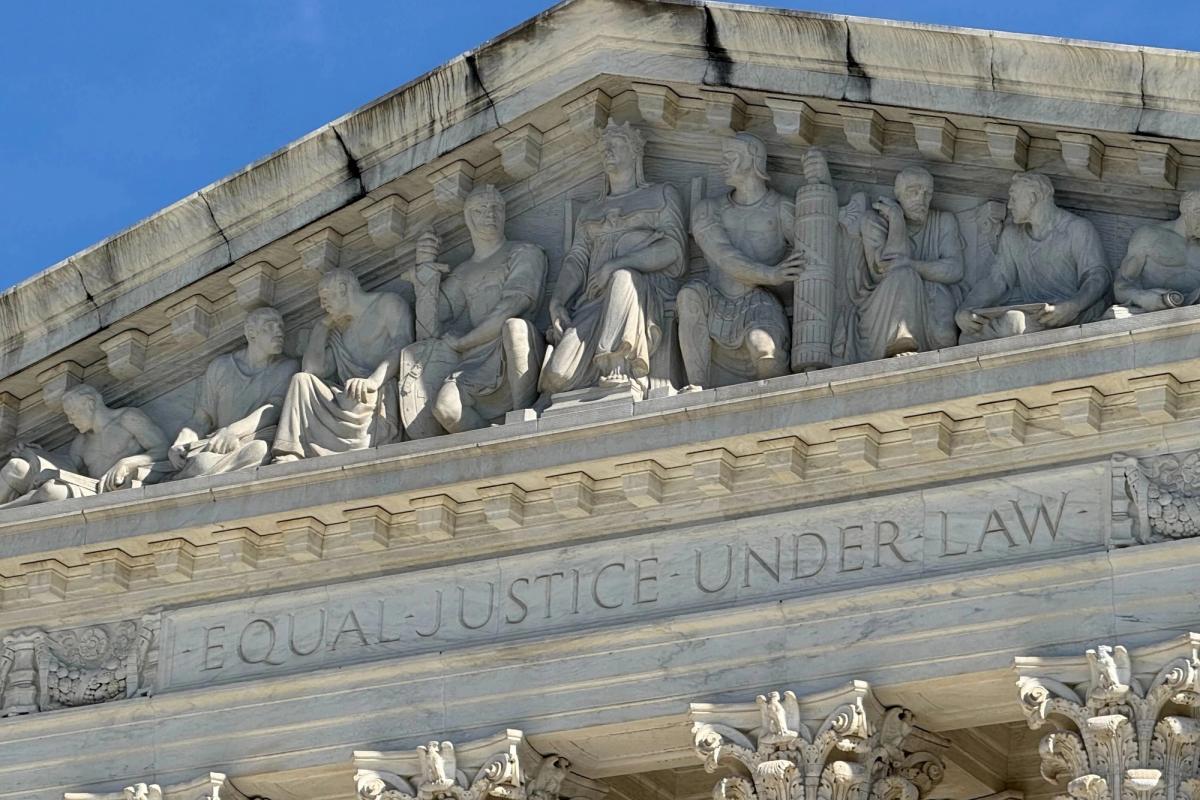
In a later chapter, Alito praises Judge Learned Hand’s famous speech on “the Spirit of Liberty.” Alito notes for instance: “I am convinced that the spirit of the Constitution—of limited but effective government, individual rights, and equal justice under law—is alive and well in the hearts of the American people.”
Alas, Alito’s discussion does not quote or acknowledge what Hand believed the spirit of liberty to be. In the speech’s most memorable and oft-repeated line, Hand posited: “The spirit of liberty is the spirit which is not too sure that it is right.”
One might say that the spirit of liberty is a bit insecure. The spirit of the Constitution is, too.
Continue reading...
[ H/T SCOTUSblog ]