




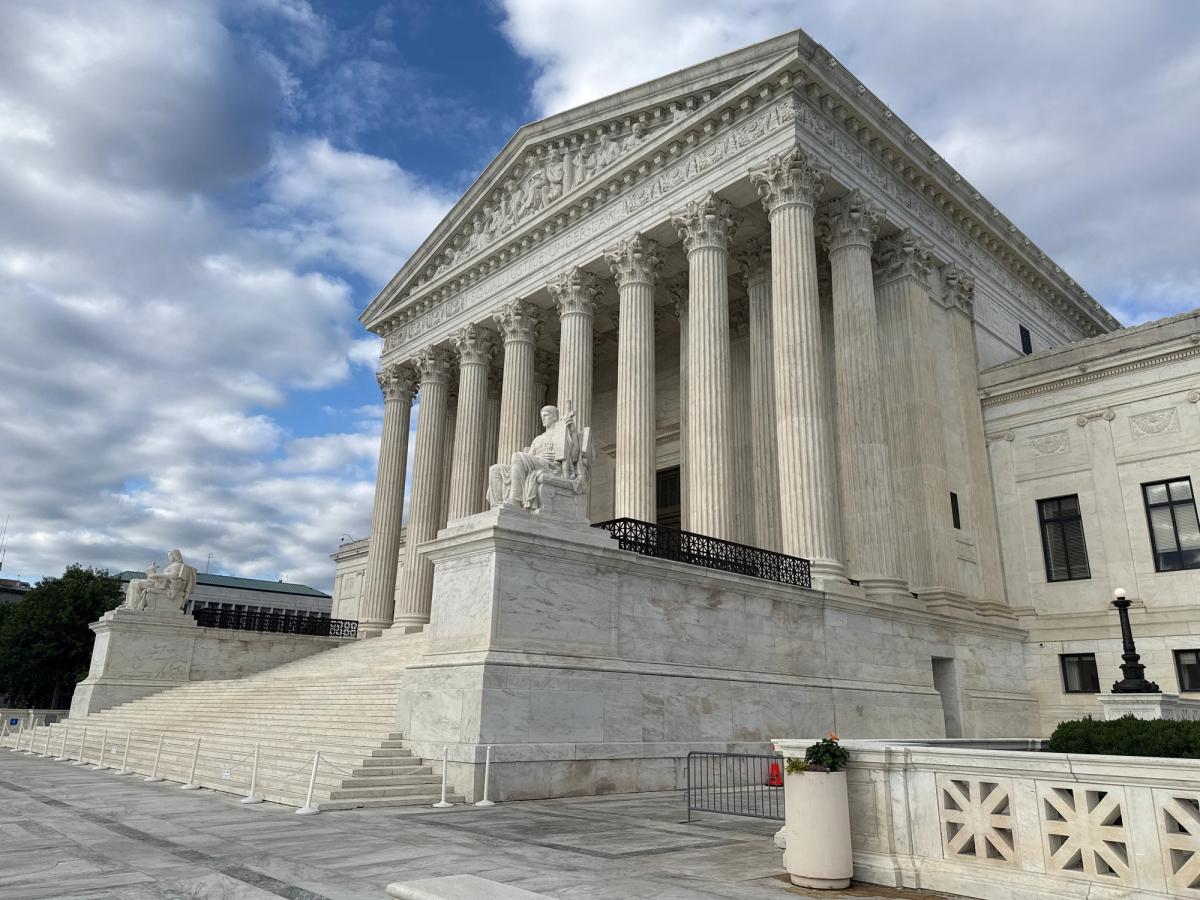
Many SCOTUSblog readers have strong opinions on not only how the Supreme Court should decide particular cases, but how it will decide such cases. Indeed, we’ve received plenty of emails over the years stating, with absolute confidence, how the most important issues before the court will be resolved. Sometimes this confidence is warranted; other times, not so much.
In collaboration with Good Judgment Inc, we’re now giving readers a way to formally prognosticate how the court will decide the most important cases of the term, and to test that collective judgment against the machines. You’ll be doing so on GJ Open, a free forecasting site created by the team behind Superforecasting. As an additional twist, Good Judgment will compare how well our SCOTUSblog forecasters predicted the outcomes of several key cases against artificial intelligence models to find out whether the machines have overtaken us yet (at least when it comes to the Supreme Court). In July, we will provide the names on SCOTUSblog of the three best forecasters (who will also perhaps receive some free swag).
To enter the contest, simply visit https://www.gjopen.com/users/sign_up. You only need a working email address, Google account, or Facebook account to do so. Once you sign up, you will be automatically directed to the SCOTUSblog 2026-27 Supreme Court Forecasting Challenge page, where you will be asked to choose the likelihood that each case will be decided one way or the other (and will be able to update your forecast until the case is decided).
As more significant cases are granted, we will add them to the page.
So good luck, SCOTUS forecasters! May the best reader (or machine) win.
***
By way of background, launched in 2015 and a public service of Good Judgment Inc, GJ Open is a free forecasting site where folks can test their forecasting skills on any number of topics. Good Judgment Inc is the commercial spinoff of the Good Judgment Project (GJP). In 2011, IARPA, the U.S. intelligence community’s equivalent to the Defense Advanced Research Projects Agency, launched a massive competition to identify cutting-edge methods to forecast geopolitical events. Four years, 500 questions, and over a million forecasts later, GJP – led by Philip Tetlock and Barbara Mellers at the University of Pennsylvania – emerged as the undisputed victor in the tournament. GJP’s forecasts were so accurate that they even outperformed intelligence analysts with access to classified data. (GJP’s successes gave rise to the book Superforecasting: The Art and Science of Prediction.)
The SCOTUSblog forecasting tournament will be led by superforecaster Ryan Adler, JD, a managing director and the question team lead at Good Judgment and a longtime SCOTUSblog fanboy.
Ryan provides the following forecasting tips:
“There is no true universal, step-by-step procedure for forecasting, only the proven need to be methodical. With that understood, there is a framework that I’ve used for years when considering SCOTUS case outcomes, though these tips are far from exhaustive.
1) Read the question and the resolution criteria completely (i.e., everything on the GJO case question page). SCOTUS cases often have nuances, and good forecasting questions are clear about what specifically is being asked about in the case. This often means there is clarifying information in the resolution criteria intended to make the line drawn reasonably bright.
2) Read the questions presented in the petition and response. Sometimes the forecasting question closely mirrors a party’s question(s) presented, and sometimes the forecasting question looks very different. Regardless, how the parties frame their argument in their questions presented can be very illustrative of what they want the court to think the case is truly about. If the court calls out a specific question or questions when it grants cert (e.g., St. Mary Catholic Parish v. Roy), it’s done some of the work for you.
3) Read the highest lower court’s decision (e.g., if the case was last heard by an appellate court, read that decision). Far more often than not, the way the court that most recently heard the case frames the legal question or questions is where SCOTUS will start. (If you get a forecasting question on an original jurisdiction case, you can skip this tip.)
4) Be ready to review your forecast after oral arguments. Forecasting questions about many topics demand constant attention, because new and illustrative information is constantly coming to light (e.g., armed conflict, financial markets). For SCOTUS questions, however, the only new information you can expect between cert being granted and the decision being handed down are oral arguments. Of course, if there’s a vacancy or change in the makeup of SCOTUS or a leak of a draft opinion, that’s definitely a development worth considering, but the vast majority of news and commentary about a potential case outcome is speculation and conjecture, not new information with new, actual insights. This doesn’t mean forecasting SCOTUS cases is the time for a Ron Popeil “set it and forget it” approach but be wary of the urge to change a forecast just because time has passed.
A few other things to keep in mind:
- Do your best not to think about how you personally want the court to decide. Good forecasts are made by anticipating what will happen – not what you’d prefer to happen. For avid court watchers, this is no simple task, but it is absolutely essential. As there’s no crying in baseball, there’s no “shoulding” in forecasting.
- The question is deliberately framed as yes or no. If the court has taught us anything, it is that there is almost no way to fully anticipate every way the ruling might come out on all of the issues (e.g., the court assuming without deciding whether Java code was copyrightable). Forecast the line drawn by the question, not other lines that may well appear in the case.
- Always go back and check the language of the question and the resolution criteria. The more complex the question, the easier it is to find yourself down a rabbit hole thinking about a question that wasn’t asked.”
Continue reading...
[ H/T SCOTUSblog ]