


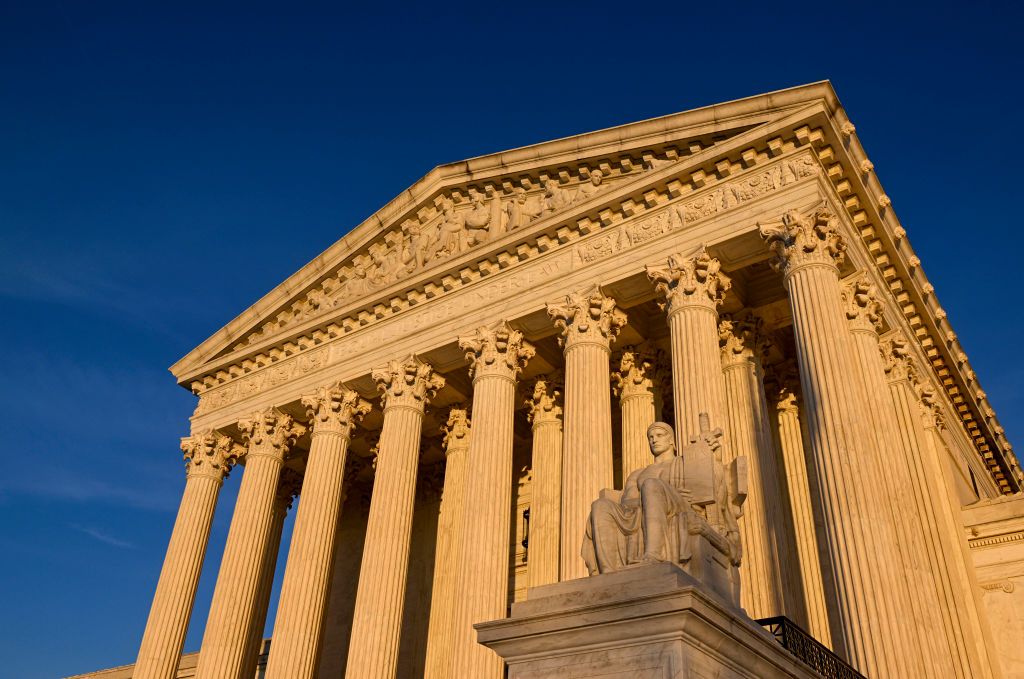
At a time when there is a desire to hold ICE agents accountable for their constitutional violations, the Supreme Court might be poised to eliminate the only way to hold them civilly liable under federal law.
By way of background, if state or local officers violate the Constitution, they can be sued under a federal statute, 42 U.S.C. Section 1983. But no federal law authorizes suits against federal officers for constitutional violations. Rather, the ability to sue a federal government officer for money damages comes from a 1971 Supreme Court decision, Bivens v. Six Unknown Named Agents of the Federal Bureau of Narcotics. There, the court said that it would allow a cause of action for money damages under the Fourth Amendment even without a federal statute authorizing it.
Nevertheless, for decades, the Supreme Court has refused to extend or even apply Bivens to other violations of constitutional rights by federal officers, and several conservative justices have called for it to be overruled. Now, in Nielsen v. Watanabe, to be argued on Nov. 9, the court will again confront whether to allow a Bivens suit – and perhaps whether to end such claims entirely.
The underlying issue is about separation of powers: should the court provide a remedy for constitutional violations or is that entirely the province of Congress? But it also is about accountability: without Bivens, how can those who violate constitutional rights, including ICE agents, be held responsible and how can those injured be compensated?
Bivens and its application
Webster Bivens alleged that he had been subjected to an illegal and humiliating search by agents of the Federal Bureau of Narcotics. Bivens sought money damages as compensation for the harms he suffered. The court held that a federal law cause of action for money damages could be inferred directly from the Fourth Amendment. The majority, in an opinion by Justice William Brennan, emphasized that individuals whose rights have been violated should not be relegated to state law remedies, which might be inadequate or hostile to the federal constitutional interest.
In an important and often-cited concurring opinion, Justice John Marshall Harlan explained that the federal courts long have devised remedies for violations of federal law. Harlan said that it is essential that federal courts be able to provide such relief because “it is apparent that some form of damages is the only possible remedy for someone in Bivens’ alleged position. … For people in Bivens’ shoes, it is damages or nothing.” Harlan rejected the claim that the court violates separation of powers when it creates such a cause of action and remedy. In his view, the court is responsible for upholding and enforcing the Bill of Rights, and, hence, the judiciary need not wait for the legislature in order to act.
Chief Justice Warren Burger and Justices Hugo Black and Harry Blackmun dissented. Each wrote an opinion arguing that separation of powers means that Congress, and not the court, should create a cause of action for damages against federal officers. Black explained that “
For a decade after Bivens, the court applied and extended it. In 1979’s Davis v. Passman, the court allowed a Bivens suit under the due process clause of the Fifth Amendment for an equal protection claim. Congressman Otto Passman fired his administrative assistant, Shirley Davis, because he wanted a male to fill the position. In allowing the suit against the congressman, the court emphasized the judiciary's role in ensuring effective protection of constitutional rights.
And only a year later, in Carlson v. Green, the court allowed a Bivens suit for violation of the Eighth Amendment. A mother sued federal prison officials on behalf of her deceased son, claiming that he was the victim of gross inadequacies of medical facilities and staff, which caused his death and constituted cruel and unusual punishment. A remedy was available under the Federal Tort Claims Act; thus, the issue before the court was whether a Bivens suit should be allowed in light of this alternative. The court concluded that Bivens suits were a “counterpart” to the Federal Tort Claims Act because the act creates liability for the federal government and a Bivens cause of action permits recovery from federal officers themselves. The court found no indication that Congress intended for the act to preclude Bivens suits.
Whither Bivens
Since 1980, however, the court has not ruled in favor of a Bivens claim. In its most recent decision about Bivens, 2022’s Egbert v. Boule, the court noted that it had “declined 11 times to imply a similar cause of action for other alleged constitutional violations” and that “in all but the most unusual circumstances, prescribing a cause of action is a job for Congress, not the courts.”
Specifically, the court has held that that such claims are not allowed if there is a statute that precludes suits (in 2010’s Hui v. Castaneda), or that provides an alternative remedy even if it is inadequate (in 1988’s Schweiker v. Chilicky). It has precluded Bivens claims for those injured while in the military, even for egregious violations of their rights (in 1987’s United States v. Stanley). It has ruled that Bivens suits should be allowed only if they are on balance desirable and consistently has found that they are not (in 2007’s Wilkie v. Robbins, 2017’s Ziglar v. Abbasi, 2020’s Hernandez v. Mesa, and Boule). And it has precluded Bivens suits against private prisons that contract with the federal government (in 2001’s Correctional Services Corp. v. Malesko) and the guards employed by them (in 2012’s Minecci v. Pollard).
Based on this line of cases, the court in Egbert v. Boule stressed that recognizing a Bivens cause of action “is ‘a disfavored judicial activity.’” The court stated that
The court then laid out the framework for Bivens claims going forward. According to the majority, this should be guided by a two-step inquiry:
This is a test that puts a very strong presumption against recognizing Bivens claims.
Nielsen v. Watanabe
Like Carlson v. Green, Nielsen v. Watanabe involves an Eighth Amendment claim for cruel and unusual punishment.The case involves a prisoner, Kekai Watanabe, who alleges that he suffered a broken tailbone when attacked by other prisoners that caused him excruciating pain and that a staff nurse, Francis Nielsen, denied him medical care. The court granted review as to whether the U.S. Court of Appeals for the 9th Circuit “erred [here] in recognizing a Bivens cause of action.”
Watanabe argues to the court that this case is governed by Carlson v. Green and does not seek to extend Bivens in any way. His brief states: “Watanabe asserts the same kind of violation of the same constitutional right by the same type of defendant in the same institutional setting pursuant to the same substantive standards as the plaintiff in Carlson. This is precisely the kind of claim this Court has long understood Carlson to encompass.”
In response, Nielsen argues that Bivens suits are strongly disfavored and that there are “significant factual differences such as the immediacy and severity of the harm alleged” compared with Carlson. But that is not all: Nielsen also expressly argues that “Bivens should be overruled” and that “Congress, not the judiciary, creates causes of action.”
The court could affirm the U.S. Court of Appeals for the 9th Circuit and allow a Bivens suit, saying that this is governed by Carlson. Or the court could distinguish Carlson, accepting Nielsen’s argument that there are sufficient factual differences between the cases, essentially limiting Bivens claims only for cruel and unusual punishment claims involving deaths. Or the court could overrule Carlson but not overrule Bivens.
Or the court could overrule Bivens entirely, which several conservative justices have advocated in the past.
The stakes
The fundamental disagreement, as it was in Bivens, is whether it is the judicial role to provide remedies for violations of constitutional rights or whether that is just for Congress. The practical reality is that without Bivens suits, those whose rights have been violated – even horribly – are left with no recourse. In Hernandez v. Mesa, for example, a boy in Mexico was killed by shot fired across the border by a federal agent in Texas. The court’s rejection of a Bivens suit left no remedy at all.
In that case, and in many other situations, the Federal Tort Claims Act does not allow suits against the United States. Often there are not state tort remedies available either. To paraphrase Justice Harlan, for people in the shoes of many injured by federal officers, it is Bivens suits or nothing.
I would like to think that the reports of egregious constitutional violations by ICE agents, including killings, would cause the court to realize the importance of Bivens suits and to not end such causes of action. That is what makes Nielsen v. Watanabe so important.
Continue reading...
[ H/T SCOTUSblog ]