


It is no secret that the morning after the midterms was the unofficial kickoff for the 2028 presidential race. Yes, we Republicans suffered a painful defeat. It’s an undeniable fact, and Republicans owned up to the loss right away. (Unlike the Democrats after President Donald Trump was first elected in 2016, when we all remember the embarrassing footage of progressives screaming, crying, and throwing tantrums in the streets — we didn’t scream, we didn’t cry; we accepted the results like grown men and looked forward to the future.)
Immediately after the results rolled in, Republicans began a period of deep self-examination — from grassroots conservative voters on social media to major media outlets and, of course, the politicians vying for leadership in 2028. But one response stood out above all the rest, once again proving that its author is fundamentally unfit to lead the Republican Party in 2028.
Before we address that specific outburst, let’s review the responses of three other potential frontrunners for the 2028 nomination.
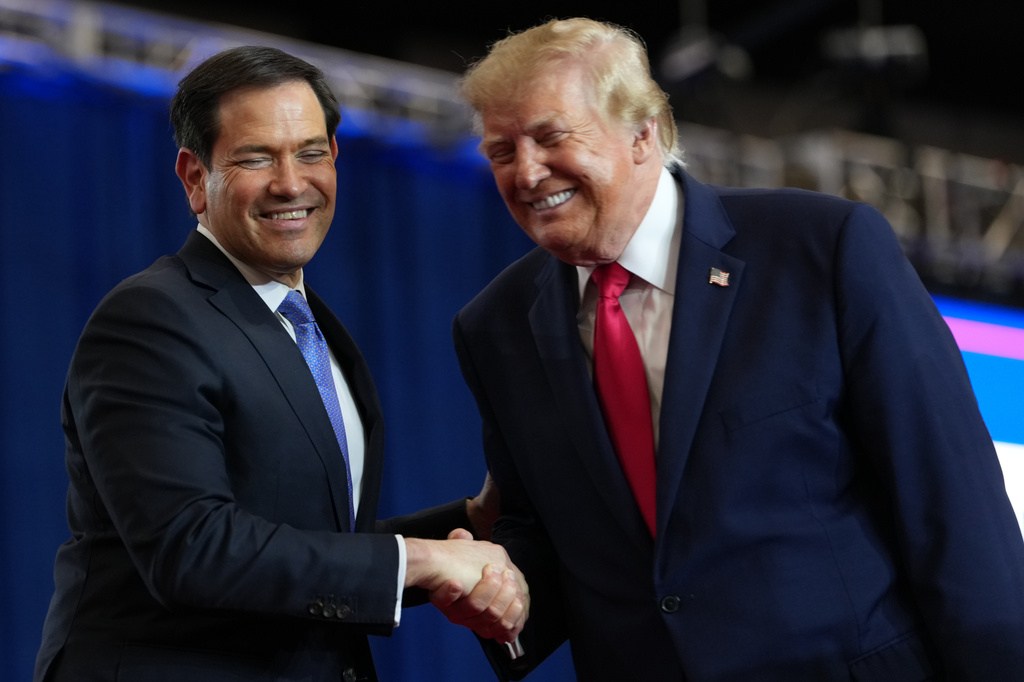
First is Secretary of State Marco Rubio. There’s a wise old saying: Sometimes silence is the smartest response — and if not silence, then absolute brevity.
In his statements to the press following the election, Rubio demonstrated precisely that level of restraint.
First, on foreign policy and executive authority, Rubio made it crystal clear that even with Democrats gaining control of Congress, it will not alter or undermine Trump’s directives on foreign policy and national security. He emphasized that the president serves as commander-in-chief and holds sole constitutional authority to lead foreign affairs.
Next, on the limits of congressional power. Having served 14 years in the Senate, Rubio noted that while he respects the legislative branch’s oversight, he understands its constitutional limits when it comes to conducting foreign strategy.
By taking this approach, Rubio delivered a statesmanlike message: Shifting dynamics on Capitol Hill will not derail the Trump administration’s international commitments. He showed maturity, measured judgment, sharp political intellect, and absolute loyalty — firmly cementing his position as a mature, steady, and thoroughly deserving candidate to lead the Republican Party into the future.
On Wednesday, Fox News brought on outgoing Florida Gov. Ron DeSantis (R-FL) to give his response to the election results. While he had a lot to say, he refrained from direct attacks on Trump and instead provided deep analytical insight into the loss. He explained:
“This was not a positive view of the Democrats,” DeSantis said. “This was a rejection of Republicans in Washington, and Democrats just happened to be the beneficiary.”
He continued: “Here’s the thing: Democrats are unpopular. They were able to win based off the sentiment that exists in the country right now. They did not earn a mandate to indulge all their left-wing fantasies. They’re going to be in there governing, and we’ll see what ends up happening.”
Instead of attacking the president or turning on America’s allies, DeSantis focused on a clear-eyed analysis of the results — measured, mature, and grounded in reality. Should he decide to run in 2028, his proven record governing Florida shows he possesses the exact character and executive capability needed to lead the Republican Party.
And then we have Sen. Ted Cruz (R-TX). Cruz also published a lengthy post on X on Wednesday, but like DeSantis, he offered thoughtful commentary rather than throwing blame or attacking Trump.
Cruz pointed to the economy and the rising cost of living. But as a true leader, rather than simply lamenting the situation, he offered concrete solutions and a path forward: “We need to listen and respond. We need to champion economic policies that make a real difference in working people’s lives, and we need to deal with the consequences.”
Cruz has long been recognized as a deep thinker, someone who dives beneath the surface of complex issues, as anyone who listens to his podcast or follows him closely already knows.
Even when addressing the war with Iran, Cruz didn’t argue that the U.S. should have avoided action altogether. Instead, he framed it with absolute clarity.
“It should have been brief, decisive, and over. It needs to end, and we should never, under any circumstances, give the Ayatollah billions of dollars,” he said.
Clear, direct, and principled.
And then came Vice President JD Vance, rushing to X before the votes were even fully counted just to “join the party.”
Instead of standing behind the administration, Vance published a sprawling post blaming Trump, effectively stabbing him in the back. Vance flatly claimed that the reason for the defeat was the Iran war, writing: “The reason we lost is the war.”
And then came the ultimate betrayal, as he added: “The president himself said so last night.”
I am deeply concerned that Vance fails to grasp a fundamental reality: Trump did not enter this conflict for fun or out of boredom. Had Iran acquired nuclear weapons, millions of Americans would have faced a direct, catastrophic threat. Iran might seem far away in the Middle East, but solid-fueled ballistic missiles — technology readily available from North Korea, China, or Russia — could easily target New York or Washington.
I’m not even touching on the disastrous geopolitical fallout for the U.S. if Iran had gone nuclear. Trump understood the stakes and made the tough call. A true leader does what is right for the nation, even when it comes at a steep personal or political cost. War always comes with a cost. Trump knew full well that this military action could trigger major midterm losses, yet he chose to act because he knew the alternative was vastly worse than losing seats in Congress.
Vance, on the other hand, behaved like an immature kid, turning against Trump the second things got rough just to score cheap political points for himself. To make matters worse, he trashed Israel along the way. As reported by Fox News citing Axios, Vance publicly criticized Israeli Prime Minister Benjamin Netanyahu’s strategy regarding Iran and urged Trump to pursue a deal instead of continuing necessary strikes.
So Vance’s solution is to just end the war and settle for another useless piece of paper — an agreement not worth the ink it’s printed on — all so he can reap a political windfall.
One would expect a vice president to stand shoulder to shoulder with his president and present constructive solutions for the path forward. Instead, Vance threw a petty tantrum of finger-pointing. Once again, he proved himself impulsive, childish, inexperienced, and shockingly disloyal. At 42, Vance is still young and clearly has a lot to learn.
Simply put: Vance is fundamentally unfit to lead the Republican Party in 2028.
DEMOCRATS RAN RADICALS AND STILL WON. DON’T BLAME THE CANDIDATES — TRUMP OWNS THIS BLOODBATH
On Wednesday, senior editor Peter Laffin noted in his column that “The argument will persist until Trump’s successor is nominated in 2028. It will be a ferocious battle of ideas, and one that is long overdue.”
Rubio, DeSantis, and Cruz are the caliber of leaders who actually fit that description: statesmen capable of engaging in a ferocious battle of ideas. One of them should lead the Republican Party into 2028.
Mendi Glik is a software engineer, political commentator, and columnist for the Jewish Press. He is also a contributor to JNS, focusing on electoral strategy and political analysis.
Continue reading...
[ H/T Washington Examiner ]