





The possible leak of a pathogen from a Russian laboratory in Siberia has caused global alarm. A 28-year-old employee of Irkutsk Research Anti-Plague Institute died of pneumonia on Oct. 2. But while this incident appears contained, the fact that it took place in Russia is concerning in and of itself.
Led by a KGB cabal, the former Russian secret police, Russia embraces pathological deceptiveness on biological threats. The same applies to Russia’s work on chemical, nuclear, and space-based weapons. That makes anything plague-related in Russia, accidental or otherwise, a prima facie national security concern for the United States.
THE US MAKES A TAIWAN NMESIS MISSILE MESS FOR CHINA
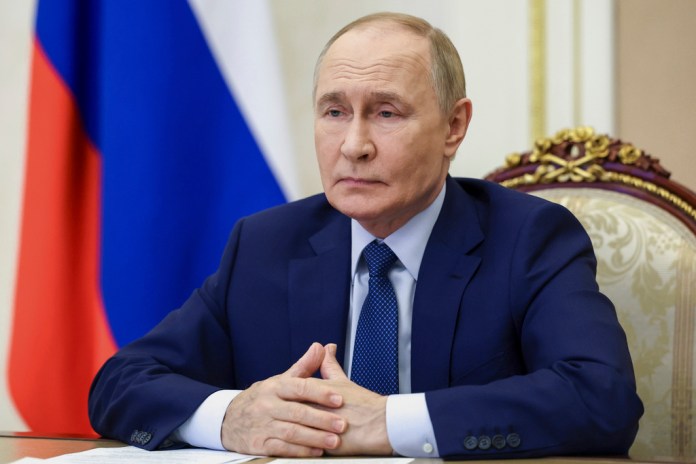
Russian authorities have plainly engaged in deception in relation to this particular incident. A senior local official first referred to the 28-year-old as having died of the pneumonic plague, only to then aggressively backtrack. Authorities now insist that tests have shown no link between the pneumonia and the woman’s work at the lab. The FSB domestic security service has also been on the ground in Irkutsk, engaging with institute staff and local medical facilities. At the same time, President Vladimir Putin has ignored U.S. and World Health Organization calls to provide more information about what actually happened.
This is not to say that we should panic. We would not see Irkutsk residents going about their lives normally were authorities concerned about a mass outbreak of either pneumonic plague or some weaponized version of the plague. U.S. and allied intelligence services would have picked up indications of mass health concern by now. Too many panicked Russian officials would be on the phone, calling Moscow and asking for guidance. Similarly, because of the hyper-public sensitivity to possible pandemics following COVID-19, whatever the U.S. intelligence community told top U.S. officials would leak to the media in short order.
Instead, our attention should fall on how Russia’s silence here relates to the Kremlin’s broader deception on these kinds of concerns.
For a start, it is possible the laboratory in question may have been involved in weaponization research related to the Plague. This weaponization has been a longstanding focus for Russia, dating back to the early days of the Soviet Union. We also know from past experience that Russia will withhold biological material (bodies, etc.) and data in an effort to hide evidence of a conspiracy. True, Russia’s secrecy in this situation may simply be designed to shield the Kremlin from international embarrassment over poor safeguards at the lab.
Still, there are other more nefarious possibilities. Were the 28-year-old to have died as a result of a weaponized or genetically altered strain of the plague, for example, Moscow would fear that any biodata it shared with the WHO would allow that organization to identify a breach of Russian obligations under the Biological Weapons Convention treaty.
This undated photo released by the Irkutsk Anti-Plague Research Institute of Siberia and Far East, shows the institute workers in a lab. (The Irkutsk Anti-Plague Research Institute of Siberia and Far East via AP)
" data-large-file="https://www.washingtonexaminer.com/wp-content/uploads/2026/10/AP26278372667862.jpg?w=696" src="https://www.washingtonexaminer.com/wp-content/uploads/2026/10/AP26278372667862.jpg?w=696" alt="Russia plague" class="wp-image-4753578" srcset="https://www.washingtonexaminer.com/wp-content/uploads/2026/10/AP26278372667862.jpg 1024w, https://www.washingtonexaminer.com/wp-content/uploads/2026/10/AP26278372667862.jpg?resize=300,200 300w, https://www.washingtonexaminer.com/wp-content/uploads/2026/10/AP26278372667862.jpg?resize=768,512 768w, https://www.washingtonexaminer.com/wp-content/uploads/2026/10/AP26278372667862.jpg?resize=150,100 150w, https://www.washingtonexaminer.com/wp-content/uploads/2026/10/AP26278372667862.jpg?resize=696,464 696w" sizes="(max-width: 1024px) 100vw, 1024px">
This undated photo released by the Irkutsk Anti-Plague Research Institute of Siberia and Far East, shows the institute workers in a lab. (The Irkutsk Anti-Plague Research Institute of Siberia and Far East via AP)
Russia has long engaged in biological warfare research. As I noted in 2020, research shows that Russia developed a “super-plague” in the early 1990s, which was resistant to antibiotics. The Soviet Union also developed antibiotic-resistant Anthrax strains. To this day, Moscow continues to engage in bioweapons research designed to blend and adapt various strains of the most dangerous organisms on Earth. Russia manifestly does not care that these activities breach its treaty obligations.
It is equally uncontroversial to assert that Russia is in absolute breach of its Chemical Weapons Convention treaty obligations. We have seen abundant proof of these breaches in recent years with the Novichok nerve agent poisonings of Russian political opposition figure Alexei Navalny and former Russian spy Sergei Skripal. Crucially, Russia was unable to hide verified confirmation by the Organization for the Prohibition of Chemical Weapons that Navalny had indeed been poisoned with this highly toxic chemical weapon. Navalny was later killed by another bioweapon while incarcerated in an Arctic prison. Offering absurd proof of the Russian state’s responsibility, the bioweapon used adapted poison from frogs that are indigenous to South American rainforests.
The trend is unmistakable. Whenever Russia signs an international treaty regarding weapons of mass destruction, it breaks that treaty if it believes that it can do so without suffering due riposte.
Take Russia’s activity on nuclear weapons. The first Trump administration rightly identified Russia’s breach of the Intermediate Nuclear Forces Treaty, for example. Although that treaty explicitly restricts intermediate-range ballistic missiles, Russia nevertheless developed an advanced intermediate-range ballistic missile, the Novator. All NATO members agreed that the Novator breached the INF treaty. Putin’s response was a predictable one. He declared that there was “no evidence of violations on [Russia’s] part.” While the U.S. then rightly withdrew from the INF treaty, the problem is that Russia’s conduct shreds the credibility of nuclear treaties more generally.
PUTIN IGNORES TWO REALITIES WITH KALININGRAD NUCLEAR THREATS
Finally, we have Russia’s antics in space. In Feb. 2024, then House Intelligence Select Committee Chairman Rep. Mike Turner (R-OH) hinted at what the Washington Examiner then first reported was a secret Russian nuclear weapons system. Specifically, a space-based nuclear weapons system designed to destroy U.S. satellite constellations. This constitutes a direct breach of the Outer Space Treaty, to which the U.S. and Russia are both parties. That treaty explicitly bans the deployment of nuclear weapons in space. Yet again, however, Russia responded with disdainful denials.
The situation in Siberia appears stable. Who knows what we may learn in the coming days and weeks. But whatever we learn, it’s crucial to remember that Russia cannot be trusted when something strange happens on an issue proximate to WMD. What Russia says and what Russia does on such concerns are often diametrically opposed.
Continue reading...
[ H/T Washington Examiner ]