




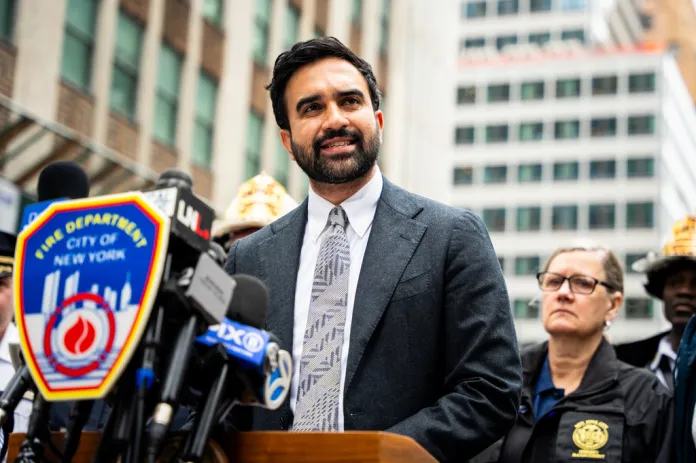
New York City Mayor Zohran Mamdani’s statement on the third anniversary of Oct. 7, 2023, begins reasonably enough. He calls the Hamas attack “horrific war crimes,” recalls the more than 1,100 Israelis who were killed and the 251 people abducted into Gaza, and offers sympathy to New Yorkers who continue to carry the trauma of that day.
So far, so good. In the political atmosphere of the past three years, even that clarity has sometimes proved elusive.
Then Mamdani moves on, and the statement becomes something else entirely. On the anniversary of the worst massacre of Jews since the Holocaust, he devotes most of his message to an indictment of Israel, accusing it of an “ongoing genocide,” invoking “apartheid” and “occupation,” describing American “complicity,” and presenting a litany of Palestinian suffering in which Israel appears almost exclusively as the perpetrator.
The Palestinian suffering is immense. Gaza has been devastated. Tens of thousands of people have died. Children have been killed in horrifying numbers, families have been obliterated, much of the territory has been reduced to ruins, and an enormous population has been displaced.
None of this would have happened if Hamas had not attacked — and done so in so barbaric a manner, hacking and burning to death entire families, raping and dismembering amid frenzied celebrations recorded pridefully on video. None of it would have gone on if Hamas had not clung on — which this savage, fanatical mafia did precisely to cause its own people’s suffering.
Hamas does not seek a resolution with Israel but the destruction of Israel. Its campaign of terrorism began in earnest as soon as the 1993 Oslo Accords between the PLO and a pro-peace Israeli government were signed — and intensified as the sides were negotiating a two-state solution in 2000.
Its goal then was to prevent a two-state solution — and its goal now is to get Palestinians killed in order to see Israel internationally isolated. Mamdani, in giving them a totally free pass, is perhaps inadvertently aiding and abetted a group that is among the most vile terrorists on earth — and is thus himself causing material harm to the Palestinians.
Israel’s conduct during the war deserves searching scrutiny, including of particular attacks that may have violated the laws of war. I have argued throughout this catastrophe that Israel was too accepting of civilian casualties that went unexplained, and that the country squandered much of the extraordinary moral and diplomatic capital it possessed on Oct. 8, 2023. There are operations that Israel should have conducted differently, rhetoric from Israeli officials that was appalling, and decisions that deserve investigation. The actions of Jewish terrorists in the West Bank are criminal as well — and the government has allowed this, disgracefully.
None of that turns the Gaza war automatically into genocide.
Yet the term — which activists began throwing around before Israel’s counteroffensive even began — has become the central accusation against Israel, repeated so casually that many people now treat the word as another synonym for a terrible war with an enormous civilian death toll.
International law says something considerably more specific. The Genocide Convention requires an “intent to destroy,” in whole or in substantial part, a national, ethnic, racial, or religious group as such. The special intent is the essence of the crime. Atrocities, disproportionate attacks, and even war crimes can occur without satisfying that standard.
The central question, therefore, concerns what Israel was trying to accomplish in Gaza.
Israel entered the war after Hamas and other Palestinian terrorists poured across its border on Oct. 7, murdered about 1,200 people and carried 251 hostages into Gaza. Its declared objectives were the return of the hostages and the destruction of Hamas’s capacity to govern Gaza and repeat such an attack. Those goals produced a brutal war against an enemy deeply embedded in one of the most densely populated urban environments on Earth.
It was a tactic clearly intended to make it so that any attack on Hamas meant harm to civilians. In private messages reported by the Wall Street Journal, Hamas leader Yahya Sinwar described mounting civilian losses as “necessary sacrifices” and declared, in the middle of the supposed “genocide,” that “We have the Israelis right where we want them.”
Israel has repeatedly documented Hamas military activity in and around civilian sites, including schools, while Hamas has disputed many Israeli accounts. Hospitals became contested military spaces amid Israeli accusations that Hamas operated from them and denials from Hamas and Palestinian medical officials.
Israel faced choices within those conditions, and it bears responsibility for the choices it made. My own view is that too often it accepted levels of collateral damage that it should have rejected. The distinction between accepting civilian deaths as a consequence of an attack and seeking the destruction of civilians as a people, however, lies at the heart of the genocide question.
Mamdani simply erases that distinction.
There is another problem with Mamdani’s presentation. He cites more than 74,000 Palestinian deaths, including more than 21,000 children, with a certainty that the circumstances of this war make difficult to sustain. The overall Gaza death toll cited internationally originates with Palestinian health authorities in Gaza and is routinely reported with that attribution. The scale of death is beyond serious dispute. The exact composition of that toll, including the number of combatants and the circumstances in which many people died, is considerably harder to establish independently.
That uncertainty hardly makes the deaths less tragic. It makes precision more important, particularly when casualty statistics are being used to establish criminal intent.
The same flattening occurs when Mamdani writes of “every shipment of food aid turned away at a border crossing.” Gaza has suffered severe food insecurity, and Israel deserves criticism for periods in which aid access was grossly inadequate. Yet the story of humanitarian assistance has been more complicated than his sentence suggests. Enormous quantities of food and humanitarian supplies have entered Gaza during the conflict, from Israel — even though Israel knows Hamas will commandeer the shipments. That is not an effective way to carry out a genocide.
Mamdani employs the same technique when he invokes Israeli bombs striking ambulances and drones striking residential buildings and journalists. Such incidents demand investigation, and attacks deliberately directed at civilians or protected medical personnel would constitute grave crimes. Yet a residential building can also contain a military target, and a journalist remains a civilian unless directly participating in hostilities.
One can believe, as I do, that Israel chose a disastrous strategy after Oct. 7.
There was another path available, however difficult. Israel could have used the extraordinary international sympathy generated by the massacre to demand a regional settlement, challenge Arab governments to help remove Hamas from power, pursue the hostages through a combination of overwhelming diplomatic pressure and tightly focused military action, and make a credible offer of a radically different future for Palestinians who rejected Hamas. Such a strategy would have required imagination and political courage that Israeli Prime Minister Benjamin Netanyahu’s government conspicuously lacked.
THE WORLD OF OCT. 8: WHERE ANTISEMITISM DIDN’T JUST RETURN — IT BECAME TRENDY
Instead Israel walked into the strategic trap Hamas had prepared. The strategy was to isolate Israel through a propaganda campaign. Mamdani is part of that campaign. And when he says that the suffering “did not begin” on Oct. 7, he is in effect saying that the attack was a response — and was implicitly justified.
Such an outrageous position puts Jews at risk as well. That such would be the actions of the mayor with the largest Jewish population anywhere outside Israel is deeply lamentable, reckless, and disgraceful.
Dan Perry, a computer scientist by education, is the former London-based Europe-Africa editor and Cairo-based Middle East editor of the Associated Press, chairman of the Foreign Press Association in Jerusalem, and the author of two books.
Continue reading...
[ H/T Washington Examiner ]