




The House passed the bipartisan Ratepayer Protection Act 417-3 on Sept. 16. Republicans and Democrats agreeing on anything is about as common as a quiet family dinner with the Sopranos. Two weeks later, the Senate blocked it 57-43, three votes shy of the 60 needed to start debate. Four Democrats voted yes. Their colleagues handed Republicans a campaign talking point and left your electric bill right where they found it.
I think Democrats would rather deny Republicans a win in an election year than hand ratepayers a head start. I can’t read minds, and Democrats have a stated reason. The vote count, the timing, and the options they passed up make that reason hard to accept at face value.
The bill, co-sponsored by Reps. Gabe Evans (R-CO) and Kathy Castor (D-FL), asks states to consider making data centers of 100 megawatts or more pay for the generation, lines, and upgrades they require, rather than shifting that cost to other customers. States would get one year to begin and two to finish. Evans said Colorado families, farmers, and small businesses should not be forced to cover the costs of new generation. Most Democrats agreed with that idea.
Ratepayers have reason to care. The Energy Information Administration projects the average residential price will reach 18.2 cents per kilowatt-hour this year, up 5.2% from 17.3 cents in 2025, and says record consumption is driven by data center development. The electricity index rose 3.8% over the 12 months ending in August, ahead of 3.4% overall inflation. In credit, a lender who funds a project on projected demand demands collateral, because projections miss. A utility that builds for a data center takes the same risk, and without a cost rule the backstop is whoever pays the monthly bill.
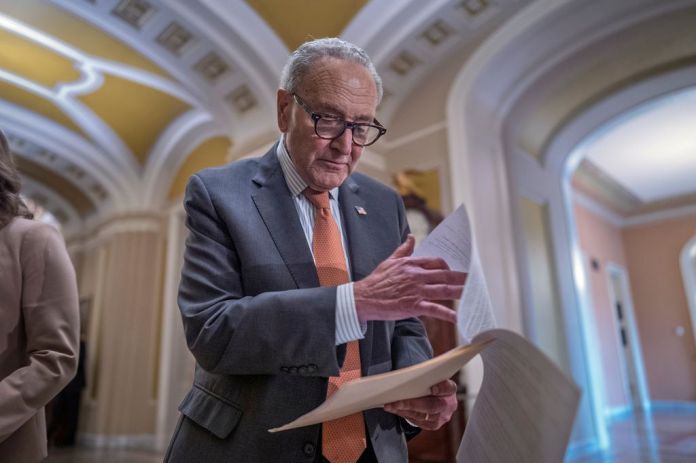
Senate Minority Leader Chuck Schumer (D-NY) called the bill “toothless” and “a fraud,” then rallied his party to block it. Sen. Martin Heinrich (D-NM) filed his own mandatory version on Aug. 3, covering loads above 150 megawatts. That’s a consistent position, and a mandate has merit. It also reaches far fewer facilities than the House bill’s 100-megawatt line. I’ve spent 30 years around private equity and private credit deals, and I’ve never watched anyone torch a term sheet because the first draft lacked every covenant. You sign the floor, then negotiate upward.
Consistency still doesn’t explain the tactics. Heinrich blocked fast-track passage the day after the House vote. Sen. Bernie Moreno (R-OH) accused him of trying to hurt Sen. Jon Husted’s (R-OH) reelection bid. Husted, who had introduced the Senate bill, summed it up after the vote: “Now they own it.” A vote to open debate commits nobody to the final text, so Democrats could have opened the floor and argued for their stronger version in public. Only four did so. The second block in two weeks came from their colleagues. George Costanza once built a winning streak by doing the opposite of his instincts. Senate Democrats tried it on a bill their House colleagues had just passed.
In the House, just three Democrats voted no. Castor helped write the bill. If the Senate version was a fraud, an awful lot of House Democrats certainly missed it.
Fair critics will note that Republicans objected to Heinrich’s alternative too, and that the bill wouldn’t take full effect for two years. Both points are true. Yet about half the states already have separate rate classes for data centers, so the bill pushes the rest toward a standard that works, and a floor that arrives in two years beats a ceiling that never arrives.
IN LIEU OF THE TRUTH: EVERY WORD IS RIGHT, BUT THE WHOLE STORY IS A LIE
Husted and Heinrich should merge their texts when the Senate returns, mandating wherever Congress can. State commissions needn’t wait, since they can write large-load rules now. Some transmission costs sit outside state jurisdiction, though, so Congress still has to act.
Epictetus’s Enchiridion opens by noting that our own actions are in our control. Senate Democrats controlled their votes. The Senate is unlikely to take up data center legislation before the midterm elections, and your electric bill will arrive anyway. When it does, check the amount, then check the roll call.
Jay Rogers is a financial professional with more than 30 years of experience in private equity, private credit, hedge funds, and wealth management. He has a Bachelor of Science in criminal justice from Northeastern University and has completed postgraduate studies at UCLA, the University of Pennsylvania, and Harvard. He writes about issues in finance, constitutional law, national security, human nature, and public policy.
Continue reading...
[ H/T Washington Examiner ]