



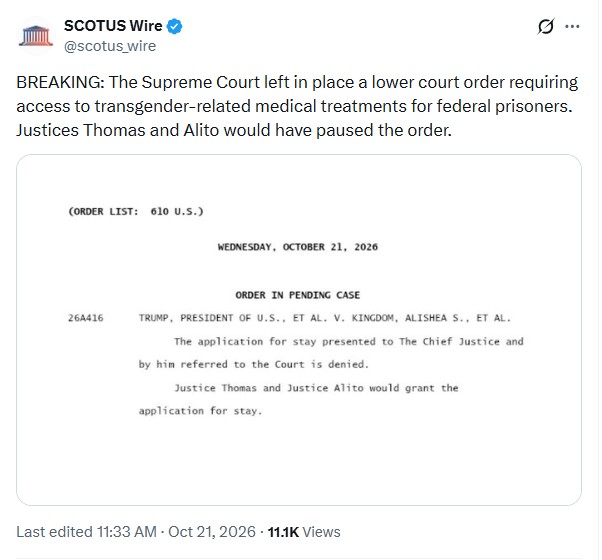
The Supreme Court handed President Donald Trump’s administration a setback Wednesday, refusing to immediately reinstate restrictions on taxpayer-funded transgender medical treatments for federal prison inmates.
The decision leaves a lower court’s injunction in place, preventing the Bureau of Prisons from enforcing a policy that would eliminate certain medical procedures, including gender-transition surgeries and hormone treatments.
The justices issued a brief order without explaining their reasoning, leaving the broader legal battle unresolved.
Conservative Justices Samuel Alito and Clarence Thomas indicated they would have allowed the Trump administration to enforce the restrictions while the case continued through the courts.
The dispute stems from an executive order Trump signed during his second term directing federal prison officials to revise medical policies involving transgender inmates.
The order sought to prevent federal money from being spent “for the purpose of conforming an inmate’s appearance to that of the opposite sex.”
Under the administration’s proposed changes, federal prisons would discontinue transition-related surgeries, gradually withdraw hormone treatments and eliminate certain accommodations, including makeup and wigs.
Mental health services would remain available to inmates under the policy.
The administration argued that the restrictions were justified by security concerns and the need to reconsider existing medical practices within federal correctional facilities.
Screenshot-X
Government attorneys maintained that the treatments “could no longer be justified.”
But attorneys representing transgender prisoners challenged the changes, arguing that abruptly ending established medical treatment could produce serious physical and psychological consequences.
POLL: Do You Believe Transgenderism Is A Mental Illness?
U.S. District Judge Royce Lamberth, a Reagan appointee, sided with the inmates and ordered the Bureau of Prisons to continue providing the disputed treatments while litigation proceeds.
Lamberth cited concerns that untreated gender dysphoria can contribute to severe depression, anxiety and suicidal thoughts.
RELATED: JUST IN: SCOTUS Issues 6-3 Ruling In Closely-Watched Case
The Trump administration appealed, but a divided federal appeals court panel declined to overturn the injunction.
That sent the dispute to the Supreme Court, where administration lawyers sought emergency intervention.
Wednesday’s decision means the existing restrictions remain blocked for now, although the justices have not issued a final ruling on whether the policy is constitutional or otherwise lawful.
According to federal court records, approximately 600 inmates were receiving hormone therapy in 2025.
Attorneys challenging the administration’s policy argued that federal prisons had provided hormone therapy for roughly three decades without the government identifying specific security incidents sufficient to justify the sweeping restrictions.
RELATED: NEW: SCOTUS To Hear Monumental Case That Could Make Or Break Trump’s Deportation Strategy
The case raises questions about federal spending, prison administration and the government’s obligations to provide medical care to incarcerated individuals.
It also represents a notable departure from several recent Supreme Court decisions involving other transgender-related policies pursued by the Trump administration.
The conservative-majority court previously allowed restrictions on transgender military service and passport sex markers to take effect while those legal challenges continued.
The justices have also upheld certain state restrictions involving medical treatments for transgender minors and participation by transgender athletes in women’s sports.
Those decisions, however, involved different laws and legal arguments.
For Donald Trump, Wednesday’s order represents a temporary obstacle to implementing another part of his administration’s broader policy agenda.
For the inmates challenging the restrictions, it preserves access to existing medical treatments while the courts examine the government’s legal authority to discontinue them.
The Supreme Court’s refusal to intervene does not settle the underlying dispute, and the administration could ultimately prevail as the case moves forward.
POLL: Is Melania Trump One Of The Best First Ladies In American History?
Continue reading...
[ H/T Trending Politics ]