


To a hammer, everything is a nail. And a special prosecutor is a very dangerous hammer.
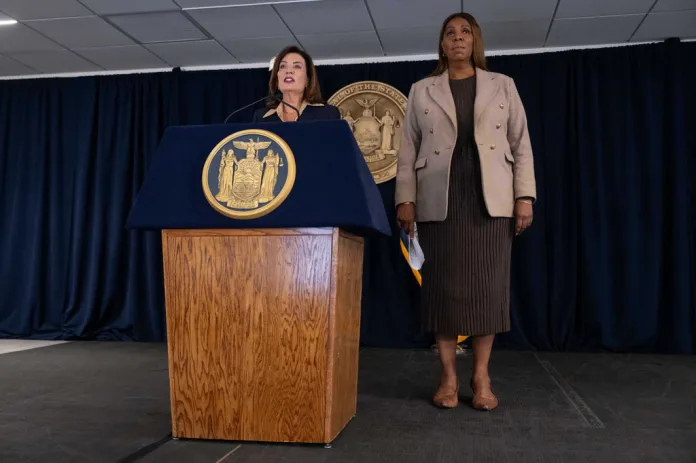
On Thursday night, Gov. Kathy Hochul (D-NY) announced that she was appointing New York Attorney General Letitia James as a special prosecutor to investigate the alleged 2024 gang rape at Cornell University. In her statement announcing the appointment, Hochul said she had “lost faith in the Tompkins County DA’s ability to fairly oversee” the case and that “the young woman at the center of this case deserves to know that every fact will be examined and justice pursued.”
The signal she is sending could not be clearer and goes well beyond the usual efforts of a politician to appease her baying constituents: There is only one acceptable outcome here, and I expect James to find it.
Having run for office in 2018 on a platform in which she proudly proclaimed she would go after President Donald Trump, and then eagerly proceeded to do so, James doubtless understands the assignment. But public statements she has already made about the case raise serious questions about whether state ethics rules should bar her from participating in the case.
On Sept. 28, just three days before Hochul announced the appointment, James released the following statement on X: “What this young woman has been forced to endure is horrific and unacceptable. I’m holding her in my heart and in my prayers. To her, and to all survivors: you’re not alone. We stand with you.”
It is hard to know where to start with this.
As an initial matter, of course, we don’t actually know what “this young woman has been forced to endure.” The point of the investigation would presumably be to find that out. And the most recent reporting by The New York Times, which obtained access to Cornell’s full investigation report in the case, suggests that Jane Doe may have consented to much, and possibly to everything, that happened that night and filed her complaint weeks later only after the fraternity’s president told her that it might not be a good idea if she came to their upcoming Halloween party.
Nor, to put it mildly, do prosecutors publicly proclaim that they hold accusers in their “heart” and “prayers.” A noble sentiment, to be sure, but typically not proclaimed by someone who is supposed to be a minister of justice.
Finally, there’s James’s declaration that she is on the side of “survivors.” Whether someone is a “survivor” is the very thing that an investigation is meant to determine. To start by assuming that an accuser is a “survivor” is to turn the burden of proof on its head. James’s job is to determine whether there is probable cause to believe that someone may have committed a crime. It is not to “stand with” either side or start by assuming the accuser has “survived” anything.
Unsurprisingly, several provisions of Rule 3.6 of the New York Rules of Professional Conduct prohibit lawyers from making statements like this.
Rule 3.6(a) prohibits lawyers from making an “extrajudicial statement that the lawyer knows or reasonably should know will be disseminated by means of public communication and will have a substantial likelihood of materially prejudicing an adjudicative proceeding in the matter.” Rule 3.6(b) lists examples of statements that risk doing that, such as statements regarding “any opinion as to the guilt or innocence of a defendant or suspect in a criminal matter that could result in incarceration.”
Given that the identities of the “Cornell Seven” had long since been made public by the time James made her statement, it is simply ludicrous to suggest that referring to Jane Doe as a “survivor” who endured something “horrific and unacceptable” is anything but an “opinion as to the guilt or innocence … of a suspect in a criminal matter.” Two decades ago, violations of this ethics provision played a role in the disbarment of Mike Nifong, who, much like James, decided that proclaiming the guilt of accused students in the Duke lacrosse case before he had undertaken any investigation of the facts would advance his political interests.
But James is a savvy operator and knows she is playing with house money. Just as her public statements about Trump did not lead to either her disqualification from his case or any consequences from the New York State Bar, she knows that this time is unlikely to be different.
So we are left with a Javert problem: Like the blinded-by-righteousness police inspector who mercilessly pursues Jean Valjean in Les Miserables, James will now begin her own pursuit of seven young men who have already been punished by Cornell, some severely, and who have reasonably believed for almost two years that they could take the local prosecutor’s declination at his word.
THEY SELECTED TRUMP, THEN SEARCHED FOR A CRIME: LETITIA JAMES WHISTLEBLOWER EXPOSES LEGAL MALPRACTICE
“This wolf comes as a wolf,” Justice Antonin Scalia opined in his famously lone dissent from the Supreme Court’s decision upholding the constitutionality of the Independent Counsel Act. And he quoted Attorney General Robert Jackson regarding “the most dangerous power of the prosecutor: that he will pick people that he thinks he should get, rather than cases that need to be prosecuted.”
So too here. James’s appointment as special prosecutor constitutes a serious threat to the rule of law. Let us hope that justice will prevail and that the guardrails will hold.
Justin Dillon, a former federal prosecutor, is a partner at Dillon PLLC, where he represents students and professors nationwide in campus misconduct cases.
Continue reading...
[ H/T Washington Examiner ]