

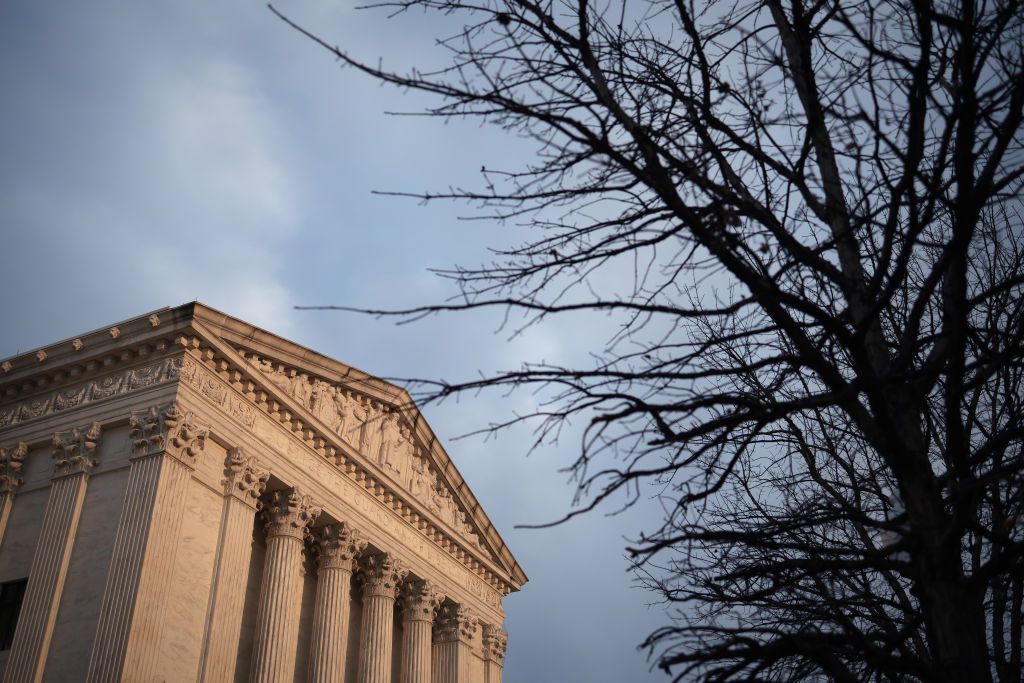
The Supreme Court will hear oral argument on Wednesday in a battle over the U.S. Air Force’s efforts to continue disposing of munitions by detonating them on a beach in northern Guam. The legal questions in Department of the Air Force v. Prutehi Guåhan are highly technical and center on the interaction (or lack thereof) between two federal environmental laws. The Air Force has asked the justices to reverse the decision against it by a federal appeals court, arguing the circuit court’s “sweeping” ruling “‘will have massive implications beyond this case.’” But the Guam-based group challenging the Air Force’s actions counters that it is simply asking the Air Force to “meaningfully consider the impacts of and alternatives to the[] open-detonation operations, including less sensitive locations,” and to do so “before the agency decides to move forward.”
A 1976 law, the Resource Conservation and Recovery Act, gives the federal Environmental Protection Agency the power to regulate hazardous waste. The law, often known as RCRA, also allows the EPA to authorize states (and territories like Guam) to administer their own hazardous-waste programs.
A separate law, the National Environmental Policy Act of 1969, or NEPA, outlines the process to assess the environmental impact of a federal agency’s action, including the preparation of an Environmental Impact Statement before the agency takes “major Federal action[] significantly affecting the quality of the human environment.”
At Tarague Beach, adjacent to Andersen Air Force Base in Guam, the Air Force has created a range to dispose of hazardous munitions such as ammunition, tear gas, and propellants, by (as relevant here) detonating them.
In May 2021, the Air Force applied to Guam’s EPA to renew the RCRA permit that lets it detonate munitions on Tarague Beach. If the permit were renewed, it would have allowed the Air Force to continue to dispose of munitions there through 2024. In October of 2021, the Guam EPA issued a preliminary decision that “neither den[ied] nor approve[d]” the Air Force’s application.
In January 2022, a group known as Prutehi Guåhan – which describes itself as a “Guam-based organization dedicated to protecting the island’s natural and cultural resources and the well-being of its people” – filed a lawsuit against the Air Force in federal court in Guam. It contended that the Air Force violated the NEPA when it submitted its application to renew its RCRA permit without including a detailed Environmental Impact Statement.
Chief U.S. District Judge Frances Tydingco-Gatewood granted the Air Force’s motion to throw out the case. She ruled (among other things) that Prutehi Guåhan had filed the case too soon, because the Guam EPA had not yet ruled on the permit application. Moreover, she added, the Air Force was not required to comply with the NEPA in applying to renew its permit.
A divided three-judge panel of the U.S. Court of Appeals for the 9th Circuit reversed that ruling and reinstated Prutehi Guåhan’s case. The Air Force went to the Supreme Court last November, asking the justices to weigh in.
There are two questions before the justices next week. The first is whether the Air Force’s application to renew its RCRA permit was the kind of “final agency action” that courts can immediately review under the Administrative Procedure Act, the federal law governing administrative agencies.
The Air Force insists that it was not. For purposes of the APA, an agency action must meet two criteria to be considered “final,” U.S. Solicitor General D. John Sauer writes. First, it must represent the end of the agency’s decision-making process; and, second, it must “determine legal rights or obligations.” But, Sauer argues, neither of those things happened when the Air Force applied to renew its permit to detonate munitions at Tarague Beach. Instead, he says, the application “is simply the initial step of an ongoing regulatory process, and it entails no meaningful legal consequences until Guam EPA grants or withholds a new permit.”
Prutehi Guåhan pushes back, stressing that the “the Air Force has made up its mind to continue [open detonation] at Tarague Beach beyond 2021. There is nothing suggesting that the Air Force’s decision was tentative or still under review within the agency.” To the contrary, the group says, because the Guam EPA has still not acted on the Air Force’s permit application, the Air Force “has in fact continued operations under” its prior permit “for nearly five years.” “There is nothing to be gained,” the group concludes, by requiring it “to wait to challenge the Air Force’s decisionmaking under NEPA until a different entity makes a decision under a different law.”
The second question before the justices is whether the federal government is required to comply with NEPA’s general environmental-review procedures before it applies to renew a RCRA permit. For the Air Force, the answer to this question is also “no.” It emphasizes that “NEPA is a purely procedural statute that generally requires federal agencies to consider the environmental effects of their actions, but that does not specifically address hazardous waste.” Because RCRA “imposes its own detailed environmental-review procedures” explicitly for hazardous wastes, the Air Force says, it “is accordingly the functional equivalent of, and thus displaces, NEPA’s similar but much more generalized requirements.”
Prutehi Guåhan, on the other hand, argues that NEPA’s requirements can be superseded by those of another environmental law “only if that law says so … or there is a clear conflict between the two.” RCRA, the group says, does not meet either of those requirements. Congress enacted NEPA, it argues, to “streamlin[e] analysis under different environmental laws in one place at an early juncture” – precisely the purpose that requiring the Air Force to provide an Environmental Impact Statement with its RCRA permit-renewal application would serve. But “f that is truly too burdensome for” the Air Force, the group continues, it “can ask Congress to create an exemption to NEPA for RCRA permitting. But this Court should not pencil one in.”
Continue reading...
[ H/T SCOTUSblog ]