






Guest Post by Simplicius
Not long after we published yesterday’s report, Russia began to again strike the South Bridge in Kiev. Yesterday we saw drones that had possibly missed and hit the bridge roadway itself, but today the drones impacted the cable stays, which seemed to be the target:
Recall that Russia is said to be using a new line of Geran-4 drones with special “wire-cutting” cumulative charges. These drones appear to be attempting to hit the suspension cables in order to cut them and force the collapse, or at least the degradation of the structural integrity, of the bridge.
Close up photos show that the cables appear to have been damaged or outright severed in some areas:
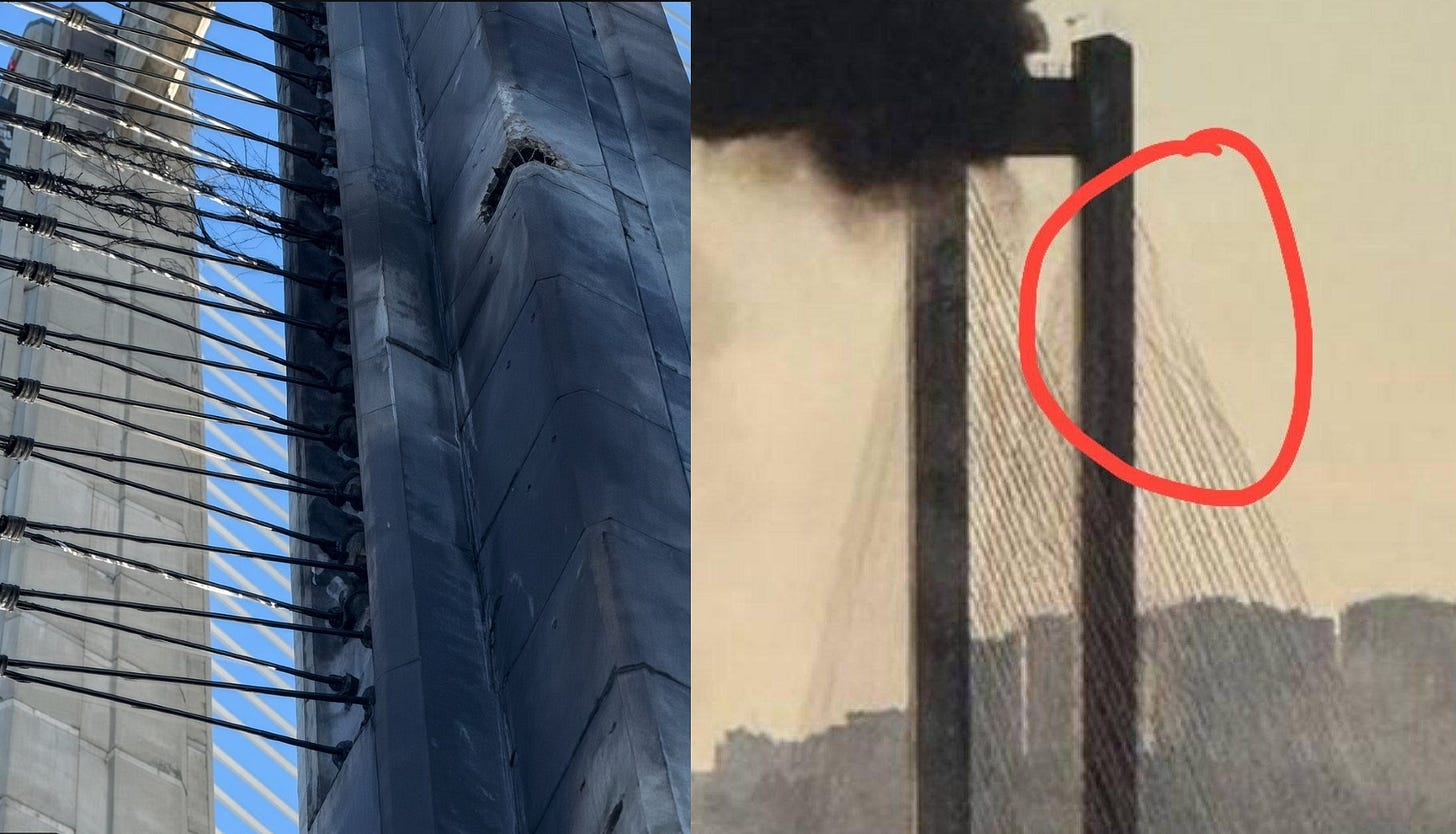
Experts please chime in in the comments section: can a suspension bridge of this nature be brought down by damaging or severing enough of the cables? Or would subsequent missile strikes have to “finish off” its structural integrity somehow?
The mood in Kiev immediately turned into grim panic as traffic jams paralyzed the city after the bridge was shut down to car traffic:
Kiev mayor Vitali Klitschko was ruffled:

https://www.bbc.com/news/articles/c6wyv44y4ywjo
Zelensky likewise believes Russia wants Kiev to be abandoned, and has been striking the city 24/7:
Every major Ukrainian outlet has suddenly grown very concerned:
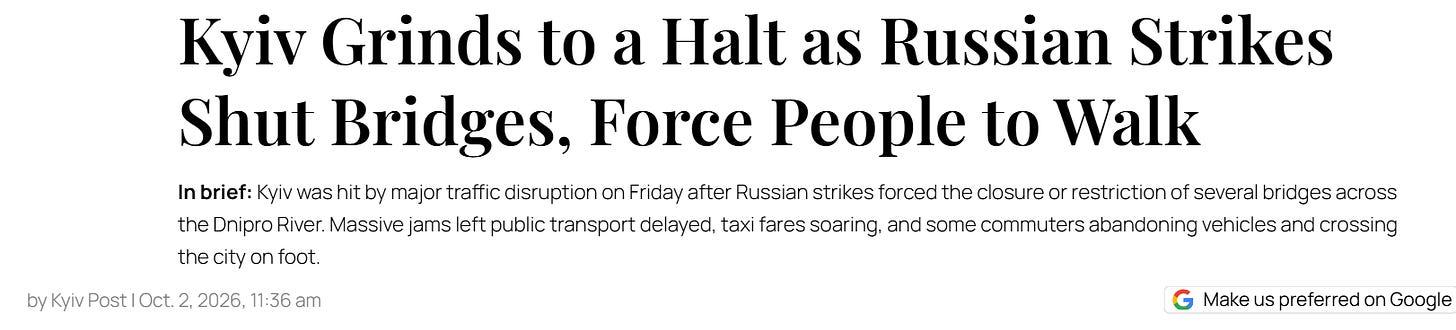
https://www.kyivpost.com/post/85928
FT reports on new “deeply disturbing intelligence” claimed to be intercepted from Russia that suggests Putin is taking the gloves off to truly unplug Ukraine like never before this winter:
Christopher Miller@ChristopherJM
More from my @FT interview with President Zelenskyy and on the intelligence intercepted by Kyiv about Russia’s winter attack plans. It’s deeply disturbing. Attacks concentrated on Kyiv, Kharkiv, Odesa and Lviv. The goal: isolate them, destroy morale, sow chaos, spark a new flood …

4:00 AM · Oct 2, 2026 · 95K Views
48 Replies · 428 Reposts · 783 Likes
NYT likewise reports more on this “leaked document”:
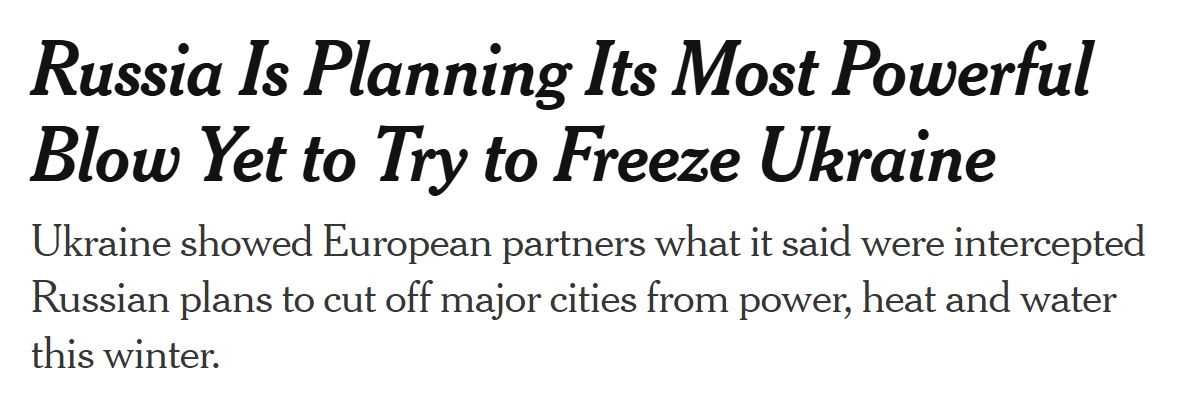
https://www.nytimes.com/2026/10/02/world/europe/russia-ukraine-winter.html
The “secret Russian plan” reportedly consists of using up to 1,000 missiles which Russia has been stockpiling—given that Iskanders have not been used much in the past few weeks—to cripple Ukraine’s energy grid:
They even claim that Russia intends to unplug Ukraine’s nuclear plants:
The plan allegedly also calls for destroying Ukraine’s water systems, which we had reported rumors of many months ago:
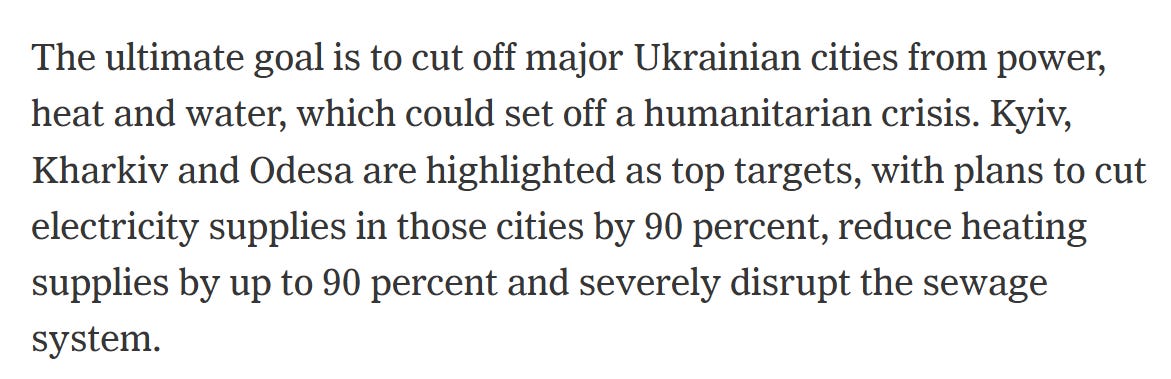
Some Ukrainian channels are likewise reporting that Putin has officially lifted restrictions on such attacks:

Recall that Ukraine is now facing a budgetary disaster, with a major deficit of funding for both the war and its economy. This winter will require massive investment in infrastructure repair that Ukraine simply will not be able to afford, with the EU now rejecting latest loan deals until Ukraine enacts more “reforms”—a globalist codeword for servitude
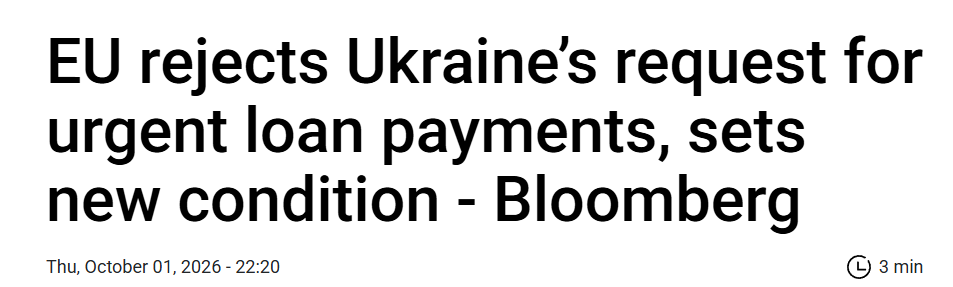
https://newsukraine.rbc.ua/news/eu-rejects-ukraine-s-request-for-urgent-loan-1790882388.html
NEXTA@nexta_tv
Western countries are preparing plans to relocate their embassies from Kyiv This is related to Russia’s systematic strikes on the Ukrainian capital, The Guardian writes. Diplomatic missions may temporarily relocate to Lviv or eastern Poland. For now, the embassies remain in

NEXTA @nexta_tv
Russian drones struck the Southern Bridge in Kyiv again This time, the strike hit the upper part of the bridge. The bridge is currently closed to ground transport and the metro. It had already been attacked by drones several times, which restricted traffic between the banks of https://t.co/zypNZbYRwB
2:03 PM · Oct 2, 2026 · 19.9K Views
12 Replies · 10 Reposts · 49 Likes
But to circle back to the bridge situation, here is one informative analysis from a Russian channel on what the attacks could mean:
And another:
It seems using a procession of cheap Geran drones to snip the cables one by one is not an altogether bad idea, in theory. Share your thoughts below.
—
As a final batch of interesting updates, for the past three days Russia has been conducting the Center-2026 military exercises in Chelyabinsk. Hosted by the Central Military District, the exercises included military units of Tajikistan, Mongolia, Belarus, China, Pakistan, and Kyrgyzstan.
Some astounding sights were seen. Most notable have been videos demonstrating the effectiveness of the Russian Arena-M system on a T-90M tank against different kinds of drones. You’ll recall a month ago we saw hazy battlefield footage of such a T-90M reportedly deflecting a Ukrainian FPV with the new hard-kill system. But now for the first time we have close-ups proving the system’s effectivity.
Here is the T-90M with mine-rollers taking out a larger OWA UAV:
Another angle:
Next we saw the prototype Sturm assault system. It is an unmanned tank with autoloaders and a shortened barrel, based on a T-72/T-90 chassis built for assault operations. It is controlled by troops sitting in a separate turretless command vehicle somewhere nearby which directs it via radio signal:
The exercises revealed several other never-before-seen systems. Recall the famous Russian LMUR missiles introduced in the SMO, fired by attack copters and controlled directly by the copilot down to their targets.
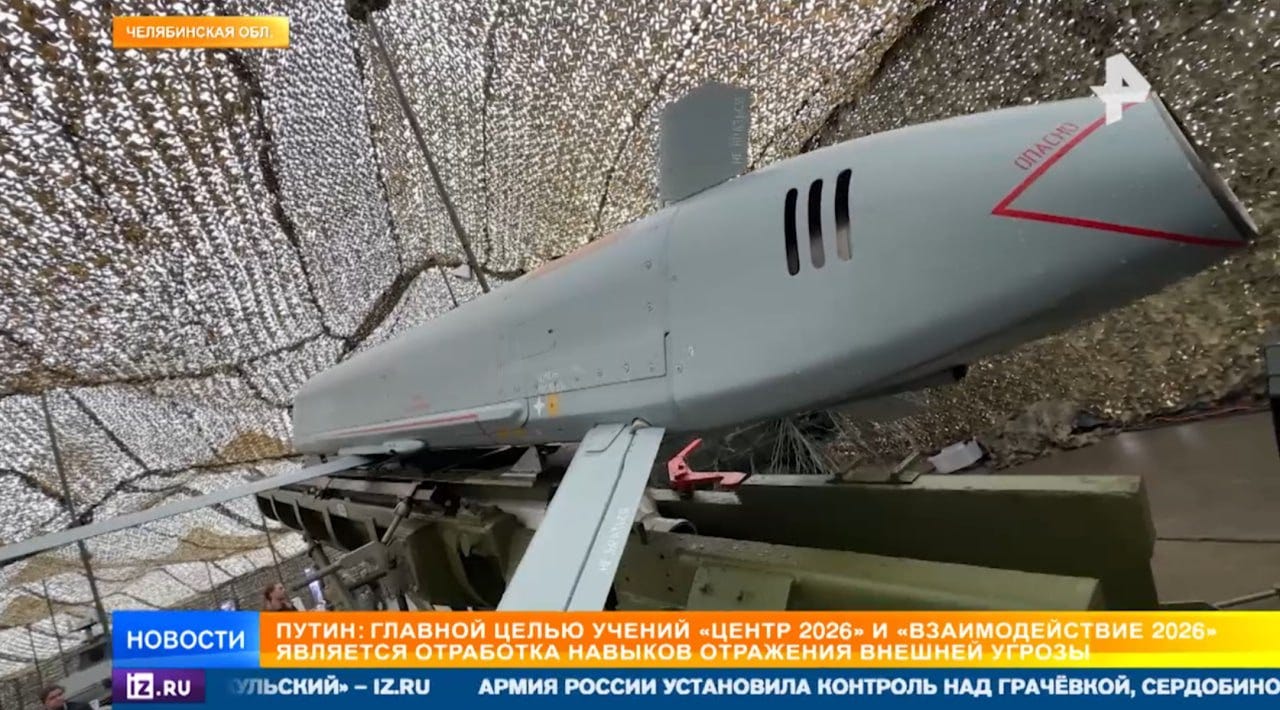
Now Russia has for the first time unveiled the ground variant of the LMUR, which fires from a truck and like a Spike NLOS missile is able to be precisely directed by an operator:
A ground launcher for the new Banderol missile was also reportedly seen:
Other general footage from the exercises that’s worth seeing. It shows the utterly futuristic nature of the current battlefield as demonstrated by Russian forces, which included the showcase of drone swarms:
And for those interested a longer version showcasing both Airborne forces exercises as well as the deployment of robotic airborne vehicles:
In conclusion, we can echo the same words from the previous article: Russia is on the path to evolving the battlefield to the point where maneuvering forces can again break out past the current ‘slow-trickle’ meta of warfare.
In particular, the use of new unmanned tanks is interesting for one major reason: previously, Russian unmanned combat vehicles like the famous Uran-9 used as far back as Syria suffered from major communications issues due to the inability to retain constant radio link to the controller on a chaotic battlefield where a plethora of terrain obstructions are present. But with the advent of Rassvet satellite systems, this issue can be entirely solved as each unmanned vehicle can have its own unbreakable satellite link giving the ability to control it from anywhere, with the “command vehicle” not needing to be anywhere nearby or in the general vicinity.
This coupled with new hard-kill technologies like the Arena-M and better anti-drone cladding as recently complained about by top Ukrainian figures like Azov’s Prokopenko, we could in the future see the resurgence of armor once more. Unmanned tanks controlled by satellite uplinks armed with kinetic hard-kill systems that shoot down drones in batches will make armored pushes viable again.
Of course, one can argue that by then the production of FPVs will be so through the roof that even such systems would not stand a chance by simple sheer saturation. But you need men to operate these systems, and if Ukraine continues to experience mass attrition to its manpower, drone operators could come in shorter and shorter supply.
Either way, the battlefield is clearly changing. Russia is adapting its tactics as seen in the new strikes on Kiev’s bridge—though we have yet to see how effective they will ultimately be.
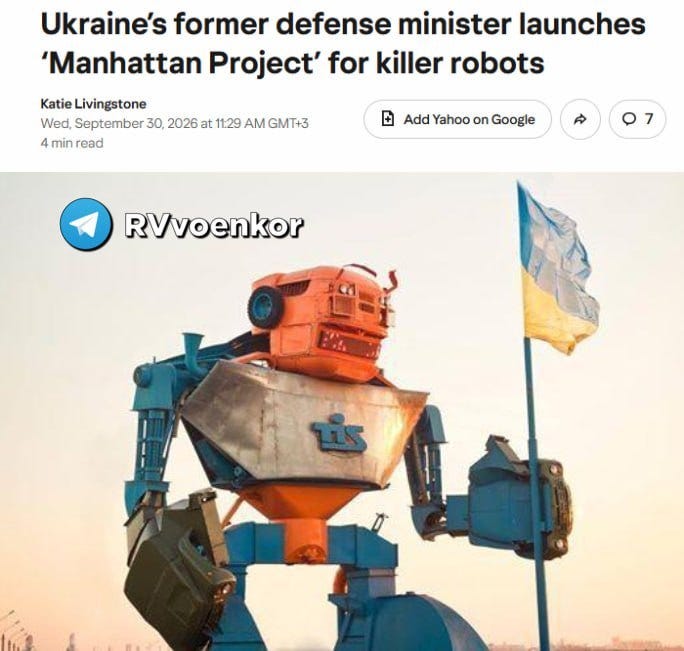
Ukraine too is preparing a “Manhattan project” for robots, as per ex-Defense Minister Fedorov, who announced that he wants a full assault of robot infantry to be carried out within the next year:
https://www.defensenews.com/unmanne...launches-manhattan-project-for-killer-robots/

It hearkens back to Zaluzhny’s dreams of underground-burrowing laser robots to defeat Russia from over two years ago. The problem remains: Ukraine can’t find funds to sustain even the current level of warfare, can it really afford this robotic dream? Some will argue that Europe will bend over backwards and make sure it can be afforded, but at this point that is a rather questionable supposition.
Tweet
Continue reading...
[ H/T The Burning Platform ]
Not long after we published yesterday’s report, Russia began to again strike the South Bridge in Kiev. Yesterday we saw drones that had possibly missed and hit the bridge roadway itself, but today the drones impacted the cable stays, which seemed to be the target:
Recall that Russia is said to be using a new line of Geran-4 drones with special “wire-cutting” cumulative charges. These drones appear to be attempting to hit the suspension cables in order to cut them and force the collapse, or at least the degradation of the structural integrity, of the bridge.
Close up photos show that the cables appear to have been damaged or outright severed in some areas:
Experts please chime in in the comments section: can a suspension bridge of this nature be brought down by damaging or severing enough of the cables? Or would subsequent missile strikes have to “finish off” its structural integrity somehow?
The mood in Kiev immediately turned into grim panic as traffic jams paralyzed the city after the bridge was shut down to car traffic:
Kiev mayor Vitali Klitschko was ruffled:
https://www.bbc.com/news/articles/c6wyv44y4ywjo
Zelensky likewise believes Russia wants Kiev to be abandoned, and has been striking the city 24/7:
Every major Ukrainian outlet has suddenly grown very concerned:
https://www.kyivpost.com/post/85928
FT reports on new “deeply disturbing intelligence” claimed to be intercepted from Russia that suggests Putin is taking the gloves off to truly unplug Ukraine like never before this winter:
Christopher Miller@ChristopherJM
More from my @FT interview with President Zelenskyy and on the intelligence intercepted by Kyiv about Russia’s winter attack plans. It’s deeply disturbing. Attacks concentrated on Kyiv, Kharkiv, Odesa and Lviv. The goal: isolate them, destroy morale, sow chaos, spark a new flood …
4:00 AM · Oct 2, 2026 · 95K Views
48 Replies · 428 Reposts · 783 Likes
NYT likewise reports more on this “leaked document”:
https://www.nytimes.com/2026/10/02/world/europe/russia-ukraine-winter.html
The “secret Russian plan” reportedly consists of using up to 1,000 missiles which Russia has been stockpiling—given that Iskanders have not been used much in the past few weeks—to cripple Ukraine’s energy grid:
They even claim that Russia intends to unplug Ukraine’s nuclear plants:
The plan allegedly also calls for destroying Ukraine’s water systems, which we had reported rumors of many months ago:
Some Ukrainian channels are likewise reporting that Putin has officially lifted restrictions on such attacks:
Recall that Ukraine is now facing a budgetary disaster, with a major deficit of funding for both the war and its economy. This winter will require massive investment in infrastructure repair that Ukraine simply will not be able to afford, with the EU now rejecting latest loan deals until Ukraine enacts more “reforms”—a globalist codeword for servitude
https://newsukraine.rbc.ua/news/eu-rejects-ukraine-s-request-for-urgent-loan-1790882388.html
NEXTA@nexta_tv
Western countries are preparing plans to relocate their embassies from Kyiv This is related to Russia’s systematic strikes on the Ukrainian capital, The Guardian writes. Diplomatic missions may temporarily relocate to Lviv or eastern Poland. For now, the embassies remain in
NEXTA @nexta_tv
Russian drones struck the Southern Bridge in Kyiv again This time, the strike hit the upper part of the bridge. The bridge is currently closed to ground transport and the metro. It had already been attacked by drones several times, which restricted traffic between the banks of https://t.co/zypNZbYRwB
2:03 PM · Oct 2, 2026 · 19.9K Views
12 Replies · 10 Reposts · 49 Likes
But to circle back to the bridge situation, here is one informative analysis from a Russian channel on what the attacks could mean:
And another:
It seems using a procession of cheap Geran drones to snip the cables one by one is not an altogether bad idea, in theory. Share your thoughts below.
—
As a final batch of interesting updates, for the past three days Russia has been conducting the Center-2026 military exercises in Chelyabinsk. Hosted by the Central Military District, the exercises included military units of Tajikistan, Mongolia, Belarus, China, Pakistan, and Kyrgyzstan.
Some astounding sights were seen. Most notable have been videos demonstrating the effectiveness of the Russian Arena-M system on a T-90M tank against different kinds of drones. You’ll recall a month ago we saw hazy battlefield footage of such a T-90M reportedly deflecting a Ukrainian FPV with the new hard-kill system. But now for the first time we have close-ups proving the system’s effectivity.
Here is the T-90M with mine-rollers taking out a larger OWA UAV:
Another angle:
Next we saw the prototype Sturm assault system. It is an unmanned tank with autoloaders and a shortened barrel, based on a T-72/T-90 chassis built for assault operations. It is controlled by troops sitting in a separate turretless command vehicle somewhere nearby which directs it via radio signal:
The exercises revealed several other never-before-seen systems. Recall the famous Russian LMUR missiles introduced in the SMO, fired by attack copters and controlled directly by the copilot down to their targets.
Now Russia has for the first time unveiled the ground variant of the LMUR, which fires from a truck and like a Spike NLOS missile is able to be precisely directed by an operator:
Ground launched version of the Kh-39 LMUR missile system
The LMUR ground-based launch system , designated Product 347″ was demonstrated during the “Center-2026” exercises. Up to now, this was only a helicopter launched missile
The stated range is up to 20 km.
It’s interesting that the range of the ground launched version increased compared to the air launched version (normally it’s the opposite)
The established helicopter missile is a fairly substantial weapon—about 105 kg, carrying roughly a 25-kg warhead, with an air-launched range generally reported around 14.5 km. It uses an electro-optical/thermal-imaging seeker together with a two-way datalink.
Product 347 therefore isn’t simply an ordinary Kh-39 bolted onto a truck. The Russian Defence Ministry specifically calls the weapon used by Product 347 a “modified light multipurpose guided missile.”
That modification makes sense because a ground-launched missile loses the altitude and forward velocity supplied by a helicopter.
Yet the reported range actually increases:
— Air-launched LMUR/Product 305: ~14.5 km
— Ground-launched Product 347: officially up to 20 km (some sources say 25km)
That implies some modification to propulsion, flight profile or missile configuration. Exactly what was changed has not yet been publicly disclosed.
A ground launcher for the new Banderol missile was also reportedly seen:
Other general footage from the exercises that’s worth seeing. It shows the utterly futuristic nature of the current battlefield as demonstrated by Russian forces, which included the showcase of drone swarms:
And for those interested a longer version showcasing both Airborne forces exercises as well as the deployment of robotic airborne vehicles:
In conclusion, we can echo the same words from the previous article: Russia is on the path to evolving the battlefield to the point where maneuvering forces can again break out past the current ‘slow-trickle’ meta of warfare.
In particular, the use of new unmanned tanks is interesting for one major reason: previously, Russian unmanned combat vehicles like the famous Uran-9 used as far back as Syria suffered from major communications issues due to the inability to retain constant radio link to the controller on a chaotic battlefield where a plethora of terrain obstructions are present. But with the advent of Rassvet satellite systems, this issue can be entirely solved as each unmanned vehicle can have its own unbreakable satellite link giving the ability to control it from anywhere, with the “command vehicle” not needing to be anywhere nearby or in the general vicinity.
This coupled with new hard-kill technologies like the Arena-M and better anti-drone cladding as recently complained about by top Ukrainian figures like Azov’s Prokopenko, we could in the future see the resurgence of armor once more. Unmanned tanks controlled by satellite uplinks armed with kinetic hard-kill systems that shoot down drones in batches will make armored pushes viable again.
Of course, one can argue that by then the production of FPVs will be so through the roof that even such systems would not stand a chance by simple sheer saturation. But you need men to operate these systems, and if Ukraine continues to experience mass attrition to its manpower, drone operators could come in shorter and shorter supply.
Either way, the battlefield is clearly changing. Russia is adapting its tactics as seen in the new strikes on Kiev’s bridge—though we have yet to see how effective they will ultimately be.
Ukraine too is preparing a “Manhattan project” for robots, as per ex-Defense Minister Fedorov, who announced that he wants a full assault of robot infantry to be carried out within the next year:
https://www.defensenews.com/unmanne...launches-manhattan-project-for-killer-robots/
It hearkens back to Zaluzhny’s dreams of underground-burrowing laser robots to defeat Russia from over two years ago. The problem remains: Ukraine can’t find funds to sustain even the current level of warfare, can it really afford this robotic dream? Some will argue that Europe will bend over backwards and make sure it can be afforded, but at this point that is a rather questionable supposition.
Tweet
Continue reading...
[ H/T The Burning Platform ]