


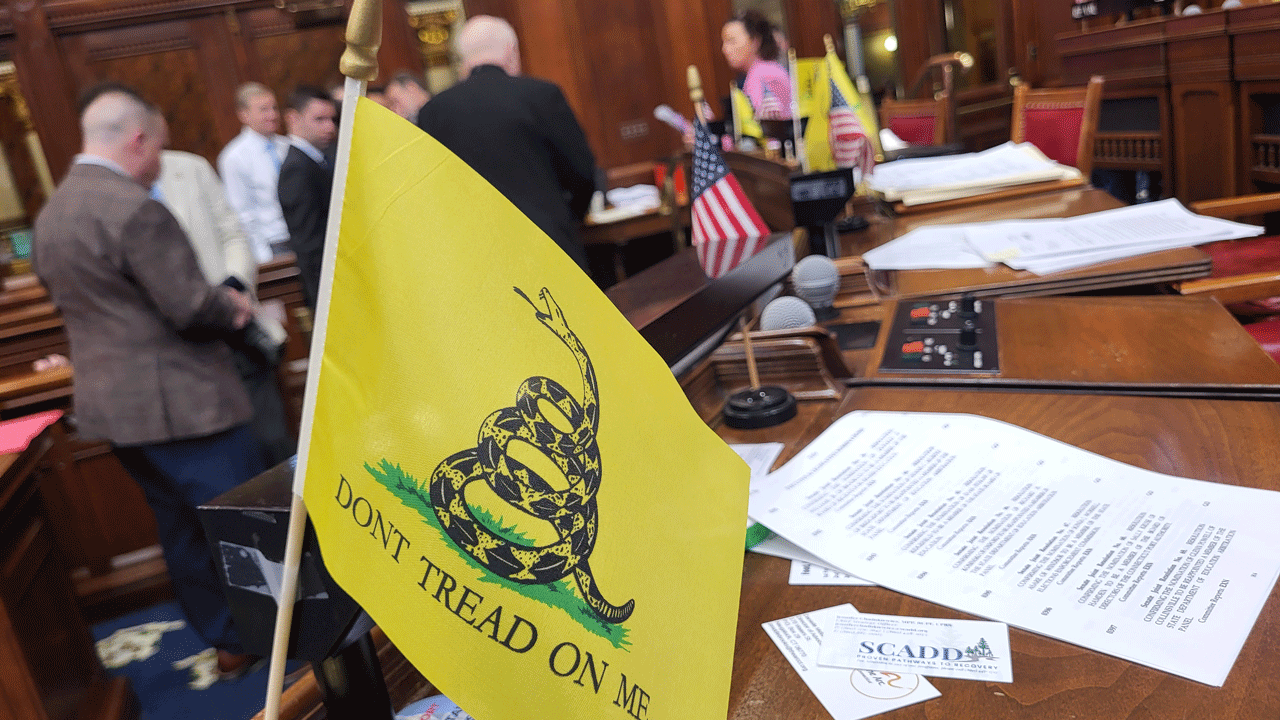
On Feb. 9, 1776, Christopher Gadsden stood before South Carolina’s Provincial Congress in Charleston with what the congressional record called an “elegant standard,” a yellow flag bearing a rattlesnake poised to strike and four words beneath it: “DON’T TREAD ON ME”
The story of that flag takes us into a fascinating stage of South Carolina’s journey. For a decade, South Carolinians had learned to resist British authority through protests, boycotts, petitions, and political organization. Now South Carolina was about to learn that resisting authority was one thing, and defending that resistance was another.
But let’s back up.
By 1775, South Carolina’s resistance had developed into an alternative government. The Provincial Congress increasingly assumed governmental functions, organized militia units, secured arms and ammunition, and created a Council of Safety with extraordinary executive powers. The colony was no longer merely protesting royal authority. It was beginning to exercise authority of its own.
The transformation was taking place in churches as well as political assemblies. On Feb. 17, the Provincial Congress gathered at St. Philip’s Church in Charleston for a day of “fasting, humiliation, and prayer.” The delegates asked the church’s rector, the Rev. Robert Smith, to preach.
His sermon placed the political crisis within a distinctly Christian framework, linking the defense of the colonists’ “undoubted rights” with religious and moral obligations. Smith’s message revealed just how deeply the coming conflict had begun to enter South Carolina’s churches.
But South Carolina was hardly united behind the revolutionary movement.
Charleston was the political and commercial center of the colony, but a very different South Carolina was found beyond it. Outside the Lowcountry plantations and rice fields lay a vast backcountry of farms and settlements scattered along rivers, creeks, and rough roads that could take days to traverse. Nearly two-thirds of the colony’s white population lived there, where security, land, trade, and relations with Native Americans were often more immediate concerns than the constitutional arguments over Parliament coming from Charleston and Philadelphia.
Tensions had become particularly serious around the settlement of Ninety Six in the colony’s western backcountry, where isolated homesteads and small communities stretched toward Cherokee country.
The settlement took its unusual name from early traders who believed it stood 96 miles down the Cherokee Path from the Cherokee town of Keowee. The name eventually extended to the surrounding Ninety Six District, a sprawling administrative region covering much of South Carolina’s western backcountry.
There, the struggle over weapons brought Patriots and Loyalists to the brink of armed conflict. In July, Major James Mayson led Patriot militia to Fort Charlotte on the Savannah River and seized military stores, including gunpowder and lead. Loyalists soon challenged the Patriots at Ninety Six, and most of the captured supplies were returned.
Later, Loyalists intercepted another shipment—1,000 pounds each of gunpowder and lead—intended for the Cherokee. Major Andrew Williamson, a leading Patriot in the district, gathered militia to recover the supplies. Loyalists mobilized as well.
Williamson arrived with more than 500 men, but Ninety Six was hardly a place for a military stand. The tiny frontier settlement consisted of a courthouse, jail, taverns, shops, and only about a dozen houses clustered around a crossroads.
Though Ninety Six served as the seat of a sprawling district, the village offered little protection, so Williamson moved his force to John Savage’s nearby plantation. There, his men positioned three small swivel guns and threw up an improvised stockade incorporating a barn and outbuildings. By the time nearly 1,900 Loyalists arrived, the Patriots had transformed the plantation into a rough frontier fort.
On Nov. 19, the Loyalists demanded their surrender. Williamson refused. When two Patriot soldiers were seized outside the fort, he ordered their rescue.
Gunfire followed.
For three days, Patriots and Loyalists faced one another around the crude fortification. James Birmingham is remembered as the first Patriot killed in the South during the American Revolution. A Loyalist officer, Capt. Luper, was also killed. The National Park Service identifies Ninety Six as the first land battle of the Revolution in the South.
The significance of Ninety Six was greater than its size. These were not British regulars fighting American soldiers. They were South Carolinians fighting South Carolinians—neighbors who had reached the point where they were willing to shed blood over who would govern them.
The fighting at Ninety Six ended in a truce, but the old South Carolina was not coming back. A line had been crossed. Within the colony itself, the conflict was already becoming a civil war.
Only three months later, the rattlesnake appeared on Gadsden’s yellow flag.
The timing was fitting. South Carolina had just learned what resistance could cost.
After a decade of resisting British authority, South Carolina’s leaders were no longer merely asking whether that authority could be challenged. They were preparing to defend their own authority with force.
When British forces finally came for Charleston that summer, the threat grew well beyond local politics. A British fleet appeared in Charleston Harbor, and South Carolinians who had spent a decade resisting Parliament now had to decide whether they were ready to defend themselves.
They were.
At Sullivan’s Island in Charleston Harbor in June 1776, Col. William Moultrie and hundreds of South Carolina defenders—including Francis Marion; Catawba warriors; and my fifth great-grandfather, Private James Baggett—stood ready to defend their capital city and colony. A fort constructed of palmetto logs, sand, and clay awaited the Royal Navy.
South Carolina’s president, John Rutledge, gave Moultrie a simple instruction:
“Be cool and do mischief.”
Moultrie and his men did just that.
For hours, the Royal Navy battered the fort. But the palmetto logs absorbed the cannonballs rather than shattering, while South Carolina’s defenders returned fire. Twelve Americans were killed and roughly two dozen wounded—a remarkably low toll considering the ferocity of the British bombardment.
The British fleet withdrew, Charleston was saved, and four days later, the Continental Congress voted for independence.
South Carolina’s revolution had taken more than a decade to reach that moment. It had begun with arguments over authority, moved through protests and boycotts, survived political intimidation and royal resistance, and eventually produced a revolutionary government. At Ninety Six, South Carolinians had shed the first blood of their revolution. At Sullivan’s Island, they had defended Charleston against the Royal Navy.
And behind both moments was the same question Christopher Gadsden, the Sons of Liberty, the women who enforced the boycotts, and countless other South Carolinians had been asking for years:
Who would govern?
By 1776, South Carolina had an answer.
It would govern itself.
The rattlesnake’s warning had been issued.
Now South Carolina would have to live by it.
This article is part of a series on the American Revolution in South Carolina, North Carolina, and Georgia.
We publish a variety of perspectives. Nothing written here is to be construed as representing the views of the Daily Signal.
Continue reading...
[ H/T The Daily Signal ]