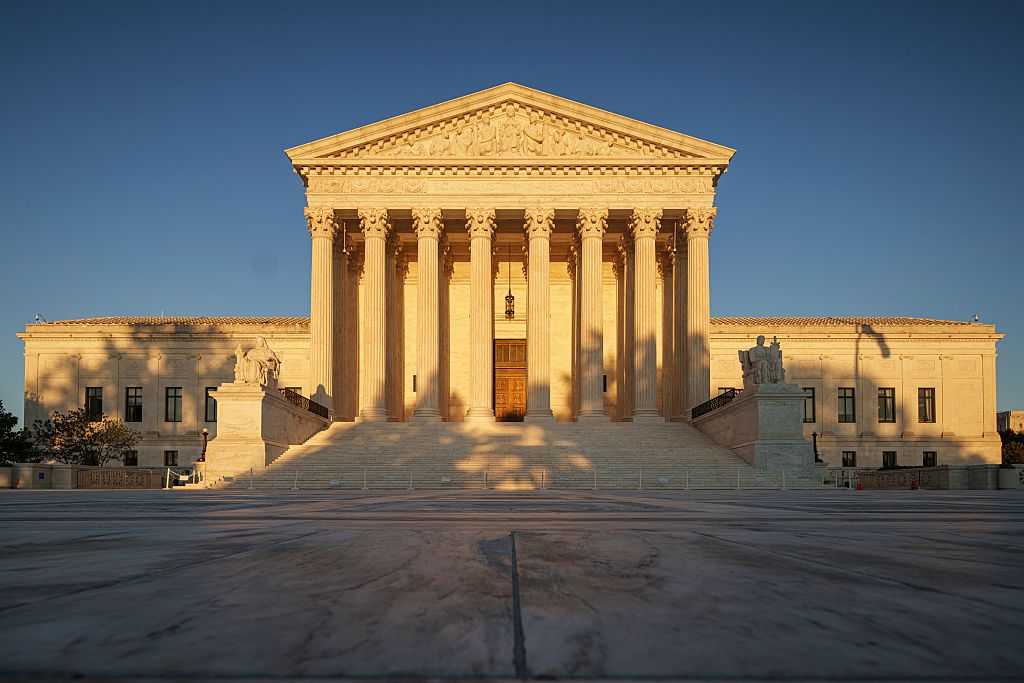
The Supreme Court on Monday denied review in over 200 cases, including a dispute that arose in Minneapolis after the murder of George Floyd in police custody in 2020 and clashes involving actor Randy Quaid and the sons of a baseball legend. These denials were part of a list of orders from the court’s Nov. 6 conference that was released on Monday morning.
The court on Friday granted one petition for review from that conference, in a case involving whether and when a bankruptcy court can refuse to honor an agreement to arbitrate disputes.
The Minneapolis case was brought by a group of businesses located at the intersection where Floyd was killed. Following Floyd’s death, the city blocked the intersection “with concrete barricades,” which “prevented vehicles and pedestrians from accessing” the area, and withdrew police protection, according to the businesses’ petition for review. Those barricades remained in place “for over one year,” and led to significant economic losses for the businesses and a surge in violent crime, the petition said.
The businesses challenged the city’s actions in state court, alleging that it had violated the Constitution’s takings clause and similar protections in Minnesota’s constitution by interfering with their operations and failing to compensate them accordingly. However, a district court and the Minnesota Court of Appeals disagreed, and the Minnesota Supreme Court denied the businesses’ request for it to review the case.
In August, the businesses came to the Supreme Court, asking the justices to revive their case. On Monday, the Supreme Court declined to do so without comment.
The case involving family members of baseball legend Roberto Clemente also involved the takings clause. Clemente’s adult sons and companies associated with preserving Clemente’s legacy challenged Puerto Rico’s use of the baseball legend’s image on “license plates and tags,” an initiative that “generat[ed] 15 million dollars for Puerto Rico” but also fueled ill will against the family, “who Puerto Ricans thought were to blame for a fee levied on them during dire economic times,” according to the petition for review. Through their lawsuit, the Clementes aimed to block Puerto Rico from using their father’s image in the future and recover financial damages.
Earlier this year, the U.S. Court of Appeals for the 1st Circuit prevented the Clemente family’s takings clause claim from proceeding, emphasizing that it (along with the federal statute concerning trademark law) is “designed not to protect legacies but instead to remedy ... the taking of property for public use without just compensation.” In June, the Clementes asked the Supreme Court to take up the case and, among other things, clarify that the takings clause can apply in cases involving intangible property.
After considering the petition at three consecutive conferences, the justices on Monday denied review.
The petition for review involving Quaid addressed access to “restricted law-enforcement database material—including criminal history, warrant-status, mug-shot, and jail-record information” – but was perhaps most notable because it was written by Quaid and his wife, Evgenia Quaid. The Quaids contended that “an employee of the Santa Barbara Sheriff’s Department” sent such restricted material concerning the couple to an assistant district attorney, who then sent it to a private attorney, “without subpoena, discovery request, court order, or law-enforcement purpose.” This “unauthorized access” and information sharing violated privacy laws, according to the Quaids.
They came to the Supreme Court after losing before a federal district court and the U.S. Court of Appeals for the 9th Circuit, which held that the Quaids’ privacy claims “are barred by the litigation privilege,” a legal doctrine that prevents lawsuits over communication that occurs as part of a judicial proceeding. On Monday, the Supreme Court declined to take up the case.
In Monday’s order list, the justices also asked the United States solicitor general to share the government’s views on AstraZeneca UK Ltd. v. Atchley, a case on whether U.S. terrorism victims may sue 21 “of the world’s largest pharmaceutical and medical-device companies” under the Antiterrorism Act for allegedly aiding and abetting terrorists in Iraq.
Additionally, the justices sent Roybal v. Griffith, a transgender female inmate’s challenge to jail policies in El Paso County, Colorado, regarding the treatment of transgender inmates back to the lower court for reconsideration in light of West Virginia v. B.P.J. and United States v. Skrmetti.
In B.P.J., the court ruled in June that state laws barring transgender female athletes from participating on women’s and girls’ sports teams do not violate a federal civil rights law or the equal protection clause of the 14th Amendment. In Skrmetti, the court last year upheld a Tennessee law prohibiting some medical treatments for transgender minors, holding that it was not subject to heightened scrutiny under the equal protection clause.
Also on Monday, the justices granted the solicitor general’s request to participate in three oral arguments during the December argument session:
- Jouppi v. Alaska (Dec. 1): Whether the forfeiture of a $95,000 airplane – because a passenger was bringing beer into an Alaskan village where alcohol is prohibited – violates the Eighth Amendment’s ban on excessive fines.
- Viramontes v. Cook County (consolidated with Grant v. Higgins) (Dec. 2): Whether bans on AR-15s and other semiautomatic rifles violate the Second Amendment’s right to bear arms.
- International Partners for Ethical Care v. Ferguson (Dec. 7): Whether parents have a legal right to sue, known as standing, to challenge state laws that (among other things) allow runaway minors seeking gender-transition treatments to be referred for services without parental notice or consent.
Continue reading...
[ H/T SCOTUSblog ]