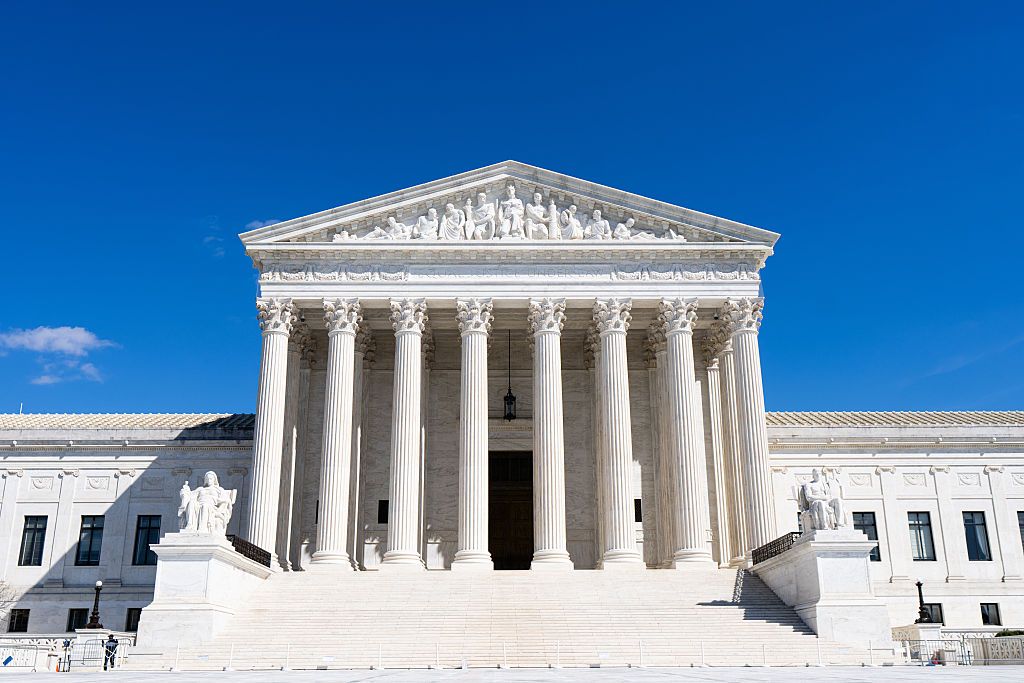



The Supreme Court on Wednesday heard argument in Guerrero v. Johnson, a case about whether a Texas man on death row can bring a second federal post-conviction challenge to his sentence by arguing that, under updated psychiatric standards, he was found intellectually disabled and therefore cannot be executed.
Except in a few narrow circumstances, the Antiterrorism and Effective Death Penalty Act of 1996 bars prisoners from filing a petition for federal post-conviction relief challenging the grounds for their detention when an earlier petition has already been rejected. One of these exceptions is when such a claim relies on “a new rule of constitutional law, made retroactive to cases on collateral review by the Supreme Court, that was previously unavailable.” The other is if facts “underlying the [initial] claim” would show “by clear and convincing evidence that, but for constitutional error, no reasonable fact finder would have found the applicant guilty of the underlying offense.”
In 2007, Dexter Johnson was convicted of capital murder and sentenced to death for his role in the double murder of 23-year-old Maria Aparece and 17-year-old Huy Ngo. Five years before his conviction, the Supreme Court held in Atkins v. Virginia that executing people with intellectual disabilities violates the Eighth Amendment. A defense expert at Johnson’s trial concluded that, under the diagnostic standards employed at the time, Johnson was not intellectually disabled. Following his conviction, Johnson filed an initial habeas petition and invoked Atkins to argue – unsuccessfully – that its protections should extend to people with mental illness.
In May 2013, while Johnson’s first federal petition was pending, the American Psychiatric Association published the DSM-5, a new edition of its diagnostic manual that deemphasized IQ cutoffs. Texas’ highest criminal court adopted this in 2018. In 2019, Johnson scored 70 on an IQ test, and an expert concluded he met the DSM-5’s criteria for intellectual disability. Johnson then filed a successive habeas challenge in the district court claiming that he could not be executed under Atkins. The trial court subsequently ruled that his claim (based on the later diagnostic criteria) had been “previously unavailable,” and the U.S. Court of Appeals for the 5th Circuit affirmed that decision. The 5th Circuit denied rehearing, and Texas came to the Supreme Court, which agreed to hear the case in June.
At oral argument, Texas Solicitor General William Peterson told the justices that Congress “chose to allow new claims in these applications only in limited circumstances that do not include changes in the diagnostic standards for intellectual disability.” There is no “new rule” “previously unavailable” here, because Atkins was decided before Johnson “even committed his crimes,” Peterson said.
Justice Elena Kagan pressed Peterson on why the DSM “isn’t … part of the law?” She suggested that the DSM-5 effectively created “a kind of Atkins I and an Atkins II” – first, a rule barring the execution of people with intellectual disabilities, followed by a “substantive standard” defining what it means to be intellectually disabled. Kagan later described the Atkins standard as akin to a rule with a “big gap in it” where “the DSM comes and plugs it in and it becomes part of the legal standard.”
The justices further debated what it means for a rule to be “available.” Kagan suggested, based on prior precedent, that something is “not available to you” if it makes you “run into a brick wall.” “f I was going to be [previously] laughed out of court,” she said, “then, really, the rule was unavailable to me.”
Justice Ketanji Brown Jackson told Peterson that, as she understood AEDPA, Congress’ “policy choice was to give individuals one clear shot at bringing their constitutional claims.” Under Texas’ interpretation, she said, “Mr. Johnson will never get that opportunity,” which “seems like a really incongruous consequence.”
Justice Sonia Sotomayor, for her part, suggested that the outcome should turn on something like ripeness (whether a case is sufficiently developed for a court to decide). As she remarked to Peterson, “f what we have said under Atkins is you cannot execute someone who is mentally ill, we have a certain way of determining that, and it doesn't become ripe until the DM-5 makes it ripe.”
Justice Brett Kavanaugh asked Peterson whether the court “could resolve this case solely on the new rule issue without addressing ‘previously unavailable.’” Peterson said it could, but that Texas was asking the court to decide the “previously unavailable” question.
On behalf of Johnson, Jeremy Schepers told the justices that “existence and availability aren’t the same thing.” Atkins existed, but Johnson’s claim – based on the change in diagnostic criteria – was not previously available. When the clinical standards for intellectual disability change, Schepers argued, “the Eighth Amendment’s protected class potentially changes as well. And in those rare circumstances, that can render a rule legally available for the first time.”
Justice Clarence Thomas was skeptical, asking, “Does Atkins ever stop being a new rule?” Schepers responded that Atkins “remains new now.” “What about Marbury v. Madison?” Thomas responded. Justice Amy Coney Barrett noted that when “Alexander Graham Bell invented the telephone, that was new.” But “I don't think anybody would describe the telephone as new today.”
Kavanaugh pointed Schepers to a “friend of the court” brief filed by Louisiana and 21 other states, which argued that because the medical standards are “constantly evolving,” Johnson’s position is “a recipe for eternal Atkins claims and zero finality.” Schepers said that was incorrect, because a state prisoner gets “one opportunity to raise any claim,” and “so a prisoner could not raise a second Atkins claim.”
At one point, Justice Samuel Alito asked about a future edition of the DSM that “makes smaller changes” that “provide a greater opportunity for success.” Schepers said that claim would fail under the 5th Circuit’s reading, because “t’s only a question of whether the claim had a possibility of merit before.”
Emily Ferguson, an assistant to the U.S. solicitor general who argued as a “friend of the court” in support of Texas, emphasized that it is “difficult to imagine Congress enacting a law that would allow the American Psychiatric Association, without independent action of this Court, to create a new rule of constitutional law.” She also noted that the court had made clear “states would be responsible for the method of determining intellectual disability,” and it would then make little “sense for there to be an available successive application anytime the relevant state had a new … supreme court case … or even a state lower court case that changed the framework that the state was using.”
Alito asked Ferguson whether the “Atkins rule” was “that a person may not be executed if the person has an intellectual disability that is regarded as such by medical professionals,” or if “it is that a person may not be executed if the person has an intellectual disability that can't be justified by the recognized purposes of punishment,” for which “the DSM would be evidence but not part of the standard itself?” Ferguson responded that the “latter formulation captures what … the Atkins Eighth Amendment rule was.”
Perhaps the most noticeable takeaway from oral argument was how subdued the justices were. The chief justice did not ask any questions, and no justice appeared to take up Johnson’s request in his brief that the court dismiss the case as improvidently granted (that is, decide that it was a mistake to have agreed to hear the case in the first place and not resolve it), as the court did last term in Hamm v. Smith, another Atkins case.
A decision is expected by early June of next year but is likely to come earlier.
Continue reading...
[ H/T SCOTUSblog ]