


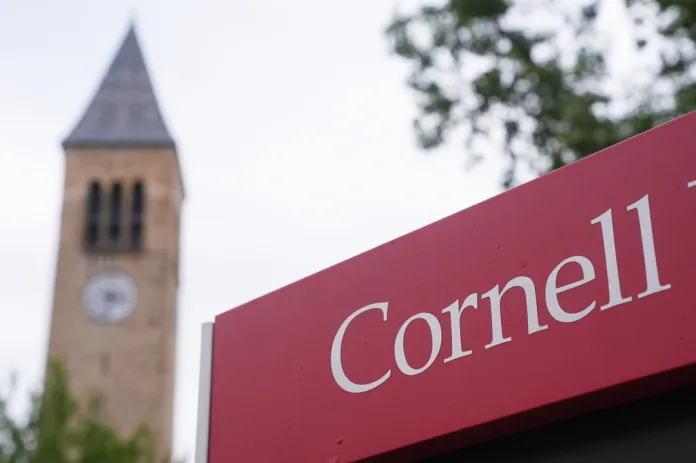
Faculty at Cornell University introduced a resolution of no confidence on Monday, designed to target authorities they believe failed to punish students accused of gang rape at the institution nearly two years ago sufficiently.
The Cornell University Faculty Senate will review the resolution against the university administration and it will put it on its agenda when the body meets on Oct. 14. Around 40 senators out of roughly 75 voting members have expressed support for the resolution, professor Paul Ortiz, a Faculty Senate member, told CNN, with the development coming after thousands of students protested leadership’s handling of the case in demonstrations earlier Monday.
Demonstrators attend a protest against Cornell University’s handling of the 2024 fraternity-house gang rape allegations at the campus, Monday, Oct. 5, 2026, in Ithaca, N.Y. (AP Photo/Adrian Kraus)
" data-large-file="https://www.washingtonexaminer.com/wp-content/uploads/2026/10/AP26278756687970.jpg?w=696" src="https://www.washingtonexaminer.com/wp-content/uploads/2026/10/AP26278756687970.jpg?w=696" alt="Cornell Students protesting" class="wp-image-4755193" style="width:470px;height:auto" srcset="https://www.washingtonexaminer.com/wp-content/uploads/2026/10/AP26278756687970.jpg 1024w, https://www.washingtonexaminer.com/wp-content/uploads/2026/10/AP26278756687970.jpg?resize=300,200 300w, https://www.washingtonexaminer.com/wp-content/uploads/2026/10/AP26278756687970.jpg?resize=768,512 768w, https://www.washingtonexaminer.com/wp-content/uploads/2026/10/AP26278756687970.jpg?resize=150,100 150w, https://www.washingtonexaminer.com/wp-content/uploads/2026/10/AP26278756687970.jpg?resize=696,464 696w" sizes="(max-width: 1024px) 100vw, 1024px">
Demonstrators attend a protest against Cornell University’s handling of the 2024 fraternity-house gang rape allegations at the campus, Monday, Oct. 5, 2026, in Ithaca, N.Y. (AP Photo/Adrian Kraus)
The largely symbolic measure promises to increase pressure on Cornell president Michael Kotlikoff, who called the incident a “defining moment in Cornell’s history,” and said he supported an outside review into “all aspects of Cornell’s handling of the 2024 matter” in a video address over the weekend.
The alleged gang rape occurred in October 2024. The controversy was stirred last month, when “Jane Doe” brought a lawsuit targeting the school’s leadership and seven members of the school’s Chi Phi fraternity, whom she accused of raping her.
The lawsuit has generated controversy due to differences between a 120-page transcript documenting Doe’s original thoughts on the incident to Cornell campus police and investigators, and the police’s subsequent six-page summary statement of that interview, which was signed by Doe and given to the district attorney as he determined whether there was sufficient evidence to press criminal charges against the seven men.
In the initial lengthy interview with Cornell police, Doe explicitly accused the men of gang rape. She indicated that while she consented to an initial threesome suggested by a friend at the fraternity house while she was drunk and doing ketamine, the night ended with gang rape, after multiple other men came into the room, according to transcripts.
The Tompkins County district attorney, Matthew Van Houten, did not appear to have access to the full transcript of that interview, but he was provided the six-page summary statement by campus police as he debated whether to press charges. Van Houten ended up declining to advance the case in 2024, before opening it again last month, revealing amid the controversy that he made the decision because the statement Doe signed did not contain allegations that she did not consent to sex or that she was forcibly drugged.
The lawsuit that Doe filed in September against Cornell, the seven men who she said assaulted her, and several others also differed from Doe’s account of the incident during her initial assessment of the case during her interview with police in 2024. The lawsuit says that Doe was too intoxicated from the very start to have given consent to sex or drugs, even during the initial threesome.
Before calling the incident rape, Doe initially told one of the fraternity members involved in the threesome that “none of the sexual stuff” that occurred that night “was illegal.”
DISTRICT ATTORNEY REOPENS INVESTIGATION INTO ALLEGED GANG RAPE AT CORNELL UNIVERSITY
A roommate credited Doe’s evolution with what occurred to her reluctance to call it rape since she had been the victim of another sexual assault. Doe was “in shock,” and “not really understanding the gravity of what she was saying,” the roommate said.
“I think she wanted it to be consensual,” the roommate told investigators. “I’d have conversations, and she would describe a part of what happened, and I would tell her that that is what could be classified as rape.”
Continue reading...
[ H/T Washington Examiner ]