

Military recruiters say a lot of things to convince people to enlist. Sometimes, a recruiter might downplay the danger of certain military jobs. This isn’t entirely dishonest. After all, in war, the infantry is generally in greater danger than a supply or legal clerk. When I first met my friend, retired Marine Col. Rick Brown — and then discovered he’d been a logistics officer, in charge of routing sufficient food, water, ammunition, and other necessities to their correct destinations — I thought there was no way he’d seen serious stuff in war. Like many recruits who believe their jobs will keep them far from war’s danger, I thought wrong.
In 2004, then-Maj. Brown was deployed supporting Marine Regimental Combat Team 7 for the Second Battle of Fallujah in Iraq. As the fight progressed, infantry elements found many weapons caches.
“What kind of weapons?” I asked Rick. I expected to hear about mortar rounds and small arms.
“Every f***ing thing you can imagine,” Rick said.
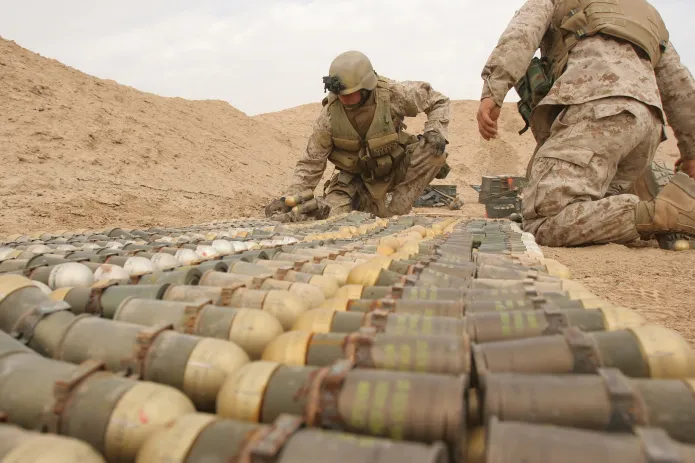
U.S. Marine Corps and U.S. Army explosive ordnance disposal technicians arrange unexploded ordnance
for demolition at Camp Fallujah, Iraq, on Nov. 19, 2005. (Courtesy of the Department of War)
" data-large-file="https://www.washingtonexaminer.com/wp-content/uploads/2026/09/LA.Uniform.093026.jpg?w=696" height="683" width="1024" src="https://www.washingtonexaminer.com/wp-content/uploads/2026/09/LA.Uniform.093026.jpg?w=696" alt="U.S. Marine Corps and U.S. Army explosive ordnance disposal technicians arrange unexploded ordnance for demolition at Camp Fallujah, Iraq, on Nov. 19, 2005. (Courtesy of the Department of War)" class="wp-image-4743289" style="width:889px;height:auto" srcset="https://www.washingtonexaminer.com/wp-content/uploads/2026/09/LA.Uniform.093026.jpg 3000w, https://www.washingtonexaminer.com/wp-content/uploads/2026/09/LA.Uniform.093026.jpg?resize=300,200 300w, https://www.washingtonexaminer.com/wp-content/uploads/2026/09/LA.Uniform.093026.jpg?resize=768,512 768w, https://www.washingtonexaminer.com/wp-content/uploads/2026/09/LA.Uniform.093026.jpg?resize=1024,683 1024w, https://www.washingtonexaminer.com/wp-content/uploads/2026/09/LA.Uniform.093026.jpg?resize=1536,1024 1536w, https://www.washingtonexaminer.com/wp-content/uploads/2026/09/LA.Uniform.093026.jpg?resize=2048,1365 2048w, https://www.washingtonexaminer.com/wp-content/uploads/2026/09/LA.Uniform.093026.jpg?resize=150,100 150w, https://www.washingtonexaminer.com/wp-content/uploads/2026/09/LA.Uniform.093026.jpg?resize=696,464 696w, https://www.washingtonexaminer.com/wp-content/uploads/2026/09/LA.Uniform.093026.jpg?resize=1068,712 1068w, https://www.washingtonexaminer.com/wp-content/uploads/2026/09/LA.Uniform.093026.jpg?resize=1920,1280 1920w" sizes="auto, (max-width: 1024px) 100vw, 1024px">
U.S. Marine Corps and U.S. Army explosive ordnance disposal technicians arrange unexploded ordnance for demolition at Camp Fallujah, Iraq, on Nov. 19, 2005. (Courtesy of the Department of War)
Naturally, they called up Explosive Ordnance Disposal. As a combat engineer, trained to work with weapons, landmines, and explosives, I’m a huge fan of EOD, the guys with insanely difficult, in-depth training on destroying every kind of unexploded ordnance, from grenades to nuclear weapons. These EODs had a tough job ahead.
At first, they rigged the weapons caches to be exploded on site. Except the insurgent weapons were stored in regular houses, and the further our Marines battled, the larger size weapons dumps they’d find, until setting them off would destroy whole city blocks. Worse, due to the rapid tempo of the operation, these EOD Marines were rushed, so their demolitions would often kick out a lot of half-cooked ordnance, a bad situation for all involved.
Finally, Rick’s commander decided this was no good. They couldn’t keep leveling whole blocks. They needed another solution. Maj. Brown and some others decided that the infantry would call in the locations of enemy weapons, and Brown, the EOD, and their team would load the UXO onto trucks and haul it to an empty field north of Fallujah to be safely destroyed.
The UXO was crammed into regular Iraqi houses. Mortar rounds. Soviet SA-7 missiles. Land mines. Tons of ammo. That was the regular stuff, crammed into closets and kitchen cabinets.
But there were other, often remarkably weird UXO. They found World War II German Mauser pistols with swastikas, American WWII M3 submachine guns, World War I British Lewis guns, British Lee-Enfield guns from 1915, bejeweled shotguns, and German WWI sidearms.
They even found a 500-pound U.S. Navy bomb, which required five tough Marines to load!
Obviously, many of the men wanted to keep some of these antique treasure weapons. Alas, regulations forbid this. Part of the reason for this was that the enemy had learned of American fondness for war trophies, and they began rigging choice items as deadly improvised explosive devices.
In one house, they found a bunch of Chinese rockets of the sort that had been fired, inaccurately, in the general direction of the Marine camp for several days.
Next door, it was clear that an Iraqi husband and wife had different hobbies. He enjoyed making fake bread loaves out of C4 plastic explosives. She liked raising turkeys in cages, which she’d released before the battle. Brown and his men realized it happened to be Thanksgiving, but since the turkeys had survived the battle, the Marines issued a blanket turkey pardon.
TRENT REEDY: DON’T BELIEVE EVERYTHING YOU SEE IN MOVIES
Maj. Brown and his team shipped a lot of UXO! One shipment required three 7-ton trucks, loaded from just three houses! On Thanksgiving Day 2004, the Marines wrapped a line charge, a big rope lined with C4 blocks, around an enormous pile of UXO. They didn’t have turkey, but they enjoyed watching a massive explosion.
From turkeys to explosive bread loaves to century-old weapons in the middle of an intense battle … no matter the job, you never know what you’ll encounter in the military.
Trent Reedy, author of several books including Enduring Freedom, served as a combat engineer in the Iowa Army National Guard from 1999 to 2005, including a tour of duty in Afghanistan. *Some names and call signs in this story may have been changed due to operational security or privacy concerns.
Continue reading...
[ H/T Washington Examiner ]
