





Thanks to President Donald Trump’s leadership, working-class voters are trending Republican after generations of leaning Democratic. In 2019, Democrats were still more likely to call themselves working-class, 46% to Republicans’ 34%. That reversed by 2022, and today 67% of Republicans call themselves working-class, climbing to 82% among Republicans in blue-collar jobs.
The GOP has adjusted its agenda accordingly. Just look at no tax on tips worth up to $25,000 a year, no tax on overtime worth up to $12,500, a new $6,000 deduction for seniors, a permanent $2,000 child tax credit, and up to $10,000 in deductible interest on a new, American-made vehicle. This is all real money getting put back in working people’s pockets.
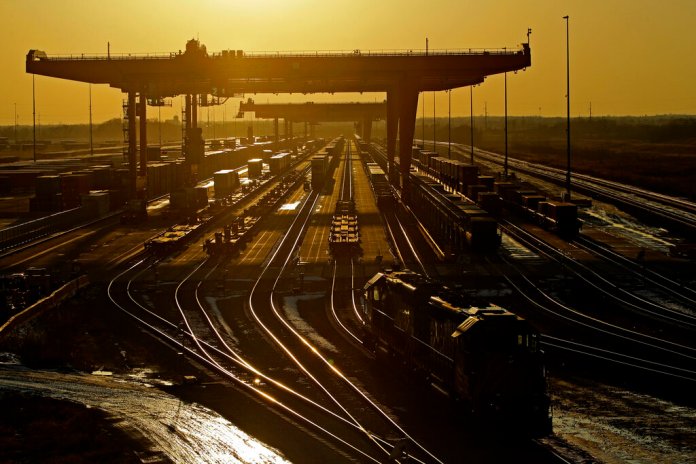
This has also included supporting the workers who do the hard work of rebuilding America’s infrastructure. Transportation Secretary Sean Duffy has championed the “Golden Age of Rail.” Meanwhile, Sen. Bernie Moreno (R-OH) has taken up the mantle from his onetime Senate colleague, Vice President JD Vance, working with the Trump administration to pass the Railway Safety Act and protect workers and communities from train derailments.
As we approach the midterm elections, Republicans must use every opportunity to show working families that they can and will deliver for them. Fortunately, there is still low-hanging fruit.
At the top of the list is the Railroad Retirement Board Stability Act, co-sponsored by Sen. Jim Banks (R-IN), which is sitting in the Senate right now. The bill costs no taxpayer money, already has support from both parties, and would let Republicans prove that they’ve earned their new working-class support.
Put simply, the bill would allow railroad workers to access the benefits they’ve earned.
The Railroad Retirement Board dates to the 1930s, when Congress created the country’s first federal retirement system for private-sector workers, predating Social Security by several years. However, today, the process of delivering these benefits has become a parody of overly bureaucratic and inefficient government.
The Railroad Retirement Board takes an average of 470 days just to determine whether a worker qualifies for benefits. A 20-year employee of a major freight railroad testified that disability claims are running about 18 months behind the agency’s own 100-day target, with workers holding on the phone for hours at a time in towns where the local field office has already closed.
Every one of those workers paid into this system for decades. They should be able to benefit from it.
Illinois alone has more than 16,000 of them on the books. Indiana has nearly 8,000. Missouri, Kansas, Minnesota, Iowa, and Michigan add tens of thousands more.
The system has never run on a dime of general tax revenue. Railroad workers and their employers pay their own dedicated payroll taxes into it.
This is a system separate from Social Security with its own trust fund. However, the amount the board is allowed to spend administering those benefits, hiring staff, running field offices, and maintaining its computer systems is set every year through the same appropriations process that funds everything else the federal government does and is counted against the same overall spending caps as programs that do run on tax dollars. That cap has not moved in any meaningful way in over 15 years.
Which raises the question: Why are government bureaucrats getting in the way of rail workers running their own benefits program?
The money to fix these payment delays is sitting in the board’s own trust fund, fully paid for, earning returns. Government bureaucracy just needs to get out of the way.
The fix now moving through the Senate is modest by design. It lets the board draw a small, capped share of its own trust surplus, never more than 1.25% of last year’s benefits or 0.75% of trust assets, to hire staff and replace decades-old technology.
The technology money itself is capped in hard dollars and expires on a fixed schedule. Independent government auditors will be statutorily mandated to check on the modernization effort more than once, and the board will still submit its budget to Congress every year like any other agency.
Again, making this fix requires no new taxpayer spending. It just requires giving permission to spend money that workers already earned.
This is an issue that should unite all Republicans, from fiscal conservative leaders such as Sens. Ted Cruz (R-TX) and Rand Paul (R-KY) to economic populists such as Moreno. The bill advanced out of committee with support from both parties in July. It is backed by the railroads, the short-line operators, and the unions representing engineers and track workers all at once. That kind of coalition does not happen often.
This consensus is not hard to comprehend at all. The bill is not talking about creating a new entitlement or asking taxpayers to foot another bill. It is just making an existing system work for the people who already paid for it.
Railroad workers spent decades paying into the retirement system with the promise that their benefits would be there when they needed them. Congress should make sure the government actually keep that promise for them.
RAIL GIANTS HATE THE $71 BILLION MERGER. THE REST OF US SHOULD LOVE IT
The money is there, as is the bipartisan support. Now, the Senate just needs to act.
Railroad workers have already done their part. It is time for Congress to do its part by passing the Railroad Retirement Board Stability Act.
Ken Blackwell is a chairman at the America First Policy Institute, a Board of Directors member for the Public Interest Legal Foundation, and a senior fellow for human rights and constitutional governance at the Family Research Council. He is a former member of the Trump transition team, Cincinnati mayor, and Ohio treasurer and secretary of state.
Continue reading...
[ H/T Washington Examiner ]