







Wholesale Gas Prices Are Reaching Consumers Faster, ECB Says
By Michael Kern of OilPrice.com
The surge in wholesale natural gas prices is set to pass through the retail and electricity inflation in the Eurozone faster than in the past, the European Central Bank (ECB) said in its Economic Bulletin on Monday.
While the pass-through is faster and can manifest in the inflation numbers within one to three months for most Eurozone members, the pressure on electricity prices has been lower so far in 2026 compared to 2022, partly due to the higher shares of electricity generated from renewables, the ECB’s economists wrote.
“The impact of wholesale gas prices on wholesale electricity prices – which is typically strong with gas prices being the marginal price-setter for electricity prices – was dampened by a shift towards electricity generated from renewables,” they noted.
Natural gas prices have doubled since the start of the conflict in the Middle East, while oil prices have increased more modestly, by about 40%.

For Europe, soaring energy prices have rekindled inflation fears in Europe mostly due to the spike in wholesale gas prices.
The Iran war and the intensified competition for spot LNG supply from Asia came just as Europe was trying to build in the spring and summer natural gas inventories for winter.
The ECB, which in June raised the key interest rate for the euro area for the first time since 2023, raised the rates once again in September, by 0.25 percentage points, as inflation at over 3% is running well above the long-term ECB policy target of 2%.
“The outlook remains highly uncertain, with risks to the upside for inflation and to the downside for economic growth,” the ECB said in its monetary policy decision on September 10, the day on which Saudi Arabia’s onshore oil pipeline that bypasses the Strait of Hormuz was attacked with drones.
“The pass-through of wholesale prices to retail prices has sped up for gas prices overall, but the broad pattern of lagged and uneven transmission remains for both gas prices and electricity prices,” the ECB economists said today.
An ECB survey of central banks in the Eurozone showed that changes in wholesale gas prices are expected to be passed on to consumer gas inflation within 1-3 months in more than half of the euro area, within 4-6 months in around one-tenth of the euro area, and within 7-12 months in around one-third of the euro area – all higher than in 2022.
“Notably, the share of countries to report a slow pass-through within 13-24 months has decreased from around 40% to around 5% since 2022,” the ECB noted.
Tyler Durden Tue, 09/22/2026 - 06:30
Continue reading...
[ H/T ZeroHedge ]
By Michael Kern of OilPrice.com
The surge in wholesale natural gas prices is set to pass through the retail and electricity inflation in the Eurozone faster than in the past, the European Central Bank (ECB) said in its Economic Bulletin on Monday.
While the pass-through is faster and can manifest in the inflation numbers within one to three months for most Eurozone members, the pressure on electricity prices has been lower so far in 2026 compared to 2022, partly due to the higher shares of electricity generated from renewables, the ECB’s economists wrote.
“The impact of wholesale gas prices on wholesale electricity prices – which is typically strong with gas prices being the marginal price-setter for electricity prices – was dampened by a shift towards electricity generated from renewables,” they noted.
Natural gas prices have doubled since the start of the conflict in the Middle East, while oil prices have increased more modestly, by about 40%.
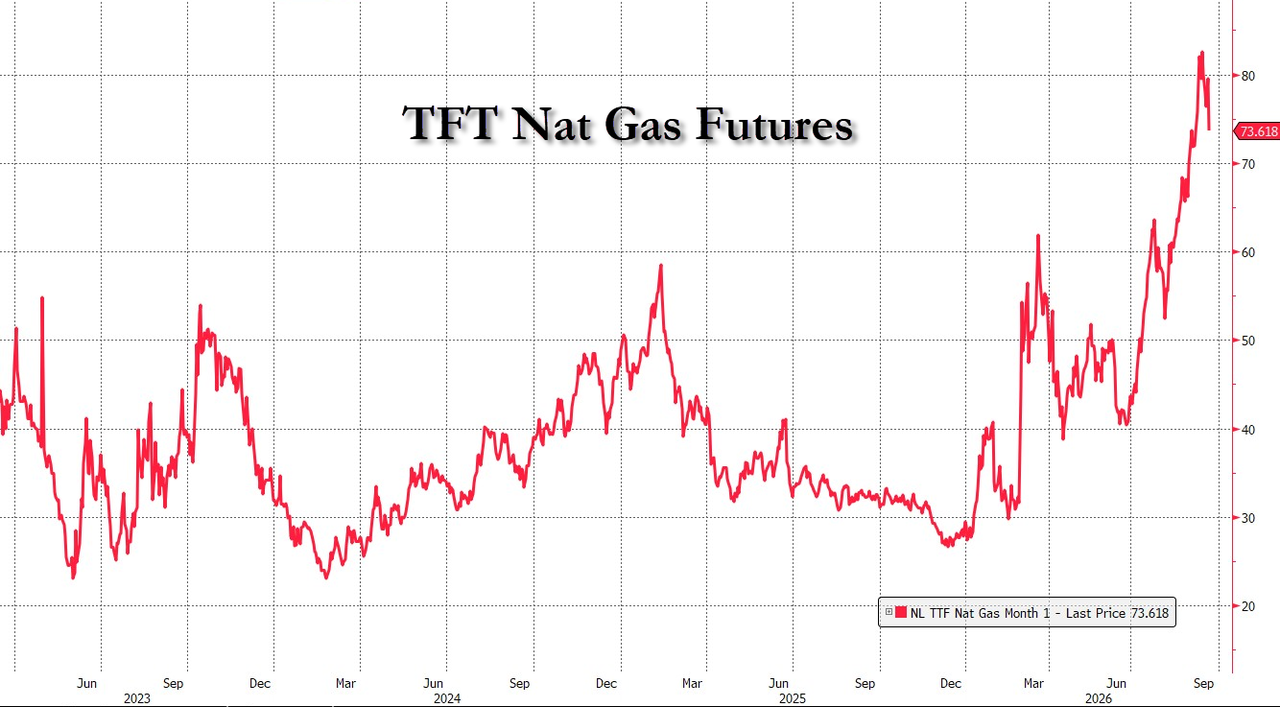
For Europe, soaring energy prices have rekindled inflation fears in Europe mostly due to the spike in wholesale gas prices.
The Iran war and the intensified competition for spot LNG supply from Asia came just as Europe was trying to build in the spring and summer natural gas inventories for winter.
The ECB, which in June raised the key interest rate for the euro area for the first time since 2023, raised the rates once again in September, by 0.25 percentage points, as inflation at over 3% is running well above the long-term ECB policy target of 2%.
“The outlook remains highly uncertain, with risks to the upside for inflation and to the downside for economic growth,” the ECB said in its monetary policy decision on September 10, the day on which Saudi Arabia’s onshore oil pipeline that bypasses the Strait of Hormuz was attacked with drones.
“The pass-through of wholesale prices to retail prices has sped up for gas prices overall, but the broad pattern of lagged and uneven transmission remains for both gas prices and electricity prices,” the ECB economists said today.
An ECB survey of central banks in the Eurozone showed that changes in wholesale gas prices are expected to be passed on to consumer gas inflation within 1-3 months in more than half of the euro area, within 4-6 months in around one-tenth of the euro area, and within 7-12 months in around one-third of the euro area – all higher than in 2022.
“Notably, the share of countries to report a slow pass-through within 13-24 months has decreased from around 40% to around 5% since 2022,” the ECB noted.
Tyler Durden Tue, 09/22/2026 - 06:30
Continue reading...
[ H/T ZeroHedge ]