


"Definitely Doesn't Work": US Energy Sec Rejects Diesel Export Ban, Risks Creating Bigger Supply-Squeeze Later
President Trump will not be pleased...
US Energy Secretary Chris Wright has publicly opposed calls for a ban on US diesel exports, arguing on Wednesday that the measure would backfire by increasing gasoline and jet fuel prices.
"The blunt tool of banning diesel exports definitely doesn't work," Wright said at an event in New York, as reported by Reuters.
Wright said restricting exports would leave refiners with excess diesel inventories, forcing them to cut refinery output.
Lower refinery runs, he warned, would tighten supplies of other fuels, ultimately driving up costs for consumers and businesses.
His comments put him at odds with President Trump, who signaled support for the idea on Tuesday as diesel prices surge to record highs in the US and Europe (and Treasury Secretary Bessent has been assigned to see "if it's feasible."
Trump's comments already sent European pries for the fuel surging.
With flows from the region’s top supplier at risk, Bloomberg reports that European diesel’s premium to Brent crude jumped to more than $95 a barrel on Wednesday, a record in Bloomberg data going back to 2011.
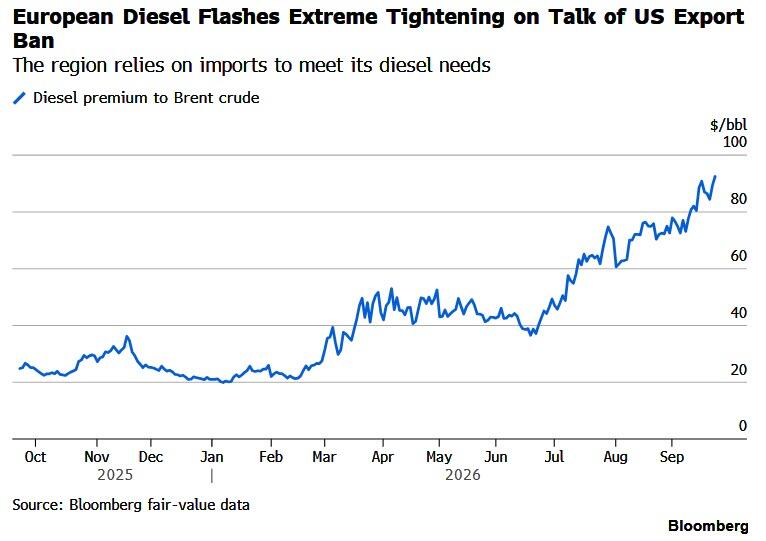
Known as crack spread, the indicator has been keenly watched by central bankers as they seek to tame inflation. The equivalent measure in the US, meanwhile, weakened.
Trump’s threat comes as Europe is already grappling with the loss of diesel shipments from the Middle East, and Russian export curbs have tightened the global fuel market further. The US has become Europe’s main overseas supplier, with American exports of the workhorse fuel surging to a weekly record near 2 million barrels a day last month.
A key US oil industry group cautioned against the move, saying it could lower American fuel production and damage the global economy.
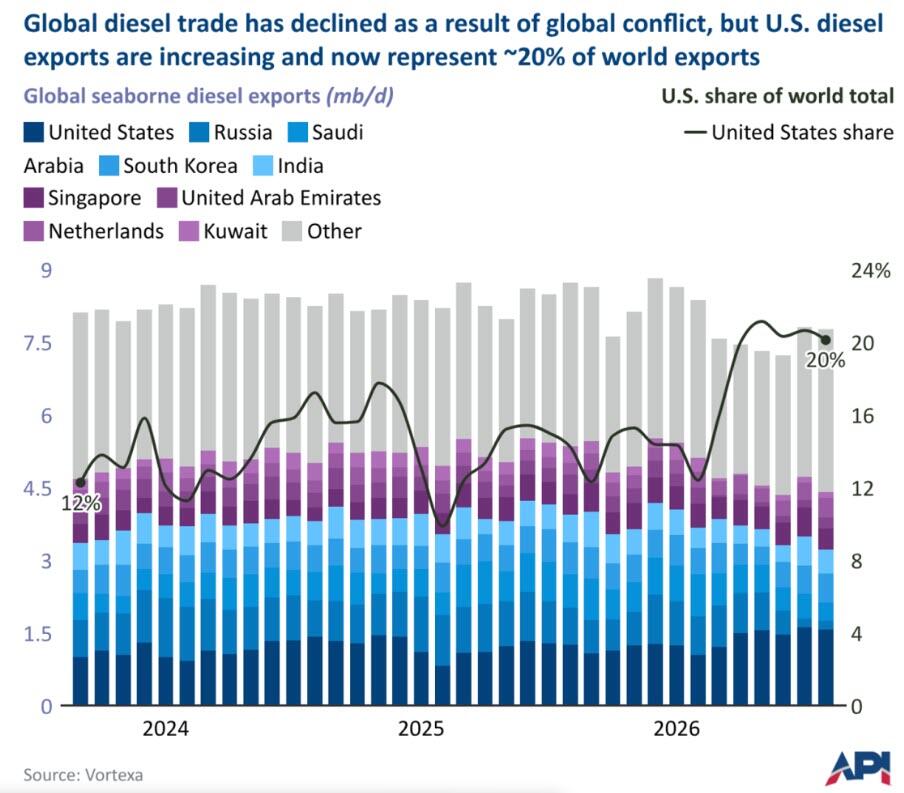
Of the 8 million barrels of diesel traded globally by sea each day, the U.S. supplies about 1.5 million of them - about 20%. An export ban would remove the single largest source of global diesel from the market, and the consequences could be catastrophic.
“Restricting exports is not a solution to high prices,” the American Petroleum Institute says.
“Removing US diesel from the market could instead result in reduced refinery runs, global economic damage and even higher US prices.”
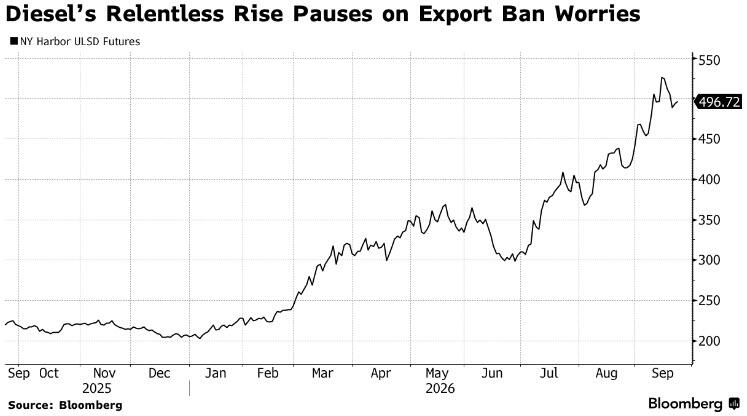
Indeed, as Bloomberg macro strategist, Michael Ball, write this morning,while The White House may be able to engineer a brief drop in US diesel prices by limiting exports, it risks creating a bigger supply problem down the road.
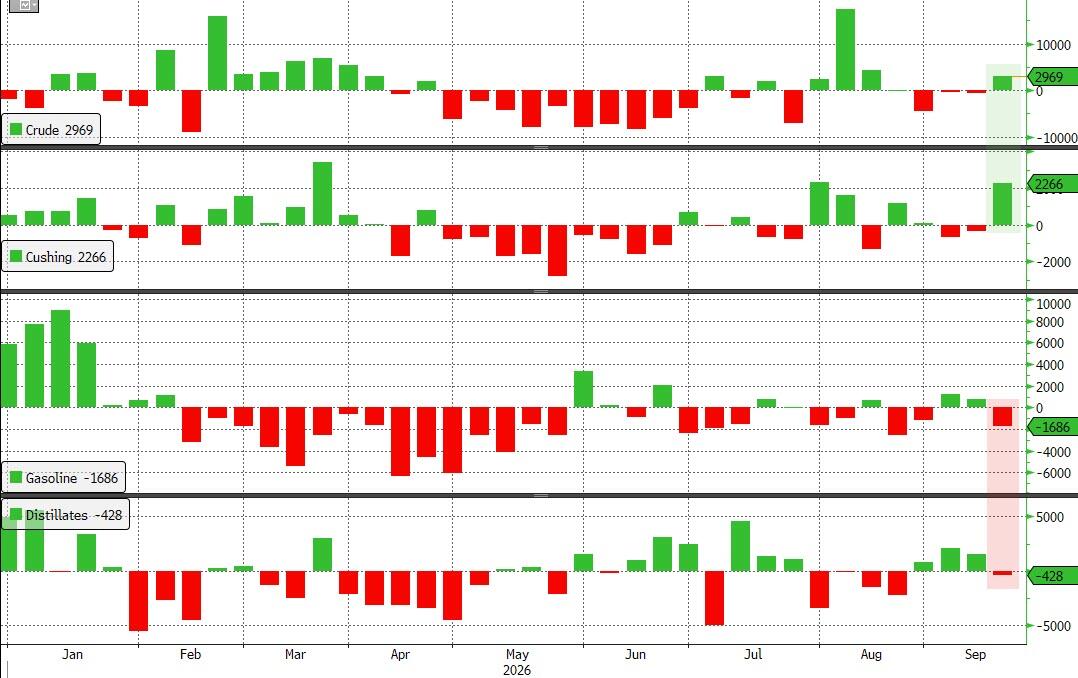
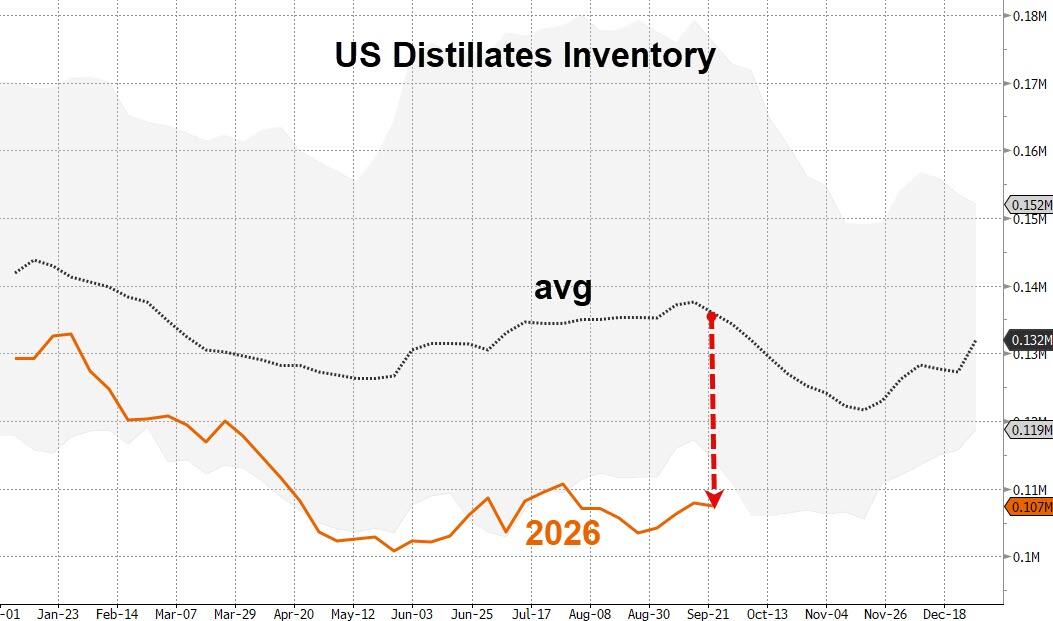
With distillate stocks at seasonally record lows...
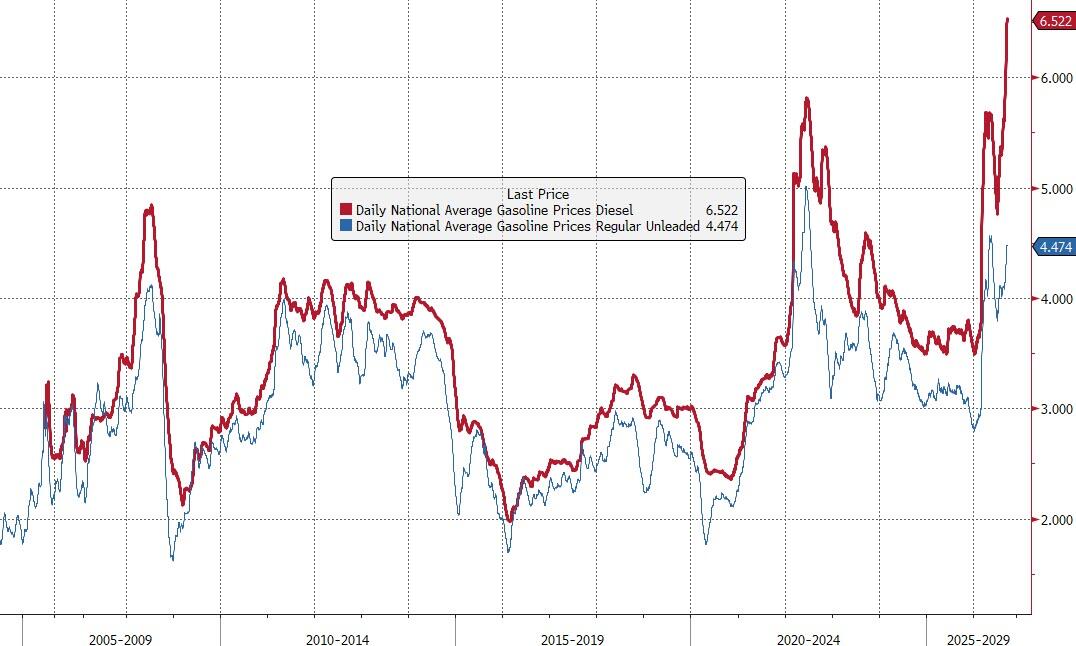
...the appeal is obvious with US diesel above $6.50 a gallon...
But a broad curb could strand as much as 1.5 million barrels a day, roughly 29% of US diesel output.
If enacted, Ball writes, the effects would be uneven across the US.
A surplus would build on the Gulf Coast, while pipeline, shipping and fuel-specification constraints limit how easily those barrels can reach tighter East and West Coast markets.
Bloomberg Intelligence estimates Gulf Coast storage could only absorb about three weeks of net diesel exports before constraints bite.
The global impact would be worse.
Kpler argues there is no real replacement for US export volumes, leaving Latin America and Northwest Europe particularly exposed and increasing competition for Indian barrels.
China could compound the squeeze as domestic inventories fall and the risk of renewed export curbs rises.
The response from refiners would create a negative feedback loop.
If trapped barrels crush margins, refiners are incentivized to cut runs and undertake maintenance.
S&P Global Energy estimates crude runs might need to fall by nearly 2 million barrels a day - more than 10% of the current production level - to clear the surplus.
That is the asymmetry: lower US diesel prices first, tighter global product markets follow, and potentially less US fuel supply later.
The more aggressive the restriction, the greater the risk that today’s price relief becomes tomorrow’s supply problem.
Tyler Durden Wed, 09/23/2026 - 12:00
Continue reading...
[ H/T ZeroHedge ]
President Trump will not be pleased...
US Energy Secretary Chris Wright has publicly opposed calls for a ban on US diesel exports, arguing on Wednesday that the measure would backfire by increasing gasoline and jet fuel prices.
"The blunt tool of banning diesel exports definitely doesn't work," Wright said at an event in New York, as reported by Reuters.
Wright said restricting exports would leave refiners with excess diesel inventories, forcing them to cut refinery output.
Lower refinery runs, he warned, would tighten supplies of other fuels, ultimately driving up costs for consumers and businesses.
His comments put him at odds with President Trump, who signaled support for the idea on Tuesday as diesel prices surge to record highs in the US and Europe (and Treasury Secretary Bessent has been assigned to see "if it's feasible."
Trump's comments already sent European pries for the fuel surging.
With flows from the region’s top supplier at risk, Bloomberg reports that European diesel’s premium to Brent crude jumped to more than $95 a barrel on Wednesday, a record in Bloomberg data going back to 2011.
Known as crack spread, the indicator has been keenly watched by central bankers as they seek to tame inflation. The equivalent measure in the US, meanwhile, weakened.
Trump’s threat comes as Europe is already grappling with the loss of diesel shipments from the Middle East, and Russian export curbs have tightened the global fuel market further. The US has become Europe’s main overseas supplier, with American exports of the workhorse fuel surging to a weekly record near 2 million barrels a day last month.
A key US oil industry group cautioned against the move, saying it could lower American fuel production and damage the global economy.
Of the 8 million barrels of diesel traded globally by sea each day, the U.S. supplies about 1.5 million of them - about 20%. An export ban would remove the single largest source of global diesel from the market, and the consequences could be catastrophic.
“Restricting exports is not a solution to high prices,” the American Petroleum Institute says.
“Removing US diesel from the market could instead result in reduced refinery runs, global economic damage and even higher US prices.”
Indeed, as Bloomberg macro strategist, Michael Ball, write this morning,while The White House may be able to engineer a brief drop in US diesel prices by limiting exports, it risks creating a bigger supply problem down the road.
With distillate stocks at seasonally record lows...
...the appeal is obvious with US diesel above $6.50 a gallon...
But a broad curb could strand as much as 1.5 million barrels a day, roughly 29% of US diesel output.
If enacted, Ball writes, the effects would be uneven across the US.
A surplus would build on the Gulf Coast, while pipeline, shipping and fuel-specification constraints limit how easily those barrels can reach tighter East and West Coast markets.
Bloomberg Intelligence estimates Gulf Coast storage could only absorb about three weeks of net diesel exports before constraints bite.
The global impact would be worse.
Kpler argues there is no real replacement for US export volumes, leaving Latin America and Northwest Europe particularly exposed and increasing competition for Indian barrels.
China could compound the squeeze as domestic inventories fall and the risk of renewed export curbs rises.
The response from refiners would create a negative feedback loop.
If trapped barrels crush margins, refiners are incentivized to cut runs and undertake maintenance.
S&P Global Energy estimates crude runs might need to fall by nearly 2 million barrels a day - more than 10% of the current production level - to clear the surplus.
That is the asymmetry: lower US diesel prices first, tighter global product markets follow, and potentially less US fuel supply later.
The more aggressive the restriction, the greater the risk that today’s price relief becomes tomorrow’s supply problem.
Tyler Durden Wed, 09/23/2026 - 12:00
Continue reading...
[ H/T ZeroHedge ]