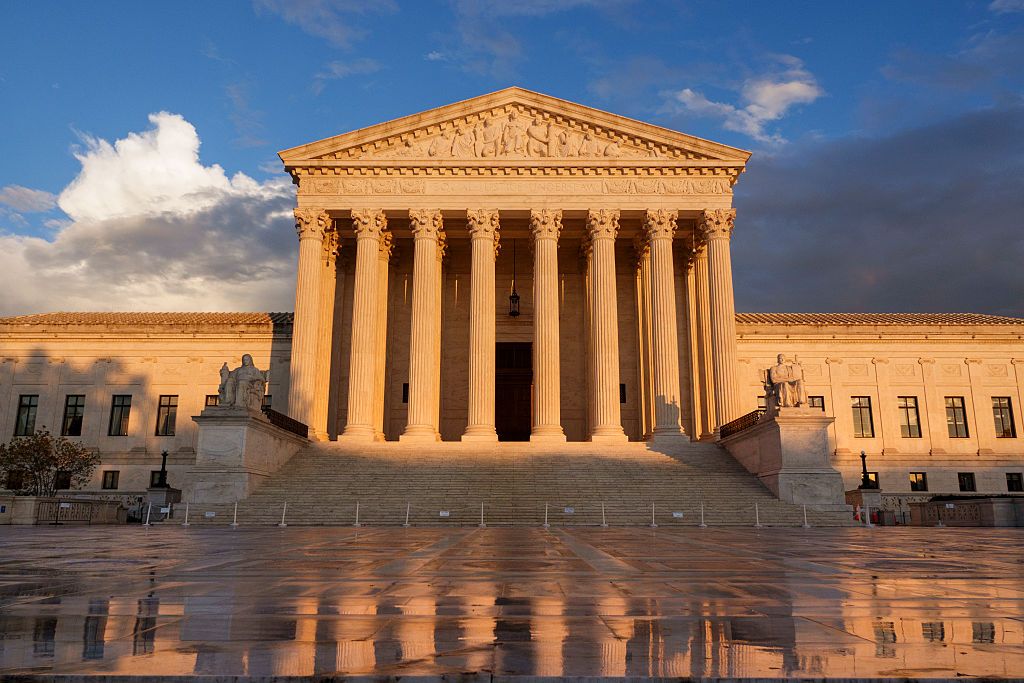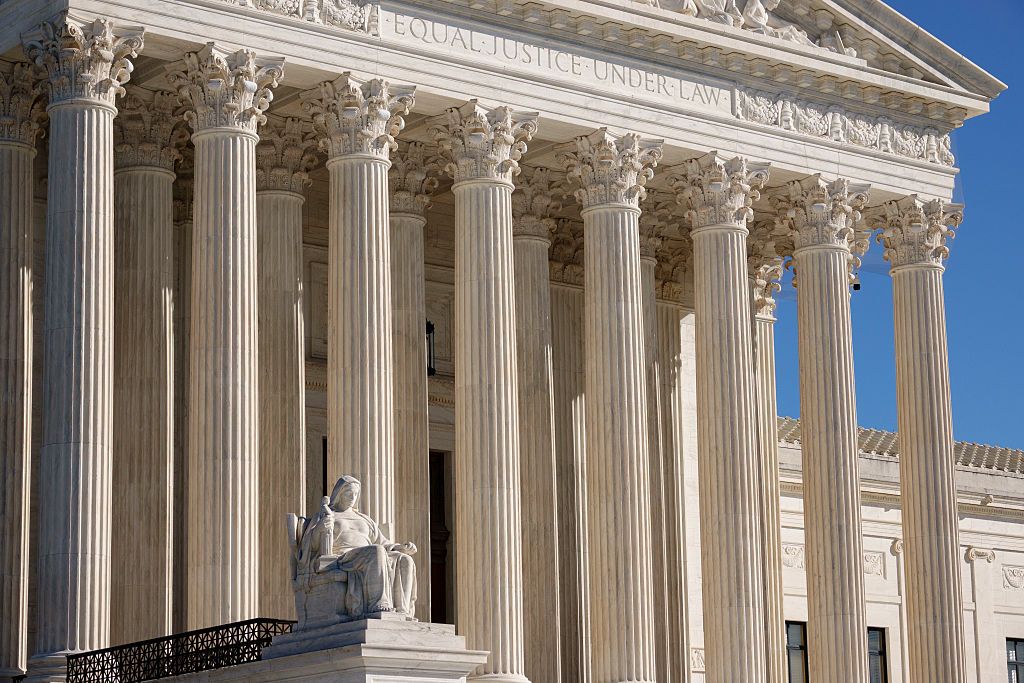






During the 2025-26 term, the Supreme Court handed President Donald Trump defeats on two of his signature initiatives – his efforts to limit birthright citizenship and impose sweeping tariffs – as well as his initial attempt to fire Lisa Cook, a member of the Federal Reserve’s Board of Governors. But those rulings do not necessarily mean the justices have seen the last of any of those issues. In the wake of the court’s decisions in each of the three cases, Trump continues to fight on, which has led (or could lead) to litigation that may reach the court again.
The Democratic Party’s decisive victory in the midterm elections, which gave it a majority in both the U.S. House of Representatives and the Senate, could theoretically hinder Trump’s plans. However, Democrats would need not just a majority to pass legislation curbing the president’s authority but a veto-proof majority: 67 votes in the Senate and 290 in the House, which could be more difficult to obtain.
Trump v. Cook
In late June, a closely divided court rebuffed – at least for the time being – Trump’s effort to fire Cook. By a vote of 5-4, the court permitted Cook to stay at the Fed while she challenges Trump’s attempt to dismiss her.
The dispute began in August 2025, when Trump posted screenshots on social media of a letter to Cook in which he fired her. Trump cited allegations that Cook, who began serving on the Fed in 2022 and whom then-President Joe Biden nominated to a full 14-year term one year later, had committed mortgage fraud in 2021 by listing two different homes – a condo in Georgia and a house in Michigan – as her primary residence on mortgage applications, making her eligible for more favorable terms.
In the wake of Trump’s attempt to dismiss her, Cook went to federal court in Washington, D.C. The lower courts there permitted her to remain in office while her challenge moved forward. The Trump administration then asked the Supreme Court to step in and pause those decisions, but it instead opted to hear oral argument.
In his opinion for the majority, Chief Justice John Roberts explained that (among other things), Trump acted improperly when he fired Cook without notifying her that he intended to do so and without giving her an opportunity to respond to the allegations against her.
Just over five weeks later, White House Deputy Chief of Staff Dan Scavino sent Cook a letter in which he notified her that Trump was “considering” whether to remove her from the Board of Governors and gave her 21 days to respond to the mortgage fraud allegations.
In a five-page letter on Aug. 26, Cook’s attorney, Abbe Lowell, characterized the allegations against her as “unfounded and untrue.” Therefore, he said, any attempt to dismiss Cook based on those accusations would be “corrosive of the independence that Congress sought to preserve” for the Federal Reserve Bank.
On Oct. 7, Trump announced the formation of a three-person committee, made up of senior administration officials, to investigate the mortgage-fraud allegations. He also directed the committee to hold a hearing at the White House on Nov. 5, but the hearing has been rescheduled for Dec. 14 because Cook could not attend on the original date.
Trump indicated that the committee should “submit written findings of fact and conclusions of law to” him and make a recommendation regarding whether Cook should be removed “[a]s soon as practicable after” that. If the committee advises Trump that Cook should be fired, it will almost certainly lead to additional litigation, which likely would return to the Supreme Court no matter how the lower courts rule. The court may then have to decide whether, in accordance with its prior opinion, the process that the Trump administration followed before firing Cook was adequate.
After the Supreme Court issued its decision in June, Cook’s original case returned to the district court for further proceedings. However, on Nov. 6, Cook and Trump asked the district court to temporarily suspend its proceedings in the case. Lowell told the justices that his client and the Trump administration “are discussing a process by which the allegations will be considered by the ‘committee of inquiry,’ including the specifics and deadlines.”
Congress could take a variety of steps to affect Trump’s efforts to fire Cook or future Fed governors: it could, for example, amend the law governing the Fed to define what constitutes “cause” allowing a president to remove a governor, or to outline the exact procedural steps that the president must follow when attempting to fire a governor. However, any such legislation would be (as noted above) potentially subject to a Trump veto. If Trump does fire Cook, the Senate could also refuse to confirm a successor.
Birthright citizenship
On the last day before its summer recess, the Supreme Court struck down Trump’s executive order seeking to end birthright citizenship – the guarantee of citizenship to virtually everyone born in the United States. In Trump v. Barbara, a majority of the court agreed with the challengers that Trump’s order cannot be reconciled with the 14th Amendment to the Constitution, which confers citizenship on anyone “born … in the United States, and subject to the jurisdiction thereof.” Roberts emphasized that the “children born of parents unlawfully or temporarily present in the United States” “satisfy both elements of the Citizenship Clause.” “Under the Constitution,” he concluded, “they are citizens at birth.”
Just over one month later, Trump signed a new executive order that sought to impose different restrictions on birthright citizenship. While his first order had barred children whose parents were either undocumented immigrants or only in the United States temporarily from gaining automatic U.S. citizenship, his Aug. 6 order would deny automatic citizenship to the children of a variety of foreign citizens in the U.S., such as employees at a foreign embassy and employees of international organizations like the United Nations and the World Bank. The order also carved out exemptions from the birthright citizenship rule for any child whose parent was designated as an “alien enemy” under several federal laws; for the children of parents who “engaged in a commercial transaction to purchase or access birthright citizenship for the person, or engaged in fraudulent activity to obtain citizenship”; and where “the person is born in a territory or territorial waters of the United States where citizenship is not conferred by Federal statute.”
On Sept. 4, the Department of Homeland Security issued an interim final rule – that is, a rule issued without first publishing a proposed rule and soliciting comments – to implement the Aug. 6 executive order.
Challenges to the second executive order have arisen in several different courts around the United States. In Barbara, the case in which the justices had struck down Trump’s first executive order, the challengers sought to add plaintiffs and claims to their case to address the second executive order. They argued that both the first and second executive orders “represent efforts to narrow the well-settled meaning of the Citizenship Clause’s language, namely ‘subject to the jurisdiction thereof,’ in order to strip U.S.-born children of citizenship beyond the exceptions set out in” in the Supreme Court’s cases, including Barbara. The challengers also asked U.S. District Judge Joseph Laplante for an injunction that would temporarily bar the Trump administration from enforcing the second executive order against the class of people who would be affected by it.
In an order on Sept. 10, Laplante expressed concerns about the use of the Barbara case to challenge the new executive order. He suggested that the challenge should instead come in a separate new proceeding. On Sept. 23, the challengers withdrew their motions to add claims and plaintiffs and seek preliminary relief from the second executive order.
Trump’s second executive order has also been challenged in the case of CASA v. Trump. Like Barbara, CASA had initially been filed in response to Trump’s first executive order on birthright citizenship. In 2025 CASA went to the Supreme Court, where the justices ruled that federal courts generally lack the authority to issue “universal” or “nationwide” injunctions – orders that bar the federal government from enforcing a policy or law anywhere in the country.
In August 2026, the plaintiffs in CASA asked U.S. District Judge Deborah Boardman to enter a preliminary injunction barring the enforcement of the second executive order. She granted that request on Sept. 2. Trump’s new executive order, she wrote, “is almost certainly unconstitutional as applied to the certified class for the simple reason that the Supreme Court in Barbara already decided that the children in the class are citizens at birth.” She temporarily prohibited the Trump administration from enforcing the new executive order against any member of the class that she had certified in the case – that is, children who would have been denied citizenship by the 2025 order.
The government asked Boardman to revoke her ruling or pause it. It argued that the named plaintiffs (and, by extension, the rest of the class) do not have a legal right to sue, known as standing, to challenge the 2026 order because their children were born before that order was issued. “Every relevant agency tasked with implementing the 2026 Executive Order,” it wrote, “has now issued public guidance and regulations explicitly saying that ‘the EO is prospective only,’ that the ‘guidance’ therefore too ‘is prospective only,’ and that the guidance ‘will become effective upon publication subject to any legal obligations,’ such as this ongoing preliminary injunction.” And in any event, the government continued, the “[p]laintiffs’ fears of being affected by the 2026 Executive Order” are “based on rife speculation.”
The American Civil Liberties Union, which also represents the plaintiffs in Barbara, filed another case, Nathan v. Trump, in Washington, D.C., in September specifically to challenge the second executive order. The plaintiffs in Nathan include an Australian citizen who, with his wife, is expecting a child through surrogacy who was scheduled to be born in the United States in October and a citizen of a Western European company who lives in the United States and is expecting a baby in April 2027; both she and her husband work for international organizations. They sought to represent a class of children and parents of children born in the United States who would be subject to the second executive order.
The case was assigned to U.S. District Judge Christopher Cooper, who has scheduled a hearing for Thursday on the challengers’ motion.
As for the role of Congress, the court’s decision in Barbara reaffirmed a broad conception of birthright citizenship under the Constitution, potentially leaving relatively little for a Democratic Congress to do – even if it could override a presidential veto.
Tariffs
In February, the Supreme Court struck down the extensive tariffs that President Donald Trump imposed in a series of executive orders in 2025. By a vote of 6-3, the justices ruled that the tariffs exceeded the powers given to the president by Congress under the International Emergency Economic Powers Act, known as IEEPA, a 1977 law that authorizes the president to regulate commerce during national emergencies created by foreign threats.
In its ruling in Learning Resources v. Trump, the court did not address whether or how the federal government should provide refunds to the importers who have paid the tariffs, estimated in 2025 at more than $200 billion. Although the government has now paid out more than $100 billion in refunds, that omission has (perhaps unsurprisingly) also led to litigation.
In V.O.S. Selections v. Trump, one of the original challenges to the IEEPA tariffs, the government is challenging the decision by Judge Richard Eaton of the U.S. Court of International Trade to enter an order that (among other things) requires the government to refund tariffs paid by importers that had not filed their own lawsuits and whose imports had been liquidated – that is, the customs duty had been finally settled – more than 80 days ago. The government contends that such an order amounts to an impermissible universal injunction, under which his order would apply broadly. The government contends that an importer can only obtain a refund if it has a court order allowing it to do so.
On Oct. 8, Eaton certified a class of importers who had paid the IEEPA tariffs but had not yet filed their lawsuits seeking a refund; if the lawsuit goes forward, it would presumably eliminate the need for each importer to file its own lawsuit to obtain a refund.
There are also several pending lawsuits involving the Trump administration’s efforts to impose new tariffs in the wake of the Supreme Court’s ruling on the IEEPA tariffs. On Feb. 20, Trump imposed sweeping tariffs under Section 122 of the Trade Act of 1974, which gives the president the power to impose temporary (up to 150 days) surcharges when there are serious international payment problems. Trump relied on his finding of such problems that “significantly harm United States national interests,” citing as an example “a substantial trade deficit.”
In May, the CIT ruled – by a vote of 2-1 – in favor of the states and companies challenging the Section 122 tariffs. The majority concluded that the grounds on which Trump’s proclamation imposing the tariffs relied did not fall within the meaning of the statute.
The government appealed the CIT’s ruling to the Federal Circuit, which paused that decision while the appeal moves forward – allowing the government to continue to collect the tariffs until July 24, when they expired.
With the Section 122 tariffs slated to expire, Trump on July 23 imposed tariffs on goods from 60 U.S. trading partners, including Canada, the United Kingdom, Japan, Australia, Vietnam, Mexico, and South Korea. In doing so, he relied on Section 301 of the Trade Act of 1974, which gives the president the power to impose tariffs based on a determination that a country has failed either “to prohibit or effectively enforce” a ban on the imported goods produced with forced labor and that failure has a negative effect on U.S. trade.
In early August, a group of 25 states, led by Oregon, challenged the Section 301 tariffs in the CIT. They contended that the Trump administration was using Section 301 and concerns about forced labor “as a pretext to continue its illegal tariff scheme.” In particular, they alleged, “there is no rational fit between the purported problem of forced labor in international supply chains and the blanket global tariffs the USTR imposed.” Learning Resources, which was one of the challengers in the IEEPA case, filed a similar case; the CIT heard oral arguments in that case, which was designated as a representative case, on Sept. 30.
Here too the newly Democratic Congress – which under the Constitution has the power to impose tariffs but has delegated the authority to control tariff policies to the president – could amend the tariff laws to narrow or strip Trump’s power, subject (as noted above) to a presidential veto.
Continue reading...
[ H/T SCOTUSblog ]