



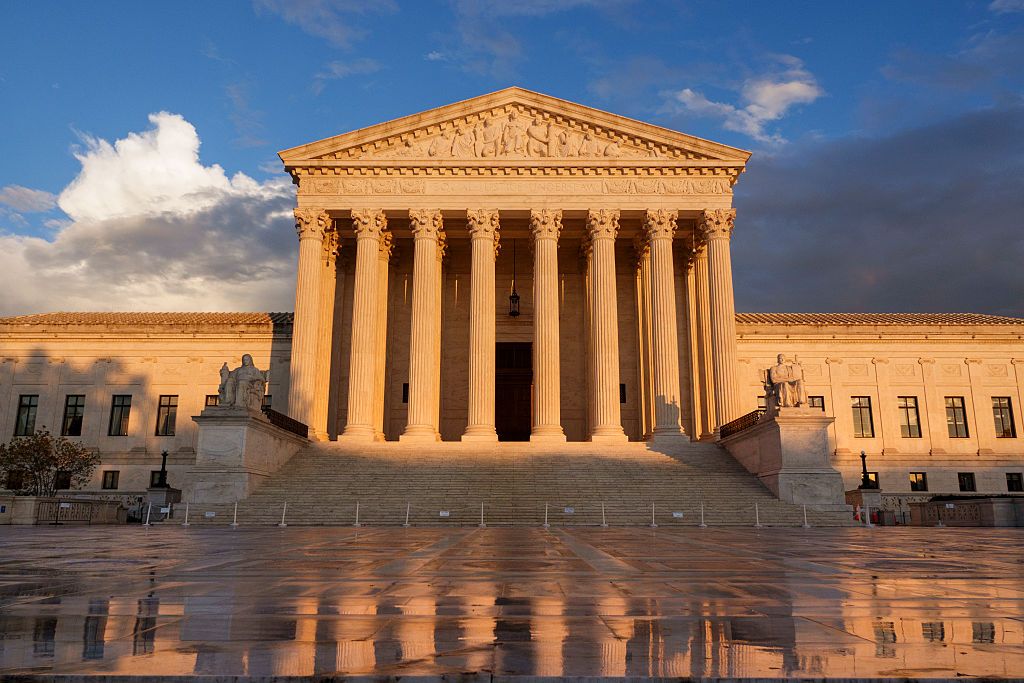
Yesterday’s argument in Department of Labor v Sun Valley Orchards showed a court open to the possibility of a major limitation on the ability of agencies to impose fines or penalties under internal adjudicative processes, at least without ready review in court.
The constitutional problem is how to distinguish between the judicial power that is allocated to the judicial branch (in Article III of the Constitution) and the executive power that is allocated to the executive branch (in Article I of the Constitution). The Supreme Court always has recognized that it is permissible for officials in the executive branch – who don’t have the protections (including life tenure) that Article III gives to federal judges – to resolve questions in a proceeding that looks an awful lot like the kind of trial you might see in a federal court. And it also on several occasions has invalidated schemes that seemed to the court to go too far in that direction. To pick the most famous example, the justices invalidated the initial version of the Bankruptcy Code of 1978 because it gave undue adjudicative responsibility to bankruptcy “judges” that are not protected by Article III. What the court has never done well is explain exactly how far such powers can go. Nevertheless, recent decisions like Loper Bright Enterprises v. Raimondo and Trump v. Slaughter show a great willingness to rein in the powers traditionally granted to the administrative state.
This case presents a dispute as to whether employers under the H-2A visa program (for temporary foreign agricultural workers) gave those employees certain things they were promised before being admitted to the United States. Conventionally, when the Department of Labor decided that an employer had failed to treat workers as it promised pre-admission, it imposed fines or penalties in an administrative proceeding, often handing the funds over to the employees as compensation in the nature of back pay. The question for the justices is whether Article III of the Constitution can tolerate that dispute being resolved internally by DOL employees rather than by judges in a federal court.
The government sees the dispute as squarely involving two categories of so-called “public rights” for which Article I treatment is permitted: the immigration power and public benefits. The immigration power is involved because the workers were permitted to enter the country on the condition that the employer treat them as agreed; the public benefit power is involved because the right to enter is a benefit almost entirely within the discretion of the executive.
Several of the justices found that argument rather weak. Chief Justice John Roberts, for example, commented early on that the leading case about the immigration power (Oceanic Steam Navigation v Mellor) “had to do very much with entry, a condition of entry, and loathsome diseases. This strikes me as significantly different. … You’re trying to leverage an entry several weeks, months … in the past to the particular condition of work that doesn’t seem to have much to do with the actual entry.” For the chief justice, the government was trying to “leverage what is a significant barrier to entry, where you have a lot of deference to the executive branch,” and “trying to … extend that broad authority beyond the justification for its application.” He repeatedly emphasized that the specifics of the case “look more like a condition of employment rather than … entry.”
In a similar vein, Justice Amy Coney Barrett stated to Principal Deputy Solicitor General Sarah Harris (arguing for the government): “I think we agree that the aliens could be removed pursuant to our immigration tradition without an Article III court. But the fines, I’m wondering if they’re different. …. So I’m … wondering here why that wouldn’t be the case for the alien. If the alien violated some sort of condition on the H-2A visa, why wouldn’t the alien be entitled to an Article III court before the alien had to pay that kind of a fine?” At which point Justice Neil Gorsuch chimed in that he “thought [an earlier case had said that] confiscating property goes to an Article III court when you’re trying to confiscate property from aliens. … I thought we decided a long time ago that you’ve got to go to an Article III court. Are … you resisting that?”
Justice Brett Kavanaugh pointed to yet another precedent on civil penalties: “In Tull [v. United States], we said … and this is 40 years ago – a civil penalty was a type of remedy at common law that could only be enforced in courts of law. …. That’s a fairly definitive statement in our precedent. What … are we supposed to do with that?”
That’s not to say that all of the justices sided against the government. Justice Elena Kagan, for example, found the case well within the boundaries of existing doctrine. To Harris, she commented early on: “sn’t there a condition of entry here? … [T]hey wouldn’t be admitted unless the employer had promised certain things.” To Robert Johnson arguing on behalf of the employer – a different Robert Johnson, not the blues singer – she was much more pointed:
Offering a parallel perspective, Ketanji Brown Jackson emphasized that the court in numerous contexts has approved administrative adjudication of civil penalties. She repeatedly challenged Johnson to reconcile his argument with those decisions.
But ominous for the government was some repeated questioning of Harris about “the best way for you to lose” (as Justice Sonia Sotomayor put it). From early on in the argument, even the justices who seem most likely to accept the constitutionality of the arrangement were trying to help Harris identify the least damaging way for the court to rule against her. At the beginning of her argument and throughout it, Harris emphasized to the justices that a broad ruling against her on the constitutional question would unsettle programs in a wide variety of areas, ranging from Medicare, to government contracts, to student loans, but that did not seem to make any headway for her.
It is not at all clear from the argument how exactly the justices are going to come down. Clearly a significant group are considering the idea that an award of civil penalties is too far removed from the entry of the employee to be protected by the “public rights” doctrine that would protect administrative determination of the right to enter. My guess is that even those justices don’t yet know how far they would be willing to go – or how far they can go and secure five votes of agreement. I expect this case to come down late and be sharply divided.
Continue reading...
[ H/T SCOTUSblog ]