



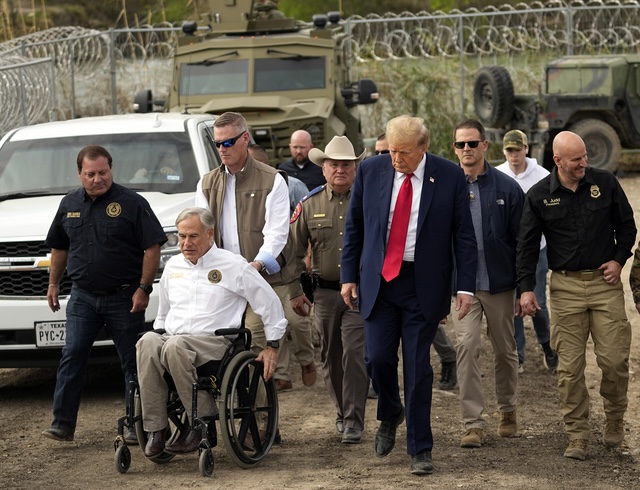
On Sept. 9 in Dallas, President Donald Trump unveiled the No Invasion of Our Country Act, meant to lock his border crackdown into permanent federal law so no future president can reverse it by executive order alone. Ten days later, on Sept. 19, his administration moved on a second, quieter front: an order tightening scrutiny of H-1B visa applications and renewing a $100,000 fee on certain petitions, aimed at employers who lay off American workers while importing cheaper foreign labor. Together, the two moves tell us something worth noticing. Even this administration treats immigration as two separate questions: who gets to cross illegally, and who America should be actively recruiting, and answering the first does not answer the second.
I came through the legal door myself. In 1982, after finishing a Ph.D. in organic chemistry at the Indian Institute of Science, Bangalore, I entered the United States on a J-1 exchange visitor visa, cleared through consular vetting in Chennai and background checks that followed me through India, London, and New York before I set foot on American soil. Legal immigration means patience and repeated screening, not a single stamp on a single form. For those of us who came that way, the case for border enforcement is not an abstraction.
Enforcement without contradiction
A secure border and more legal immigration are not competing instincts; they require each other. When people cross illegally and disappear into off-the-books work, they lose the legal standing to bargain for fair pay, and that missing leverage drags down wages for the American workers competing beside them. Making border enforcement permanent, rather than dependent on which party holds the White House, is a plain governing responsibility, and it deserves support on those terms alone.
A second front, already underway
The Sept. 19 H-1B order draws a line our immigration debate usually blurs. It does not shut the door on skilled foreign workers; it targets abuse, employers who lay off U.S. engineers and quietly refile for cheaper H-1B replacements, or staffing firms that treat the visa as bulk-rate labor rather than a tool for genuine skill shortages. That is the right target, but policing abuse is not the same as having a strategy. It protects the program’s integrity. It does not grow to the scale the country now needs.
The math our rivals cannot escape
China’s population fell for a fourth straight year in 2025, with births collapsing to 7.92 million, a level demographers compare to 1738, when its entire population was roughly 150 million. Its fertility rate fell to about 0.96 children per woman, less than half of what is needed to hold a population steady, and nearly a quarter of its people are already 60 or older, a share expected to reach 400 million by 2035. Beijing cannot out-produce its way out of that math, and its closed, state-controlled system is poorly built to out-recruit its way out either. The U.S.’s own fertility rate hit a record low of 1.57 in 2025, and the Congressional Budget Office projects U.S. deaths will exceed births by around 2033. But unlike China, we hold one advantage no closed society can copy: the world’s best scientists and engineers still want to come here.
Building the second pillar
STOP CHASING CHINA’S MIDDLE CLASS: IT’S BROKE, AND XI IS KEEPING IT THAT WAY
Congress should build on what the administration has already started by authorizing an independent commission of economists, security professionals, and infrastructure planners to set multiyear, high-skill immigration targets tied to real labor shortages, semiconductor technicians, rural physicians, AI researchers, and defense engineers among them, rather than arbitrary annual caps. The vetting system we already run for consular screening and security clearances should be expanded, not slowed, and linked to faster approval for applicants who clear it, while sponsorship stays limited to spouses and minor children. New arrivals should be steered toward the industrial hubs and underserved regions that need them most, paired with real investment in housing and infrastructure.
Labor economists are right to worry that careless expansion could suppress wages in specific technical fields, which is exactly the discipline the Sept. 19 order is testing on a small scale and should be built permanently into a larger system. Enforcing the border keeps the U.S. secure. Recruiting the world’s best keeps America ahead. Trump began his first job in Dallas and the second, more quietly, in Washington nine days later. The task now is to connect the two into one strategy before the demographic clock ticking for both nations runs out on the advantage we still hold.
Meda Parameswara Reddy, Ph.D., is the director of the Reddy Center for Critical and Integrated Thinking. A former R&D executive holding 30 U.S. patents, he specializes in interdisciplinary research.
Continue reading...
[ H/T Washington Examiner ]