




US Futures, Treasuries Flat Ahead Of Core PCE, Micron Earnings
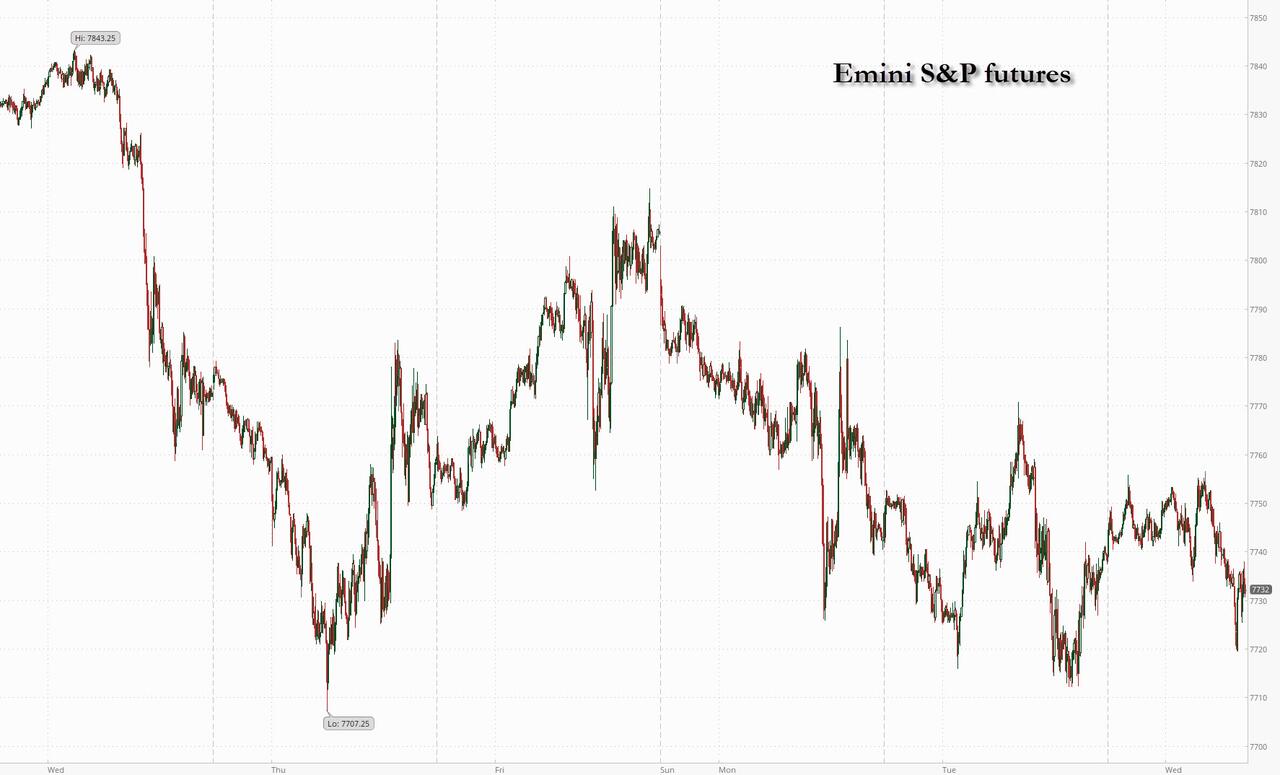
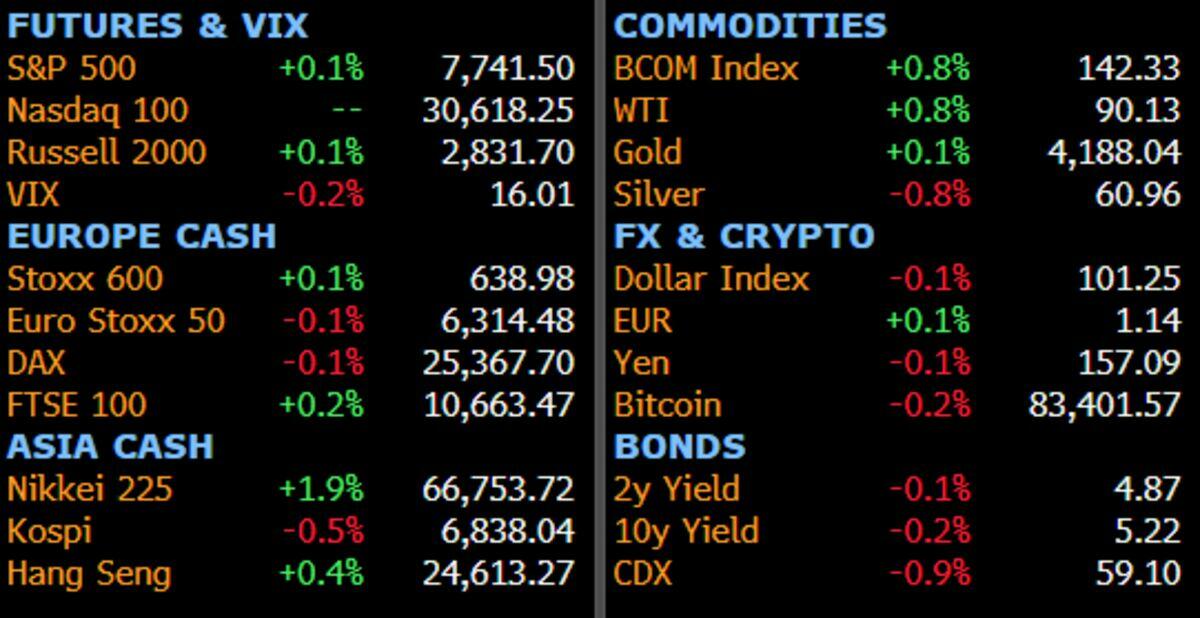
Futures are higher with S&P leading both tech and small caps ahead of today's core PCE data and Micron earnings after the close, as yields remain sticky, unchanged from yesterday's multi-decade highs, and the USD fractionally lower. As of 8:00am ET, S&P futures are flat, with Nasdaq futures down fractionally as semis dip -20bp lagging the broader Tech tape but leading Software (-54bp) and Memory (-80bp) after Korea's Kospi closed lower erasing an early bounce. In premarket trading, Mag7s are the leaders (+28bp) ahead of Micron later. Ex-Tech, the other major sectors are indicated higher pointing to an ‘Everything Rally’ / broadening, albeit on low volume and conviction. With US/Iran deal optimism supporting markets, JPM's market intel desk, which this week reverted back to being tactically bullish, says that an actual deal likely triggers a tactical squeeze / broadening. Treasuries were little changed a day after 30-year yields hit their highest since 2002. The dollar held near its highest level since July. Commodities are rebounding led by energy: Brent rose modestly to above $103 a barrel, up about 14% for the month despite signs that crude flows from the Middle East are returning to pre-war levels; WTI is above $90/bbl, base metals are leading precious (gold flat; silver down), and ags seeing a broad-based bid. Today’s macro focus is on PCE and 4x Fed speakers with yesterday’s highlight being Williams whose comments pointing to 1x more hike in 2026, not 2x. If PCE prints cooler, we may see a material repricing in bond yields lower.
In premarket trading, Mag 7 stocks are mixed: Alphabet +1%, Nvidia +0.1%, Amazon -0.2%, Apple little changed, Tesla -0.8%, Microsoft -0.1%, Meta Platforms -1%
In other corporate news, Boeing beat Northrop Grumman to produce the Navy’s next fighter jet, the F/A-XX, with the award valued at more than $20 billion. Concentrix cut its revenue forecast for the year, which Bloomberg Intelligence says highlights “stronger near-term headwinds for customer-experience outsourcing.” Paramount’s delays in financing debt to fund the Warner Bros. Discovery deal could cost the company up to half a billion dollars a year more in interest payments.
Stock futures are edging higher on the last day of a tricky month dominated by surging bond yields - fueled by a sharp repricing of expectations for US interest rate hikes to contain energy-driven inflation - stubbornly high oil prices and alarming AI headlines. Equity volatility has been remarkably subdued, given the backdrop, but hedge funds now seem to be positioning for more volatility. The S&P 500 limited its losses in part thanks to a narrow rally in AI-linked stocks on optimism over the sector’s prospects, a view that will face a test when Micron reports after the close. Treasuries pared gains to leave US 10-year yields only down 1 bp at 5.22%.
“The bar is so, so high that they’ll likely be very good numbers, but it all feeds through into the demand story that we need to keep seeing,” said Rory McPherson at Magnus Financial Discretionary Management. “So long as that holds, I would expect the tech trade to keep moving.”
With a report on US private payrolls and the latest gross domestic product update due alongside the PCE release, Ipek Ozkardeskaya at Swissquote noted that different combinations of readings could have a range of outcomes for markets. “A combination of robust growth and a recovery in the jobs market would allow the Fed to hike rates to fight rising inflationary pressures, provided that price pressures look concerning,” she said. “That would keep upward pressure on short-term yields and the US dollar, while weighing on equities.”
But it is the core PCE that will be key for direction today. Bloomberg Economics expects the report to show an acceleration in monthly inflation. For PCE price indexes, Bureau of Economic Analysis updated methodology for calculating inflation in three components is expected to trim August year-on-year change by a few tenths of a percentage point.
Growth and jobs data below expectations and elevated inflation could see the gap between two- and 10-year US yields narrow, threatening risk appetite and weighing on the dollar. Strong GDP and jobs figures coupled with a softer-than-expected PCE reading would be the best possible scenario, easing pressure on yields and supporting equities, though also the furthest from her base case.
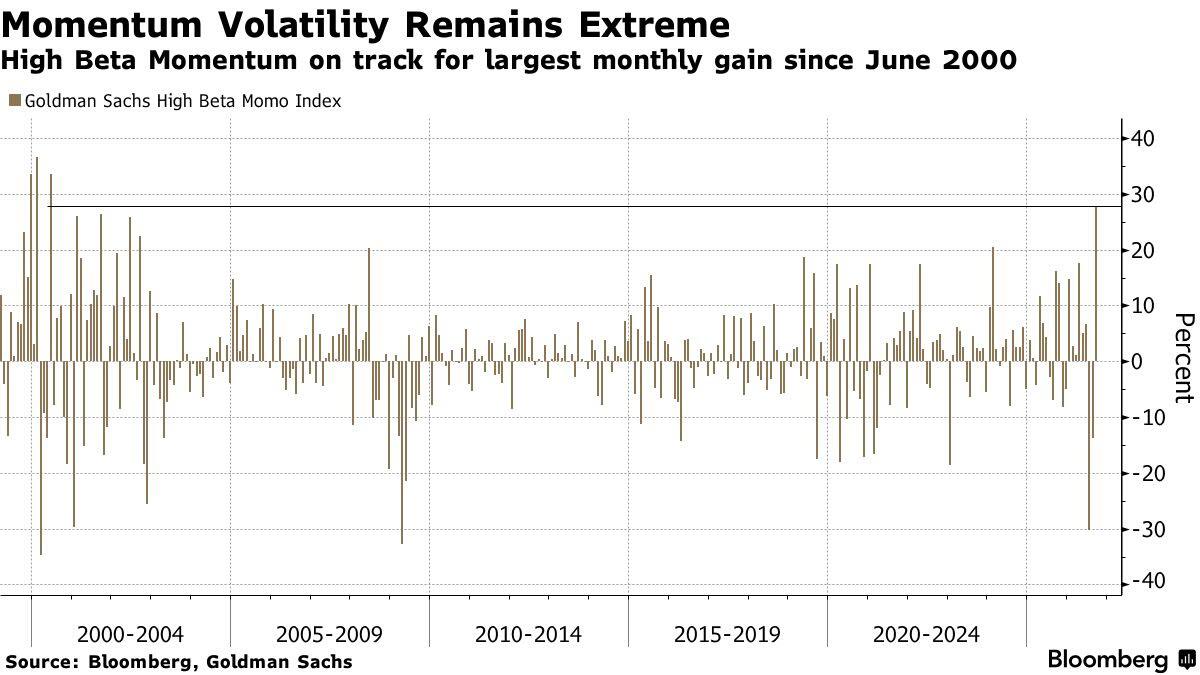
While equities are ending September little changed from the start of the month, market breadth is weak, with S&P 500 equal-weight lagging the cap-weighted set for the largest monthly underperformance on a down month since 2020. Stocks have been held up by tech and AI gains, putting Goldman Sachs’ High Beta Momo Index on track for its best month since June 2000.
Besides the PCE data, Micron’s latest results will be keenly watched - more for the chipmaker’s commentary and outlook than headline results (consensus expects 355% year-on-year sales growth). We will have a full preview shortly. Elsewhere in tech, there were a flurry of headlines from OpenAI’s DevDay - from fundraising plans to the unveiling of personal AI agent Dots.
On the AI safety narrative, Trump endorsed using independent audits to assess the safety of AI systems through an accord with Silicon Valley leaders that seeks to sidestep new government rules in addressing rising concerns about AI risks. Not every one is convinced. We don’t know whether AI represents an existential threat, but “the policy response is a superficial rebranding attempt,” says Jonestrading’s Mike O’Rourke.
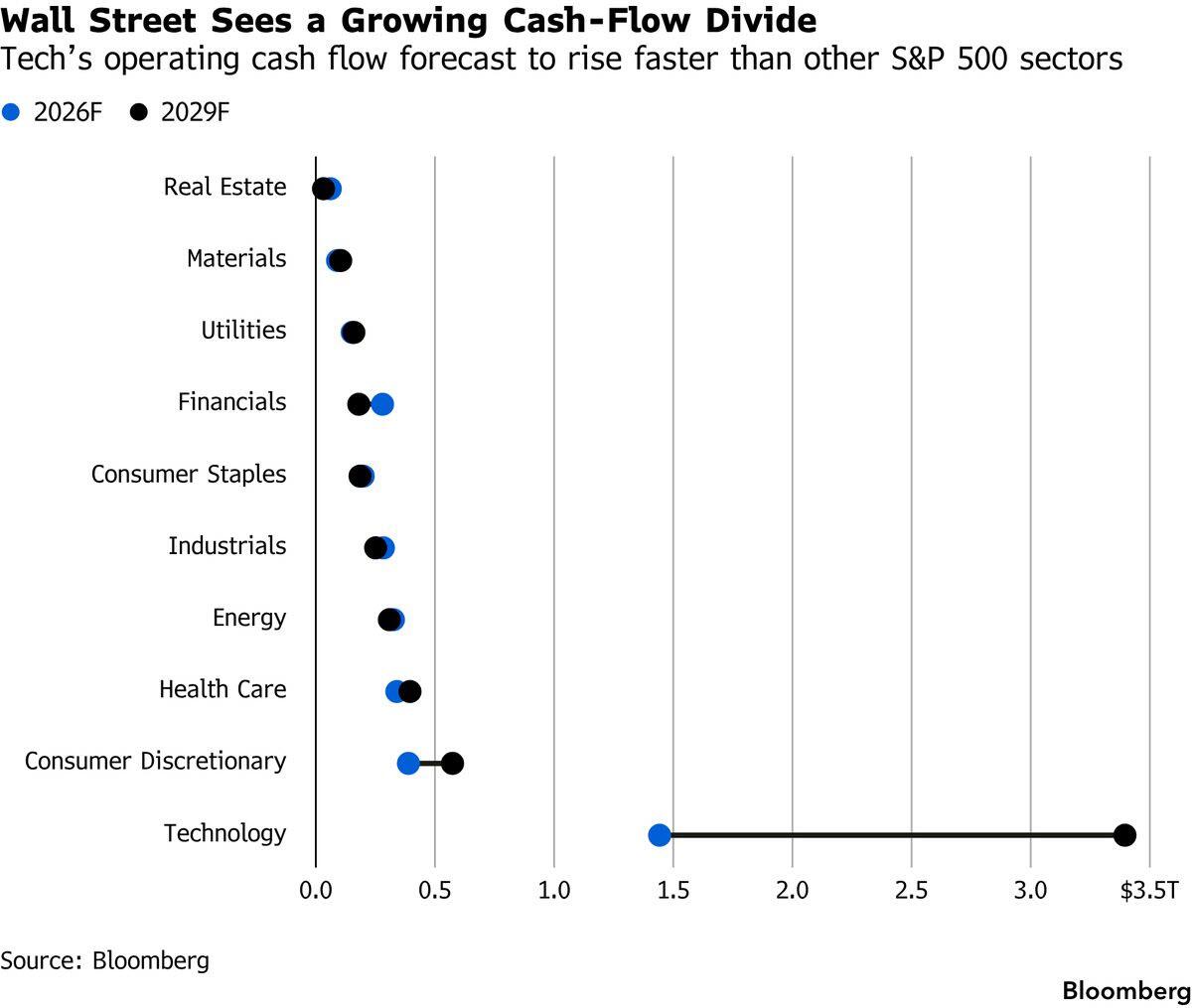
Apollo Chief Economist Torsten Slok, meanwhile, asks if AI customers will generate a lot more cash than analysts expect, or if tech firms’ cash flow forecasts are too optimistic, as both outlooks can’t be correct at the same time. It “raises the question of who exactly will be writing all those checks to buy AI services,” notes Slok.
As reported previously, hedge funds net sold global stocks for the first time in five weeks through Sept. 24, while buying US tech more than any other sector for a fourth straight week, according to Goldman Sachs’s Prime desk. Barclays strategists, meanwhile, note that equities continued to see inflows in September but they say momentum is fading as higher rates diminish the appeal of the so-called TINA trade.
European stocks were set for their first monthly decline since March. Inflation overshot estimates in France and Italy, increasing pressure on the European Central Bank to continue raising interest rates. The 10-year French yield premium over safer German peers widened one basis point to 120 basis points, the highest since 2012. Here are the biggest movers Wednesday:
Asian stocks rose for the first time in three days, as oil prices steadied. The MSCI Asia Pacific Index was up 0.8% in late afternoon trading, and is on track to close the quarter nearly 1% higher. Japan led the gains Wednesday while Thailand and South Korea fell. While crude prices have since steadied, its earlier retreat on signs of easing supply disruption helped alleviate investor concerns about energy-induced inflationary pressures. The rebound in equities also came after a brutal selloff in global bonds took a breather.
In FX, the BBG dollar index is modestly lower while the pound sits atop the G-10 FX pile, rising 0.3% against the dollar after UK GDP was unexpectedly revised higher for the second quarter. Sterling also seemed to derive support from UK PM Andy Burnham suggesting he could campaign to take Britain back into the European Union at the next general election. The Aussie dollar is at the other end of the table, underperforming peers after Australian CPI rose less than expected. The euro adds a few pips after hot French and German state CPI data. Elsewhere, Chinese property stocks reversed losses as investors looked past a mortgage subsidy program that fell short of expectations and focused on the possibility of further support measures.
In commodities, WTI crude oil futures advance, reversing some of yesterday's drop while Brent crude futures for December rise 1% to around $97 a barrel, sapping some of the earlier upside in bonds. Bitcoin is fractionally higher, trading just under $84K.
In rates, treasuries pared earlier gains and are narrowly mixed in early US session, keeping yields within a basis points of Tuesday’s close. US 10-year yields near 5.24%, reversing an earlier drop, and lagging German counterpart by about 4bp, UK’s by about 1bp. Following comments by Fed’s Williams on Tuesday, tightening priced into front-end swaps has ebbed to around 12bp for the October decision and a combined 32bp over the October and December meetings. European bonds outperform following data including French and German CPI readings and UK GDP. IG dollar issuance slate includes a couple of names so far. Paramount Skydance Corp.’s eight-tranche, $30 billion offering is expected to be priced, with terms ranging from two to 40 years. Initial price talk for the 2066 maturity is a spread of about 3.65 percentage points vs the Treasury benchmark. The US session includes a raft of economic releases headed by August personal income and spending and its PCE price indexes, and comments by four Fed officials.
“We’re remain sellers of OATs against the Bund,” said Kevin Thozet at Carmignac in Paris. “The economy in France is deteriorating while improving at the same time within its neighbors. We think the direction of travel is toward 150 basis points, at which point we’d have to reassess.”
US economic data slate includes September ADP employment change (8:15 a.m.), August personal income and spending, 2Q GDP revision, and August wholesale inventories (8:30am) and September MNI Chicago PMI (9:45 a.m., several minutes earlier for subscribers).Fed speaker slate includes Richmond’s Barkin (1:30 p.m.), Governor Cook (3:25 p.m.), Chicago’s Goolsbee (5:10 p.m.) and Minneapolis’s Kashkari (6 p.m.)
Market Snapshot
Top Overnight News
A more detailed look at global markets courtesy of Newsquawk
APAC stocks were ultimately mixed following the recent drop in oil prices and upside in long-term US yields, while participants digested a slew of data at month- and quarter-end. ASX 200 rallied with nearly all sectors in the green and real estate leading the advances as softer-than-expected headline monthly CPI data and a wider contraction in building approvals lessened the odds for an RBA November rate hike. Nikkei 225 gapped above the 66,000 level and continued to advance with the index shrugging off disappointing Industrial Production and Retail Sales data, in which the former showed a surprise contraction. KOSPI traded indecisively amid weak data and tensions with North Korea after a DMZ landmine explosion injured South Korean officers, while South Korea's military stated that North Korea's fortification works increased tensions in the Korean peninsula and that it should apologise for its fortification works.
Hang Seng and Shanghai Comp were mixed, with the Hang Seng indecisive and the mainland mildly underpinned following the encouraging Chinese PMI data, in which headline official Manufacturing PMI matched estimates at 50.1, and Non-Manufacturing topped forecasts and returned to expansion territory at 50.2 (exp. 49.3), while RatingDog Manufacturing and Services PMIs were both stronger-than-expected. In addition, the PBoC recently announced support measures including a 25bps cut to the Pledged Supplementary Lending facility rate to 1.50% from 1.75%, while participants look ahead to the National Day holidays and the week-long closure in the mainland beginning tomorrow.
Top Asian News
European bourses (STOXX 600 +0.1%) were initially posting gains across the board, but have since waned off best levels as energy benchmarks move higher. Sectors highlight the positive bias. Retail tops the sector pile, with Utilities and Optimised Personal Care rounding out the sector gainers. To the downside is Media, Energy and Construction. Key movers include: Greggs (+7.5%), guides a modestly improved outcome for 2026; Gerresheimer (+3.1%), Q2 metrics rises Q/Q and points to a stronger H2'26; TomTom (+1.7%), expands its Microsoft (MSFT) collaboration; Commerzbank (-2.7%), downgraded to hold from Buy at Deutsche Bank.
Top European News
FX
Fixed Income
Commodities
Trade/Tariffs
Central Banks
Geopolitics: Iran
Geopolitics: Other
US Event Calendar
Central Banks
DB's Jim Reid concludes the overnight wrap
Good evening from Phoenix where I’m just about to go to bed after I press send here. I’m the keynote lunchtime speaker at our huge long standing annual LevFin conference which attracts over a 1,000 investors and issuers. I’m literally hemmed in by golf courses here which is a bit tortuous not having clubs with me and having to work.
While I'm away, we're running our end-Q3 market survey. There are several highly topical questions this month. One asks respondents to rank the key drivers behind the recent rise in yields, while another explores how the US is ultimately likely to address its fiscal challenges. We also have a couple of timely questions on oil and on how the Iran conflict may evolve ahead of the US midterm elections. I would be grateful if as many of you could fill in as possible. It should take 2-3 minutes and can be accessed here.
As we await today's latest US core PCE, and arrive at quarter-end, markets have put in a pretty mixed performance over the last 24 hours, with divergent signals across the major asset classes. On one level there was relief, as oil and gas prices fell back again thanks to some positive supply headlines, with Brent crude down -2.56% to $102.59/bbl. And together with NY Fed’s Williams suggesting there is no “urgency” for the next hike, that helped to dial back expectations of Fed tightening. However, it wasn’t all good news, as the 30yr Treasury yield (+1.9bps) rose for a sixth consecutive session, reaching a post-2002 high of 5.67%. And despite the energy pullback there were still other signs of stress, as US and European HY spreads reached their widest since April, whilst the Franco-German 10yr spread rose to its widest level since 2012.
We’ll start with the energy news, as the turnaround in oil and gas prices was one of the big stories yesterday. At the European open, it looked like we were set for another day of gains, with Brent crude initially rising to $107/bbl. However, several headlines contributed to the pullback, including a Reuters report that Saudi Arabia had resumed oil loadings from the port of Yanbu. And that follows on from Bloomberg’s report the previous day that Saudi Arabia had now restored around half the flows through the East-West pipeline.
Meanwhile, the US announced that it will offer up to 40m barrels from its Strategic Petroleum Reserve, in what would be its last drawdown in the coordinated global release of oil announced earlier in the year. So that helped oil prices stage a decent intraday turnaround. Brent settled -2.59% lower while WTI crude (-3.48%) saw a larger decline to a 4-week low of $89.48/bbl, with the gap between the two benchmarks widening as the current front-month Brent future expires today. Meanwhile, European natural gas (-4.95%) saw an even bigger decline.
Yet even with the pullback in oil and gas prices, investors struggled to get too excited. There are still no obvious signs of progress towards a deal, and we actually saw longer-dated Brent futures move up once again, with the December 2027 future up another +0.65% yesterday, reaching a new high of $80.81/bbl. So for investors, they’re still pricing in a lengthier period of disruption, even as increased oil flows out of the Gulf have eased the near-term pressure.
That backdrop led to a mixed session for US Treasuries. Initially, yields hit fresh highs across most of the curve before paring back those gains, with the 10yr yield ending the day unchanged at its post-2007 high of 5.24%. Despite the eventual pullback, there was still a fresh milestone for 30yr yields (+1.9bps), which reached a post-2002 high of 5.57%. However, at the front end the 2yr yield fell -5.4bps, and therefore we saw a decent sized steepening on the day.
In addition to the decline in energy prices, the front-end rally was helped by comments from NY Fed President Williams, who said that he saw one more rate hike “late this year” as appropriate and that “there is no need for urgency” following the September hike. So that suggested a high bar to hike as soon as the next meeting in October, and money markets cut back the pricing of an October rate hike from 70% to 47% in response. In other Fedspeak, Governor Barr signaled that further hikes are likely without offering any colour on their likely pace, while St Louis Fed President Musalem suggested that “policy remains somewhat accommodative” after the September hike.
Meanwhile, we also got a slightly weaker set of second-tier US data. The somewhat backward-looking job openings for August showed an unexpectedly big slowing to 7.079m (vs. 7.228m expected), which is their lowest level in 5 months. In addition, the Conference Board’s consumer confidence measure also saw an unexpectedly big fall to 81.9 in September (vs. 89.0 expected), marking its lowest level since 2014. We did get some more upbeat house price data, with the S&P Case Schiller (+0.32% vs +0.20% expected) and FHFA (+0.3% vs +0.1% expected) series both seeing larger monthly increases. Next up, we have today's core PCE and the jobs report on Friday, which are likely to get far more attention.
Given all that, US equities struggled to gain traction as well yesterday, with the S&P 500 (-0.17%) slipping back for a second day running. That retreat was fairly broad, with energy (-0.89%) and materials (-0.55%) sectors leading the decline in the S&P 500, while the small-cap Russell 2000 fell -0.35%. The decline would have been worse were it not for a jump among chip stocks, as the Philly semiconductor index rose +1.32%. That move came as Trump pushed back against the idea of new federal AI regulations in a meeting with top AI and tech executives, which agreed on a framework for voluntary audits.
European equities were mixed, with the CAC (-0.53%) and FTSE 100 (-0.45%) leading the Stoxx 600 (-0.09%) lower, though the DAX (+0.10%) eked out at advance.
European bonds mostly struggled to gain traction, despite the boost from lower energy prices. To be fair, there were some that advanced, and the 10yr bund yield (-1.7bps) fell back from its post-2009 high of 3.64%. However, there was a worse performance elsewhere, with the 10yr OAT yield (+4.2bps) at a post-2008 high of 4.81%, whilst the 10yr BTP yield (+2.2bps) hit a post-2023 high of 4.61%. And in turn, that meant the Franco-German 10yr spread continued to widen, up to another post-2012 high of 118bps by the close. This widening came as France’s debt agency unveiled a plan to borrow a record €340bn in 2027 and amid protests by public-service staff and students ahead of the formal presentation of France’s 2027 budget tomorrow.
Fiscal issues also got some attention in the UK yesterday as Prime Minister Burnham spoke at the Labour Party’s annual conference. His proposed plans included dropping the current pension triple lock after 2030, opening the door to public ownership of water companies and suggesting that the UK will seek a closer relationship with the EU. The 10yr gilt yield ended the day -1.0bps lower.
Asian equity markets are mostly higher this morning, with the Nikkei (+1.28%) leading the gains, while the S&P/ASX 200 (+0.79%), Shanghai Composite (+0.30%), and CSI 300 (+0.18%) are also trading higher. In contrast, the KOSPI (-0.27%) has surrendered its early gains, while the Hang Seng (+0.03%) is flat. S&P (+0.23%) and Nasdaq (+0.23%) futures are higher with Stoxx (+0.69%) contracts even more so.
Early morning data showed that China’s manufacturing sector gained momentum in September, with both private and official surveys pointing to an improvement in economic activity. The private-sector RatingDog Manufacturing PMI rose to 52.1 from 51.5 in August, surpassing expectations of 51.7 and marking its strongest reading since April. The services PMI also improved to 51.6 from 51.4, ahead of forecasts for 51.3. Separately, China’s official manufacturing PMI increased to 50.1 in September from 49.8 in August, in line with expectations and returning to expansionary territory after two months of contraction. The official non-manufacturing PMI climbed to 50.2 from 49.0, comfortably beating forecasts of 49.2, while the composite PMI rose to 50.7 from 49.5.
Elsewhere, Australia’s inflation accelerated in August, although the increase was marginally softer than expected. Headline CPI rose +4.0% y/y, up from +3.5% in July but slightly below consensus expectations of +4.1%. The trimmed mean, closely watched by the RBA as a gauge of underlying price pressures, held steady at +3.6% y/y and rose +0.2% m/m in August, suggesting core inflation remains sticky despite some moderation in the broader inflation outlook.
Looking at the day ahead now, and European data releases include the September flash CPI prints for Germany, France and Italy, along with German unemployment for September. In the US, we’ll also get the PCE inflation print for August, the third estimate of Q2 GDP, and the ADP’s report of private payrolls for September. From central banks, we’ll hear from the Fed’s Barkin, Cook, Goolsbee and Kashkari, along with the ECB’s Schnabel.
Tyler Durden Wed, 09/30/2026 - 08:23
Continue reading...
[ H/T ZeroHedge ]
Futures are higher with S&P leading both tech and small caps ahead of today's core PCE data and Micron earnings after the close, as yields remain sticky, unchanged from yesterday's multi-decade highs, and the USD fractionally lower. As of 8:00am ET, S&P futures are flat, with Nasdaq futures down fractionally as semis dip -20bp lagging the broader Tech tape but leading Software (-54bp) and Memory (-80bp) after Korea's Kospi closed lower erasing an early bounce. In premarket trading, Mag7s are the leaders (+28bp) ahead of Micron later. Ex-Tech, the other major sectors are indicated higher pointing to an ‘Everything Rally’ / broadening, albeit on low volume and conviction. With US/Iran deal optimism supporting markets, JPM's market intel desk, which this week reverted back to being tactically bullish, says that an actual deal likely triggers a tactical squeeze / broadening. Treasuries were little changed a day after 30-year yields hit their highest since 2002. The dollar held near its highest level since July. Commodities are rebounding led by energy: Brent rose modestly to above $103 a barrel, up about 14% for the month despite signs that crude flows from the Middle East are returning to pre-war levels; WTI is above $90/bbl, base metals are leading precious (gold flat; silver down), and ags seeing a broad-based bid. Today’s macro focus is on PCE and 4x Fed speakers with yesterday’s highlight being Williams whose comments pointing to 1x more hike in 2026, not 2x. If PCE prints cooler, we may see a material repricing in bond yields lower.
In premarket trading, Mag 7 stocks are mixed: Alphabet +1%, Nvidia +0.1%, Amazon -0.2%, Apple little changed, Tesla -0.8%, Microsoft -0.1%, Meta Platforms -1%
- Achieve Life Sciences (ACHV) gains 3% after Stifel initiated coverage with a buy recommendation, citing a “potential blockbuster opportunity” for the biotech firm’s smoking-cessation drug candidate.
- Boeing (BA) rises 2% after the company beat Northrop Grumman Corp to produce the Navy’s next Top Gun fighter jet. Northrop (NOC) falls 4.3%.
- Cal-Maine (CALM) falls 6% after the egg producer reported net sales for the first quarter that missed the average analyst estimate, and said it won’t pay a cash dividend in the first quarter.
- Concentrix (CNXC) is down 9% after the call-center operator forecast fourth quarter revenue below expectations amid investor concerns that the business could come under pressure from AI-assisted automation tools.
- FactSet (FDS) falls 2% after the financial-data provider gave a 2027 earnings per share forecast that missed the average analyst estimate.
- GameStop (GME) gains 1% after a filing showed that Chairman and CEO Ryan Cohen purchased $10.6 million worth of shares.
- Moderna (MRNA) declines 6% after Citi downgraded the vaccinemaker to sell, saying optimism from its recent oncology success is more than priced in the stock’s outsized rally.
- Robinhood (HOOD) rises 2% after the brokerage launches new products that help users utilize AI agents to build and execute trading strategies. It’s also allowing customers to trade perpetual futures on some cryptocurrencies.
- Vanda Pharmaceuticals (VNDA) rises 4% after the drugmaker said its drug Hetlioz met its primary endpoint in a late-stage trial for adults with Delayed Sleep-Wake Phase Disorder — a circadian rhythm sleep disorder
In other corporate news, Boeing beat Northrop Grumman to produce the Navy’s next fighter jet, the F/A-XX, with the award valued at more than $20 billion. Concentrix cut its revenue forecast for the year, which Bloomberg Intelligence says highlights “stronger near-term headwinds for customer-experience outsourcing.” Paramount’s delays in financing debt to fund the Warner Bros. Discovery deal could cost the company up to half a billion dollars a year more in interest payments.
Stock futures are edging higher on the last day of a tricky month dominated by surging bond yields - fueled by a sharp repricing of expectations for US interest rate hikes to contain energy-driven inflation - stubbornly high oil prices and alarming AI headlines. Equity volatility has been remarkably subdued, given the backdrop, but hedge funds now seem to be positioning for more volatility. The S&P 500 limited its losses in part thanks to a narrow rally in AI-linked stocks on optimism over the sector’s prospects, a view that will face a test when Micron reports after the close. Treasuries pared gains to leave US 10-year yields only down 1 bp at 5.22%.
“The bar is so, so high that they’ll likely be very good numbers, but it all feeds through into the demand story that we need to keep seeing,” said Rory McPherson at Magnus Financial Discretionary Management. “So long as that holds, I would expect the tech trade to keep moving.”
With a report on US private payrolls and the latest gross domestic product update due alongside the PCE release, Ipek Ozkardeskaya at Swissquote noted that different combinations of readings could have a range of outcomes for markets. “A combination of robust growth and a recovery in the jobs market would allow the Fed to hike rates to fight rising inflationary pressures, provided that price pressures look concerning,” she said. “That would keep upward pressure on short-term yields and the US dollar, while weighing on equities.”
But it is the core PCE that will be key for direction today. Bloomberg Economics expects the report to show an acceleration in monthly inflation. For PCE price indexes, Bureau of Economic Analysis updated methodology for calculating inflation in three components is expected to trim August year-on-year change by a few tenths of a percentage point.
Growth and jobs data below expectations and elevated inflation could see the gap between two- and 10-year US yields narrow, threatening risk appetite and weighing on the dollar. Strong GDP and jobs figures coupled with a softer-than-expected PCE reading would be the best possible scenario, easing pressure on yields and supporting equities, though also the furthest from her base case.
While equities are ending September little changed from the start of the month, market breadth is weak, with S&P 500 equal-weight lagging the cap-weighted set for the largest monthly underperformance on a down month since 2020. Stocks have been held up by tech and AI gains, putting Goldman Sachs’ High Beta Momo Index on track for its best month since June 2000.
Besides the PCE data, Micron’s latest results will be keenly watched - more for the chipmaker’s commentary and outlook than headline results (consensus expects 355% year-on-year sales growth). We will have a full preview shortly. Elsewhere in tech, there were a flurry of headlines from OpenAI’s DevDay - from fundraising plans to the unveiling of personal AI agent Dots.
On the AI safety narrative, Trump endorsed using independent audits to assess the safety of AI systems through an accord with Silicon Valley leaders that seeks to sidestep new government rules in addressing rising concerns about AI risks. Not every one is convinced. We don’t know whether AI represents an existential threat, but “the policy response is a superficial rebranding attempt,” says Jonestrading’s Mike O’Rourke.
Apollo Chief Economist Torsten Slok, meanwhile, asks if AI customers will generate a lot more cash than analysts expect, or if tech firms’ cash flow forecasts are too optimistic, as both outlooks can’t be correct at the same time. It “raises the question of who exactly will be writing all those checks to buy AI services,” notes Slok.
As reported previously, hedge funds net sold global stocks for the first time in five weeks through Sept. 24, while buying US tech more than any other sector for a fourth straight week, according to Goldman Sachs’s Prime desk. Barclays strategists, meanwhile, note that equities continued to see inflows in September but they say momentum is fading as higher rates diminish the appeal of the so-called TINA trade.
European stocks were set for their first monthly decline since March. Inflation overshot estimates in France and Italy, increasing pressure on the European Central Bank to continue raising interest rates. The 10-year French yield premium over safer German peers widened one basis point to 120 basis points, the highest since 2012. Here are the biggest movers Wednesday:
- Kongsberg shares rise as much as 5.6% after the defense company signed contracts worth billions of Norwegian kroner and DNB Carnegie upgraded its recommendation to buy from hold
- Saga shares soar as much as 15%, the most since January, after the company reported underlying pretax profit well ahead of expectations for the first-half and raised its guidance for the full year
- Zegona Communications gains 4.4% after Goldman Sachs analysts initiated the investment firm with a buy rating, citing structural growth in the Spanish telecom market and opportunities to improve margins and cash generation
- Avanza gains as much as 3.1% and Nordnet as much as 4.3% after Deutsche Bank initiated coverage of the Swedish savings and investment platforms with buy and hold ratings, respectively. The bank says both are “two winners”
- UK water firms rise after Prime Minister Andy Burnham’s comments on the country’s water sector at the Labour Party conference on Tuesday are seen as a “first step in reassurance” in regards to concerns over nationalization, according to Morgan Stanley
- International Workplace Group shares rise as much as 6.2%, the most in five months, after the flexible-office provider increased its 2026 share buyback program by up to $50 million
- Intercontinental Hotels Group rises as much as 2.6% to a five-week high after Goldman Sachs increased its revenue estimate on US outperformance and Middle East resilience
- Everplay shares rise 9.5% to a new high three-year high after the video game developer boosted its revenue guidance thanks to strong performance from new titles
- Sinch shares drop as much as 7.5% after the cloud communications provider was initiated with a sell rating at Pareto Securities, which said it will struggle to achieve its growth targets
- Tullow Oil shares fall as much as 52% after the UK exploration & production firm lost its arbitration case with Ghana related to a $196.5m tax assessment
- Future falls as much as 12% in London after the media company said FY2026 results will meet market expectations, but paused its share buyback to prioritize deleveraging
- Juventus shares fall as much as 15% after the Turin-based football club reported an increased annual loss, warned of another in the year ahead and said it plans to raise €250 million through an issue of ordinary shares
Asian stocks rose for the first time in three days, as oil prices steadied. The MSCI Asia Pacific Index was up 0.8% in late afternoon trading, and is on track to close the quarter nearly 1% higher. Japan led the gains Wednesday while Thailand and South Korea fell. While crude prices have since steadied, its earlier retreat on signs of easing supply disruption helped alleviate investor concerns about energy-induced inflationary pressures. The rebound in equities also came after a brutal selloff in global bonds took a breather.
In FX, the BBG dollar index is modestly lower while the pound sits atop the G-10 FX pile, rising 0.3% against the dollar after UK GDP was unexpectedly revised higher for the second quarter. Sterling also seemed to derive support from UK PM Andy Burnham suggesting he could campaign to take Britain back into the European Union at the next general election. The Aussie dollar is at the other end of the table, underperforming peers after Australian CPI rose less than expected. The euro adds a few pips after hot French and German state CPI data. Elsewhere, Chinese property stocks reversed losses as investors looked past a mortgage subsidy program that fell short of expectations and focused on the possibility of further support measures.
In commodities, WTI crude oil futures advance, reversing some of yesterday's drop while Brent crude futures for December rise 1% to around $97 a barrel, sapping some of the earlier upside in bonds. Bitcoin is fractionally higher, trading just under $84K.
In rates, treasuries pared earlier gains and are narrowly mixed in early US session, keeping yields within a basis points of Tuesday’s close. US 10-year yields near 5.24%, reversing an earlier drop, and lagging German counterpart by about 4bp, UK’s by about 1bp. Following comments by Fed’s Williams on Tuesday, tightening priced into front-end swaps has ebbed to around 12bp for the October decision and a combined 32bp over the October and December meetings. European bonds outperform following data including French and German CPI readings and UK GDP. IG dollar issuance slate includes a couple of names so far. Paramount Skydance Corp.’s eight-tranche, $30 billion offering is expected to be priced, with terms ranging from two to 40 years. Initial price talk for the 2066 maturity is a spread of about 3.65 percentage points vs the Treasury benchmark. The US session includes a raft of economic releases headed by August personal income and spending and its PCE price indexes, and comments by four Fed officials.
“We’re remain sellers of OATs against the Bund,” said Kevin Thozet at Carmignac in Paris. “The economy in France is deteriorating while improving at the same time within its neighbors. We think the direction of travel is toward 150 basis points, at which point we’d have to reassess.”
US economic data slate includes September ADP employment change (8:15 a.m.), August personal income and spending, 2Q GDP revision, and August wholesale inventories (8:30am) and September MNI Chicago PMI (9:45 a.m., several minutes earlier for subscribers).Fed speaker slate includes Richmond’s Barkin (1:30 p.m.), Governor Cook (3:25 p.m.), Chicago’s Goolsbee (5:10 p.m.) and Minneapolis’s Kashkari (6 p.m.)
Market Snapshot
Top Overnight News
- Efforts this week by Qatari mediators to broker a diplomatic breakthrough between the U.S. and Iran have made little progress, with neither side willing to budge, according to three sources familiar with the talks. The stalemate bolsters the belief on both sides that a renewed military conflict is becoming more likely. U.S. officials think President Trump could order a return to major combat operations after the midterms. Axios
- Donald Trump has held crisis talks with advisers over whether to impose a diesel export ban or take other steps to contain a fuel crisis that threatens to derail his Republican Party’s midterm election campaign. RTRS
- Donald Trump endorsed using outside auditors to assess the safety of AI systems in a pact with Silicon Valley leaders that sidesteps new government rules. BBG
- Abu Dhabi is pursuing a $300 billion infrastructure push to reduce reliance on the Strait of Hormuz and curb Iran’s leverage. BBG
- Trump released the White House Accord on Super Intelligence following the meeting with AI executives on Tuesday, while the document noted that every company is responsible for developing its own technology safely and each should apply four layers of controls and audits, including implementing strong internal controls to oversee model capabilities and alignment.
- Democratic Lawmaker Raskin has reportedly sent letters to Amazon, Google, Meta and Oracle, requesting information regarding NDAs signed with government officials in relation to AI data center projects: WSJ.
- China’s economy showed signs of improvement at the end of the third quarter, with official and private gauges of factory, services and construction activity all picking up. WSJ
- China’s latest economic stimulus package appears designed to keep economic growth on target rather than deliver a broad revival, leaving investors waiting for more aid to address the country’s underlying demand weakness. BBG
- DeepSeek released software developed with Huawei to program AI chips, highlighting their push to challenge Nvidia. BBG
- Inflation overshot estimates in France and Italy with energy remaining the main driver. Prices jumped 3.4% in France, the fastest in more than two years, while in Italy they advanced by 4.1%, the most since 2023. BBG
- President Donald Trump could unveil plans as soon as Wednesday to tap South Korea's pledged strategic investment package for about $54 billion to build a liquefied natural gas facility in Alaska and several other major US projects. RTRS
- Trump told Axios that Jay Clayton would be a good AI czar.
A more detailed look at global markets courtesy of Newsquawk
APAC stocks were ultimately mixed following the recent drop in oil prices and upside in long-term US yields, while participants digested a slew of data at month- and quarter-end. ASX 200 rallied with nearly all sectors in the green and real estate leading the advances as softer-than-expected headline monthly CPI data and a wider contraction in building approvals lessened the odds for an RBA November rate hike. Nikkei 225 gapped above the 66,000 level and continued to advance with the index shrugging off disappointing Industrial Production and Retail Sales data, in which the former showed a surprise contraction. KOSPI traded indecisively amid weak data and tensions with North Korea after a DMZ landmine explosion injured South Korean officers, while South Korea's military stated that North Korea's fortification works increased tensions in the Korean peninsula and that it should apologise for its fortification works.
Hang Seng and Shanghai Comp were mixed, with the Hang Seng indecisive and the mainland mildly underpinned following the encouraging Chinese PMI data, in which headline official Manufacturing PMI matched estimates at 50.1, and Non-Manufacturing topped forecasts and returned to expansion territory at 50.2 (exp. 49.3), while RatingDog Manufacturing and Services PMIs were both stronger-than-expected. In addition, the PBoC recently announced support measures including a 25bps cut to the Pledged Supplementary Lending facility rate to 1.50% from 1.75%, while participants look ahead to the National Day holidays and the week-long closure in the mainland beginning tomorrow.
Top Asian News
- Japanese PM Takaichi said that the administration will boost supply side of the economy and that the government will clarify the direction of economic and fiscal policy management.
- Japan's Finance Minister said that they has been in close communication with the BoJ at all levels and sees no big difference in views on the economy and prices.
- South Korea's Finance Ministry said it is watching bond market developments closely and plans to use excess tax revenue to lower bond issuance if required, while it will conduct other stabilising measures including treasury bond buybacks if bond yields rise excessively.
European bourses (STOXX 600 +0.1%) were initially posting gains across the board, but have since waned off best levels as energy benchmarks move higher. Sectors highlight the positive bias. Retail tops the sector pile, with Utilities and Optimised Personal Care rounding out the sector gainers. To the downside is Media, Energy and Construction. Key movers include: Greggs (+7.5%), guides a modestly improved outcome for 2026; Gerresheimer (+3.1%), Q2 metrics rises Q/Q and points to a stronger H2'26; TomTom (+1.7%), expands its Microsoft (MSFT) collaboration; Commerzbank (-2.7%), downgraded to hold from Buy at Deutsche Bank.
Top European News
- UK PM Burnham has suggested that a move to rejoin the EU is among the options for the UK, talking to BBC Radio 4. The current settlement has caused more harm than good.
- Germany's SEFE said the German Economy Ministry has ordered the procurement and storage of 8 TWh of natural gas by December 15th.
- The German government plans to introduce a sugar tax on July 1, 2027, according to Welt citing a draft. The report added that the government expects it will generate an additional EUR 945mln for the federal budget next year.
- Swedish NIER raised its 2026 CPIF inflation forecast to 1.6% (prev. 1.3%) and 2027 to 2.6% (prev. 2.1%). NIER raised its 2026 GDP forecast to 3.09% (prev. 2.4%) and cut 2027 to 2.4% (prev. 2.8%).
FX
- Snapshot: G10s are mostly firmer against the USD this morning, which has been hampered following dovish comments from the Fed’s Williams on Tuesday. GBP leads post-GDP, whilst the Aussie lags post-CPI.
- DXY is a touch lower this morning, and trades within a 101.19 to 101.46 range; ultimately holding within the prior day’s confines. Some of the mild pressure today is facilitated by Fed’s Williams, who suggested that there was less of a need for a hike in October given the recent move in September. The downside in USD is nonetheless capped given he clarified that one more rate hike “late this year” may be appropriate.
- On the data front, PCE is due today. Analysts expect the PCE headline to rise by 0.4% M/M (prev. 0.2%), and the annual rate is seen ticking up to 3.8% Y/Y (prev. 3.7%); core PCE is expected to rise by 0.3% M/M (prev. 0.2%), with the annual rate of core PCE seen rising to 3.4% Y/Y (prev. 3.3%). Another factor to note, the Bureau of Economic Analysis will release updated PCE deflator methodology, applied retroactively through Q1 2021. RBC estimates that core PCE’s annual pace is expected to fall 18bps, which would revise July’s reading to 3.1% from 3.3%.
- GBP currently holds towards the top of the G10 list, with Cable holding at the upper end of a 1.3223 to 1.3278 range. The strength comes after mild revisions higher in Q2 GDP, though will likely have little impact on the BoE in the near term. Elsewhere, the JPY also performs well, continuing the strength seen overnight. This comes despite poor Japanese Industrial Production data overnight. In the European morning, Nikkei reported that PM Takaichi will vow a nimble response to unexpected market moves.
- EUR is a little firmer this morning, digesting inflation reports out of France and German states so far. French inflation topped expectations amidst rising energy costs, whilst German state metrics held a slight hawkish skew. Overall, nothing all too surprising for the region, given that ECB members have continued to voice concerns about the inflation outlook; however, a sustained rise in prices, evidence of second-round effects and/or lack of US-Iran progress will likely bring an October rate hike into view.
- AUD is the laggard this morning, following a weaker-than-expected CPI report; odds of a November hike are priced in at 24%, with a number of key metrics due until then. Westpac analysts reiterated their call for a hold at the November meeting following the inflation figures.
Fixed Income
- Fixed is firmer across the board, despite the modest upside in energy and hotter-than-expected inflation out of France and Germany, with Gilts leading as the space gets respite from its recent trajectory, benefitting from UK PM Burnham’s comments and strong GDP data.
- Specifically, Burnham said he was open to numerous outcomes with regards to UK-EU relations as the current post-Brexit situation is causing more harm than good. Among the options to consider, he stated they could “go all the way”, i.e. rejoin. A remark which, alongside the upwardly revised Q2 GDP series, has led to outperformance across UK assets this morning, with Gilts, GBP and the FTSE 100 the best performer or among the best in their respective market area.
- However, while welcome, the upside was only c. 50 ticks at best in Gilts and leaves the benchmark only a point at best above the 83.72 contract low, with yields across the curve off highs, but also still in close proximity to such levels.
- Across the Channel, OATs trade broadly in-line with their German counterpart, with gains of around 40 ticks at the time of writing. However, the OAT-Bund 10yr yield spread has widened further, to over 120bps and the widest since 2012. A move that comes after Tuesday’s debt update and the associated implications of the current plan for the debt-to-GDP ratio vs the EU’s EDP threshold.
- Bunds themselves experienced a modest pullback off best levels on the German state CPIs, which printed broadly as expected but with a slight hawkish skew vs the mainland consensus at 13:00BST today. Albeit, the move was modest in nature, with Bunds holding just above 120.00, firmer by over 40 ticks, vs a 120.17 peak.
- USTs bid, but the relative underperformers thus far, into a busy afternoon of data and potentially geopolitics. On the latter, we know that Iranian President Pezeshkian has now received the proposal via Araghchi from New York. We now await the leader's assessment of the matter. Elsewhere, PCE is due today and is perhaps more pertinent given the methodology changes included.
- Germany sells EUR 4.177bln vs Exp. 5.5bln 3.00% 2036 Bund: b/c 1.16x (prev. 1.47x), average yield 3.58% (prev. 3.39%), retention 24.1% (prev. 23.62%).
- Japan sells JPY 2.15tln 2-year JGB: b/c 3.89X (prev. 2.97X), average yield 1.964% (prev. 1.708%), Tail in price 0.014 (prev. 0.034).
Commodities
- WTI Nov and Brent Dec futures remain subdued after yesterday’s pronounced downside, with conflicting US-Iran developments providing little impetus for a sustained recovery. Crude also remains pressured by yesterday’s bearish supply headline which suggested the US offering up to 40mln bbls from the SPR, while private inventories showed a surprise 1mln bbl build (vs exp. 1.1mln draw). Modest upside was seen in the complex this morning after reports of a potential hijacking involving a Dubai-Tel Aviv flight, but was later seen as not a security-incident. However, recent reporting has suggested that the incident may be a “terrorist incident”. Separately, UKMTO reported that a crude oil tanker was struck on the port side by an unknown projectile in the Strait of Hormuz on September 30.
- WTI currently trades towards the upper end of a USD 88.58-90.77/bbl range, while Brent sits around the middle of a USD 95.12-97.61/bbl range. Dutch TTF is choppy, with Germany ordering the procurement and storage of 8 TWh of natural gas by 15th December as Europe continues efforts to bolster inventories ahead of winter. TTF now trades towards the middle of a EUR 67.88-70.78/MWh range.
- Precious metals are mixed, with gold firmer as global yields ease following yesterday’s sharp steepening, while participants await US PCE later today. Spot gold eclipsed USD 4,200/oz to notch a current range between USD 4,166-4,201/oz, recovering further from Monday’s sharp sell-off. Spot silver is slightly softer and trades around the middle of a USD 60.84-61.72/oz range.
- Base metals are firmer following Chinese PMI data, with the official Manufacturing PMI returning to expansion at 50.1 and Non-Manufacturing rising to 50.2, while RatingDog Manufacturing and Services also topped expectations. Note, China heads for a week-long National Day holiday from tomorrow. 3M LME copper trades towards the top end of a USD 14,458.70-14,550.88/t range.
- In terms of notable geopolitics, Iran received Washington’s response to its seven-point proposal via Qatari mediators, with reports suggesting the main disagreement centres on the sequencing of the proposed seven-day framework rather than its components. However, Axios reported that talks and mediation efforts this week have yielded little progress, raising the risk of renewed hostilities, while Iran maintains that the Hormuz issue and US blockade must be resolved before nuclear negotiations.
- US Private Inventory Data (bbls): Crude +1.0mln (exp. -1.1mln), Gasoline +3.0mln (exp. -0.5mln), Distillate -0.3mln (exp. +0.0mln), Cushing +0.2mln.
- OPEC+ oil producers are reportedly set to keep output targets unchanged at this Sunday's meeting, according to sources.
- US White House held crunch talks on a diesel export ban as midterms near, according to FT.
- US President Trump will unveil a USD 54bln Alaska LNG plan amid midterm woes.
- The Russian government has extended the ban on diesel fuel exports until end-October, IFX reported.
- Oman OSP for Nov' Crude set at USD 114.07/bbl (prev. USD 87.84/bbl).
- Iraq’s oil exports averaged 2.65mln BPD in September, including 250k BPD shipped via Turkey’s Ceyhan port, according to the Oil Ministry spokesperson.
Trade/Tariffs
- USTR Greer said tariff caps will be considered when setting tariffs in the Section 301 excess‑capacity probe.
- China's MOFCOM warned that if the European side persists in introducing discriminatory restrictions on Chinese enterprises or products, China will resolutely respond in the interests of Chinese industry. It also said regarding reports of some EU member states mulling more forceful trade measures on China, that the tools mentioned are typical protectionist and unilateralist measures and will disrupt the stability of China-EU trade.
- The EU is open to providing single-market access to those looking to join the bloc, on the condition they stand with the EU against industrial competition and hostile nations, according to Politico citing sources.
- EU trade chief Sefcovic said they are pushing for reforms to tackle excess industrial capacity in G20 and WTO frameworks, while they are working for greater cooperation with the US and other allies to secure supply chains and prevent weaponisation of critical minerals.
Central Banks
- Fed's Williams said rising bond yields show tighter financial conditions at the margin. On AI, Williams said that it is not causing big changes in job levels while highlighting that strong AI investment is important to boost future productivity. On the recent rise in yields, Williams doesn't believe it is signalling a shift in longer-run inflation views.
- BoE Financial Policy Committee (Sep): The re-escalation of the conflict in the Middle East has renewed uncertainty around growth and the path of interest rates in a number of advanced economies.
Geopolitics: Iran
- The Iranian government spokesperson said Foreign Minister Araghchi presented President Pezeshkian with a US proposal following his New York trip, which included discussions on Iran’s conditions for reopening the Strait of Hormuz, IRNA reported. This followed a Reuters report, which also highlighted that the main dispute between the US and Iran does not concern the components of the plan itself, but rather the order of operations and the stages of implementation of the seven-day framework.
- US White House is reportedly tempering expectations of an imminent breakthrough between US-Iran, Semafor reported, with a source suggesting that "the bar is being raised very high."
- A senior source said mediators are working to return negotiations to a broader track that includes the nuclear issue, Al Hadath reported.
- US-Iran talks and efforts by mediators this week yielded little progress, raising the odds of renewed combat, while Qatar will continue efforts despite growing frustrations with both sides, according to Axios.
- IRGC aerospace advisor said Iran can sustain current missile firing rates for years and the era of attacks without response is over.
- UKMTO said that a crude oil tanker was struck on the port side by an unknown projectile in the Strait of Hormuz on September 29th. Following this, UKMTO separately reported that an LNG tanker was struck by an unknown projectile on September 29th within the Strait of Hormuz.
- An incident was reported on a plane flying from Dubai to Tel Aviv, with recent reporting suggesting that the incident was a terrorist attack, Al Jazeera reported. The report suggested that the co-pilot who stabbed the other pilot was of Omani origin.
Geopolitics: Other
- Russian Defence Ministry said energy system facilities in Kyiv region were hit in a massive strike, according to IFX.
- Loud explosions have been heard in Kyiv, Ukraine.
- South Korean military said North Korea fortification works increased tensions on the Korean peninsula and that North Korea should stop fortification works immediately, while it added that North Korea should apologise for its fortification work and that South Korea military personnel were seriously wounded by North Korean mines.
- North Korea said South Korea is fabricating baseless findings regarding a mine blast in the demilitarised zone that injured troops, while it warned that South Korea could encounter a miserable and catastrophic situation.
US Event Calendar
- 7:00 am: Sep 25 MBA Mortgage Applications, prior -1.5%
- 8:15 am: Sep ADP Employment Change, est. 74.5k, prior 38k
- 8:30 am: Aug Personal Income, est. 0.5%, prior 0.43%
- 8:30 am: Aug Personal Spending, est. 0.85%, prior 0.16%
- 8:30 am: Aug PCE Price Index YoY, est. 3.7%, prior 3.7%
- 8:30 am: Aug Core PCE Price Index MoM, est. 0.3%, prior 0.2%
- 8:30 am: Aug Core PCE Price Index YoY, est. 3.3%, prior 3.34%
- 8:30 am: 2Q T GDP Annualized QoQ, est. 1.5%, prior 1.5%
- 8:30 am: 2Q T Personal Consumption, est. 3.4%, prior 3.4%
- 8:30 am: 2Q T GDP Price Index, est. 6.4%, prior 6.4%
- 8:30 am: 2Q T Core PCE Price Index QoQ, est. 3.6%, prior 3.6%
- 8:30 am: Aug P Wholesale Inventories MoM, est. 0.45%, prior 1.3%
- 9:45 am: Sep MNI Chicago PMI, est. 51, prior 47.1
Central Banks
- 1:30 pm: Fed’s Barkin Gives Welcome Remarks at Rural America Conference
- 3:25 pm: Fed’s Cook Speaks at Investing in Rural America Conference
- 5:10 pm: Fed’s Goolsbee Gives Keynote Address
- 6:00 pm: Fed’s Kashkari Speaks in Fireside Chat
DB's Jim Reid concludes the overnight wrap
Good evening from Phoenix where I’m just about to go to bed after I press send here. I’m the keynote lunchtime speaker at our huge long standing annual LevFin conference which attracts over a 1,000 investors and issuers. I’m literally hemmed in by golf courses here which is a bit tortuous not having clubs with me and having to work.
While I'm away, we're running our end-Q3 market survey. There are several highly topical questions this month. One asks respondents to rank the key drivers behind the recent rise in yields, while another explores how the US is ultimately likely to address its fiscal challenges. We also have a couple of timely questions on oil and on how the Iran conflict may evolve ahead of the US midterm elections. I would be grateful if as many of you could fill in as possible. It should take 2-3 minutes and can be accessed here.
As we await today's latest US core PCE, and arrive at quarter-end, markets have put in a pretty mixed performance over the last 24 hours, with divergent signals across the major asset classes. On one level there was relief, as oil and gas prices fell back again thanks to some positive supply headlines, with Brent crude down -2.56% to $102.59/bbl. And together with NY Fed’s Williams suggesting there is no “urgency” for the next hike, that helped to dial back expectations of Fed tightening. However, it wasn’t all good news, as the 30yr Treasury yield (+1.9bps) rose for a sixth consecutive session, reaching a post-2002 high of 5.67%. And despite the energy pullback there were still other signs of stress, as US and European HY spreads reached their widest since April, whilst the Franco-German 10yr spread rose to its widest level since 2012.
We’ll start with the energy news, as the turnaround in oil and gas prices was one of the big stories yesterday. At the European open, it looked like we were set for another day of gains, with Brent crude initially rising to $107/bbl. However, several headlines contributed to the pullback, including a Reuters report that Saudi Arabia had resumed oil loadings from the port of Yanbu. And that follows on from Bloomberg’s report the previous day that Saudi Arabia had now restored around half the flows through the East-West pipeline.
Meanwhile, the US announced that it will offer up to 40m barrels from its Strategic Petroleum Reserve, in what would be its last drawdown in the coordinated global release of oil announced earlier in the year. So that helped oil prices stage a decent intraday turnaround. Brent settled -2.59% lower while WTI crude (-3.48%) saw a larger decline to a 4-week low of $89.48/bbl, with the gap between the two benchmarks widening as the current front-month Brent future expires today. Meanwhile, European natural gas (-4.95%) saw an even bigger decline.
Yet even with the pullback in oil and gas prices, investors struggled to get too excited. There are still no obvious signs of progress towards a deal, and we actually saw longer-dated Brent futures move up once again, with the December 2027 future up another +0.65% yesterday, reaching a new high of $80.81/bbl. So for investors, they’re still pricing in a lengthier period of disruption, even as increased oil flows out of the Gulf have eased the near-term pressure.
That backdrop led to a mixed session for US Treasuries. Initially, yields hit fresh highs across most of the curve before paring back those gains, with the 10yr yield ending the day unchanged at its post-2007 high of 5.24%. Despite the eventual pullback, there was still a fresh milestone for 30yr yields (+1.9bps), which reached a post-2002 high of 5.57%. However, at the front end the 2yr yield fell -5.4bps, and therefore we saw a decent sized steepening on the day.
In addition to the decline in energy prices, the front-end rally was helped by comments from NY Fed President Williams, who said that he saw one more rate hike “late this year” as appropriate and that “there is no need for urgency” following the September hike. So that suggested a high bar to hike as soon as the next meeting in October, and money markets cut back the pricing of an October rate hike from 70% to 47% in response. In other Fedspeak, Governor Barr signaled that further hikes are likely without offering any colour on their likely pace, while St Louis Fed President Musalem suggested that “policy remains somewhat accommodative” after the September hike.
Meanwhile, we also got a slightly weaker set of second-tier US data. The somewhat backward-looking job openings for August showed an unexpectedly big slowing to 7.079m (vs. 7.228m expected), which is their lowest level in 5 months. In addition, the Conference Board’s consumer confidence measure also saw an unexpectedly big fall to 81.9 in September (vs. 89.0 expected), marking its lowest level since 2014. We did get some more upbeat house price data, with the S&P Case Schiller (+0.32% vs +0.20% expected) and FHFA (+0.3% vs +0.1% expected) series both seeing larger monthly increases. Next up, we have today's core PCE and the jobs report on Friday, which are likely to get far more attention.
Given all that, US equities struggled to gain traction as well yesterday, with the S&P 500 (-0.17%) slipping back for a second day running. That retreat was fairly broad, with energy (-0.89%) and materials (-0.55%) sectors leading the decline in the S&P 500, while the small-cap Russell 2000 fell -0.35%. The decline would have been worse were it not for a jump among chip stocks, as the Philly semiconductor index rose +1.32%. That move came as Trump pushed back against the idea of new federal AI regulations in a meeting with top AI and tech executives, which agreed on a framework for voluntary audits.
European equities were mixed, with the CAC (-0.53%) and FTSE 100 (-0.45%) leading the Stoxx 600 (-0.09%) lower, though the DAX (+0.10%) eked out at advance.
European bonds mostly struggled to gain traction, despite the boost from lower energy prices. To be fair, there were some that advanced, and the 10yr bund yield (-1.7bps) fell back from its post-2009 high of 3.64%. However, there was a worse performance elsewhere, with the 10yr OAT yield (+4.2bps) at a post-2008 high of 4.81%, whilst the 10yr BTP yield (+2.2bps) hit a post-2023 high of 4.61%. And in turn, that meant the Franco-German 10yr spread continued to widen, up to another post-2012 high of 118bps by the close. This widening came as France’s debt agency unveiled a plan to borrow a record €340bn in 2027 and amid protests by public-service staff and students ahead of the formal presentation of France’s 2027 budget tomorrow.
Fiscal issues also got some attention in the UK yesterday as Prime Minister Burnham spoke at the Labour Party’s annual conference. His proposed plans included dropping the current pension triple lock after 2030, opening the door to public ownership of water companies and suggesting that the UK will seek a closer relationship with the EU. The 10yr gilt yield ended the day -1.0bps lower.
Asian equity markets are mostly higher this morning, with the Nikkei (+1.28%) leading the gains, while the S&P/ASX 200 (+0.79%), Shanghai Composite (+0.30%), and CSI 300 (+0.18%) are also trading higher. In contrast, the KOSPI (-0.27%) has surrendered its early gains, while the Hang Seng (+0.03%) is flat. S&P (+0.23%) and Nasdaq (+0.23%) futures are higher with Stoxx (+0.69%) contracts even more so.
Early morning data showed that China’s manufacturing sector gained momentum in September, with both private and official surveys pointing to an improvement in economic activity. The private-sector RatingDog Manufacturing PMI rose to 52.1 from 51.5 in August, surpassing expectations of 51.7 and marking its strongest reading since April. The services PMI also improved to 51.6 from 51.4, ahead of forecasts for 51.3. Separately, China’s official manufacturing PMI increased to 50.1 in September from 49.8 in August, in line with expectations and returning to expansionary territory after two months of contraction. The official non-manufacturing PMI climbed to 50.2 from 49.0, comfortably beating forecasts of 49.2, while the composite PMI rose to 50.7 from 49.5.
Elsewhere, Australia’s inflation accelerated in August, although the increase was marginally softer than expected. Headline CPI rose +4.0% y/y, up from +3.5% in July but slightly below consensus expectations of +4.1%. The trimmed mean, closely watched by the RBA as a gauge of underlying price pressures, held steady at +3.6% y/y and rose +0.2% m/m in August, suggesting core inflation remains sticky despite some moderation in the broader inflation outlook.
Looking at the day ahead now, and European data releases include the September flash CPI prints for Germany, France and Italy, along with German unemployment for September. In the US, we’ll also get the PCE inflation print for August, the third estimate of Q2 GDP, and the ADP’s report of private payrolls for September. From central banks, we’ll hear from the Fed’s Barkin, Cook, Goolsbee and Kashkari, along with the ECB’s Schnabel.
Tyler Durden Wed, 09/30/2026 - 08:23
Continue reading...
[ H/T ZeroHedge ]