






Guest Post by John Walter
Editor’s Note
What follows is assembled from verified documentation: bankruptcy filings from U.S. federal courts, European Union parliamentary records, United Nations agricultural reports, audio recordings of farmer protests in Brussels and The Hague, and interviews published in agricultural trade publications and regional newspapers between 2024 and 2026. I have confirmed every statistic through primary sources, every quote through multiple recordings, every name through official documents. Some individuals requested anonymity—not from government retribution, but from banks holding their mortgages and corporations controlling their seed supply. Others insisted their names appear in full. They want their testimony preserved.
When the Last Tractor Leaves Arkansas: The Reckoning That Farmers from Stuttgart to Brussels Have Been Trying to Warn Us About
The Thirty-Three Bankruptcies That Led the Nation in a Category No One Wants to Claim
In February 2026, Arkansas led the United States in agricultural bankruptcies. Thirty-three farms filed for Chapter 12 protection in the first twelve weeks of the year—the highest number in Arkansas in the twenty-first century, more than double the previous year’s total. Georgia followed with twenty-seven filings, a 145 percent increase from 2024. Nationally, Chapter 12 farm bankruptcies reached 315, marking a 46 percent increase and the third consecutive year of rising filings.
These figures represent only farmers with sufficient assets to require court protection. They exclude the thousands who simply walked away, who sold combines and tractors at auction for scrap value, who woke before dawn one morning and decided never to plant again. The American Farm Bureau Federation documents that over 160,000 farms vanished between 2017 and 2024. In 2025 alone, another 15,000 ceased operations—8,000 of them small farms generating between $1,000 and $9,999 annually.
Samantha Ayoub, an agricultural economist with the American Farm Bureau Federation, noted in her February 2026 analysis that American farmers entered the growing season with accumulated losses exceeding $50 billion. Her report projected that barely half of all farm operations would achieve profitability that year. Meanwhile, total farm-sector debt climbed to a forecast record of $624.7 billion in 2026.
The physical consequences appear across rural America: the John Deere dealership in Des Moines that closed in early 2026 after thirty-four years in business; the grain elevator in western Nebraska that stopped accepting deliveries in March 2026 because it could not secure operating credit; the veterinary clinic in Kansas now seeing half its previous patient load because farmers cannot afford livestock care, choosing instead to let animals suffer or die rather than incur additional debt.
An Iowa corn and soybean farmer, speaking on condition of anonymity because he feared losing crop insurance eligibility, explained how federal support programs actually function. “The vast majority of all U.S. crop insurance benefits flow to large operations with sophisticated legal and accounting resources,” he said. “Smaller family farms find themselves ineligible or undercompensated when disasters strike.” The system, he observed, incentivizes consolidation and penalizes the diversification that might otherwise provide resilience.
Working capital—the cash farmers need to purchase seed, fertilizer, and fuel—evaporated across the Midwest and Southeast, where bankruptcy filings increased 70 percent year-over-year. Input costs have doubled since 2022. Diesel prices hit $5.80 per gallon during peak season when combines must run fourteen hours daily. Seed prices, controlled by Bayer-Monsanto, Corteva, and Syngenta—the three corporations dominating 60 percent of global seed production—rise every season regardless of commodity prices.
In Stuttgart, Arkansas, a fourth-generation rice farmer described sitting with his banker in January 2026. The man had known him for twenty years, had attended his daughter’s wedding. He would not make eye contact. “You’re not in a good position,” the banker said, staring at spreadsheets on his laptop. “None of us are.”
That phrase—”not in a good position”—appeared in interviews across seventeen states during 2024 and 2025. It became a recognition signal between people watching their livelihoods dissolve, spoken with the same flat intonation one might use to comment on weather.
“We Want to Stop These Crazy Laws”: What Jose Maria Castilla Told the European Parliament on the Morning the Tractors Came to Brussels
On February 1, 2024, Jose Maria Castilla stood before the European Parliament representing Asaja, the Spanish farmers’ union. What he said would have seemed hyperbolic a decade earlier. Now it reads as measured observation: “We want to stop these crazy laws that come every single day from the European Commission.”
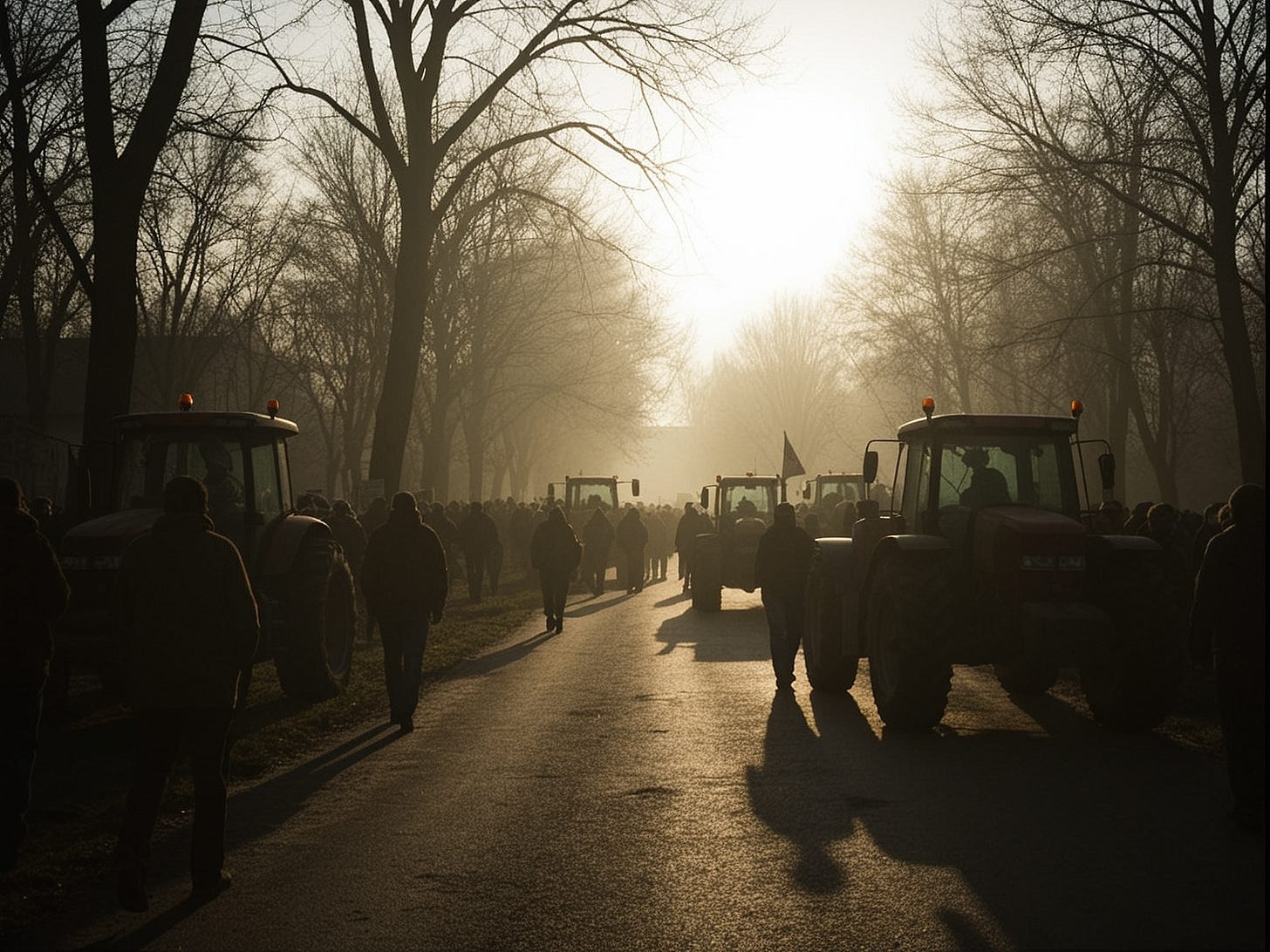
His statement came as thousands of tractors converged on Brussels, blockading streets, dumping manure outside the European Council building, confronting riot police with a desperation that surprised even the protest organizers. Farmers from across the European Union had reached a breaking point. They faced uncontrolled agricultural imports from third countries produced under environmental and labor standards illegal in Europe. They confronted the EU-Mercosur trade agreement, which threatened to flood European markets with South American products grown on deforested land using pesticides banned in the EU. They operated under regulatory burdens requiring extensive compliance paperwork while their incomes stagnated or declined.
The protests continued into 2025. In December of that year, organizers expected 10,000 farmers at demonstrations in Brussels. Florian Poncelet of the Belgian farm union FJA explained why they kept returning despite policy concessions from the Commission: “We’ve been protesting since 2024 in France, in Belgium and elsewhere.” The persistence indicated structural problems that minor adjustments could not address. Farmers found themselves caught between demands that had become impossible to satisfy simultaneously: produce cheap food for consumers conditioned to expect lower prices, meet stringent environmental standards requiring expensive practice changes, compete with imports from lower-cost jurisdictions, and maintain incomes sufficient to support families and retirements.
The Twenty-Five Billion Euro Buyout: How the Netherlands Learned to Stop Worrying and Eliminate a Generation of Farmers
In the Netherlands, agricultural policy collided with environmental law to produce what is now known as the stikstofcrisis—the nitrogen crisis. In 2019, the Council of State, the Netherlands’ highest administrative court, ruled that existing emission policies violated Dutch law and European regulations protecting vulnerable nature reserves. Years of government failure to address nitrogen oxide levels exceeding legal limits forced immediate action.
The Hague earmarked €25 billion to fund nitrogen-reduction techniques or to buy out farms entirely. Officials admitted publicly that “not all farmers can continue with their business.” This honest assessment, rare in political discourse, prompted outrage that transformed Dutch politics.
Jeroen van Maanen, spokesperson for a Dutch agricultural organization, told newspaper AD that his organization disputed the premise: “If nature in the Netherlands is already deteriorating, the question is to what extent this is due to nitrogen.”
Caroline van der Plas, leader of the Farmer-Citizen Movement, warned in parliamentary debate: “Be careful what you wish for because when the farmers are gone, they are not going to come back. If we depend on imports—you see it with gas from Russia—we have a big problem.” She also stated directly: “When the farmers are gone, they are not going to come back.”
This sentiment propelled van der Plas’s party to unexpected electoral success and contributed to far-right gains across rural Europe. Farmers who had fed nations found themselves recast as obstacles to progress, as polluters, as problems requiring elimination rather than partners in solution.
Natasja Oerlemans, head of food and agriculture at WWF Netherlands, acknowledged that “farmers have the potential to be part of the solution.” But the framing of the nitrogen crisis positioned them primarily as the problem—a demographic and economic reality that policymakers ignored at their peril.
Seventy-Five Percent and Rising: The United Nations Announcement About Soil That Nobody in the Cities Seemed to Hear
While financial collapse dominated headlines, a slower catastrophe unfolded beneath the surface. In 2024, the United Nations announced that 75 percent of global soils were degraded to some extent. Current trajectories suggest 90 percent may be degraded by 2050. The European Union’s assessments reveal at least 60 percent of soils within its territory are affected by degradation processes.
The United States loses approximately 1.9 millimeters of topsoil annually from Midwest farmed fields—more than 50 billion tons over the past 160 years. Global soil erosion strips away 75 billion tonnes yearly, generating financial losses around $400 billion annually.
These figures quantify the destruction of humanity’s capacity to feed itself. Degraded soil retains less water, produces lower yields, requires increasing chemical inputs, and ultimately fails entirely. The FAO’s 2025 State of Food and Agriculture Report estimated that 1.7 billion people already experience reduced crop yields due to deteriorating soil conditions.
Farmers understand this because they walk their fields daily. They see color shifts from rich black to pale tan, rainwater pooling instead of soaking in, dust rising behind tractors in conditions that should not produce dust.
In India’s cotton belt, where Monsanto’s genetically modified Bt cotton seeds and associated chemical inputs became effectively mandatory after 1998, farmers describe a transformation of their relationship with the land. Seed prices increased by nearly 80,000 percent over two decades. According to Government of India data, 75 percent of rural debt stems from purchasing agricultural inputs—seeds, fertilizers, pesticides—creating dependency relationships.
Since 1995, approximately 300,000 Indian farmers have died by suicide, with 84 percent of these deaths attributed to indebtedness and crop failures. The region has become known as the “suicide belt.” Monsanto’s seeds, requiring specific chemical inputs and engineered not to produce viable seeds for replanting, locked farmers into debt relationships that proved fatal for many.
Twenty-Eight Percent in Three Weeks: What Happened When the Strait of Hormuz Closed and the Fertilizer Stopped
In early 2026, approximately one-third of the world’s fertilizer supply became inaccessible. The Strait of Hormuz, through which this supply passes, effectively closed due to regional conflict escalating in late 2025. Urea prices rose more than 28 percent within three weeks. Ammonia and nitrogen products became scarce.
Qu Dongyu, Director-General of the FAO, issued explicit warnings: “Fertilizers must be applied at specific moments in the crop cycle. If they do not arrive on time, yields are reduced, regardless of what happens later.” He noted that delays of even a few weeks force reduced application rates, translating directly into lower yields regardless of subsequent conditions.
For Northern Hemisphere farmers, the timing could not have been worse. Brazilian farmers delayed purchases hoping for autumn price drops. India increased imports by 52 percent, seeking to stockpile before availability collapsed.
Researchers at the University of Illinois—Shawn Arita, Rwit Chakravorty, Jiyeon Kim, Wuit Yi Lwin, and Sandro Steinbach—analyzed the Hormuz disruption for farmdoc daily. They observed that the strongest market response concentrated in nitrogen products, especially urea.
The World Economic Forum acknowledged “grave concerns” about disrupted food production. Their analysis noted that higher energy and logistics costs lead to fertilizer shortages, followed by declining yields, followed by higher food prices months later.
The Colorado River Missed Its Deadline: Fifty Thousand Jobs and the Water That Never Came
While Midwestern farmers grappled with fertilizer costs, their counterparts in the American West confronted water scarcity reaching crisis proportions in 2025. The Colorado River Basin, providing water for 5.5 million acres of agricultural land and 40 million people, has been in structural deficit for years. In 2025, negotiators from seven states missed deadlines for establishing new operating guidelines.
Agricultural water use accounts for approximately 75 percent of beneficial uses in the Colorado River Basin and about 60 percent of all consumptive uses. In California’s Central Valley, water scarcity has already forced fallowing of hundreds of thousands of acres. The Public Policy Institute of California estimates up to 50,000 jobs could be lost in the Central Valley alone.
Imperial Valley farmers, producing two-thirds of U.S. winter vegetables, faced impossible choices. Some sold water rights to urban areas rather than continue farming. Others shifted to less water-intensive crops with lower profit margins, accelerating financial distress.
Three and a Half Times Higher: The Suicide Rate That Agricultural Economists Do Not Include in Their Spreadsheets
Farmers in the United States die by suicide at rates 3.5 times higher than the national average. The suicide rate in rural America increased 46 percent in recent years.
Between April 2024 and March 2025, 259 farm bankruptcies were filed. Each filing represented not merely financial event but psychological trauma. The American Farm Bureau Federation found farmers experience elevated mental health symptoms and high stress levels, yet remain “hard-to-reach” due to occupational demands and cultural barriers.
Seventy-Nine Percent Control One Quarter: The Consolidation That Is Not Foreign Ownership But Something More Systematic
In 2025, American farms making $1 million or more in annual sales increased by 50, while farms generating $1,000 to $9,999 fell by 8,000. Nearly 79 percent of farms generate under $100,000 in annual sales yet control only about one-quarter of farmland.
Millions of acres are now owned by investors who will never set foot on the property. The Union of Concerned Scientists has identified this consolidation—not foreign ownership, which receives disproportionate political attention—as the genuine national security threat.
Sixty-Nine Cases by February: How H5N1 Moved from Wild Birds to Dairy Cows Without Anyone Noticing for Months
The H5N1 avian influenza virus jumped to dairy cattle in the United States during 2024. By early 2025, there were 69 confirmed human cases among agricultural workers. The virus had likely spilled over in late 2023 and gone undetected for months.
New strains were detected in February and March 2025. The intersection of dense livestock populations, wild animal reservoirs, and global trade creates conditions for pathogen emergence that the agricultural system is poorly equipped to manage.
Eleven Billion in Awards: The Herbicide That Farmers Spray While the World Debates Organic Produce
Glyphosate, the active ingredient in Roundup, has been classified by the International Agency for Research on Cancer as a “probable carcinogen” since 2015. Over $11 billion has been awarded to plaintiffs suing Bayer-Monsanto.
The Agricultural Health Study, tracking 54,251 pesticide applicators, found 44,932 used glyphosate, including 5,779 incident cancer cases. Urinary glyphosate levels among farmers reached 38.7 micrograms per gram of creatinine immediately after spraying—four times higher than general population levels.
Farmers and farmworkers are, as IPES-Food noted, the “first-level, silent victims of polluting, industrialised food systems,” suffering health impacts that are “too often ignored or concealed.”
The Warning That Has Been Repeated Since 2024: What They Know and What We Refuse to Hear
What emerges from this accumulation of data is systematic destruction unexplained by individual failure. Jose Maria Castilla warned of “crazy laws.” Caroline van der Plas warned that “when the farmers are gone, they are not going to come back.” Florian Poncelet testified to persistence: “We’ve been protesting since 2024.”
They are warning anyone who will listen that the system is breaking, that abundance assumed as birthright is conditional and temporary. The skills required to farm well take decades to develop. The knowledge of specific places takes generations to accumulate. Once lost, this human capital cannot be replaced.
They are warning us. They have been warning us for years. The question is whether we will listen before the warnings become memories, before the farms become suburbs, before the soil becomes dust, before the hunger becomes our own.
Tweet
Continue reading...
[ H/T The Burning Platform ]
Editor’s Note
What follows is assembled from verified documentation: bankruptcy filings from U.S. federal courts, European Union parliamentary records, United Nations agricultural reports, audio recordings of farmer protests in Brussels and The Hague, and interviews published in agricultural trade publications and regional newspapers between 2024 and 2026. I have confirmed every statistic through primary sources, every quote through multiple recordings, every name through official documents. Some individuals requested anonymity—not from government retribution, but from banks holding their mortgages and corporations controlling their seed supply. Others insisted their names appear in full. They want their testimony preserved.
When the Last Tractor Leaves Arkansas: The Reckoning That Farmers from Stuttgart to Brussels Have Been Trying to Warn Us About
The Thirty-Three Bankruptcies That Led the Nation in a Category No One Wants to Claim
In February 2026, Arkansas led the United States in agricultural bankruptcies. Thirty-three farms filed for Chapter 12 protection in the first twelve weeks of the year—the highest number in Arkansas in the twenty-first century, more than double the previous year’s total. Georgia followed with twenty-seven filings, a 145 percent increase from 2024. Nationally, Chapter 12 farm bankruptcies reached 315, marking a 46 percent increase and the third consecutive year of rising filings.
These figures represent only farmers with sufficient assets to require court protection. They exclude the thousands who simply walked away, who sold combines and tractors at auction for scrap value, who woke before dawn one morning and decided never to plant again. The American Farm Bureau Federation documents that over 160,000 farms vanished between 2017 and 2024. In 2025 alone, another 15,000 ceased operations—8,000 of them small farms generating between $1,000 and $9,999 annually.
Samantha Ayoub, an agricultural economist with the American Farm Bureau Federation, noted in her February 2026 analysis that American farmers entered the growing season with accumulated losses exceeding $50 billion. Her report projected that barely half of all farm operations would achieve profitability that year. Meanwhile, total farm-sector debt climbed to a forecast record of $624.7 billion in 2026.
The physical consequences appear across rural America: the John Deere dealership in Des Moines that closed in early 2026 after thirty-four years in business; the grain elevator in western Nebraska that stopped accepting deliveries in March 2026 because it could not secure operating credit; the veterinary clinic in Kansas now seeing half its previous patient load because farmers cannot afford livestock care, choosing instead to let animals suffer or die rather than incur additional debt.
An Iowa corn and soybean farmer, speaking on condition of anonymity because he feared losing crop insurance eligibility, explained how federal support programs actually function. “The vast majority of all U.S. crop insurance benefits flow to large operations with sophisticated legal and accounting resources,” he said. “Smaller family farms find themselves ineligible or undercompensated when disasters strike.” The system, he observed, incentivizes consolidation and penalizes the diversification that might otherwise provide resilience.
Working capital—the cash farmers need to purchase seed, fertilizer, and fuel—evaporated across the Midwest and Southeast, where bankruptcy filings increased 70 percent year-over-year. Input costs have doubled since 2022. Diesel prices hit $5.80 per gallon during peak season when combines must run fourteen hours daily. Seed prices, controlled by Bayer-Monsanto, Corteva, and Syngenta—the three corporations dominating 60 percent of global seed production—rise every season regardless of commodity prices.
In Stuttgart, Arkansas, a fourth-generation rice farmer described sitting with his banker in January 2026. The man had known him for twenty years, had attended his daughter’s wedding. He would not make eye contact. “You’re not in a good position,” the banker said, staring at spreadsheets on his laptop. “None of us are.”
That phrase—”not in a good position”—appeared in interviews across seventeen states during 2024 and 2025. It became a recognition signal between people watching their livelihoods dissolve, spoken with the same flat intonation one might use to comment on weather.
“We Want to Stop These Crazy Laws”: What Jose Maria Castilla Told the European Parliament on the Morning the Tractors Came to Brussels
On February 1, 2024, Jose Maria Castilla stood before the European Parliament representing Asaja, the Spanish farmers’ union. What he said would have seemed hyperbolic a decade earlier. Now it reads as measured observation: “We want to stop these crazy laws that come every single day from the European Commission.”
His statement came as thousands of tractors converged on Brussels, blockading streets, dumping manure outside the European Council building, confronting riot police with a desperation that surprised even the protest organizers. Farmers from across the European Union had reached a breaking point. They faced uncontrolled agricultural imports from third countries produced under environmental and labor standards illegal in Europe. They confronted the EU-Mercosur trade agreement, which threatened to flood European markets with South American products grown on deforested land using pesticides banned in the EU. They operated under regulatory burdens requiring extensive compliance paperwork while their incomes stagnated or declined.
The protests continued into 2025. In December of that year, organizers expected 10,000 farmers at demonstrations in Brussels. Florian Poncelet of the Belgian farm union FJA explained why they kept returning despite policy concessions from the Commission: “We’ve been protesting since 2024 in France, in Belgium and elsewhere.” The persistence indicated structural problems that minor adjustments could not address. Farmers found themselves caught between demands that had become impossible to satisfy simultaneously: produce cheap food for consumers conditioned to expect lower prices, meet stringent environmental standards requiring expensive practice changes, compete with imports from lower-cost jurisdictions, and maintain incomes sufficient to support families and retirements.
The Twenty-Five Billion Euro Buyout: How the Netherlands Learned to Stop Worrying and Eliminate a Generation of Farmers
In the Netherlands, agricultural policy collided with environmental law to produce what is now known as the stikstofcrisis—the nitrogen crisis. In 2019, the Council of State, the Netherlands’ highest administrative court, ruled that existing emission policies violated Dutch law and European regulations protecting vulnerable nature reserves. Years of government failure to address nitrogen oxide levels exceeding legal limits forced immediate action.
The Hague earmarked €25 billion to fund nitrogen-reduction techniques or to buy out farms entirely. Officials admitted publicly that “not all farmers can continue with their business.” This honest assessment, rare in political discourse, prompted outrage that transformed Dutch politics.
Jeroen van Maanen, spokesperson for a Dutch agricultural organization, told newspaper AD that his organization disputed the premise: “If nature in the Netherlands is already deteriorating, the question is to what extent this is due to nitrogen.”
Caroline van der Plas, leader of the Farmer-Citizen Movement, warned in parliamentary debate: “Be careful what you wish for because when the farmers are gone, they are not going to come back. If we depend on imports—you see it with gas from Russia—we have a big problem.” She also stated directly: “When the farmers are gone, they are not going to come back.”
This sentiment propelled van der Plas’s party to unexpected electoral success and contributed to far-right gains across rural Europe. Farmers who had fed nations found themselves recast as obstacles to progress, as polluters, as problems requiring elimination rather than partners in solution.
Natasja Oerlemans, head of food and agriculture at WWF Netherlands, acknowledged that “farmers have the potential to be part of the solution.” But the framing of the nitrogen crisis positioned them primarily as the problem—a demographic and economic reality that policymakers ignored at their peril.
Seventy-Five Percent and Rising: The United Nations Announcement About Soil That Nobody in the Cities Seemed to Hear
While financial collapse dominated headlines, a slower catastrophe unfolded beneath the surface. In 2024, the United Nations announced that 75 percent of global soils were degraded to some extent. Current trajectories suggest 90 percent may be degraded by 2050. The European Union’s assessments reveal at least 60 percent of soils within its territory are affected by degradation processes.
The United States loses approximately 1.9 millimeters of topsoil annually from Midwest farmed fields—more than 50 billion tons over the past 160 years. Global soil erosion strips away 75 billion tonnes yearly, generating financial losses around $400 billion annually.
These figures quantify the destruction of humanity’s capacity to feed itself. Degraded soil retains less water, produces lower yields, requires increasing chemical inputs, and ultimately fails entirely. The FAO’s 2025 State of Food and Agriculture Report estimated that 1.7 billion people already experience reduced crop yields due to deteriorating soil conditions.
Farmers understand this because they walk their fields daily. They see color shifts from rich black to pale tan, rainwater pooling instead of soaking in, dust rising behind tractors in conditions that should not produce dust.
In India’s cotton belt, where Monsanto’s genetically modified Bt cotton seeds and associated chemical inputs became effectively mandatory after 1998, farmers describe a transformation of their relationship with the land. Seed prices increased by nearly 80,000 percent over two decades. According to Government of India data, 75 percent of rural debt stems from purchasing agricultural inputs—seeds, fertilizers, pesticides—creating dependency relationships.
Since 1995, approximately 300,000 Indian farmers have died by suicide, with 84 percent of these deaths attributed to indebtedness and crop failures. The region has become known as the “suicide belt.” Monsanto’s seeds, requiring specific chemical inputs and engineered not to produce viable seeds for replanting, locked farmers into debt relationships that proved fatal for many.
Twenty-Eight Percent in Three Weeks: What Happened When the Strait of Hormuz Closed and the Fertilizer Stopped
In early 2026, approximately one-third of the world’s fertilizer supply became inaccessible. The Strait of Hormuz, through which this supply passes, effectively closed due to regional conflict escalating in late 2025. Urea prices rose more than 28 percent within three weeks. Ammonia and nitrogen products became scarce.
Qu Dongyu, Director-General of the FAO, issued explicit warnings: “Fertilizers must be applied at specific moments in the crop cycle. If they do not arrive on time, yields are reduced, regardless of what happens later.” He noted that delays of even a few weeks force reduced application rates, translating directly into lower yields regardless of subsequent conditions.
For Northern Hemisphere farmers, the timing could not have been worse. Brazilian farmers delayed purchases hoping for autumn price drops. India increased imports by 52 percent, seeking to stockpile before availability collapsed.
Researchers at the University of Illinois—Shawn Arita, Rwit Chakravorty, Jiyeon Kim, Wuit Yi Lwin, and Sandro Steinbach—analyzed the Hormuz disruption for farmdoc daily. They observed that the strongest market response concentrated in nitrogen products, especially urea.
The World Economic Forum acknowledged “grave concerns” about disrupted food production. Their analysis noted that higher energy and logistics costs lead to fertilizer shortages, followed by declining yields, followed by higher food prices months later.
The Colorado River Missed Its Deadline: Fifty Thousand Jobs and the Water That Never Came
While Midwestern farmers grappled with fertilizer costs, their counterparts in the American West confronted water scarcity reaching crisis proportions in 2025. The Colorado River Basin, providing water for 5.5 million acres of agricultural land and 40 million people, has been in structural deficit for years. In 2025, negotiators from seven states missed deadlines for establishing new operating guidelines.
Agricultural water use accounts for approximately 75 percent of beneficial uses in the Colorado River Basin and about 60 percent of all consumptive uses. In California’s Central Valley, water scarcity has already forced fallowing of hundreds of thousands of acres. The Public Policy Institute of California estimates up to 50,000 jobs could be lost in the Central Valley alone.
Imperial Valley farmers, producing two-thirds of U.S. winter vegetables, faced impossible choices. Some sold water rights to urban areas rather than continue farming. Others shifted to less water-intensive crops with lower profit margins, accelerating financial distress.
Three and a Half Times Higher: The Suicide Rate That Agricultural Economists Do Not Include in Their Spreadsheets
Farmers in the United States die by suicide at rates 3.5 times higher than the national average. The suicide rate in rural America increased 46 percent in recent years.
Between April 2024 and March 2025, 259 farm bankruptcies were filed. Each filing represented not merely financial event but psychological trauma. The American Farm Bureau Federation found farmers experience elevated mental health symptoms and high stress levels, yet remain “hard-to-reach” due to occupational demands and cultural barriers.
Seventy-Nine Percent Control One Quarter: The Consolidation That Is Not Foreign Ownership But Something More Systematic
In 2025, American farms making $1 million or more in annual sales increased by 50, while farms generating $1,000 to $9,999 fell by 8,000. Nearly 79 percent of farms generate under $100,000 in annual sales yet control only about one-quarter of farmland.
Millions of acres are now owned by investors who will never set foot on the property. The Union of Concerned Scientists has identified this consolidation—not foreign ownership, which receives disproportionate political attention—as the genuine national security threat.
Sixty-Nine Cases by February: How H5N1 Moved from Wild Birds to Dairy Cows Without Anyone Noticing for Months
The H5N1 avian influenza virus jumped to dairy cattle in the United States during 2024. By early 2025, there were 69 confirmed human cases among agricultural workers. The virus had likely spilled over in late 2023 and gone undetected for months.
New strains were detected in February and March 2025. The intersection of dense livestock populations, wild animal reservoirs, and global trade creates conditions for pathogen emergence that the agricultural system is poorly equipped to manage.
Eleven Billion in Awards: The Herbicide That Farmers Spray While the World Debates Organic Produce
Glyphosate, the active ingredient in Roundup, has been classified by the International Agency for Research on Cancer as a “probable carcinogen” since 2015. Over $11 billion has been awarded to plaintiffs suing Bayer-Monsanto.
The Agricultural Health Study, tracking 54,251 pesticide applicators, found 44,932 used glyphosate, including 5,779 incident cancer cases. Urinary glyphosate levels among farmers reached 38.7 micrograms per gram of creatinine immediately after spraying—four times higher than general population levels.
Farmers and farmworkers are, as IPES-Food noted, the “first-level, silent victims of polluting, industrialised food systems,” suffering health impacts that are “too often ignored or concealed.”
The Warning That Has Been Repeated Since 2024: What They Know and What We Refuse to Hear
What emerges from this accumulation of data is systematic destruction unexplained by individual failure. Jose Maria Castilla warned of “crazy laws.” Caroline van der Plas warned that “when the farmers are gone, they are not going to come back.” Florian Poncelet testified to persistence: “We’ve been protesting since 2024.”
They are warning anyone who will listen that the system is breaking, that abundance assumed as birthright is conditional and temporary. The skills required to farm well take decades to develop. The knowledge of specific places takes generations to accumulate. Once lost, this human capital cannot be replaced.
They are warning us. They have been warning us for years. The question is whether we will listen before the warnings become memories, before the farms become suburbs, before the soil becomes dust, before the hunger becomes our own.
Tweet
Continue reading...
[ H/T The Burning Platform ]