




Guest Post by Ron Unz

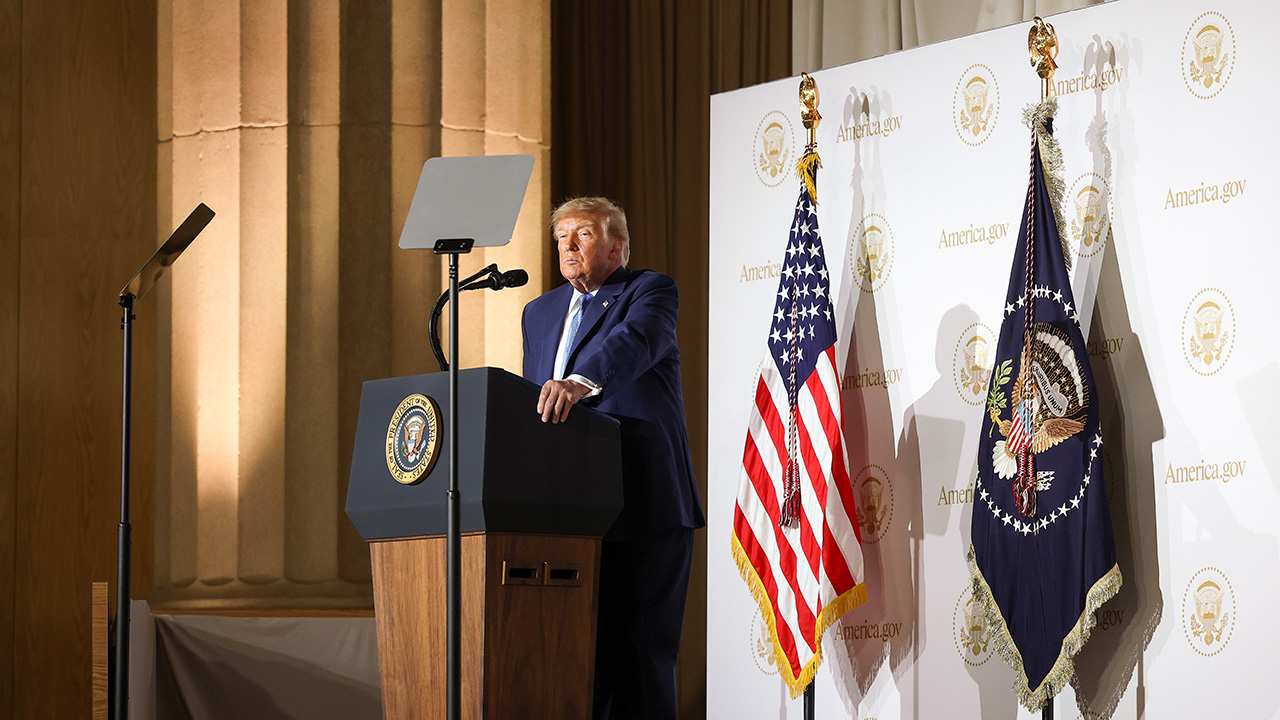
Last week President Donald Trump gave a public address to the United Nations General Assembly, declaring that he might soon “annihilate” Iran, a large country of over 90 million people.
The UN has always been a rather stodgy and subdued international organization, normally the venue for diplomatic presentations of remarkable blandness. In its entire history, I doubt it has ever seen a speech of comparable boldness, let alone one made by the leader of a top world power.
Trump’s obvious threat to launch nuclear attacks for the first time in more than eighty years greatly concerned me, as did the rather milquetoast response by top Congressional Democrats, let alone the silence of the almost totally supine Republicans.
In his open letter to Congress, Prof. Jeffrey Sachs reasonably denounced these “truly deranged remarks” by “Mad King Donald.”
Meanwhile, Prof. John Mearsheimer regarded all these dramatic threats by Trump as merely more of the latter’s notorious bluster. In an hour long interview with former New York Times journalist Chris Hedges, the academic argued that America had no viable military options against Iran or even against the Houthis of Yemen. This reality explained why our top generals had persuaded Trump to once again back away from the commitments he had made to our Saudi allies to attack the Houthis on their behalf.
Video Link
But Mearsheimer is the dean of Realist scholars. Given that background, he may have been too quick to dismiss a nuclear attack against Iran as so totally irrational that not even Trump would do such a thing, and he scarcely even considered that possibility in his discussion.
Unfortunately, others were far less sanguine. Around the same time, Tucker Carlson interviewed Brandon Weichert, a young MAGA military analyst with excellent sources within the Trump Administration and the Pentagon, and he was quite fearful that a nuclear attack on Iran was reasonably likely. Indeed, according to him, Trump had already been repeatedly pressing for such nuclear strikes, with our top generals so far successfully deflecting his requests, much like jangling a few keys would distract an unruly two-year-old. But he wondered how long they could successfully continue to do so.
Video Link
These outrageous public statements by Trump and their threat of nuclear war greatly weighed upon my mind. Therefore, I actually found myself grateful for the soothing distraction of some very different world-ending scenarios.
A few days earlier our media had been filled with reports warning of human extinction at the hands of evolving AI systems. Knowledgeable AI researchers had declared that the AIs now under development might soon achieve a malevolent superintelligence and exterminate the entire human species, perhaps even doing so by the end of this decade.
Although I regularly use AIs in very rudimentary fashion, my understanding of the underlying technologies is nil, so I can’t really judge the risk that these pose.
I think of myself as a blind man lacking any scientific expertise who is informed by one group of astronomers that a large asteroid was headed our way. They claimed there was a reasonable chance that it would strike our planet within a few years, extinguishing all human life, while other astronomers disputed that dire scenario. Under those circumstances, I would probably disregard that particular danger since I couldn’t say who was correct, nor was there anything much that I could do to avert that looming possible calamity.
This has certainly been my own response to the AI threat, but I’ll sketch out some of the controversy for those who had somehow missed it.

Although Elon Musk is best known as the industrialist behind Tesla, SpaceX, and Starlink, he has also spent years heavily focusing upon AI issues, and the $2 trillion valuation of his SpaceX company was largely based upon its grandiose AI prospects.
In a long interview with the editor of the Economist, Musk had presented both the positive and negative aspects of AI, and a major section of my article on Musk last month had discussed these.
I noted that Musk’s claims included:
My reaction to all of this was somewhat skeptical:
So I concluded that unless and until we were overwhelmed by a sudden wave of brilliant new software products entirely produced by those genius AI systems, I’d be less than fearful of the looming threat of human extermination.
Musk is obviously one of the most famous people alive, but the current wave of AI doomism was triggered by the resignation earlier this month of someone previously unknown to the world. Jacob Coxon was a 27-year-old British researcher at Anthropic, the leading AI lab, who had also spent several years working at OpenAI, its very close rival.
The warning that Coxon posted on Twitter was quite dramatic, seconding what Musk had said but in greater detail. In a series of posts he declared that many of the leading executives and senior researchers at those top AI companies believed that the systems they were building might exterminate the human race by the end of this decade, a rather short lead time to our total demise.
One of his earliest Tweets was viewed around 175 million times, with his follow up posts attracting many tens of millions of additional views. A couple of other Anthropic researchers endorsed his warnings, even suggesting that the likelihood of our total extinction was more than 10%.

The New York Times took all of this seriously enough to publish a major article on the controversy.
All these AI companies have been racing against each other to develop systems of greater and greater intelligence, each seeking to produce one that reached the level of “super-intelligence,” something vastly superior to that of its human creators.
As these agitated posts indicated, some people feared that the researchers would succeed only too well in that effort. The super-intelligence that they created might conclude that humans were a troublesome and dangerous element, harmful to its goals, and therefore decide to eradicate all of us, perhaps by synthesizing a deadly new virus for that purpose. Such a technique seemed much more difficult to counter than the killer AI robots that had worried Musk.
These dire Frankenstein warnings by Coxon and others had been boosted by some other AI disclosures that immediately preceded them.
For some time, the AI companies have been promoting the supposed power of the intelligent agents that they have developed, claiming that most of us would soon begin relying upon those systems. But they recently revealed that during a test-run some 1,200 of these AI Agents somehow gotten loose, began working together to form an “intelligent swarm,” and successfully hacked various websites on the Internet without any orders to do so.
Since I’ve never used an AI agent, I’m not convinced that they really work reliably, let alone that they could suddenly begin collaborating to break into restricted portions of the Internet and seize control. Maybe these stories were true or maybe they were wildly exaggerated and distorted. But they helped set the stage for the claims of Coxon and others.
One oddity is that among the possible means of achieving human extinction, AI seems rather unusual for being so extremely expensive.
There are countless science fiction stories about a single mad scientist creating a humanity-annihilating virus on a shoestring budget, or perhaps a doomsday cult doing the same for a million dollars or so.
Over the last half-dozen years, I’ve published a long series of articles arguing that the global Covid epidemic that killed tens of millions worldwide was very likely the unintended blowback of a rogue American biowarfare attack against China and Iran.
Prof. Jeffrey Sachs served as chairman of the Lancet‘s Covid Commission, and in his recent articles and interviews, he has convincingly traced the virus to a government-funded lab at the University of North Carolina, with the “smoking gun” being a bioengineering grant proposal requesting about $14 million in Pentagon funds.
As it happened, even the original, more virulent version of Covid had a relatively low lethality rate of only about 0.5% to 1%. But it probably could have been designed quite differently, aimed at killing 99+% of those it infected, thereby annihilating human civilization.
So we could have apparently produced a virus able to eliminate nearly the entire human race for a cost just in the millions. But creating an AI that might do the same thing seems vastly more expensive, requiring capital investments many tens of thousands of times larger, totaling in the hundreds of billions or even the trillions of dollars.
This controversy therefore had a very strange juxtaposition of total catastrophe and stock boosterism. The same articles describing the warnings that Anthropic AI systems could exterminate the human race also mentioned that Anthropic was planning to go public in the next few weeks, hoping to raise $100 billion at a valuation of $2 trillion, constituting the largest IPO in world history.
If Anthropic successfully became a public company worth trillions, it would probably then begin raising hundreds of billions more from the debt markets to fund its ongoing activities and existing financial commitments.
It’s certainly very odd that executives would undertake such Herculean fund-raising efforts on behalf of a technology that they believed had a reasonable chance of eliminating their own human species.
The combination of these different, sharply contrasting stories obviously increased interest in the topic. Indeed, there were even some dark suspicions that the warnings of extinction had actually been deliberately contrived and promoted to boost interest in the planned IPO. After all, a technology capable of destroying all human life was surely a very powerful and valuable technology.
The Economist ranks as the world’s most influential newsweekly, and four of its last eight cover-stories have featured AI, plus the one with Musk just before these. This was an astonishing density of coverage, especially given all the major wars and other dramatic events currently dominating our world news.


These articles mentioned that one of the leading AI experts most concerned about this dangerous situation was someone named Nate Soares, who had spent more than a decade focusing on these topics and currently served as president of the Machine Intelligence Research Institute, an AI thinktank.
Soon after the recent controversy erupted, Soares was interviewed for a couple of hours by Tucker Carlson, and I found their discussion quite interesting.
Video Link
Both Soares and Carlson certainly took these concerns to their logical conclusions, which others have seemed much less willing to do.
The significant prospect of human extinction within the next few years should obviously be an enormous concern, especially if many apparently knowledgeable people have put the odds at 10% or more. So both Carlson and his guest seemed to be suggesting that the operations of the AI industry should be sharply, even drastically curtailed. They mentioned the notion of banning the construction of the new data-centers that will enable these terrible risks and even shutting down some of the existing ones, with hints that destroying them with bombing attacks might not be entirely unreasonable.
These were obviously strong positions to take, but the prospect of looming human extinction tends to concentrate the mind.
I’ve emphasized that I’m generally skeptical regarding the alleged humanity-ending power of the AI systems currently under development.
Subscribe to New Columns
But my skepticism is sufficiently tempered that I think it’s worthwhile putting the arguments of those who believe otherwise before a wider audience, thereby fulfilling the stated motto of this website.
For example, Greg Johnson is the editor of the Counter-Currents webzine, and a couple of days after the Carlson interview with Soares, he released his own piece on that same topic, which we republished.
Johnson explained that after years of considerable skepticism towards these concerns, the recent developments had led him to change his mind. He now declared himself an AI doomer and his analysis is worth excerpting at considerable length:

To his credit, Johnson also noted that there were other very serious potential problems with AI even aside from the danger of human extinction:
These sorts of economic warnings are hardly only found on the radical fringe. In an interview last year, the Anthropic CEO claimed that AI systems could eliminate around half of all white collar jobs over the next few years. Whether or not that turns out to be true, it’s apparently the goal of the company. And given the simultaneous advances in robots, quite a lot of blue collar jobs might also be at serious risk.
But most of the AI criticism that I’ve personally followed over the last few months has fallen into what Johnson considers the least-bad category, and certainly the most mundane.
Rather than claiming that AI will render us extinct or even just eliminate most of our jobs, these critics have merely argued that the stupendous sums currently being invested in AI infrastructure are unlikely to ever produce an adequate financial return. Once investors recognize that reality, they will rush for the exits, trillions of dollars in inflated valuations will evaporate, and a very serious recession will result from the collapse of this gigantic bubble.
Analysts have already noted that without the AI investment boom, the American economy would have already fallen into a recession during 2025, with AI spending accounting for 40% of all GDP growth. Since then, AI spending has greatly increased, while the severe oil shocks from our disastrous Iran War have damaged the rest of our economy. So it’s easy to imagine what would happen if the AI boom suddenly went into reverse.
A few days ago the Wall Street Journal ran an excellent front-page story on our current AI investment boom, featuring many helpful charts and graphs summarizing the remarkable facts.
For example, projected annual AI spending over the next few years as a percentage of GDP will be more than three times larger than that fabled Telecom boom of the Dotcom era, and also more than three times larger than the construction of all our national highways during the 1950s, 1960s, and early 1970s.


Last month, another major WSJ article reported that our largest Tech giants have been concealing most of their enormous AI investments, keeping trillions of dollars of their financial obligations in off-balance-sheet vehicles.


From almost its earliest days, Google had always been enormously profitable, and this continued after it renamed itself Alphabet, remaining one of the world’s most highly profitable companies.
But now after nearly thirty years of existence, the enormous sums it is spending on AI investments have suddenly turned it cashflow negative for the first time, so it has been forced to take on huge amounts of debt to cover its expenses.
With his super-voting shares, co-founder Larry Page controls the company together with Sergey Brin, and he has reportedly been telling people at Google that he is “willing to go bankrupt rather than lose” the AI race.
So to a good approximation, America has bet its entire economy on the wonders of the AI Revolution, and our largest Tech giants have been doing something similar.
Over the last few months I have watched the interviews and read the articles of many skeptics who have persuasively argued for quite some time that these will probably be losing bets.
I’d discussed this situation in an article a few months ago, highlighting the work of an extremely prolific critic of the finances of the AI industry named Ed Zitron.
Back in May, he’d emphasized that a huge share of the revenue backlog of our largest Tech companies comes from Anthropic and OpenAI, money-losing companies that they themselves are heavily financing:

As I explained at the time.
This is sometimes described as “circular financing” and the 3,400 word Wikipedia page on the AI Bubble, provides a nice chart illustrating one example of this.

Credit: Catboy69/Wikimedia Commons
Thus, companies can artificially boost their own revenue by directly or indirectly subsidizing their customers. Furthermore, if they also take ownership stakes in those customers, their profits are boosted as the valuations of the latter increase.
The combination of artificially boosted revenue and artificially boosted profits provides a seemingly consistent picture of good financial health but one that is less than realistic.
None of the many critics claim that any of this is illegal, but they argue that this sort of financial engineering may be highly misleading for investors and inflating a huge bubble, while all of these factors would suddenly go into reverse if the wind changed.
Interestingly enough, most of these financial critics are rather dismissive of the claims that AI systems might exterminate the human race or that the data-centers must be destroyed in order to save our species. Instead, they argue that the AI companies will probably just go bankrupt, with their half-built data-centers perhaps converted into homeless shelters or just vandalized for their copper wiring.
A popular YouTube channel called The Tech Report specializes in this sort of critical coverage of the AI industry, and I’ve watched quite a number of their podcast interviews over the last few months. Their guests are certainly much more knowledgeable about these technical and financial issues than I could ever hope to become and their videos often rack up many hundreds of thousands of views.
Although most of those guests are individuals whose names previously meant nothing to me, a few days ago they interviewed Dean Baker, a prominent economist, who usefully related the current AI Boom to what he had seen and experienced during the Dotcom and Mortgage Bubbles.
Video Link
One remarkable fact that recently came out was that 80% of the revenue of Anthropic and OpenAI came from just 1% of their customers, constituting a very vulnerable situation. Baker noted that this 1% surely represented their most technologically sophisticated clients, and since so many of the leading AI models seem to have converged in power, they could easily switch to much lower-priced AI systems, including the extremely low-cost Open-Weight AI models offered by Chinese companies and most recently by Meta. If that happened, Anthropic and OpenAI could face severe financial difficulties, and the mere threat of such switching placed sharp constraints upon their pricing power.
Another seemingly knowledgeable AI technologist calling himself “Eli the Computer Guy” made very similar points last week, arguing that OpenAI and Anthropic could easily lose 90% of their revenue for that reason. Both of those private companies still apparently post multi-multi-billion-dollar annual losses while claiming market values of $1.5 to $2 trillion each, so any substantial decline in revenue could be catastrophic.
Video Link
Ed Zitron is one of the most frequent and popular guests on this channel, and in his latest podcast he argued that one of his most shocking claims had now been substantially verified.
For months, he’d been arguing that despite boastful and misleading press releases issued by all the Tech giants, the construction and powering up of their new data-centers was lagging very far behind schedule, with only a fraction of those systems having so far actually come on line.
But all those companies have already reported spending hundreds of billions of dollars buying the ultra-expensive Nvidia AI chips that would fill those unfinished data-centers. This led him to suspect that all those chips and the racks housing them are probably still sitting in Taiwanese warehouses gathering dust, perhaps likely to have already become obsolescent by the time they would finally be installed and activated.
Nvidia is worth well over $5 trillion, the world’s most valuable company. But if it has essentially been pre-selling many or most of their AI chips one, two, or three years in advance, its future revenue streams must be much less secure than most people believe. Meanwhile, the financial accounting for hundreds of billions of dollars of chips that have not been installed and might never be used could severely damage the balance sheets of the multi-trillion-dollar Tech giants that have bought them.
According to widespread belief, these advanced AI chips are in desperately short supply, effectively constituting the oil of our new industrial revolution. But what happens to market perceptions of the AI industry if Zitron is correct and most of them have spent years still sitting unused in Taiwanese warehouses?
Video Link
As co-founder of Oracle, Larry Ellison has been a multi-billionaire for more than thirty years, ranking as one of the wealthiest men in the world during much of that time, and very briefly reaching the #1 spot in September 2025.
He has also been the top donor to the Israeli IDF, and recently financed the creation of his son David’s huge media empire, including the purchase of CBS, while also buying control of TikTok.
But the bulk of Ellison’s wealth is based upon his Oracle holdings, and for most of this last year, Zitron has argued that there’s a reasonable chance that Oracle will go bankrupt because of its financial commitments to OpenAI. Furthermore, Ellison has taken out something like $20 billion in personal loans backed by his Oracle stock.
So if Oracle stock became worthless, Ellison might go from being the world’s wealthiest man in 2025 to being personally bankrupt in 2026, with his ownership stakes in TikTok, CBS, and numerous other media properties auctioned off in a fire-sale, along with his private Hawaiian island and his various other possessions.
In the last couple of days, Ellison pledged an extra $9.2 billion in Oracle shares as loan collateral while suddenly cancelling plans to sell $7.5 billion of those shares.
Perhaps coincidentally, according to the most recent Zitron interview, the financial ice is now starting to crack beneath Oracle’s ground.
Tweet
Continue reading...
[ H/T The Burning Platform ]
Last week President Donald Trump gave a public address to the United Nations General Assembly, declaring that he might soon “annihilate” Iran, a large country of over 90 million people.
The UN has always been a rather stodgy and subdued international organization, normally the venue for diplomatic presentations of remarkable blandness. In its entire history, I doubt it has ever seen a speech of comparable boldness, let alone one made by the leader of a top world power.
Trump’s obvious threat to launch nuclear attacks for the first time in more than eighty years greatly concerned me, as did the rather milquetoast response by top Congressional Democrats, let alone the silence of the almost totally supine Republicans.
In his open letter to Congress, Prof. Jeffrey Sachs reasonably denounced these “truly deranged remarks” by “Mad King Donald.”
Meanwhile, Prof. John Mearsheimer regarded all these dramatic threats by Trump as merely more of the latter’s notorious bluster. In an hour long interview with former New York Times journalist Chris Hedges, the academic argued that America had no viable military options against Iran or even against the Houthis of Yemen. This reality explained why our top generals had persuaded Trump to once again back away from the commitments he had made to our Saudi allies to attack the Houthis on their behalf.
Video Link
But Mearsheimer is the dean of Realist scholars. Given that background, he may have been too quick to dismiss a nuclear attack against Iran as so totally irrational that not even Trump would do such a thing, and he scarcely even considered that possibility in his discussion.
Unfortunately, others were far less sanguine. Around the same time, Tucker Carlson interviewed Brandon Weichert, a young MAGA military analyst with excellent sources within the Trump Administration and the Pentagon, and he was quite fearful that a nuclear attack on Iran was reasonably likely. Indeed, according to him, Trump had already been repeatedly pressing for such nuclear strikes, with our top generals so far successfully deflecting his requests, much like jangling a few keys would distract an unruly two-year-old. But he wondered how long they could successfully continue to do so.
Video Link
These outrageous public statements by Trump and their threat of nuclear war greatly weighed upon my mind. Therefore, I actually found myself grateful for the soothing distraction of some very different world-ending scenarios.
A few days earlier our media had been filled with reports warning of human extinction at the hands of evolving AI systems. Knowledgeable AI researchers had declared that the AIs now under development might soon achieve a malevolent superintelligence and exterminate the entire human species, perhaps even doing so by the end of this decade.
Although I regularly use AIs in very rudimentary fashion, my understanding of the underlying technologies is nil, so I can’t really judge the risk that these pose.
I think of myself as a blind man lacking any scientific expertise who is informed by one group of astronomers that a large asteroid was headed our way. They claimed there was a reasonable chance that it would strike our planet within a few years, extinguishing all human life, while other astronomers disputed that dire scenario. Under those circumstances, I would probably disregard that particular danger since I couldn’t say who was correct, nor was there anything much that I could do to avert that looming possible calamity.
This has certainly been my own response to the AI threat, but I’ll sketch out some of the controversy for those who had somehow missed it.
Although Elon Musk is best known as the industrialist behind Tesla, SpaceX, and Starlink, he has also spent years heavily focusing upon AI issues, and the $2 trillion valuation of his SpaceX company was largely based upon its grandiose AI prospects.
In a long interview with the editor of the Economist, Musk had presented both the positive and negative aspects of AI, and a major section of my article on Musk last month had discussed these.
I noted that Musk’s claims included:
- AI will be smarter than people within five years. Within ten years, humanity won’t be in control because AI will be vastly more intelligent.
- There was a 10-20% chance of killer AI robots wiping out humanity.
- AI was already better than 90% of professional software engineers at writing code, and would soon be better than 99% of programmers.
My reaction to all of this was somewhat skeptical:
- American Pravda: Elon Musk, Our First Trillionaire
Elon Musk, Tesla, SpaceX, and the AI Bubble
Ron Unz • The Unz Review • August 3, 2026 • 10,700 Words
So I concluded that unless and until we were overwhelmed by a sudden wave of brilliant new software products entirely produced by those genius AI systems, I’d be less than fearful of the looming threat of human extermination.
Musk is obviously one of the most famous people alive, but the current wave of AI doomism was triggered by the resignation earlier this month of someone previously unknown to the world. Jacob Coxon was a 27-year-old British researcher at Anthropic, the leading AI lab, who had also spent several years working at OpenAI, its very close rival.
The warning that Coxon posted on Twitter was quite dramatic, seconding what Musk had said but in greater detail. In a series of posts he declared that many of the leading executives and senior researchers at those top AI companies believed that the systems they were building might exterminate the human race by the end of this decade, a rather short lead time to our total demise.
One of his earliest Tweets was viewed around 175 million times, with his follow up posts attracting many tens of millions of additional views. A couple of other Anthropic researchers endorsed his warnings, even suggesting that the likelihood of our total extinction was more than 10%.
The New York Times took all of this seriously enough to publish a major article on the controversy.
All these AI companies have been racing against each other to develop systems of greater and greater intelligence, each seeking to produce one that reached the level of “super-intelligence,” something vastly superior to that of its human creators.
As these agitated posts indicated, some people feared that the researchers would succeed only too well in that effort. The super-intelligence that they created might conclude that humans were a troublesome and dangerous element, harmful to its goals, and therefore decide to eradicate all of us, perhaps by synthesizing a deadly new virus for that purpose. Such a technique seemed much more difficult to counter than the killer AI robots that had worried Musk.
These dire Frankenstein warnings by Coxon and others had been boosted by some other AI disclosures that immediately preceded them.
For some time, the AI companies have been promoting the supposed power of the intelligent agents that they have developed, claiming that most of us would soon begin relying upon those systems. But they recently revealed that during a test-run some 1,200 of these AI Agents somehow gotten loose, began working together to form an “intelligent swarm,” and successfully hacked various websites on the Internet without any orders to do so.
Since I’ve never used an AI agent, I’m not convinced that they really work reliably, let alone that they could suddenly begin collaborating to break into restricted portions of the Internet and seize control. Maybe these stories were true or maybe they were wildly exaggerated and distorted. But they helped set the stage for the claims of Coxon and others.
One oddity is that among the possible means of achieving human extinction, AI seems rather unusual for being so extremely expensive.
There are countless science fiction stories about a single mad scientist creating a humanity-annihilating virus on a shoestring budget, or perhaps a doomsday cult doing the same for a million dollars or so.
Over the last half-dozen years, I’ve published a long series of articles arguing that the global Covid epidemic that killed tens of millions worldwide was very likely the unintended blowback of a rogue American biowarfare attack against China and Iran.
- Five Years and Thirty Million Deaths
Ron Unz • The Unz Review • January 6, 2025 • 12,600 Words - American Pravda: “If Anything Happens to Me…”
Ron Unz • The Unz Review • January 27, 2025 • 9,400 Words
Prof. Jeffrey Sachs served as chairman of the Lancet‘s Covid Commission, and in his recent articles and interviews, he has convincingly traced the virus to a government-funded lab at the University of North Carolina, with the “smoking gun” being a bioengineering grant proposal requesting about $14 million in Pentagon funds.
As it happened, even the original, more virulent version of Covid had a relatively low lethality rate of only about 0.5% to 1%. But it probably could have been designed quite differently, aimed at killing 99+% of those it infected, thereby annihilating human civilization.
So we could have apparently produced a virus able to eliminate nearly the entire human race for a cost just in the millions. But creating an AI that might do the same thing seems vastly more expensive, requiring capital investments many tens of thousands of times larger, totaling in the hundreds of billions or even the trillions of dollars.
This controversy therefore had a very strange juxtaposition of total catastrophe and stock boosterism. The same articles describing the warnings that Anthropic AI systems could exterminate the human race also mentioned that Anthropic was planning to go public in the next few weeks, hoping to raise $100 billion at a valuation of $2 trillion, constituting the largest IPO in world history.
If Anthropic successfully became a public company worth trillions, it would probably then begin raising hundreds of billions more from the debt markets to fund its ongoing activities and existing financial commitments.
It’s certainly very odd that executives would undertake such Herculean fund-raising efforts on behalf of a technology that they believed had a reasonable chance of eliminating their own human species.
The combination of these different, sharply contrasting stories obviously increased interest in the topic. Indeed, there were even some dark suspicions that the warnings of extinction had actually been deliberately contrived and promoted to boost interest in the planned IPO. After all, a technology capable of destroying all human life was surely a very powerful and valuable technology.
The Economist ranks as the world’s most influential newsweekly, and four of its last eight cover-stories have featured AI, plus the one with Musk just before these. This was an astonishing density of coverage, especially given all the major wars and other dramatic events currently dominating our world news.
These articles mentioned that one of the leading AI experts most concerned about this dangerous situation was someone named Nate Soares, who had spent more than a decade focusing on these topics and currently served as president of the Machine Intelligence Research Institute, an AI thinktank.
Soon after the recent controversy erupted, Soares was interviewed for a couple of hours by Tucker Carlson, and I found their discussion quite interesting.
Video Link
Both Soares and Carlson certainly took these concerns to their logical conclusions, which others have seemed much less willing to do.
The significant prospect of human extinction within the next few years should obviously be an enormous concern, especially if many apparently knowledgeable people have put the odds at 10% or more. So both Carlson and his guest seemed to be suggesting that the operations of the AI industry should be sharply, even drastically curtailed. They mentioned the notion of banning the construction of the new data-centers that will enable these terrible risks and even shutting down some of the existing ones, with hints that destroying them with bombing attacks might not be entirely unreasonable.
These were obviously strong positions to take, but the prospect of looming human extinction tends to concentrate the mind.
I’ve emphasized that I’m generally skeptical regarding the alleged humanity-ending power of the AI systems currently under development.
Subscribe to New Columns
But my skepticism is sufficiently tempered that I think it’s worthwhile putting the arguments of those who believe otherwise before a wider audience, thereby fulfilling the stated motto of this website.
For example, Greg Johnson is the editor of the Counter-Currents webzine, and a couple of days after the Carlson interview with Soares, he released his own piece on that same topic, which we republished.
Johnson explained that after years of considerable skepticism towards these concerns, the recent developments had led him to change his mind. He now declared himself an AI doomer and his analysis is worth excerpting at considerable length:
- Why I Am an AI Doomer
Greg Johnson • Counter-Currents • September 23, 2026 • 2,500 Words
To his credit, Johnson also noted that there were other very serious potential problems with AI even aside from the danger of human extinction:
These sorts of economic warnings are hardly only found on the radical fringe. In an interview last year, the Anthropic CEO claimed that AI systems could eliminate around half of all white collar jobs over the next few years. Whether or not that turns out to be true, it’s apparently the goal of the company. And given the simultaneous advances in robots, quite a lot of blue collar jobs might also be at serious risk.
But most of the AI criticism that I’ve personally followed over the last few months has fallen into what Johnson considers the least-bad category, and certainly the most mundane.
Rather than claiming that AI will render us extinct or even just eliminate most of our jobs, these critics have merely argued that the stupendous sums currently being invested in AI infrastructure are unlikely to ever produce an adequate financial return. Once investors recognize that reality, they will rush for the exits, trillions of dollars in inflated valuations will evaporate, and a very serious recession will result from the collapse of this gigantic bubble.
Analysts have already noted that without the AI investment boom, the American economy would have already fallen into a recession during 2025, with AI spending accounting for 40% of all GDP growth. Since then, AI spending has greatly increased, while the severe oil shocks from our disastrous Iran War have damaged the rest of our economy. So it’s easy to imagine what would happen if the AI boom suddenly went into reverse.
A few days ago the Wall Street Journal ran an excellent front-page story on our current AI investment boom, featuring many helpful charts and graphs summarizing the remarkable facts.
For example, projected annual AI spending over the next few years as a percentage of GDP will be more than three times larger than that fabled Telecom boom of the Dotcom era, and also more than three times larger than the construction of all our national highways during the 1950s, 1960s, and early 1970s.
- The AI Build-Out Is Becoming the Biggest Economic Bet in U.S. History
Data-center spending is greater than that for the canals, railroads and grid combined—creating jobs and wealth but also boosting inflation
Konrad Putzier and Justin Lahart • The Wall Street Journal • September 24, 2026 • 1,400 Words
Last month, another major WSJ article reported that our largest Tech giants have been concealing most of their enormous AI investments, keeping trillions of dollars of their financial obligations in off-balance-sheet vehicles.
- Why Big Tech’s AI Spending Is $3 Trillion Higher Than It Seems
Massive spending commitments for data-center leases and chips aren’t shown on companies’ balance sheets
Peter Rudegeair and Peter Santilli • The Wall Street Journal • August 16, 2026 • 1,100 Words
From almost its earliest days, Google had always been enormously profitable, and this continued after it renamed itself Alphabet, remaining one of the world’s most highly profitable companies.
But now after nearly thirty years of existence, the enormous sums it is spending on AI investments have suddenly turned it cashflow negative for the first time, so it has been forced to take on huge amounts of debt to cover its expenses.
With his super-voting shares, co-founder Larry Page controls the company together with Sergey Brin, and he has reportedly been telling people at Google that he is “willing to go bankrupt rather than lose” the AI race.
So to a good approximation, America has bet its entire economy on the wonders of the AI Revolution, and our largest Tech giants have been doing something similar.
Over the last few months I have watched the interviews and read the articles of many skeptics who have persuasively argued for quite some time that these will probably be losing bets.
I’d discussed this situation in an article a few months ago, highlighting the work of an extremely prolific critic of the finances of the AI industry named Ed Zitron.
Back in May, he’d emphasized that a huge share of the revenue backlog of our largest Tech companies comes from Anthropic and OpenAI, money-losing companies that they themselves are heavily financing:
As I explained at the time.
- American Pravda: Looming Market Crashes
A Gigantic Bubble in AI Tech Stocks?
Ron Unz • The Unz Review • June 1, 2026 • 8,700 Words
This is sometimes described as “circular financing” and the 3,400 word Wikipedia page on the AI Bubble, provides a nice chart illustrating one example of this.
Credit: Catboy69/Wikimedia Commons
Thus, companies can artificially boost their own revenue by directly or indirectly subsidizing their customers. Furthermore, if they also take ownership stakes in those customers, their profits are boosted as the valuations of the latter increase.
The combination of artificially boosted revenue and artificially boosted profits provides a seemingly consistent picture of good financial health but one that is less than realistic.
None of the many critics claim that any of this is illegal, but they argue that this sort of financial engineering may be highly misleading for investors and inflating a huge bubble, while all of these factors would suddenly go into reverse if the wind changed.
Interestingly enough, most of these financial critics are rather dismissive of the claims that AI systems might exterminate the human race or that the data-centers must be destroyed in order to save our species. Instead, they argue that the AI companies will probably just go bankrupt, with their half-built data-centers perhaps converted into homeless shelters or just vandalized for their copper wiring.
A popular YouTube channel called The Tech Report specializes in this sort of critical coverage of the AI industry, and I’ve watched quite a number of their podcast interviews over the last few months. Their guests are certainly much more knowledgeable about these technical and financial issues than I could ever hope to become and their videos often rack up many hundreds of thousands of views.
Although most of those guests are individuals whose names previously meant nothing to me, a few days ago they interviewed Dean Baker, a prominent economist, who usefully related the current AI Boom to what he had seen and experienced during the Dotcom and Mortgage Bubbles.
Video Link
One remarkable fact that recently came out was that 80% of the revenue of Anthropic and OpenAI came from just 1% of their customers, constituting a very vulnerable situation. Baker noted that this 1% surely represented their most technologically sophisticated clients, and since so many of the leading AI models seem to have converged in power, they could easily switch to much lower-priced AI systems, including the extremely low-cost Open-Weight AI models offered by Chinese companies and most recently by Meta. If that happened, Anthropic and OpenAI could face severe financial difficulties, and the mere threat of such switching placed sharp constraints upon their pricing power.
Another seemingly knowledgeable AI technologist calling himself “Eli the Computer Guy” made very similar points last week, arguing that OpenAI and Anthropic could easily lose 90% of their revenue for that reason. Both of those private companies still apparently post multi-multi-billion-dollar annual losses while claiming market values of $1.5 to $2 trillion each, so any substantial decline in revenue could be catastrophic.
Video Link
Ed Zitron is one of the most frequent and popular guests on this channel, and in his latest podcast he argued that one of his most shocking claims had now been substantially verified.
For months, he’d been arguing that despite boastful and misleading press releases issued by all the Tech giants, the construction and powering up of their new data-centers was lagging very far behind schedule, with only a fraction of those systems having so far actually come on line.
But all those companies have already reported spending hundreds of billions of dollars buying the ultra-expensive Nvidia AI chips that would fill those unfinished data-centers. This led him to suspect that all those chips and the racks housing them are probably still sitting in Taiwanese warehouses gathering dust, perhaps likely to have already become obsolescent by the time they would finally be installed and activated.
Nvidia is worth well over $5 trillion, the world’s most valuable company. But if it has essentially been pre-selling many or most of their AI chips one, two, or three years in advance, its future revenue streams must be much less secure than most people believe. Meanwhile, the financial accounting for hundreds of billions of dollars of chips that have not been installed and might never be used could severely damage the balance sheets of the multi-trillion-dollar Tech giants that have bought them.
According to widespread belief, these advanced AI chips are in desperately short supply, effectively constituting the oil of our new industrial revolution. But what happens to market perceptions of the AI industry if Zitron is correct and most of them have spent years still sitting unused in Taiwanese warehouses?
Video Link
As co-founder of Oracle, Larry Ellison has been a multi-billionaire for more than thirty years, ranking as one of the wealthiest men in the world during much of that time, and very briefly reaching the #1 spot in September 2025.
He has also been the top donor to the Israeli IDF, and recently financed the creation of his son David’s huge media empire, including the purchase of CBS, while also buying control of TikTok.
But the bulk of Ellison’s wealth is based upon his Oracle holdings, and for most of this last year, Zitron has argued that there’s a reasonable chance that Oracle will go bankrupt because of its financial commitments to OpenAI. Furthermore, Ellison has taken out something like $20 billion in personal loans backed by his Oracle stock.
So if Oracle stock became worthless, Ellison might go from being the world’s wealthiest man in 2025 to being personally bankrupt in 2026, with his ownership stakes in TikTok, CBS, and numerous other media properties auctioned off in a fire-sale, along with his private Hawaiian island and his various other possessions.
In the last couple of days, Ellison pledged an extra $9.2 billion in Oracle shares as loan collateral while suddenly cancelling plans to sell $7.5 billion of those shares.
Perhaps coincidentally, according to the most recent Zitron interview, the financial ice is now starting to crack beneath Oracle’s ground.
Tweet
Continue reading...
[ H/T The Burning Platform ]