






WARREN, Michigan — Michael Howard never intended to become a furniture maker. He didn’t own a screwdriver, had never built a table, and had no business plan. He did have a new house, an empty garage, and a wife who was starting to wonder whether he had lost his mind.
The young couple had just moved back to Michigan and discovered they had no real furniture. At a big-box store, Howard found a poorly made, overpriced dining table that cost about $700. The four chairs they needed would add another $175 each.
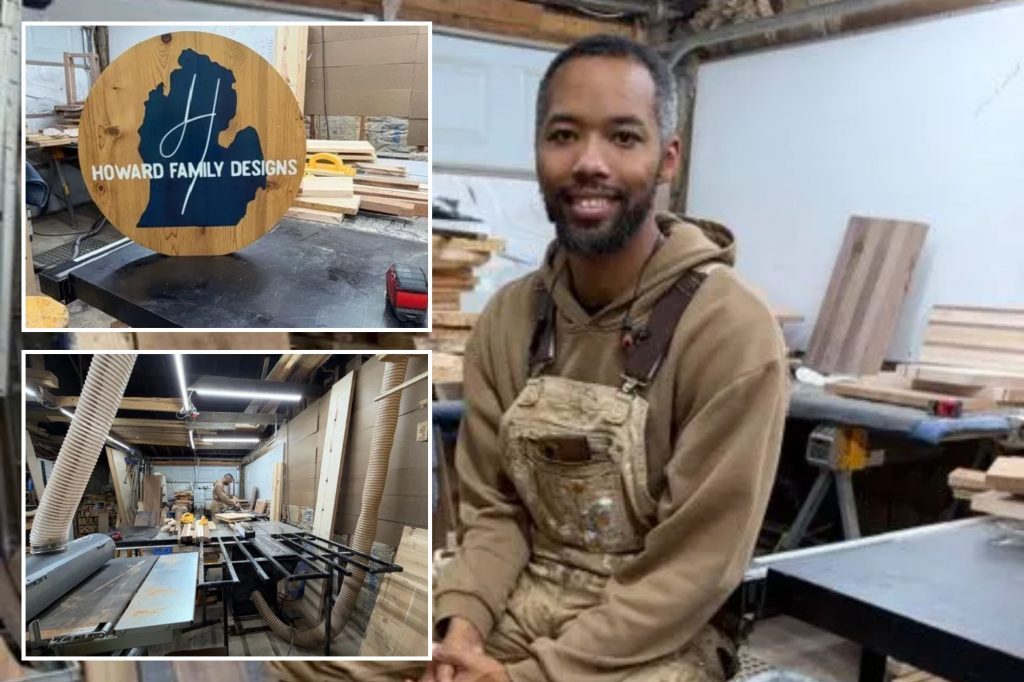
Michigan small business owner Michael Howard on Oct. 29, 2026 in Warren, Michigan. (Barnini Chakraborty/Washington Examiner)
" data-large-file="https://www.washingtonexaminer.com/wp-content/uploads/2026/10/image2-6-rotated.jpeg?w=480" src="https://www.washingtonexaminer.com/wp-content/uploads/2026/10/image2-6-rotated.jpeg?w=480" alt="" class="wp-image-4785607" srcset="https://www.washingtonexaminer.com/wp-content/uploads/2026/10/image2-6-rotated.jpeg 480w, https://www.washingtonexaminer.com/wp-content/uploads/2026/10/image2-6-rotated.jpeg?resize=225,300 225w" sizes="(max-width: 480px) 100vw, 480px">
Michigan small business owner Michael Howard on Oct. 29, 2026 in Warren, Michigan. (Barnini Chakraborty/Washington Examiner)
“I think we’re going to build our own furniture,” he told her.
She reminded him that he didn’t know how. But Howard went home, opened his computer, and started learning.
In the garage, he taught himself to build a desk and a dining table. He posted photos online, and someone asked where he had bought the table.
“I got it in my garage,” Howard told the person. “Because I made it.”
Could he make another?
“I guess so.”
The first order led to requests from people at his church, a Starbucks manager, and others who had seen his work. What began as a way to furnish his own home grew into Howard Family Designs, a small woodworking business in Warren.
Nearly a decade later, Howard has built a business around the idea that furniture can do more than fill a room. It can provide a livelihood, teach a trade, and give families a chance to furnish their homes with something built to last.
Now, that mission is under pressure from a trade war that has made the wood he relies on more expensive, just as customers are pulling back on spending.
President Donald Trump’s tariffs on Canadian lumber have squeezed a business that depends heavily on cross-border supplies. Howard estimates that about 70% of the softwood lumber he uses comes from Canada, and he says the United States cannot readily replace the supply and milling capacity that he needs.
At the same time, customers facing higher household expenses are postponing purchases that once seemed within reach. Howard says the combination has forced him to raise prices, cut workers, and give up the warehouse space the business had grown into.
The pressure is threatening not only his livelihood, but also the social mission he built into the company.
A business born out of poverty
Howard’s commitment to helping others is rooted in his own childhood.
He grew up in a single-parent household in inner-city Detroit where money was scarce. His mother raised the family, and Howard worked three jobs while attending college full-time and playing basketball. By his sophomore year, he and his mother were technically above the poverty line.
His family also faced a crisis that shaped his understanding of what a community can do for people with nowhere else to turn.
His younger sister was born with an extraordinarily rare condition. About two-thirds of her brain was outside her skull, and she faced severe medical complications that affected her vision, mobility, and ability to eat. The family could not afford the surgeries she needed.
People in the community began contributing what they could, even if it was just a dollar a month. The family’s story eventually reached television, bringing more attention and donations. Neurosurgeon Dr. Ben Carson, also a Detroit native, performed two surgeries and covered much of the cost, Howard said.
The family eventually moved south, in part because of the challenges of accessing medical care in Michigan. Howard’s sister died, and he and his mother returned to Michigan the day he graduated college.
Years later, as he considered how to build a business that could support more than just his own family, Howard found inspiration in an unlikely place: Motown.
He admired the way Berry Gordy built a family-centered operation that allowed people to pursue their ambitions while maintaining a safety net. Howard wanted to create something similar — a business where people could learn a skill, earn money, and have a place to turn when they needed help.
The name Howard Family Designs reflected that idea.
He now teaches his four children woodworking, hoping they will grow up with a skill they can use to support themselves. The youngest is still an infant, but Howard sees the shop as a place where the family can learn together and build something that lasts beyond a single generation.
More than furniture
Handcrafted sign and logo made by Michigan small business owner Michael Howard on Oct. 29, 2026. (Barnini Chakraborty/Washington Examiner)" data-large-file="https://www.washingtonexaminer.com/wp-content/uploads/2026/10/image0-17-rotated.jpeg?w=480" src="https://www.washingtonexaminer.com/wp-content/uploads/2026/10/image0-17-rotated.jpeg?w=480" alt="" class="wp-image-4785608" srcset="https://www.washingtonexaminer.com/wp-content/uploads/2026/10/image0-17-rotated.jpeg 480w, https://www.washingtonexaminer.com/wp-content/uploads/2026/10/image0-17-rotated.jpeg?resize=225,300 225w" sizes="auto, (max-width: 480px) 100vw, 480px">
Handcrafted sign and logo made by Michigan small business owner Michael Howard on Oct. 29, 2026. (Barnini Chakraborty/Washington Examiner)
The business makes high-end pieces for customers willing to pay for craftsmanship. Dining tables can sell for $2,000 to $5,000, and some exotic-wood cutting boards cost upwards of $300.
But those sales help support a very different part of the operation.
Howard uses revenue from more expensive commissions to make furniture available to families who otherwise couldn’t afford it. For those customers, he may build a table from less expensive pine, charge only for materials, or provide the piece free.
The shop also serves as a training ground. Howard has taught people how to work with wood, operate machinery, and build furniture. He also lets people use his shop and tools, including a table saw that cost about $5,000 and that he bought with savings and grant money.
For Howard, teaching someone a trade is as important as completing an order. He wants people to leave with skills they can use to make a living, whether they stay with him or eventually start something of their own.
But that model depends on having enough business to keep people working.
Tariffs hit from both sides
Howard said the business weathered the pandemic, but this year he finally began raising prices.
The trade uncertainty that followed Trump’s return to office made customers more cautious, Howard said. Even before the latest lumber measures directly affected his costs, he noticed people holding on to their money rather than committing to large purchases.
Then the price of the wood itself became a more immediate problem.
Howard said he buys as much American lumber as he can, but cannot find enough domestic supply to meet his needs. Canadian softwood is an essential part of his operation, he said, because U.S. mills cannot readily provide the volume and types of lumber he uses.
Replacing that capacity would take major investment and years of work, he said. In the meantime, restricting Canadian supplies can also push up domestic lumber prices as more buyers compete for what is available.
The impact reaches beyond the price of the wood. Importers initially pay tariffs, but those costs can be passed along through suppliers and eventually reach businesses such as Howard’s. He says he has little choice but to pass some of the increases on to customers.
That leaves him caught between higher production costs and customers who are increasingly reluctant to spend.
People who once might have ordered a dining table are now prioritizing groceries, medicine, school supplies, and utility bills, he said. Some customers have asked why he doesn’t simply buy American lumber.
“We buy as much American as we can, but it’s not enough,” Howard said.
The result is a business squeezed from both ends. The cost of making furniture is rising while fewer people are willing or able to buy it.
People behind the business
The slowdown has forced Howard to make decisions he had hoped to avoid.
He has let go of two workers, including one who had been with him for years. Howard initially hired one young man at his mother’s request, bringing him into the shop to learn the trade. The worker started by moving lumber and gradually learned to build furniture. Eventually, he was able to handle a substantial share of the business.
Michigan business owner Michael Howard cuts wood in his garage on Oct. 29, 2026. (Barnini Chakraborty/Washington Examiner)
" data-large-file="https://www.washingtonexaminer.com/wp-content/uploads/2026/10/image1-12.jpeg?w=640" src="https://www.washingtonexaminer.com/wp-content/uploads/2026/10/image1-12.jpeg?w=640" alt="" class="wp-image-4785609" srcset="https://www.washingtonexaminer.com/wp-content/uploads/2026/10/image1-12.jpeg 640w, https://www.washingtonexaminer.com/wp-content/uploads/2026/10/image1-12.jpeg?resize=300,225 300w" sizes="auto, (max-width: 640px) 100vw, 640px">
Michigan business owner Michael Howard cuts wood in his garage on Oct. 29, 2026. (Barnini Chakraborty/Washington Examiner)
Another worker came to the shop with a friend to help move lumber.
Howard said he paid them fairly and gave them the opportunity to develop skills that could support them elsewhere. At one point, one employee earned more than Howard because he was doing so much of the production work.
But with orders slowing and the future uncertain, Howard could no longer promise the steady work they needed.
The contraction has reached the business’s physical footprint, too.
At one point, Howard Family Designs had grown enough to operate out of a warehouse. But as economic concerns mounted, he decided he could no longer justify the lease. He moved the operation back into the garage where the business began.
He also lost a planned project to build out a medical facility, a job that would have provided his workers with thousands in net income and the possibility of more work.
The lost orders and the layoffs have changed how Howard spends his days. Instead of growing the business, he is spending more time in the shop making the products himself.
HERE ARE THE MESSAGES THAT COULD DECIDE THE MIDTERM ELECTIONS AS CAMPAIGNS MAKE THEIR FINAL PITCHES
“I love being in the shop,” he said. “But if I’m in the shop working and building products, I can’t be in the office building the business.”
For now, Howard is trying to keep his business afloat. The garage that launched Howard Family Designs has become its refuge again. And the man who started building furniture because he couldn’t afford to buy it is once more trying to make something out of what he has.
Continue reading...
[ H/T Washington Examiner ]