

Something very interesting is happening in response to the AI revolution. The biggest questions about what human beings are — and who we want to become — are now being engaged at scale. It is basically a cliché at this point to point out, “Oh, there’s another artificial intelligence conference happening?” Or another AI podcast. Another AI cable news segment. Another AI legislative committee.
But this is a proportionate response to the moment we face. We are in the early stages of a revolution and, quite rightly, it is all hands on deck. Even religious communities are gearing up for a massive response. I’m one of three lay consultants for a new AI task force created by the U.S. Conference of Catholic Bishops, for instance, and one of our main goals is to continue building our relationships with Silicon Valley and the AI labs working on the growing edges of the revolution — relationships that the Church has been cultivating for some time.
Recently, an explosive article in the New York Times offered in-depth coverage of the relationship between Anthropic, religious organizations, and particularly the Catholic Church. It was explosive because some of the meetings were private and at least appeared secretive, suggesting that something nefarious was happening. The stakes were made higher by the fact that Anthropic is unusually interested in exploring whether their large language model, Claude, is conscious and may even be a kind of person.
The controversy surrounding this story, especially in the minds and hearts of many religious people, threatens to derail the cooperation necessary for an all-hands-on-deck response. It plays into stereotypes many have of Silicon Valley as being bizarrely out of touch and ideologically focused on transhumanism and even a quasi-religious perspective on the sacredness of the replacement technology they are developing. For many, the secret nature of the meetings also contributed to the cult-like vibes.
To be fair, there is significant evidence of cult-like behavior — especially in the stories told by people like Emil Torres, who were once on the inside of these communities. Torres describes the culture with an acronym, TESCREL: Transhumanism, Extropianism, Singularitarianism, Cosmism, Rationalism, Effective Altruism, Longtermism. Without getting into each one, the seven ideas here form a worldview with the goal of creating a cosmic post-human technocratic utopia. And several of the founders and funders of this movement include people central to the founding of AI companies like Anthropic, OpenAI, and DeepMind.
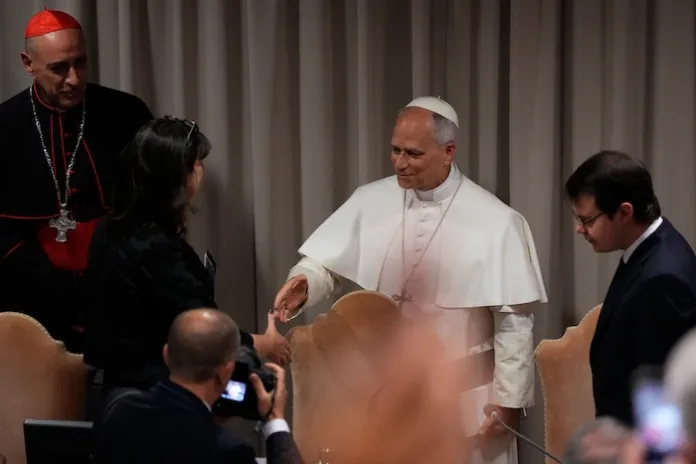
Pope Leo XIV bids farewell to, from left, Cardinal Víctor Manuel Fernández, prefect of the Dicastery for the Doctrine of the Faith, theologian Anna Rowlands and Anthropic co-founder Christopher Olah at the end of the presentation of his first encyclical, “Magnifica humanitas: On Safeguarding the Human Person in the Time of Artificial Intelligence,” at the Vatican, Monday, May 25, 2026. (AP Photo/Alessandra Tarantino)
" data-image-caption="
Pope Leo XIV bids farewell to, from left, Cardinal Víctor Manuel Fernández, prefect of the Dicastery for the Doctrine of the Faith, theologian Anna Rowlands and Anthropic co-founder Christopher Olah at the end of the presentation of his first encyclical, “Magnifica humanitas: On Safeguarding the Human Person in the Time of Artificial Intelligence,” at the Vatican, Monday, May 25, 2026. (AP Photo/Alessandra Tarantino)
" data-large-file="https://www.washingtonexaminer.com/wp-content/uploads/2026/05/Pope-Leo-XIV.jpg?w=696" src="https://www.washingtonexaminer.com/wp-content/uploads/2026/05/Pope-Leo-XIV.jpg?w=696" alt="Pope Leo XIV bids farewell to, from left, Cardinal Víctor Manuel Fernández, prefect of the Dicastery for the Doctrine of the Faith, theologian Anna Rowlands and Anthropic co-founder Christopher Olah at the end of the presentation of his first encyclical, "Magnifica humanitas: On Safeguarding the Human Person in the Time of Artificial Intelligence," at the Vatican, Monday, May 25, 2026. (AP Photo/Alessandra Tarantino)" class="wp-image-4581189" srcset="https://www.washingtonexaminer.com/wp-content/uploads/2026/05/Pope-Leo-XIV.jpg 700w, https://www.washingtonexaminer.com/wp-content/uploads/2026/05/Pope-Leo-XIV.jpg?resize=300,200 300w, https://www.washingtonexaminer.com/wp-content/uploads/2026/05/Pope-Leo-XIV.jpg?resize=150,100 150w, https://www.washingtonexaminer.com/wp-content/uploads/2026/05/Pope-Leo-XIV.jpg?resize=696,464 696w" sizes="(max-width: 700px) 100vw, 700px">
Pope Leo XIV bids farewell to, from left, Cardinal Víctor Manuel Fernández, prefect of the Dicastery for the Doctrine of the Faith, theologian Anna Rowlands and Anthropic co-founder Christopher Olah at the end of the presentation of his first encyclical, “Magnifica humanitas: On Safeguarding the Human Person in the Time of Artificial Intelligence,” at the Vatican, Monday, May 25, 2026. (AP Photo/Alessandra Tarantino)
On their account, human beings only have instrumental value. We are merely containers of welfare to be maximized. And since artificial forms of “life” can more efficiently produce and maximize such welfare, we ought to move quickly in a post-human direction as a culture.
Indeed, Torres claims that leaders of this movement have drawn explicit (and deeply offensive) analogies between choosing to have a disabled child today and choosing to have a biological child in the coming post-human era.
We will first upgrade ourselves via transhumanism. Then we will replace ourselves via post-humanism. And AIs will be the ones to replace us.
Being confronted with such ideas is enough to radicalize almost anyone, but especially those of us who have a fundamentally different vision of human nature. Pope Leo’s encyclical Magnifica Humanitas presents a beautiful, contrasting vision of what makes human beings valuable. Rather than being isolated containers of value or disvalue, human beings have been created by God with a fixed, embodied, and relational nature.
We are finite and dependent creatures who flourish, not despite our limitations, but because of them. The aspects of humanity transhumanists have decided are unequivocally bad are, in fact, what make it possible for us to develop into mature moral creatures with compassion, generosity, and spirituality.
Paradoxically, then, a transhumanist vision, which promises us an upgrade, fundamentally diminishes who we are.
Happily, a pro-human perspective was offered repeatedly by the religious guests invited to the convenings at Anthropic. Far from indoctrination, as I discussed in an interview with the National Catholic Register, the sessions I attended were often filled with prayerful and even holy discussions about how we ought to hold onto a deeply human vision of the future in light of what appears to be coming our way. And the conveners of the sessions were very happy for us to offer these perspectives.
What I’ve learned from my now sustained engagement with multiple AI companies is that the “tech world” is far more complex and interesting than the stereotypes would have us believe. Sure, transhumanist cultism and a commitment to AI personhood have a significant place in some circles, but in other places it is not present at all. At times I’ve even seen such ideas mocked.
News outlets report that belief in Christianity has a “fading stigma” in Silicon Valley, and I’ve experienced that firsthand. Indeed, at a recent meeting with the folks at OpenAI (the opening dinner of which was attended by the Archbishop of San Francisco), I had wonderful interactions with several employees who were deeply Catholic and clearly trying to live out their authentic faith through their work. Several of those who were not Catholic also seemed taken with Magnifica Humanitas and the prospect of engaging and even cooperating with the Catholic Church. One of my hosts texted me soon after I left, noting that after my visit he reached out to his Catholic friend and said that, for the first time, he “understood the beauty” of the faith.
Beyond OpenAI, there are exciting developments at Google DeepMind as well. Recently, they sent Paige Bailey, the Engineering Lead for Developer Relations, to join me in a Word on Fire livestreamed discussion of Magnifica Humanitas. A committed Episcopalian, Bailey noted that she didn’t think any of the AI models are conscious and that several people throughout her company were captivated by Pope Leo’s vision. She even noted that one engineering lead rewrote their team’s operating principles in light of the encyclical.
“I don’t think anybody was expecting the Church to be leading this conversation,” she said.
The pro-human perspective is also embraced by the CEO of Microsoft AI, Mustafa Suleyman. He firmly rejects any moral status of even the most advanced AI models and believes that human beings must remain firmly in control. Suleyman even signed the Future of Life Institute’s “Pro-Human Declaration” — which, among other things, insists that AI must not supplant the uniquely human relationships that give life meaning: family, friendship, faith, and community.
There is so much work to do, together, to build an adequate response to the AI revolution. We need massively powerful coalitions of groups to meet the needs of the moment, and these coalitions simply must include the big AI labs. It is true that, in some isolated circles, an anti-human ideology rules the day, but we must not let legitimate concern for such an ideology lead us to despair.
Instead, we should take heart that we have profoundly interesting and willing partners available who can help us keep our future human. They will be necessary partners if our future is to be a human one. We must find ways to work together.
Continue reading...
[ H/T Washington Examiner ]