
![‘I had this [bleeping] thing locked up’: Hollywood actress is crushed her son did not turn out gay despite dressing him in drag as a child](https://www.wnd.com/wp-content/uploads/2018/11/curtain-theater-movie-play-pixabay-600.jpg)




Pinky Promise
By Molly Schwarz, cross-asset macro strategist at Rabobank
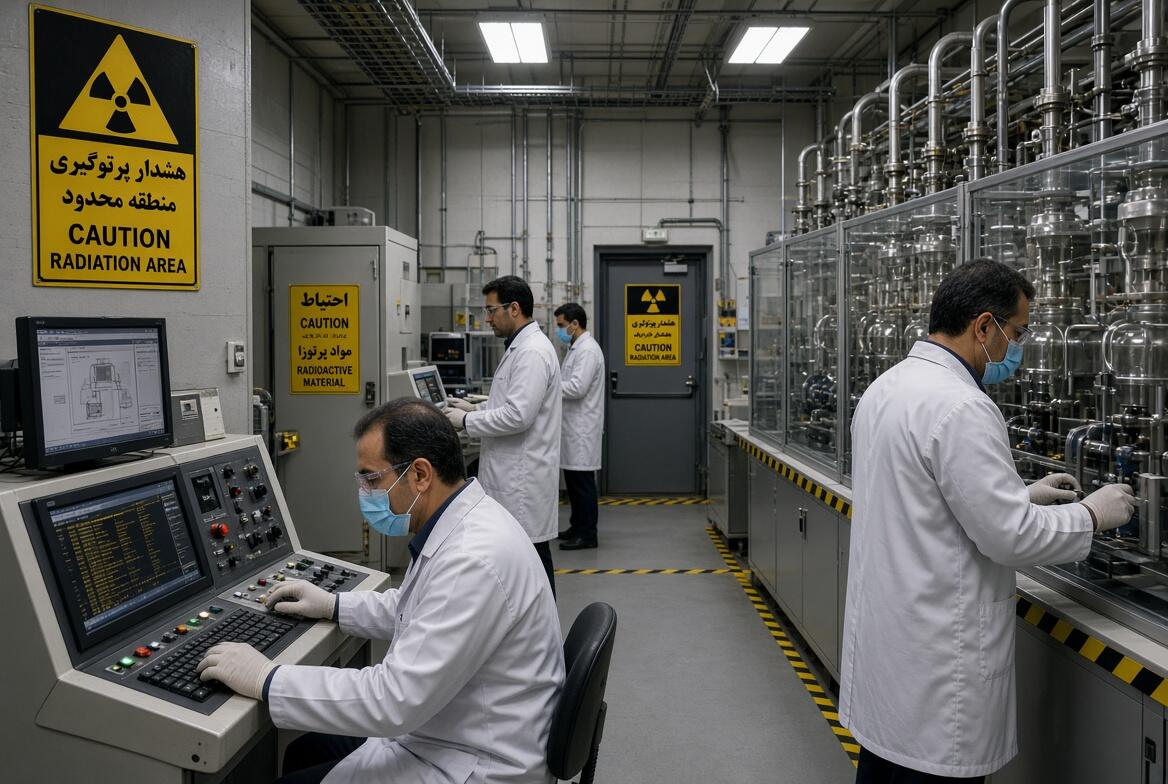
Iran is feeling some of the economic pressure of Bessent’s “Operation Economic Outcast” with reports from Al-Hadath suggesting that Iran has agreed to halt uranium enrichment in exchange for the relaxing of US sanctions. This, of course, is the uranium that Iran was apparently never enriching, and even if they were enriching it in facilities that no one is allowed to check, it would only be for peaceful purposes. Pinky promise.
But, should these reports be verified, this could suggest some meaningful steps in the right direction to start to ease military and economic pressures in the Middle East. Total regime change in Iran is likely off the table, but convincing the current regime in Iran to give up on its goal of obtaining a nuclear weapon is…unlikely. A “compromise” where Iran pretends to stop enriching Uranium, and gets some economic relief in the process, and the US has an out where the GOP can save some face, right before the midterms, could mean end game. However, this all necessitates that the Al-Hadath headline is legitimate, that Iranian officials stand by their word, and that the US agrees to such conditions.
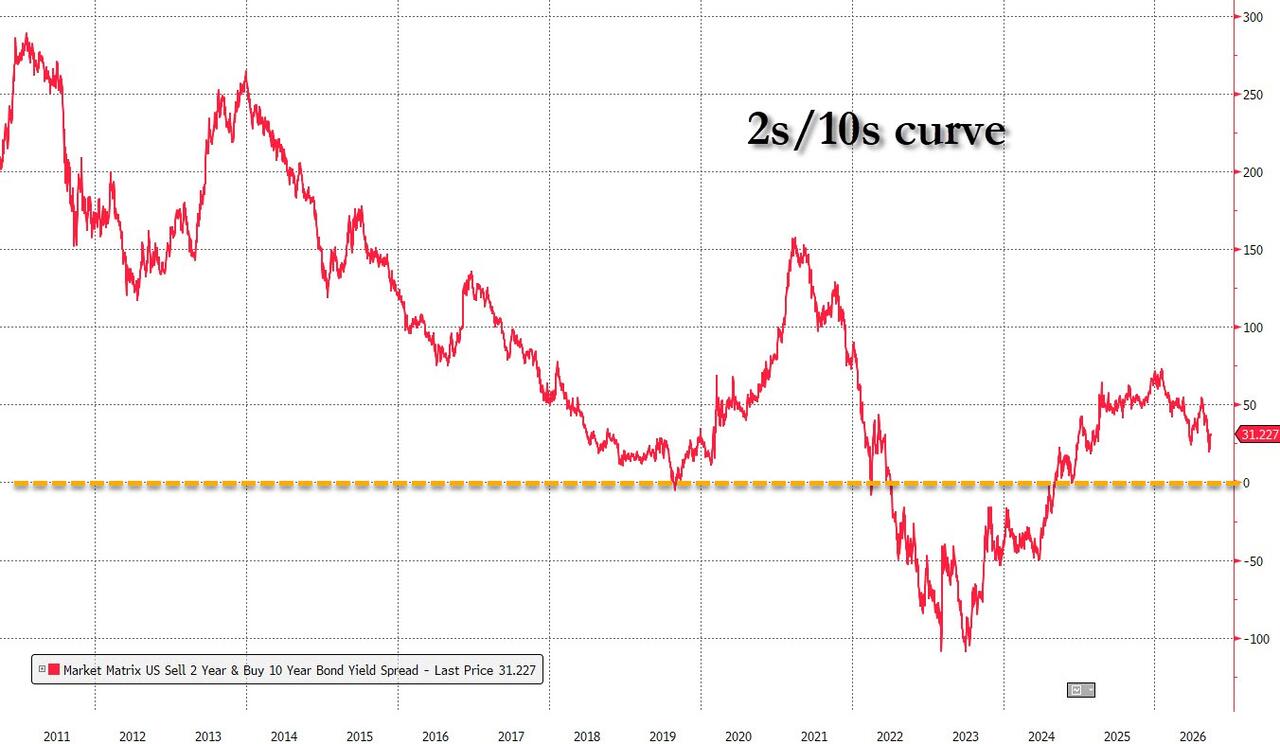
But markets were happy to digest whatever positive news they could, with Brent crude oil dropping around $4 on the announcement to $105/bbl. Despite the retracement in oil, yields still made their way higher, with the 2-year trading back up to 4.92%, and the 10-year up to 5.23%, after briefly breaking above 5.25%. Some talks are circulating about potential re-inversion of the US yield curve, as traders price in more hikes in the short end (17.5bp at the October meeting, and 94.6bp by July of 2027), but a look at the current spread of 32bp suggests that there’s still some way to go before reinversion becomes dinner-table talk.
Stablecoin has also made its way back into US-Senate headlines, after the Senate failed to pass the CLARITY Act a few weeks ago. However, the recent headline suggests that the passage of the CLARITY Act might also be farther off than originally thought. On Monday, the US Senate subcommittee on investigations released a 28-page report cleverly titled “Tethered to Terrorism” which highlighted findings that Tether stablecoin had been used by the Iranian regime to evade sanctions and fund its proxy groups throughout the Middle East. Much of the fear surrounding stablecoin and other cryptocurrencies is the lack of traceability and the ability to use it for nefarious transactions. Which reminds me of an interesting proposition: imagine that instead of digital banking transactions, we instead printed physical cash, that could be circulated both domestically and internationally, without ever leaving a documented online trail that the cops nor the IRS could easily follow? Think about the millions of dollars of taxes that could be evaded and all the black market transactions that could take place…crazy, right?
The Financial Times reports that “EU countries are considering NATO-style joint responses to Russian hybrid attacks.” Hybrid attacks—those that include both physical and online warfare—were flagged recently by Danish intelligence, suggesting that their frequency, including those against NATO members, could increase in the coming months. But mobilizing 27 member-countries to go to war, when they can’t even agree on whether to sanction Russian gas or not, is easier said than done. One unnamed, but brilliant EU diplomat said “I’m not sure that anyone thinks the way to fight back against the Russians is to hold more meetings.” While wise in theory, holding meetings is what the EU does best. Defense ministers were invited to discuss the proposals yesterday.
The US and China agreed to extend their trade truce to January 10 to lift tariffs on USD 60 billion of “non-sensitive goods,” with each country receiving USD 30 billion of preferential trade status on their respective exports. Non-sensitive goods may or may not include military arms, apparently, as the US ambassador to China, David Perdue, said that Trump offered to sell arms to China. In the realm of national security, it’s not a great idea to be reliant on your adversaries for weapons. But, in the case of the US, exporting weapons to your adversaries might be good business—notwithstanding that US law prohibits arms sales to China. Nor what happens if American (or Taiwanese) troops find themselves staring down the barrel of an M16. Unless, as part of the arms deal, China pinky promises to only use them for peaceful purposes. It should be noted that the White House has denied all claims of Trump making such an offer, and Xi’s response to this offer has not been revealed.
Tyler Durden Tue, 09/29/2026 - 10:05
Continue reading...
[ H/T ZeroHedge ]
By Molly Schwarz, cross-asset macro strategist at Rabobank
Iran is feeling some of the economic pressure of Bessent’s “Operation Economic Outcast” with reports from Al-Hadath suggesting that Iran has agreed to halt uranium enrichment in exchange for the relaxing of US sanctions. This, of course, is the uranium that Iran was apparently never enriching, and even if they were enriching it in facilities that no one is allowed to check, it would only be for peaceful purposes. Pinky promise.
But, should these reports be verified, this could suggest some meaningful steps in the right direction to start to ease military and economic pressures in the Middle East. Total regime change in Iran is likely off the table, but convincing the current regime in Iran to give up on its goal of obtaining a nuclear weapon is…unlikely. A “compromise” where Iran pretends to stop enriching Uranium, and gets some economic relief in the process, and the US has an out where the GOP can save some face, right before the midterms, could mean end game. However, this all necessitates that the Al-Hadath headline is legitimate, that Iranian officials stand by their word, and that the US agrees to such conditions.
But markets were happy to digest whatever positive news they could, with Brent crude oil dropping around $4 on the announcement to $105/bbl. Despite the retracement in oil, yields still made their way higher, with the 2-year trading back up to 4.92%, and the 10-year up to 5.23%, after briefly breaking above 5.25%. Some talks are circulating about potential re-inversion of the US yield curve, as traders price in more hikes in the short end (17.5bp at the October meeting, and 94.6bp by July of 2027), but a look at the current spread of 32bp suggests that there’s still some way to go before reinversion becomes dinner-table talk.
Stablecoin has also made its way back into US-Senate headlines, after the Senate failed to pass the CLARITY Act a few weeks ago. However, the recent headline suggests that the passage of the CLARITY Act might also be farther off than originally thought. On Monday, the US Senate subcommittee on investigations released a 28-page report cleverly titled “Tethered to Terrorism” which highlighted findings that Tether stablecoin had been used by the Iranian regime to evade sanctions and fund its proxy groups throughout the Middle East. Much of the fear surrounding stablecoin and other cryptocurrencies is the lack of traceability and the ability to use it for nefarious transactions. Which reminds me of an interesting proposition: imagine that instead of digital banking transactions, we instead printed physical cash, that could be circulated both domestically and internationally, without ever leaving a documented online trail that the cops nor the IRS could easily follow? Think about the millions of dollars of taxes that could be evaded and all the black market transactions that could take place…crazy, right?
The Financial Times reports that “EU countries are considering NATO-style joint responses to Russian hybrid attacks.” Hybrid attacks—those that include both physical and online warfare—were flagged recently by Danish intelligence, suggesting that their frequency, including those against NATO members, could increase in the coming months. But mobilizing 27 member-countries to go to war, when they can’t even agree on whether to sanction Russian gas or not, is easier said than done. One unnamed, but brilliant EU diplomat said “I’m not sure that anyone thinks the way to fight back against the Russians is to hold more meetings.” While wise in theory, holding meetings is what the EU does best. Defense ministers were invited to discuss the proposals yesterday.
The US and China agreed to extend their trade truce to January 10 to lift tariffs on USD 60 billion of “non-sensitive goods,” with each country receiving USD 30 billion of preferential trade status on their respective exports. Non-sensitive goods may or may not include military arms, apparently, as the US ambassador to China, David Perdue, said that Trump offered to sell arms to China. In the realm of national security, it’s not a great idea to be reliant on your adversaries for weapons. But, in the case of the US, exporting weapons to your adversaries might be good business—notwithstanding that US law prohibits arms sales to China. Nor what happens if American (or Taiwanese) troops find themselves staring down the barrel of an M16. Unless, as part of the arms deal, China pinky promises to only use them for peaceful purposes. It should be noted that the White House has denied all claims of Trump making such an offer, and Xi’s response to this offer has not been revealed.
Tyler Durden Tue, 09/29/2026 - 10:05
Continue reading...
[ H/T ZeroHedge ]