





Name one memorable episode of the late-1980s NBC sitcom A Different World. Go ahead, I’ll wait. Sure, the Cosby Show spinoff featured, in the first of its six seasons, both Lisa Bonet and Marisa Tomei, two fascinating actresses heading in diametrically opposite career directions. And yes, the character name Dwayne Wayne will forever ring a bell for children of Ronald Reagan’s America. Having managed to get by on five channels until well into the 1990s, I can tell you precisely where A Different World was set (the fictional black college Hillman) and which of Bonet’s on-screen parents were meant to have been graduates (both). I can even hum the theme song. I just can’t recall a single subplot, joke, set piece, or lesson learned.
One could argue, of course, that the series wasn’t intended for white guys like me in the first place. In a recent article plugging Netflix’s just-launched remake of the show, Essence magazine enthused that black viewers of the original “could recognize pieces of themselves in [its] characters.” The same article lauded a 25% increase in historically black college or university enrollment between 1976 and 1994, with “the largest gains occurring while A Different World was on television.”
I will not deny that these phenomena are real, nor that black “representation” is as valid a reason as any to enjoy a show. Still, it strikes me as strange that we’re rebooting a forgettable university sitcom at the very moment when people’s disdain for higher education is near its peak. For professors, taxpayers, and the college-going public, the 33 years since NBC’s series went off the air really have produced a different world. I assure you: It isn’t the one that university types would have chosen.
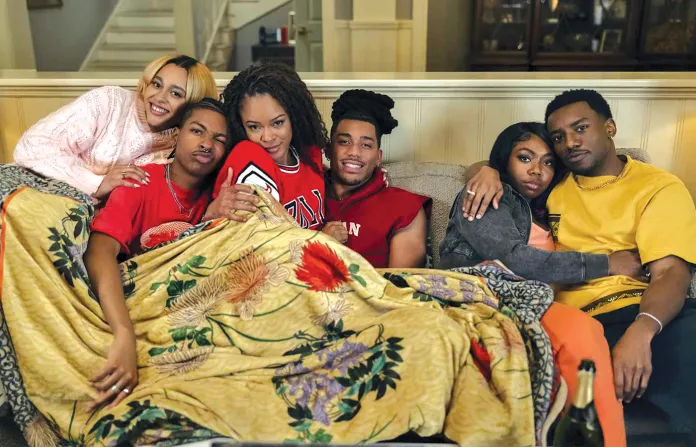
Kennedi Reece as Hazel, Jordan Aaron Hall as Amir, Maleah Joi Moon as Deborah, Cornell Young IV as Shaquille, Alijah Kai as Rashida, and Chibuikem Uche as Kojo in “A Different World.” (Courtesy of Netflix)
" data-large-file="https://www.washingtonexaminer.com/wp-content/uploads/2026/10/LA.TV_.101426.jpg?w=696" height="658" width="1024" src="https://www.washingtonexaminer.com/wp-content/uploads/2026/10/LA.TV_.101426.jpg?w=696" alt="Kennedi Reece as Hazel, Jordan Aaron Hall as Amir, Maleah Joi Moon as Deborah, Cornell Young IV as Shaquille, Alijah Kai as Rashida, and Chibuikem Uche as Kojo in "A Different World." (Courtesy of Netflix)" class="wp-image-4760454" style="width:768px;height:auto" srcset="https://www.washingtonexaminer.com/wp-content/uploads/2026/10/LA.TV_.101426.jpg 1400w, https://www.washingtonexaminer.com/wp-content/uploads/2026/10/LA.TV_.101426.jpg?resize=300,193 300w, https://www.washingtonexaminer.com/wp-content/uploads/2026/10/LA.TV_.101426.jpg?resize=768,494 768w, https://www.washingtonexaminer.com/wp-content/uploads/2026/10/LA.TV_.101426.jpg?resize=1024,658 1024w, https://www.washingtonexaminer.com/wp-content/uploads/2026/10/LA.TV_.101426.jpg?resize=150,96 150w, https://www.washingtonexaminer.com/wp-content/uploads/2026/10/LA.TV_.101426.jpg?resize=696,447 696w, https://www.washingtonexaminer.com/wp-content/uploads/2026/10/LA.TV_.101426.jpg?resize=1068,687 1068w" sizes="(max-width: 1024px) 100vw, 1024px">
Kennedi Reece as Hazel, Jordan Aaron Hall as Amir, Maleah Joi Moon as Deborah, Cornell Young IV as Shaquille, Alijah Kai as Rashida, and Chibuikem Uche as Kojo in “A Different World.” (Courtesy of Netflix)
Netflix’s reboot, now streaming in its 10-episode entirety, seems well aware of the changes wrought on campuses over the last few decades. In its first two episodes alone, the series considers a college athlete’s “name, image, and likeness” deal and portrays both radicalized classroom instruction and a student “shout-down” of a disliked administrator. The third and fourth episodes add to that list examinations of hook-up culture and the financial travails now faced even by richly endowed universities.
Yet, despite this verisimilitude, the new show seems strangely confused about how college students actually behave. Contra series lead Deborah Wayne (Maleah Joi Moon), they don’t complain about the difficulty of maintaining a 3.0 GPA, grade inflation having long ago blown the lid off that mark. Nor do they speak in quasi-sophisticated legalese — “Those alleged actions were a horrific misstep” — or eschew phone culture to interact with one another IRL.
Were Netflix’s A Different World merely a humorous rendering of quotidian campus life, one might accept it as this generation’s Saved by the Bell: The College Years (1993-94) or Undeclared (2001-02). Alas, the show means to be taken seriously, even as it tries, and fails, to show audiences a good time. Speaking to the Hollywood Reporter last month, showrunner and creator Felicia Pride declared herself to be “in the business of illuminating our humanity back to ourselves.” That may or may not be inspiring, but it practically guarantees that we are not in for a profusion of laughs.
Indeed, the new show’s unfunniness may well be its most striking characteristic, edging out by a nose its overreliance on original-series stalwarts Kadeem Hardison, who reprises the role of Dwayne Wayne, and Jasmine Guy, who returns as Southern belle Whitley Gilbert. That neither performer is particularly compelling, or even slightly funny, is beside the point. Their job is to provide a nostalgic hook for viewers who recall the pair’s stormy courtship as the original production’s longest-lasting narrative arc.
Netflix’s series fares better with its other actors, who, if not exactly hilarious, are at least watchable most of the time. In addition to Moon’s Deborah, the production serves up Cornell Young IV as five-star football recruit Shaquille; Alijah Kai as Deborah’s overachieving roommate, Rashida; and Chibuikem Uche as Ghanaian-Nigerian, by way of Britain, fashion-merchandising student Kojo. Best of all is Kennedi Reece as Hazel, a God-fearing young woman with all the doe-eyed naivete one expects Hollywood to assign to such a person. Given how complicated prestige-TV plots have become in recent years, it’s almost refreshing that A Different World plows ahead with its stock characters. The laundry-folder or dinner-preparer trying to half-watch the show will keep up just fine.
‘FAUDA’S’ NEW SEASON IS A GRIPPING, MOVING TRIBUTE TO THE VICTIMS OF OCT. 7
Netflix’s reboot is at its best when daring to wring humor from black stereotypes — “Condoms!” a male student replies when asked to name his biggest pet peeve. To the show’s real detriment, however, such moments are few and far between, significantly outpaced by Very Important Lessons concerning, say, neurodiversity or gay polyamorous love. It is not the case that comedy must transgress elite norms to land, but it is very much true that “jokes” meant to reinforce the progressive social order tend to fall as flat as a frat-house sofa. By the time the show starts unironically quoting activist Bell Hooks — sorry, “bell hooks” — in its second episode, most viewers will be flipping over to reruns of Friends.
Or perhaps I’m wrong, and Netflix’s production will inspire yet another wave of enthusiastic HBCU enrollment. If the new A Different World is accurate, such students will find themselves in a self-serious atmosphere of identitarianism and complaint. They may have a great time there, but I don’t envy them.
Graham Hillard is the TV critic for the Washington Examiner magazine.
Continue reading...
[ H/T Washington Examiner ]
