









Polling — and poll “unskewing” — can be perilous business.
Back in 2012, many smart Republicans were convinced pollsters were slanting their results by oversampling Democrats, leading to many enthusiastic predictions that Mitt Romney was actually ahead in key battleground states. The Romney campaign itself believed its candidate would win. He did not. The polls were broadly correct. The folly of attempting to “unskew” the polls was laid bare.
But then a funny thing happened: Political polling did, in fact, start to chronically overestimate Democrats’ support, including in all three subsequent presidential elections (President Donald Trump was on the ballot every time) and numerous major Senate and gubernatorial races. Sometimes, the aggregated averages have turned out to be bang on.
In other cases, the data have been a hot mess. We’ve mentioned the extraordinary case of Maine’s 2020 Senate contest on multiple occasions because it’s illustrative of a polling disaster: Every single public poll projected a Democratic victory, usually by a relatively comfortable margin. The Republican incumbent, Sen. Susan Collins (R-ME), won by 9 points.
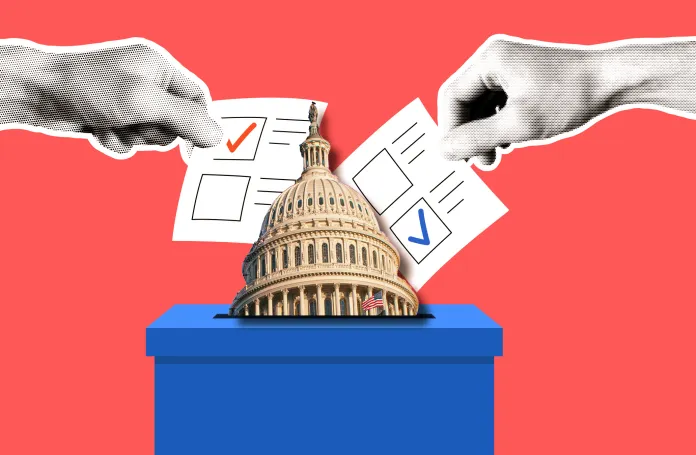
(Washington Examiner illustration; Getty Images)
" data-large-file="https://www.washingtonexaminer.com/wp-content/uploads/2026/10/Senate_control.jpg?w=696" height="670" width="1024" src="https://www.washingtonexaminer.com/wp-content/uploads/2026/10/Senate_control.jpg?w=696" alt="Senate 2026 midterm elections voting" class="wp-image-4760469" style="width:786px;height:auto" srcset="https://www.washingtonexaminer.com/wp-content/uploads/2026/10/Senate_control.jpg 2063w, https://www.washingtonexaminer.com/wp-content/uploads/2026/10/Senate_control.jpg?resize=300,196 300w, https://www.washingtonexaminer.com/wp-content/uploads/2026/10/Senate_control.jpg?resize=768,503 768w, https://www.washingtonexaminer.com/wp-content/uploads/2026/10/Senate_control.jpg?resize=1024,670 1024w, https://www.washingtonexaminer.com/wp-content/uploads/2026/10/Senate_control.jpg?resize=1536,1005 1536w, https://www.washingtonexaminer.com/wp-content/uploads/2026/10/Senate_control.jpg?resize=2048,1340 2048w, https://www.washingtonexaminer.com/wp-content/uploads/2026/10/Senate_control.jpg?resize=150,98 150w, https://www.washingtonexaminer.com/wp-content/uploads/2026/10/Senate_control.jpg?resize=696,455 696w, https://www.washingtonexaminer.com/wp-content/uploads/2026/10/Senate_control.jpg?resize=1068,699 1068w, https://www.washingtonexaminer.com/wp-content/uploads/2026/10/Senate_control.jpg?resize=1920,1256 1920w" sizes="(max-width: 1024px) 100vw, 1024px">
(Washington Examiner illustration; Getty Images)
More recently, polling misfired badly in a pair of closely watched Democratic primaries this summer. In Michigan’s Senate primary, the left-wing Abdul el Sayed was expected to win by 10 percentage points over his “establishment” rival, Rep. Haley Stevens (D-MI). It was going to be a romp. What actually transpired was a nail-biter in which el Sayed barely clung on by a single point. Most surveys taken during the final stretch of that campaign pegged Stevens’s share of the vote in the 30s or low 40s. She ended up attracting nearly 48% of the vote. Her supporters, including many black voters, were routinely missed in the polling.
Elsewhere in the Midwest, Wisconsin Democrats were going to nominate a wacky leftist for governor. The numbers all pointed strongly in that direction. Several polls gave Democratic Socialists of America-aligned Francesca Hong a huge lead in the ballpark of 20 percentage points. She lost. It’s not a great mystery as to why so many Americans are, quite understandably, profoundly skeptical of polling.
But with multiple indicators pointing to a building blue wave, could Republican Party doomerism, which Washington Examiner chief political correspondent Byron York addressed in a piece last week, be overblown? There aren’t many Republicans who are expecting a good midterm election this cycle, or even a decent one. The prevailing question seems to be: How bad will it get?
Part of the answer comes back to the aforementioned doomerism. Sky-high Democratic enthusiasm, coupled with independents swinging back toward the Democrats (despite the opposition party’s continued unpopularity), is a recipe for a tough night for the party in power. But what could make the difference between tough and disastrous is participation and engagement among Republican voters. A certain blend of panic and gloom and despair can depress turnout, making those sentiments a self-fulfilling prophecy. Because so many of the crucial Senate races this year are taking place in red states, engagement and turnout shifts could very well prove determinative.
CNN political data guru Harry Enten highlighted a factor that is probably giving some Democratic strategists and candidates heartburn, even in a season that’s shaping up well for their party. Particularly in the Midwest, Enten observed, Democrats have ultimately undershot their polling position when the real votes were counted, pointing to a recent but fairly consistent flaw in survey methodologies.
In short, a lot of Republican voters just haven’t been showing up in these polls, while Democrats have been overrepresented. In Iowa, Michigan, and Ohio, all states hosting critical 2026 Senate battles, the “GOP outperformed September polls in the major 2024 races. That is president and Senate in the states that had a Senate race.”
Some specifics: “In Iowa, where the Democrats have been getting really good polls, Republicans outperformed their September polls by 9 points back in 2024. How about Ohio? Six points. How about Michigan? Five points.”
But that was a red-tinted year with a presidential contest at the top of the ballot. Does this pattern hold true in midterm elections, too? Yes, Enten says. “The GOP outperformed September polls in the major 2018 statewide races by 6 points in Iowa, 6 points in Ohio, and 8 points in Michigan.
“The bottom line is this, over the last few cycles, whether it be 2018, 2016, 2020, or 2024, Republicans have outperformed their September polls by at least 5 points in all these three states where Democrats right now are ahead,” Enten said. Conservative-leaning pollster Patrick Ruffini (who was hailed for key trend-spotting insights in 2024) has detected a similar issue, providing a “heat map” of polling misses across all 50 states. Two of those states are not in the Midwest but also boast a recent history of significant Democratic overperformance and GOP underperformance in surveys: Alaska and Maine, where pivotal Senate races are playing out right now.
THE SUSAN COLLINS FIREWALL
Ruffini’s analysis finds that in the Trump era, with roughly one month to go before an election, 93% of public polls overstated Democrats’ support in the three Midwestern states Enten also highlighted. In recent midterm elections, the average polling miss (at this stage of the cycle versus the final result) in Iowa, Michigan, and Ohio was approximately 6.5 points. Things can be true until they’re not, and there’s no question that multiple factors suggest Team Red is in some serious trouble this fall.
A 2006 or 2008 wipeout is entirely possible. But it’s not inevitable. If a small handful of states once again see similar polling failures along now-familiar lines, Republicans may overperform once again — and the Senate majority could be saved. The GOP had better hope its voters are ready to make this happen, because otherwise, the picture looks fairly grim.
Continue reading...
[ H/T Washington Examiner ]
