




"Mission Accomplished": BOJ Declares Victory Over Deflation, Then Speeds Up ETF Dump To A Breakneck 43 Years
Fourteen years, three governors, negative rates, yield curve control and the largest central bank equity hoard in history later, the Bank of Japan finally said the words.
In its quarterly Outlook Report released overnight alongside a widely expected decision to keep the policy rate at 1.25% (by an 8-1 vote, with hawk Hajime Takata dissenting in favor of a hike to 1.50%), the BOJ quietly retired the phrase it has used for years, that it expects to achieve its 2% target "between the second half of fiscal 2026 and fiscal 2027", and replaced it with this:
In other words, the war on deflation that has defined the Japanese economy for three decades is, officially, over. Reuters called it the BOJ declaring "victory in a nearly 14-year battle to hit its price target"; the FT went with victory in a war "that had defined the Japanese economy for decades." We'd go with something shorter: mission accomplished. Which, as anyone who remembers the original banner will tell you, tends to be the point where the real trouble starts.
And in case anyone thought the BOJ was just going to sit back and enjoy the moment, the central bank also nearly tripled the pace of its ETF sales, a surprise that nobody had in their models, and which shortens the time it will take to unwind its massive equity pile from 112 years to... 43 years. Progress!
We start with Goldman, whose Japan economist Tomohiro Ota summarized the decision in his post-meeting note "BOJ: Status Quo Maintained at October MPM, Underlying Inflation Assessed as Generally Consistent with Price Stability Target" (available to pro subs). The headline numbers barely moved: the growth forecast was "broadly unchanged" while the inflation forecasts were nudged lower for FY2026 and higher for FY2027 to reflect the jump in crude since the summer (with Brent at $116 this morning, probably not the last time we'll hear that excuse):
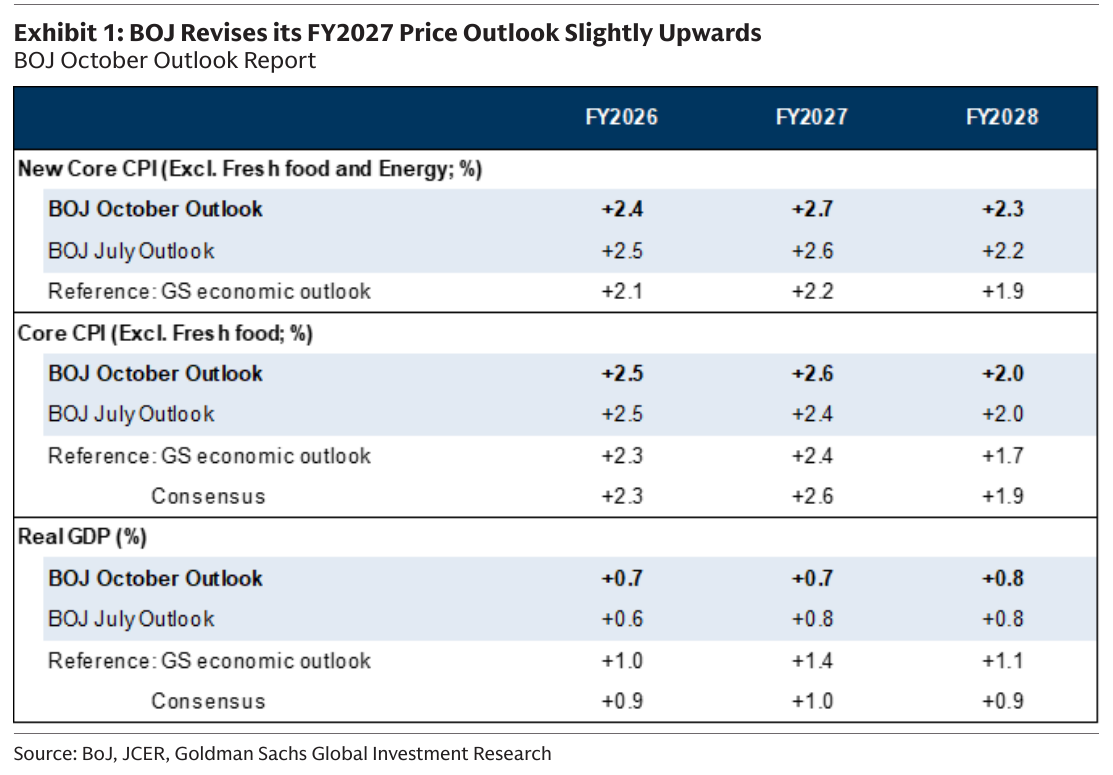
The full table is worth a second look, because the BOJ's FY2026 core-core forecast was actually cut to 2.4% from 2.5%, and Goldman's own forecasts sit below the BOJ's across the board, with GS seeing core-core at 1.9% in FY2028. So the central bank declared victory on underlying inflation on the same morning its own near-term forecast drifted lower, and the same morning Tokyo core-core CPI decelerated to 2.6% from 2.9%, according to Deutsche Bank's Jim Reid. Maybe a coincidence. Maybe a central bank that has waited 14 years to say the words and wasn't going to let a soft Tokyo print ruin the occasion.
The rest of the statement was a copy-paste of September. Risks to growth remain "generally balanced," risks to prices are still "skewed to the upside" (Middle East, AI, FX), and the BOJ kept the language, used since June, that it "will continue to raise the policy interest rate." The one new line Goldman flagged was a cautionary note about foreign central banks:
Translation: with Warsh's Fed and the ECB both eyeing hikes, the rate differential isn't closing, and the yen knows it. More on that below.
Ueda's press conference delivered the hawkish part of the "hawkish hold." The BOJ had entered a new "phase," he said, one focused on the risk of inflation overshooting rather than undershooting, and the Board will debate a hike at every meeting, including December:
Reuters notes that the BOJ raised rates in June and again in September, a much faster cadence than the roughly twice-a-year hikes of 2024 and 2025, and most economists it polled now expect a hike to 1.5% in December, with the terminal rate centered on 1.75% to 2%. Meiji Yasuda's Kazutaka Maeda went a step further, saying the BOJ "may now be contemplating increases every three months." Here is how the full journey from negative rates looks, with the market and Goldman's end-2027 calls tacked on:
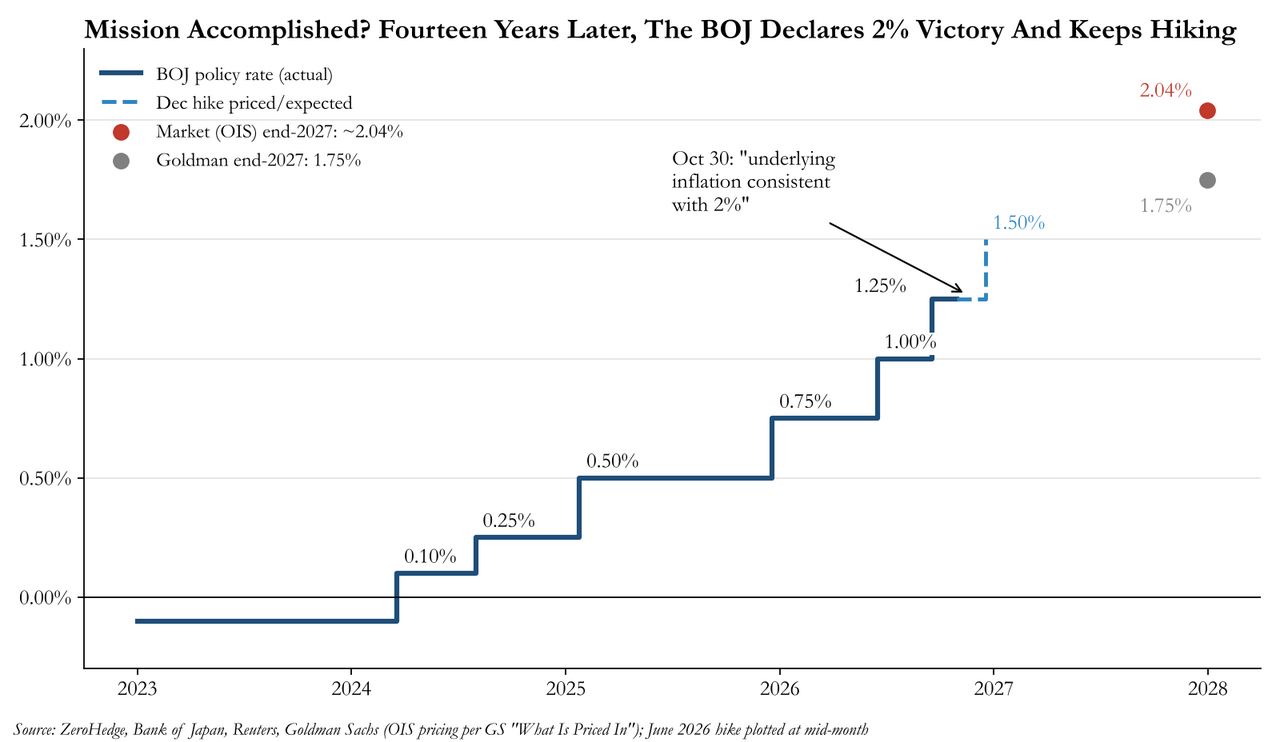
Note the gap at the far right: per Goldman's rates strategists, OIS is pricing the BOJ policy rate at about 2.04% by end-2027, versus Goldman's 1.75% forecast. So the market is already more hawkish than the house, which matters for what happened next in FX.
With the rate decision priced to perfection, the only genuine curveball was the ETF announcement, which we flagged in real time just minutes after the rate decision hit:
The details, again courtesy of Goldman's Ota: the ETF sales that began in January 2026 at an annual pace of ¥330bn (book value) will be increased to ¥860bn per year from January 2027 (a unanimous vote, in case anyone was wondering how controversial selling stocks at a 43-year pace is). "The change will shorten the time horizon required to complete the ETF selling, from 112 years to around 43 years."
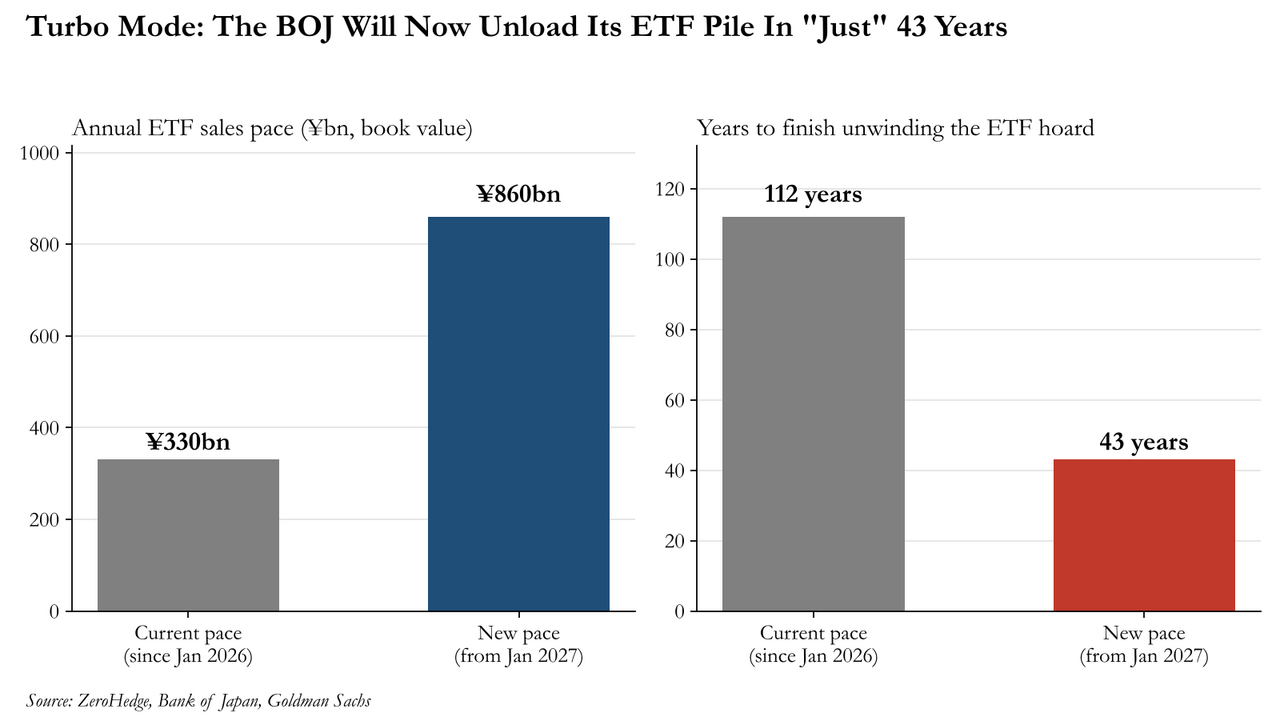
Goldman's FX desk, in its morning update (available to pro subs), called the acceleration "the only real surprise," noting it shortens the unwind "to around just a mere 43 years." Deutsche Bank's Jim Reid was even drier: "Probably beyond the natural life of the EMR regardless of the pace!"
Regular readers will recall that when the BOJ first unveiled the ETF unwind back in September 2025, we summed it up in "BOJ Shocks Market With Start Of ETF Selling As It Keeps Rates Unchanged" with one line: you won't be alive to see the BOJ sell 20% of its ETF holdings, let alone all of it. Ueda himself admitted as much at the time: "We won't be here in 100 years' time. But our intention is to keep selling for more than 100 years." Well, at 43 years the math has improved, but for most of the BOJ's board (and most of ZH's readers) our original call still stands, so we'll allow ourselves a modest victory lap.
Some napkin math: ¥860bn a year for 43 years implies a book value of roughly ¥37 trillion (the same figure you get from ¥330bn over 112 years). The market value is far higher: the stockpile was worth over ¥75 trillion when the unwind was announced, and the Nikkei has gone up another ~25% this year alone.
So how did Japanese stocks take the news that their biggest shareholder is now selling almost three times faster? According to Bloomberg, with "confidence." Aizawa Securities' Yukihiro Kawanishi pointed out that the BOJ's planned selling of roughly ¥2.4 trillion a year at market value compares with average daily Topix turnover of about ¥9 trillion. Put differently, the BOJ will dump about a quarter of one day's trading volume... per year.
The Nikkei did close down 2.1%, but that had everything to do with the AI and chip unwind after Intel and Amazon (Murata -11%, plus a 16% plunge in Fujitsu on an earnings miss) and very little to do with the BOJ, as Goldman's regional desk noted; banks actually outperformed into the decision. It does cap what Goldman's APAC desk calls the worst October for the Nikkei since 2018, a story we covered earlier this morning in "Futures Slide As AI Reckoning Claims Amazon, Intel; Oil Jumps On Hormuz Tanker Hits." Even so, the index is still up about 25% YTD on top of last year's 26%, so the BOJ is selling into one of the best two-year runs in decades. Timing, as they say, is everything.
There was another, less advertised beneficiary. Bloomberg Economics' Taro Kimura noted that most of the realized gains from the sales are likely to be remitted to government coffers, which helps fund PM Sanae Takaichi's "ambitious fiscal plans." So the BOJ's equity unwind doubles as a modest revenue stream for one of the developed world's most indebted governments. Monetary and fiscal policy have never been closer... or as Japan likes to call it, Tuesday.
And then there's the yen, which is the only market that really matters here. The BOJ's victory declaration was supposed to be the hawkish catalyst, yet the yen initially strengthened after the decision before paring gains as Ueda "offered few fresh clues on timing," per Goldman's regional wrap, and was trading around 157-158 per dollar. Deutsche's Reid had it up just 0.22% at 157.38 heading into the presser.
Goldman's FX desk explains why:
And the kicker: Goldman's FX strategists "remain of the view that any further domestic policy shifts... will take time to occur, if at all, and therefore also see near-term headwinds for JPY given the punitive carry and BoJ under-delivery risks." Goldman's JPY positioning score has already swung back into positive territory, which leaves plenty of room for disappointment:
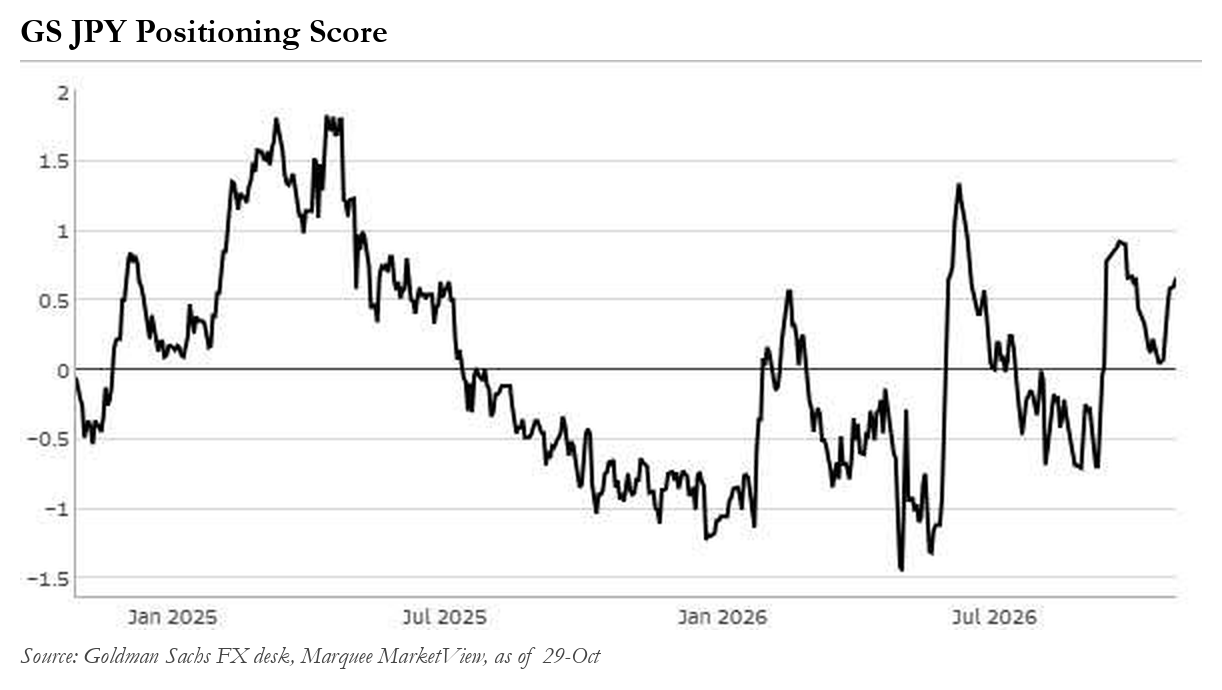
This is the same story we've been telling since the summer. The BOJ hikes, the yen briefly cheers, the Fed (or now the ECB too) out-hawks it, and the carry trade reasserts itself. When the BOJ hiked to 1.25% on September 18, the yen promptly plunged until the BOJ conducted a "rate check," which as we wrote in "Yen Jumps On Report Of BOJ "Rate Check" But It's "Too Little Too Late"" (Sep 18), only slowed the bleeding. And that came after Japan's record July-August intervention, which was funded by selling almost $90 billion in Treasuries.
Which brings us to the one domestic shift that could actually move the needle. In a companion note "Q&A on a Potential GPIF Allocation Shift" (also available to pro subs), Goldman's senior FX strategist Karen Fishman walks through what it would take for Japan's giant pension whale to bring money home. The answer: not much. GPIF doesn't even need to change its targets, since its current allocations sit at the midpoint of the allowable bands:
The earliest realistic timeline is Spring 2027, at the fiscal-year-end "annual verification." Until then, Fishman argues, short USDJPY is "a much more attractive portfolio hedge now than it has been in recent years, especially with the likelihood of greater AI-related volatility that could push both equities and yields lower together." Readers will recall that Tokyo has been nudging pensions homeward since July (""GPIF To The Rescue?" Yen Jumps After Japan Urges Pension Funds To Invest More At Home"), and the same repatriation logic is behind the relentless Treasury selling we flagged in "Focus Turns To Japan As Source Of Relentless Treasury Selling" (Sep 30) and the French bond rout in "Sayonara, OATs" (Oct 5). Every BOJ hike makes "home" a little more attractive for Japan's trillions parked abroad, and that is the channel through which today's decision reaches global bond markets.
So where does that leave us? The BOJ has declared victory over deflation, signaled December is live, and put its ETF unwind on a schedule that at least some of today's traders might live to see. Ueda's own framing is that the job now is to keep inflation anchored at 2%, which, with Brent at $116, the yen near 158 and a food consumption-tax cut set to muddy the data from FY2027, sounds a lot harder than getting there.
Goldman's Ota will be watching four things for the timing of the next move: i) Ueda's view on the exchange rate and yen-driven inflation risk, ii) the impact of tighter financial conditions, iii) the risk of inflation overshooting 2%, and iv) the level of the neutral rate. Note that the first item on that list is the yen. That is the tell. The market is already pricing more hikes than Goldman expects, the yen is barely responding, and every major central bank is leaning hawkish at the same time. Which means the BOJ probably delivers in December... and the yen probably shrugs again, until either MoF picks up the phone or GPIF picks up the bond ticket. We'd bet on the phone call coming first.
After all, it took the BOJ 14 years to hit 2% and it will take 43 more to sell the stocks it bought trying. Patience, in Japan, is a policy tool too.
Much more in the full Goldman Japan Economics note "BOJ: Status Quo Maintained at October MPM" and the "Q&A on a Potential GPIF Allocation Shift" note, both available to pro subs.
Tyler Durden Fri, 10/30/2026 - 09:42
Continue reading...
[ H/T ZeroHedge ]
Fourteen years, three governors, negative rates, yield curve control and the largest central bank equity hoard in history later, the Bank of Japan finally said the words.
In its quarterly Outlook Report released overnight alongside a widely expected decision to keep the policy rate at 1.25% (by an 8-1 vote, with hawk Hajime Takata dissenting in favor of a hike to 1.50%), the BOJ quietly retired the phrase it has used for years, that it expects to achieve its 2% target "between the second half of fiscal 2026 and fiscal 2027", and replaced it with this:
In other words, the war on deflation that has defined the Japanese economy for three decades is, officially, over. Reuters called it the BOJ declaring "victory in a nearly 14-year battle to hit its price target"; the FT went with victory in a war "that had defined the Japanese economy for decades." We'd go with something shorter: mission accomplished. Which, as anyone who remembers the original banner will tell you, tends to be the point where the real trouble starts.
And in case anyone thought the BOJ was just going to sit back and enjoy the moment, the central bank also nearly tripled the pace of its ETF sales, a surprise that nobody had in their models, and which shortens the time it will take to unwind its massive equity pile from 112 years to... 43 years. Progress!
A Hawkish Hold... With An Asterisk
We start with Goldman, whose Japan economist Tomohiro Ota summarized the decision in his post-meeting note "BOJ: Status Quo Maintained at October MPM, Underlying Inflation Assessed as Generally Consistent with Price Stability Target" (available to pro subs). The headline numbers barely moved: the growth forecast was "broadly unchanged" while the inflation forecasts were nudged lower for FY2026 and higher for FY2027 to reflect the jump in crude since the summer (with Brent at $116 this morning, probably not the last time we'll hear that excuse):
The full table is worth a second look, because the BOJ's FY2026 core-core forecast was actually cut to 2.4% from 2.5%, and Goldman's own forecasts sit below the BOJ's across the board, with GS seeing core-core at 1.9% in FY2028. So the central bank declared victory on underlying inflation on the same morning its own near-term forecast drifted lower, and the same morning Tokyo core-core CPI decelerated to 2.6% from 2.9%, according to Deutsche Bank's Jim Reid. Maybe a coincidence. Maybe a central bank that has waited 14 years to say the words and wasn't going to let a soft Tokyo print ruin the occasion.
The rest of the statement was a copy-paste of September. Risks to growth remain "generally balanced," risks to prices are still "skewed to the upside" (Middle East, AI, FX), and the BOJ kept the language, used since June, that it "will continue to raise the policy interest rate." The one new line Goldman flagged was a cautionary note about foreign central banks:
Translation: with Warsh's Fed and the ECB both eyeing hikes, the rate differential isn't closing, and the yen knows it. More on that below.
Ueda's press conference delivered the hawkish part of the "hawkish hold." The BOJ had entered a new "phase," he said, one focused on the risk of inflation overshooting rather than undershooting, and the Board will debate a hike at every meeting, including December:
Reuters notes that the BOJ raised rates in June and again in September, a much faster cadence than the roughly twice-a-year hikes of 2024 and 2025, and most economists it polled now expect a hike to 1.5% in December, with the terminal rate centered on 1.75% to 2%. Meiji Yasuda's Kazutaka Maeda went a step further, saying the BOJ "may now be contemplating increases every three months." Here is how the full journey from negative rates looks, with the market and Goldman's end-2027 calls tacked on:
Note the gap at the far right: per Goldman's rates strategists, OIS is pricing the BOJ policy rate at about 2.04% by end-2027, versus Goldman's 1.75% forecast. So the market is already more hawkish than the house, which matters for what happened next in FX.
The Real Surprise: 43 Years (Down From 112)
With the rate decision priced to perfection, the only genuine curveball was the ETF announcement, which we flagged in real time just minutes after the rate decision hit:
The details, again courtesy of Goldman's Ota: the ETF sales that began in January 2026 at an annual pace of ¥330bn (book value) will be increased to ¥860bn per year from January 2027 (a unanimous vote, in case anyone was wondering how controversial selling stocks at a 43-year pace is). "The change will shorten the time horizon required to complete the ETF selling, from 112 years to around 43 years."
Goldman's FX desk, in its morning update (available to pro subs), called the acceleration "the only real surprise," noting it shortens the unwind "to around just a mere 43 years." Deutsche Bank's Jim Reid was even drier: "Probably beyond the natural life of the EMR regardless of the pace!"
Regular readers will recall that when the BOJ first unveiled the ETF unwind back in September 2025, we summed it up in "BOJ Shocks Market With Start Of ETF Selling As It Keeps Rates Unchanged" with one line: you won't be alive to see the BOJ sell 20% of its ETF holdings, let alone all of it. Ueda himself admitted as much at the time: "We won't be here in 100 years' time. But our intention is to keep selling for more than 100 years." Well, at 43 years the math has improved, but for most of the BOJ's board (and most of ZH's readers) our original call still stands, so we'll allow ourselves a modest victory lap.
Some napkin math: ¥860bn a year for 43 years implies a book value of roughly ¥37 trillion (the same figure you get from ¥330bn over 112 years). The market value is far higher: the stockpile was worth over ¥75 trillion when the unwind was announced, and the Nikkei has gone up another ~25% this year alone.
"Overdone"... Says The Market That Fell 2% Anyway
So how did Japanese stocks take the news that their biggest shareholder is now selling almost three times faster? According to Bloomberg, with "confidence." Aizawa Securities' Yukihiro Kawanishi pointed out that the BOJ's planned selling of roughly ¥2.4 trillion a year at market value compares with average daily Topix turnover of about ¥9 trillion. Put differently, the BOJ will dump about a quarter of one day's trading volume... per year.
The Nikkei did close down 2.1%, but that had everything to do with the AI and chip unwind after Intel and Amazon (Murata -11%, plus a 16% plunge in Fujitsu on an earnings miss) and very little to do with the BOJ, as Goldman's regional desk noted; banks actually outperformed into the decision. It does cap what Goldman's APAC desk calls the worst October for the Nikkei since 2018, a story we covered earlier this morning in "Futures Slide As AI Reckoning Claims Amazon, Intel; Oil Jumps On Hormuz Tanker Hits." Even so, the index is still up about 25% YTD on top of last year's 26%, so the BOJ is selling into one of the best two-year runs in decades. Timing, as they say, is everything.
There was another, less advertised beneficiary. Bloomberg Economics' Taro Kimura noted that most of the realized gains from the sales are likely to be remitted to government coffers, which helps fund PM Sanae Takaichi's "ambitious fiscal plans." So the BOJ's equity unwind doubles as a modest revenue stream for one of the developed world's most indebted governments. Monetary and fiscal policy have never been closer... or as Japan likes to call it, Tuesday.
The Yen: Enough To Justify Pricing, Not Enough To Move It
And then there's the yen, which is the only market that really matters here. The BOJ's victory declaration was supposed to be the hawkish catalyst, yet the yen initially strengthened after the decision before paring gains as Ueda "offered few fresh clues on timing," per Goldman's regional wrap, and was trading around 157-158 per dollar. Deutsche's Reid had it up just 0.22% at 157.38 heading into the presser.
Goldman's FX desk explains why:
And the kicker: Goldman's FX strategists "remain of the view that any further domestic policy shifts... will take time to occur, if at all, and therefore also see near-term headwinds for JPY given the punitive carry and BoJ under-delivery risks." Goldman's JPY positioning score has already swung back into positive territory, which leaves plenty of room for disappointment:
This is the same story we've been telling since the summer. The BOJ hikes, the yen briefly cheers, the Fed (or now the ECB too) out-hawks it, and the carry trade reasserts itself. When the BOJ hiked to 1.25% on September 18, the yen promptly plunged until the BOJ conducted a "rate check," which as we wrote in "Yen Jumps On Report Of BOJ "Rate Check" But It's "Too Little Too Late"" (Sep 18), only slowed the bleeding. And that came after Japan's record July-August intervention, which was funded by selling almost $90 billion in Treasuries.
The GPIF Wildcard
Which brings us to the one domestic shift that could actually move the needle. In a companion note "Q&A on a Potential GPIF Allocation Shift" (also available to pro subs), Goldman's senior FX strategist Karen Fishman walks through what it would take for Japan's giant pension whale to bring money home. The answer: not much. GPIF doesn't even need to change its targets, since its current allocations sit at the midpoint of the allowable bands:
The earliest realistic timeline is Spring 2027, at the fiscal-year-end "annual verification." Until then, Fishman argues, short USDJPY is "a much more attractive portfolio hedge now than it has been in recent years, especially with the likelihood of greater AI-related volatility that could push both equities and yields lower together." Readers will recall that Tokyo has been nudging pensions homeward since July (""GPIF To The Rescue?" Yen Jumps After Japan Urges Pension Funds To Invest More At Home"), and the same repatriation logic is behind the relentless Treasury selling we flagged in "Focus Turns To Japan As Source Of Relentless Treasury Selling" (Sep 30) and the French bond rout in "Sayonara, OATs" (Oct 5). Every BOJ hike makes "home" a little more attractive for Japan's trillions parked abroad, and that is the channel through which today's decision reaches global bond markets.
Victory Declared, Yen Unimpressed
So where does that leave us? The BOJ has declared victory over deflation, signaled December is live, and put its ETF unwind on a schedule that at least some of today's traders might live to see. Ueda's own framing is that the job now is to keep inflation anchored at 2%, which, with Brent at $116, the yen near 158 and a food consumption-tax cut set to muddy the data from FY2027, sounds a lot harder than getting there.
Goldman's Ota will be watching four things for the timing of the next move: i) Ueda's view on the exchange rate and yen-driven inflation risk, ii) the impact of tighter financial conditions, iii) the risk of inflation overshooting 2%, and iv) the level of the neutral rate. Note that the first item on that list is the yen. That is the tell. The market is already pricing more hikes than Goldman expects, the yen is barely responding, and every major central bank is leaning hawkish at the same time. Which means the BOJ probably delivers in December... and the yen probably shrugs again, until either MoF picks up the phone or GPIF picks up the bond ticket. We'd bet on the phone call coming first.
After all, it took the BOJ 14 years to hit 2% and it will take 43 more to sell the stocks it bought trying. Patience, in Japan, is a policy tool too.
Much more in the full Goldman Japan Economics note "BOJ: Status Quo Maintained at October MPM" and the "Q&A on a Potential GPIF Allocation Shift" note, both available to pro subs.
Tyler Durden Fri, 10/30/2026 - 09:42
Continue reading...
[ H/T ZeroHedge ]