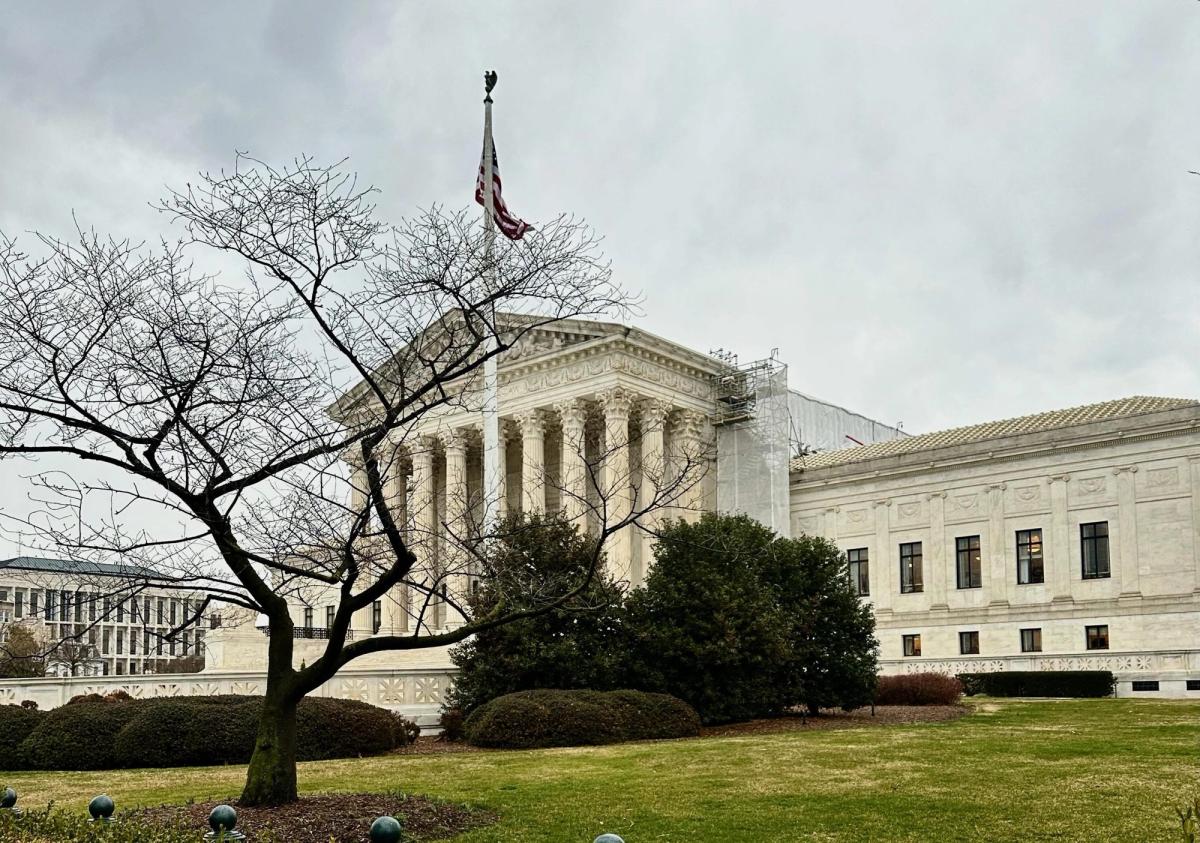







The Supreme Court will hear oral argument on Nov. 4 in Guerrero v. Johnson, a case about the limited circumstances in which a state prisoner can return to federal court for a second round of post-conviction review.
But let’s back up a bit: If inmates want to challenge the grounds for their detention, they must typically bring a habeas claim. The Antiterrorism and Effective Death Penalty Act of 1996, seeking to curb the number of such petitions, made it significantly more difficult to bring successive applications. Specifically, under 28 U.S.C. § 2244(b)(2) of AEDPA, a new claim in a second federal habeas petition is barred unless it falls under one of two exceptions. The first is when such a claim “relies on a new rule of constitutional law, made retroactive to cases on collateral review by the Supreme Court, that was previously unavailable.” The second exception covers claims based on “the facts underlying the [initial] claim,” but only if those facts would show “by clear and convincing evidence that, but for constitutional error, no reasonable factfinder would have found the applicant guilty of the underlying offense.”
Texas inmate Dexter Johnson brought his claim under the first exception, contending that he cannot be put to death based on the court’s 2002 ruling in Atkins v. Virginia, which held that executing people with intellectual disabilities violates the Eighth Amendment’s ban on cruel and unusual punishment. Johnson did not present the Atkins claim in his initial petitions but, after qualifying as intellectually disabled under revised diagnostic standards, raised this in a subsequent petition. The question before the justices is whether Johnson’s Atkins claim was “previously unavailable” to him.
Some background
In 2007, Johnson was convicted of capital murder and sentenced to death in Texas for his role in the double murder of 23-year-old Maria Aparece and 17-year-old Huy Ngo. At trial, a defense expert testified that Johnson’s IQ was between 74 and 88 and he “did not have obvious deficits” with regard to “personal independence and social responsibility when compared to other people of similar age and sociocultural background.” Under the diagnostic standards in place at that time, the expert concluded that Johnson was not intellectually disabled. (Johnson did not raise an Atkins claim in his initial habeas petitions but invoked Atkins in those petitions to argue – unsuccessfully – that its protections should extend to people with mental illness.)
In May 2013, while Johnson’s federal petition was pending, the American Psychiatric Association published the fifth edition of its diagnostic manual, known as the DSM-5, which Texas’ highest criminal court adopted in 2018. The new edition de-emphasized IQ cutoffs and recognized that someone whose score is above 70 may still be intellectually disabled. In April 2019, an expert gave Johnson an IQ test on which he scored 70, and a second expert agreed that Johnson met the DSM-5’s criteria for intellectual disability.
Johnson filed a successive habeas application in the district court, in which he claimed that he could not be executed under Atkins. After an evidentiary hearing, the trial court determined that Johnson’s Atkins claim was previously unavailable and consequently stayed his execution. The state appealed to the U.S. Court of Appeals for the 5th Circuit, which in July 2025 affirmed the district court’s decision. The full 5th Circuit then declined to rehear the case by a vote of 9-7. In February, the state asked the Supreme Court to weigh in, which the Supreme Court agreed in June to do.
The parties’ arguments
In its brief, the Office of the Texas Attorney General maintains that “Johnson’s Atkins claim does not rely on a change in the law.” Instead, it emphasizes, Atkins was decided well before Johnson filed his initial habeas application, and “before Johnson even committed the capital murder for which he was sentenced to death.” Nor, according to the Texas AG’s office, would permitting Johnson to bring such a claim serve the purpose of enabling successive petitions, which is to allow for new evidence as to whether a person is “guilty of the underlying offense.”
The state further presses the point that no “rule” was previously unavailable here. “An object—or a rule—can be available even when it is not needed or useful. A carpenter, for example, likely has a hammer ‘available,’ even when working on a task for which a hammer would not be necessary or useful,” the state writes. The publication of the DSM-5 may have allowed Johnson to discover a new factual predicate, according to the state, but it does not change the availability of any rule. Instead, the 5th Circuit’s approach “erases the line Congress drew between new law and new facts and effectively writes § 2244(b)(2)(B)’s limitations out of the statute.”
Johnson’s attorneys counter that something is “available” only if it is “capable of being used by a person, for a purpose”; prior to the publication of the DSM-5, no such usage was possible. “No one would say the hammer was available to the carpenter if it were locked in a toolbox he couldn’t open,” Johnson’s team writes. “Mr. Johnson did not change; his intellectual and adaptive characteristics are the same as always. What changed was the framework that made Atkins capable of protecting him. Atkins was not available to him before; now it is.” Nor, contrary to the AG’s claim otherwise, Johnson’s lawyers argue, would this open the “floodgates” to many other such challenges. Because very few rules are retroactive, such issues rarely arise.
Perhaps unsurprisingly given its stance on capital punishment, the Trump administration filed a “friend of the court” brief supporting Texas. Echoing several of the state’s arguments, U.S. Solicitor General D. John Sauer asserts that “
On Johnson’s side, the National Association of Criminal Defense Lawyers compares Johnson’s claim to second petitions based on new science about “microscopic hair comparison analysis, arson science, and shaken baby syndrome.” According to the NACDL, “claims of constitutional error grounded in faulty science in a second or successive petition” must be allowed to go forward because “flawed analytical methods may not be debunked until” it is too late.
One final thing worth mentioning: Last term, after hearing argument in Hamm v. Smith, a dispute over how courts should weigh multiple IQ scores in Atkins cases, the justices dismissed the case as improvidently granted (known as a “DIG”) – that is, they decided that it was a mistake to have agreed to hear the case in the first place and did not resolve it. At the end of his brief, Johnson asks the court to do the same in his case on the ground that the state has continually changed its arguments. Whatever the merits of Johnson’s position on that front, it seems unlikely the court will DIG two Atkins cases in successive terms.
The decision in Guerrero v. Johnson is expected by late June or early July.
Continue reading...
[ H/T SCOTUSblog ]