


During Donald Trump’s first run for the presidency, China, the economic behemoth that was gutting America’s manufacturing base and flexing its muscles in East Asia, was his favorite punching bag. Yet as Trump was seeking to reclaim the presidency after four years in the political wilderness, his new foreign target was much closer to home: Mexico.
By and large, Trump’s political coalition loved it. The trade hawks wanted large-scale tariffs on products coming out of Mexico, both to send a message that the United States would no longer be taken advantage of and to ensure China wasn’t using America’s southern neighbor to sidestep American levies on a laundry list of Chinese goods. Immigration hard-liners like Stephen Miller viewed Mexico as a big part of the problem, averting their gaze as tens of thousands of migrants made their way north to the U.S. southern border. The law enforcement community, meanwhile, regarded Mexico as the chief adversary in America’s battle against drug addiction, whose government was either incapable of stopping fentanyl from being smuggled into the U.S. or, even worse, cooperating with the cartels to do so.
Fortunately for proponents of the U.S.-Mexico relationship, the worst-case scenario of a complete and total rupture hasn’t come to pass. At least not yet. For now, Trump and Mexican President Claudia Sheinbaum seem to respect each other on a personal level. The cartels, who have taken control of roughly a third of Mexican territory, are under a significant degree of military pressure compared to what they dealt with under Sheinbaum’s predecessor, Andres Manuel Lopez Obrador. And the Sinaloa Cartel, Joaquin “El Chapo” Archivaldo Guzman Loera’s former group, is busy fighting a two-front war against the Mexican state and the descendants of El Chapo’s former business partner, Ismael “El Mayo” Zambada Garcia, who pled guilty to drug trafficking and was sentenced in July to life in prison.
Yet all of that headway remains vulnerable to the mood of one man: Trump, who is never completely satisfied unless other states are following his orders without reservation. That’s a problem for Mexico, which doesn’t take kindly to being bossed around or threatened by a much larger neighbor that gulped up about half of its territory nearly 180 years ago.
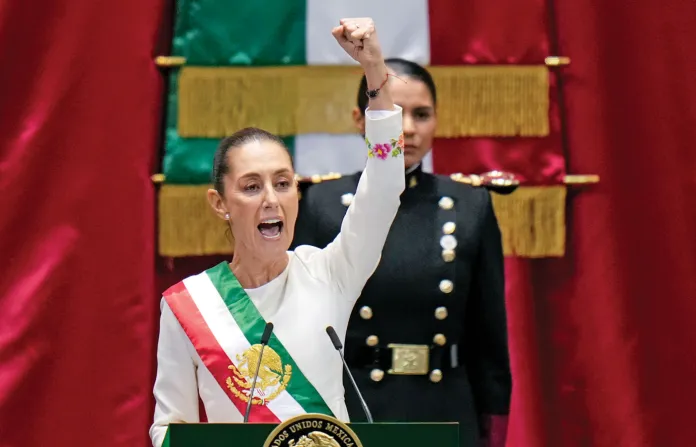
Mexican President Claudia Sheinbaum speaks after taking the oath of office in Mexico City, Oct. 1, 2024. (Eduardo Verdugo/AP)
" data-large-file="https://www.washingtonexaminer.com/wp-content/uploads/2026/09/Fea.Mexico.091626.jpg?w=696" height="658" width="1024" src="https://www.washingtonexaminer.com/wp-content/uploads/2026/09/Fea.Mexico.091626.jpg?w=696" alt="Mexican President Claudia Sheinbaum speaks after taking the oath of office in Mexico City, Oct. 1, 2024. (Eduardo Verdugo/AP)" class="wp-image-4724756" style="aspect-ratio:1.557075223566544;width:435px;height:auto" srcset="https://www.washingtonexaminer.com/wp-content/uploads/2026/09/Fea.Mexico.091626.jpg 1400w, https://www.washingtonexaminer.com/wp-content/uploads/2026/09/Fea.Mexico.091626.jpg?resize=300,193 300w, https://www.washingtonexaminer.com/wp-content/uploads/2026/09/Fea.Mexico.091626.jpg?resize=768,494 768w, https://www.washingtonexaminer.com/wp-content/uploads/2026/09/Fea.Mexico.091626.jpg?resize=1024,658 1024w, https://www.washingtonexaminer.com/wp-content/uploads/2026/09/Fea.Mexico.091626.jpg?resize=150,96 150w, https://www.washingtonexaminer.com/wp-content/uploads/2026/09/Fea.Mexico.091626.jpg?resize=696,447 696w, https://www.washingtonexaminer.com/wp-content/uploads/2026/09/Fea.Mexico.091626.jpg?resize=1068,687 1068w" sizes="auto, (max-width: 1024px) 100vw, 1024px">
Mexican President Claudia Sheinbaum speaks after taking the oath of office in Mexico City, Oct. 1, 2024. (Eduardo Verdugo/AP)
On the face of it, Trump and Sheinbaum are getting on just fine. Recognizing very early on that her mentor’s so-called hugs, not bullets strategy against the cartels was doing nothing to decrease the levels of violence in the country, Sheinbaum wasted no time enacting a more aggressive counter-drug policy prefaced on building up the capacity of the intelligence services, deploying the army in the country’s hot spots, and making sure Mexico’s various security agencies at the national, regional, and local levels were sharing information in real time.
The Trump administration, which continues to fight a literal war on drugs by blowing up alleged drug vessels transiting the Caribbean and deploying U.S. special operations forces to Ecuador, is appreciative of Sheinbaum’s willingness to act on U.S. intelligence. The demise of Nemesio Ruben “El Mencho” Oseguera Cervantes, the head of the Jalisco New Generation Cartel, in February 2026, is an apt illustration of how effective the security partnership can be when the Mexican army and the Central Intelligence Agency collaborate. It’s no wonder, then, that the Sheinbaum administration has permitted CIA surveillance flights over Mexico’s cartel-infested areas, with Sinaloa coming in for special attention. All of this is a far cry from the days of AMLO, when the Mexican government severely restricted the access of U.S. agents on Mexican soil, required Mexican agencies to document all of their interactions with foreign law enforcement, and gutted elite anti-drug units.
If this were the end of the story, then Washington and Mexico City could go home at the end of a long day’s work with smiling faces. Unfortunately, it’s not so simple. The first nine months of this year have proven to be an incredibly challenging period for the U.S.-Mexico relationship as a whole, a time filled with competing national priorities, contrasting political incentives, and a guy in the White House determined to break the crime-politico nexus that has bedeviled Mexico for decades. Combine this with intense Mexican nationalism and Sheinbaum’s internal juggling act within her own Morena party, and it doesn’t take a lot of imagination to envision whatever goodwill between the two partners evaporating as quickly as it came.
The first sign of trouble occurred in April, when two U.S. officials were killed in a car crash in Mexico. Those two Americans turned out to be employees of the CIA who were coming back from a raid on a drug manufacturing plant in the northern Mexican state of Chihuahua. Worse still, the Mexican government didn’t have a clue that those CIA agents were in the country, let alone participating in a counter-narcotics operation.
A soldier stands guard in the Mexican state of Michoacan by a charred vehicle set on fire following the death of cartel leader Nemesio ‘El Mencho’ Oseguera, Feb. 22, 2026. (Armando Solis/AP)
" data-large-file="https://www.washingtonexaminer.com/wp-content/uploads/2026/09/Fea.Mexico2.091626.jpg?w=696" height="658" width="1024" src="https://www.washingtonexaminer.com/wp-content/uploads/2026/09/Fea.Mexico2.091626.jpg?w=696" alt="A soldier stands guard in the Mexican state of Michoacan by a charred vehicle set on fire following the death of cartel leader Nemesio ‘El Mencho’ Oseguera, Feb. 22, 2026. (Armando Solis/AP)" class="wp-image-4724757" style="aspect-ratio:1.5570804741110418;width:436px;height:auto" srcset="https://www.washingtonexaminer.com/wp-content/uploads/2026/09/Fea.Mexico2.091626.jpg 1400w, https://www.washingtonexaminer.com/wp-content/uploads/2026/09/Fea.Mexico2.091626.jpg?resize=300,193 300w, https://www.washingtonexaminer.com/wp-content/uploads/2026/09/Fea.Mexico2.091626.jpg?resize=768,494 768w, https://www.washingtonexaminer.com/wp-content/uploads/2026/09/Fea.Mexico2.091626.jpg?resize=1024,658 1024w, https://www.washingtonexaminer.com/wp-content/uploads/2026/09/Fea.Mexico2.091626.jpg?resize=150,96 150w, https://www.washingtonexaminer.com/wp-content/uploads/2026/09/Fea.Mexico2.091626.jpg?resize=696,447 696w, https://www.washingtonexaminer.com/wp-content/uploads/2026/09/Fea.Mexico2.091626.jpg?resize=1068,687 1068w" sizes="auto, (max-width: 1024px) 100vw, 1024px">
A soldier stands guard in the Mexican state of Michoacan by a charred vehicle set on fire following the death of cartel leader Nemesio ‘El Mencho’ Oseguera, Feb. 22, 2026. (Armando Solis/AP)
Sheinbaum, keen to exhibit her nationalist credentials and aware that her political party doesn’t take kindly to any signs of U.S. interference, registered her disgust. “There cannot be agents from any U.S. government institution operating in the Mexican field,” she said. An investigation was launched, questions were asked of the Americans, and Chihuahua Gov. Maria Eugenia Campos was summoned to the prosecutor’s office in Mexico City for questioning. The entire episode rekindled the countries’ most rabid assumptions about the other — for Mexico, that their northern neighbor couldn’t care less about Mexican sovereignty; for the U.S., that Mexican politicians are insufficiently robust against the cartels that have killed hundreds of thousands of people over the last two decades.
Yet as bad as this incident was, a more consequential event a few weeks later risked unraveling the security relationship altogether. On April 29, the prosecutors in the Southern District of New York published an indictment of 10 Mexican officials and politicians, including Morena stalwart and Sinaloa Gov. Ruben Rocha Moya, on charges ranging from narcotics importation conspiracy and the possession of destructive devices to conspiracy. The allegations against Rocha Moya were especially damning. According to the indictment, the governor agreed to install corrupt individuals in state offices who would go easy on the Chapitos faction of the Sinaloa Cartel in exchange for their help in suppressing votes for Rocha Moya’s opponents. The U.S. Justice Department made a show of the charges.
“The defendants allegedly used positions of trust to protect cartel operations, enabling a pipeline of deadly drugs into our country,” Drug Enforcement Administration chief Terrance Cole said. “No one is above the law.”
That wasn’t all. Weeks later, news stories began to percolate that the U.S. Justice Department was widening the net even further. Two other Mexican governors, Alfonso Durazo of Sonora and Americo Villarreal Anaya, have had their U.S. visas stripped and are reportedly under investigation for colluding with narco-traffickers (both maintain their innocence). A third, Baja California Gov. Marina del Pilar Avila, also had her visa taken away and was offered to provide information to U.S. authorities in order to get it reinstated. Ditto Andres Manuel Lopez Beltran, the son of Lopez Obrador, whose travel was restricted by the Trump administration for unknown reasons.
Sinaloa Gov. Ruben Rocha Moya takes part in an annual earthquake drill in Culiacan, Mexico, Sept. 19, 2024. In April 2026, U.S. federal prosecutors indicted Rocha Moya and other officials for corruption and collusion with drug cartels. (Eduardo Verdugo/AP)
" data-large-file="https://www.washingtonexaminer.com/wp-content/uploads/2026/09/Fea.Mexico3.091626.jpg?w=696" height="658" width="1024" src="https://www.washingtonexaminer.com/wp-content/uploads/2026/09/Fea.Mexico3.091626.jpg?w=696" alt="Sinaloa Gov. Ruben Rocha Moya takes part in an annual earthquake drill in Culiacan, Mexico, Sept. 19, 2024. In April 2026, U.S. federal prosecutors indicted Rocha Moya and other officials for corruption and collusion with drug cartels. (Eduardo Verdugo/AP)" class="wp-image-4724758" style="aspect-ratio:1.5570769547204184;width:859px;height:auto" srcset="https://www.washingtonexaminer.com/wp-content/uploads/2026/09/Fea.Mexico3.091626.jpg 1400w, https://www.washingtonexaminer.com/wp-content/uploads/2026/09/Fea.Mexico3.091626.jpg?resize=300,193 300w, https://www.washingtonexaminer.com/wp-content/uploads/2026/09/Fea.Mexico3.091626.jpg?resize=768,494 768w, https://www.washingtonexaminer.com/wp-content/uploads/2026/09/Fea.Mexico3.091626.jpg?resize=1024,658 1024w, https://www.washingtonexaminer.com/wp-content/uploads/2026/09/Fea.Mexico3.091626.jpg?resize=150,96 150w, https://www.washingtonexaminer.com/wp-content/uploads/2026/09/Fea.Mexico3.091626.jpg?resize=696,447 696w, https://www.washingtonexaminer.com/wp-content/uploads/2026/09/Fea.Mexico3.091626.jpg?resize=1068,687 1068w" sizes="auto, (max-width: 1024px) 100vw, 1024px">
Sinaloa Gov. Ruben Rocha Moya takes part in an annual earthquake drill in Culiacan, Mexico, Sept. 19, 2024. In April 2026, U.S. federal prosecutors indicted Rocha Moya and other officials for corruption and collusion with drug cartels. (Eduardo Verdugo/AP)
For Sheinbaum, none of this would be especially bothersome if it weren’t for the fact that most of the Mexican politicians Washington is targeting are members of her political movement. Despite her promise to keep a cool head when dealing with Trump, Sheinbaum’s temper has flared up recently. The deference shown during the first year of Trump’s second term has now given way to resistance and annoyance. Sheinbaum’s political allies are increasingly beholden to the belief that Washington is seeking to embarrass Morena in the lead-up to the 2027 Mexican legislative elections. It’s a theory Sheinbaum is becoming more sympathetic toward with every perceived American intrusion into Mexican political life.
“An incident of this magnitude is unprecedented in our bilateral relations,” she told a rally weeks after the Sinaloa indictments were handed down. “Is this really a legitimate, genuine interest in helping Mexico? Or are we perhaps seeing sectors of the U.S. far Right positioning themselves ahead of their 2026 elections? Or do they intend to influence the 2027 election in our country?”
From the U.S. perspective, it’s easy to dismiss all of these questions as the rantings of a Mexican political elite that sees a gringo spy on every corner. Others interpret these remarks as a symbolic trope meant to cover Sheinbaum’s nationalist bona fides as the head of a party that prides itself on being an anti-establishment attack dog transitioning Mexico into a left-wing, corruption-free utopia.
President Donald Trump, left, and Mexico’s President Claudia Sheinbaum at the conclusion of a World Cup championship soccer match between Spain and Argentina in East Rutherford, New Jersey, Sunday, July 19, 2026. (Jacquelyn Martin/AP)
" data-large-file="https://www.washingtonexaminer.com/wp-content/uploads/2026/09/Fea.Mexico4.091626.jpg?w=696" height="658" width="1024" src="https://www.washingtonexaminer.com/wp-content/uploads/2026/09/Fea.Mexico4.091626.jpg?w=696" alt="President Donald Trump, left, and Mexico’s President Claudia Sheinbaum at the conclusion of a World Cup championship soccer match between Spain and Argentina in East Rutherford, New Jersey, Sunday, July 19, 2026. (Jacquelyn Martin/AP)" class="wp-image-4724759" style="width:847px;height:auto" srcset="https://www.washingtonexaminer.com/wp-content/uploads/2026/09/Fea.Mexico4.091626.jpg 1400w, https://www.washingtonexaminer.com/wp-content/uploads/2026/09/Fea.Mexico4.091626.jpg?resize=300,193 300w, https://www.washingtonexaminer.com/wp-content/uploads/2026/09/Fea.Mexico4.091626.jpg?resize=768,494 768w, https://www.washingtonexaminer.com/wp-content/uploads/2026/09/Fea.Mexico4.091626.jpg?resize=1024,658 1024w, https://www.washingtonexaminer.com/wp-content/uploads/2026/09/Fea.Mexico4.091626.jpg?resize=150,96 150w, https://www.washingtonexaminer.com/wp-content/uploads/2026/09/Fea.Mexico4.091626.jpg?resize=696,447 696w, https://www.washingtonexaminer.com/wp-content/uploads/2026/09/Fea.Mexico4.091626.jpg?resize=1068,687 1068w" sizes="auto, (max-width: 1024px) 100vw, 1024px">
President Donald Trump, left, and Mexico’s President Claudia Sheinbaum at the conclusion of a World Cup championship soccer match between Spain and Argentina in East Rutherford, New Jersey, Sunday, July 19, 2026. (Jacquelyn Martin/AP)
But there’s nothing symbolic about how Mexico has chosen to respond. Sheinbaum has rejected Washington’s extradition request for Rocha Moya and panned the U.S. Justice Department’s case against him as evidence-free flimflam. When Lopez Beltran lost his right to travel to the U.S., Sheinbaum used her daily morning press conference to insinuate that Trump is surrounded by dark, far-right evildoers whose mission is to destroy any sense of progress in Mexico. The Mexican government may be arresting thousands of low-level cartel members and sending troops to destroy fentanyl labs, but the country’s power brokers are beginning to wonder whether the person up north who matters most even appreciates Mexico’s efforts.
Thus far, the institutional ties that bind the U.S. and Mexico are working as normal. U.S. Ambassador Ronald Johnson is meeting with senior Mexican officials every day to deepen the bilateral relationship, strengthen security cooperation between their respective agencies, and, at times, has taken it upon himself to turn down the temperature whenever acrimony at the top surfaces.
TRUMP HAS THE CARTELS ON THEIR HEELS — NOW WITH COLOMBIA’S HELP
However, none of this is going to get any smoother over time. With Mexico preparing for elections next year and the Trump administration highly likely to indict more Mexican politicians for conspiracy, corruption, and collusion with the cartels, Sheinbaum’s famous level-headness risks exploding into the kind of fiery rage her immediate predecessor was known for.
Whether U.S. and Mexican policymakers can prevent political turmoil from undermining the relationship’s more functional side remains a long-term question. We better hope they can, because the only winner otherwise are the cartels that continue killing in Mexico and running drugs in the U.S.
Daniel R. DePetris is a fellow at Defense Priorities.
Continue reading...
[ H/T Washington Examiner ]