





China Buys Record Amount Of Gold As India Panics, Scraps Key Tax Relief On Precious Imports
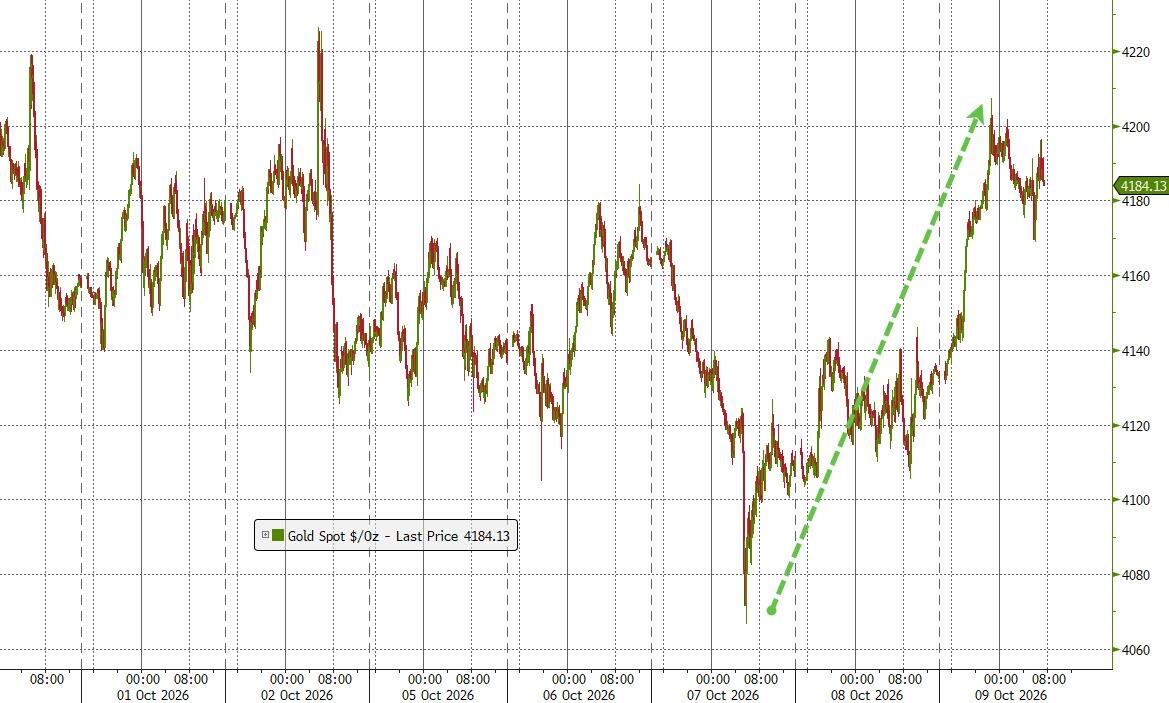
Gold is climbing notably this morning, underscoring the potential for the precious metal to ratchet higher into year-end thanks to sustained buying from central banks and retail investors.
On the retail side, the total known ETF holdings of bullion are up this week, set to match the 12-week streak of gains posted through April 18, 2025.
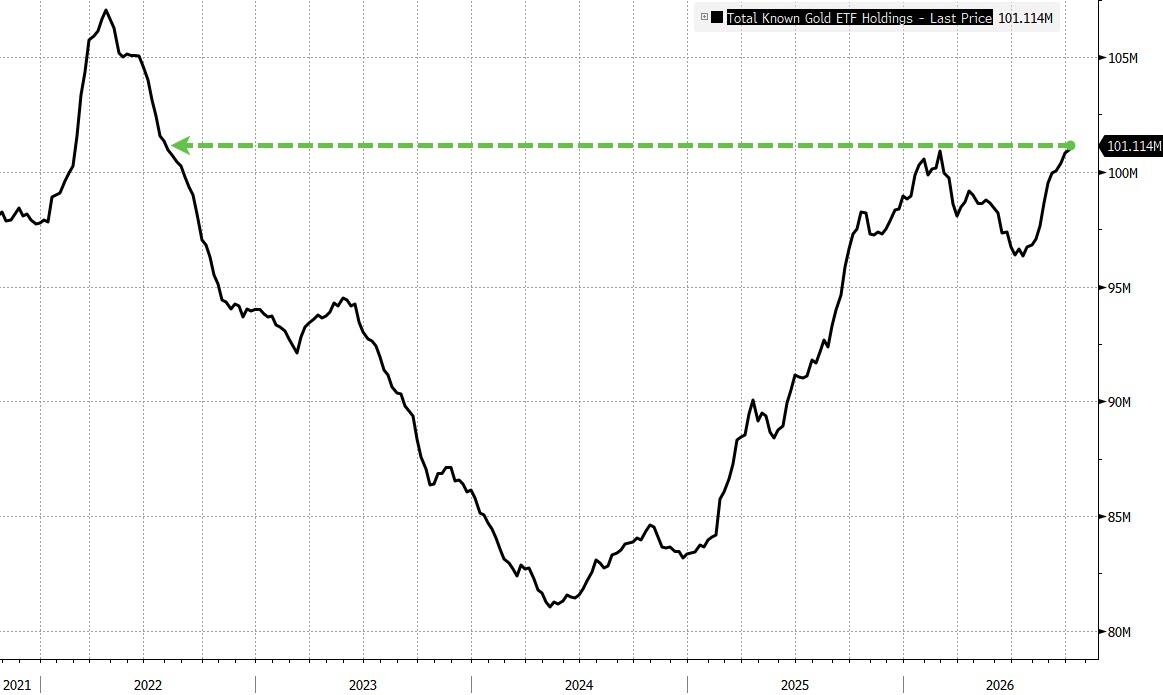
That means the stockpile exceeds the peak touched just before the outbreak of the Iran war.
And central banks are backing up the truck as The Financial Times reports that China has spent a record sum importing more than 1,000 tonnes of gold this year as the central bank and local investors pour cash into bullion amid rising geopolitical tensions abroad and poor returns on local assets.
The world’s second-largest economy spent $158.8bn on gold in the first eight months of the year. That compared with spending of $96.5bn for all of 2025 on 886 tonnes of gold.
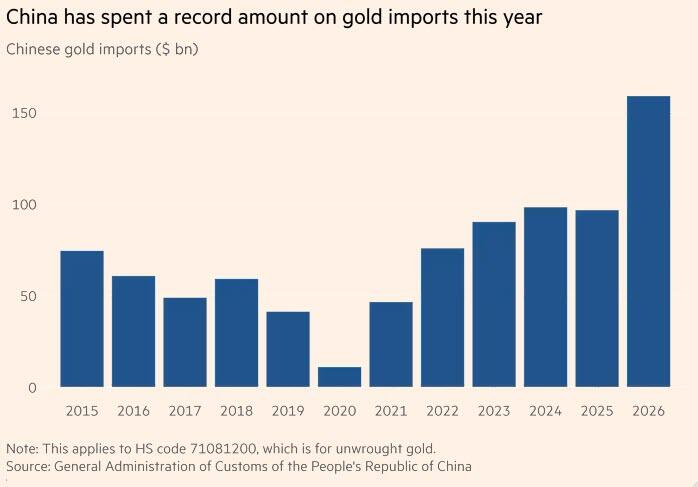
The jump comes after China reined in gold purchases last year during an intense rally that sent bullion prices soaring from about $2,625 a troy ounce at the start of 2025 to a peak of $5,595 in January.
There are signs that Chinese investors are increasing gold purchases as part of broader efforts to diversify their assets. Chinese holdings of US Treasuries fell to $618bn in July — the lowest level since August 2008.
But not everyone is embracing domestic demand for the barbarous relic...
India cut a key precious metals import tax relief policy overnight amid the country's broader 2026 efforts to curb non-essential gold imports, ease pressure on foreign exchange reserves, and support the rupee amid high fuel costs and currency weakness.
The official stated reason is tax parity: to stop the tax treatment itself from making one import route (banks/nominated agencies) preferential over others (including channels such as the India International Bullion Exchange).
Simply put, the specific 'key gold import tax relief' being scrapped is the bank IGST exemption (framed politically as parity), but it is part of the same policy environment of measures taken earlier in 2026 explicitly aimed at moderating gold imports and protecting forex reserves:
In mid-May 2026 the government sharply raised effective customs duty on gold and silver from 6% to 15% (basic customs duty to 10% + Agriculture Infrastructure and Development Cess to 5%), with platinum rising similarly. Officials framed this as curbing non-essential/discretionary imports so foreign exchange could be prioritized for essentials (crude oil, fertilizers, industrial inputs, etc.) amid the West Asia crisis, elevated oil prices, and pressure on the rupee.
PM Modi publicly appealed to citizens to avoid gold purchases for a year.
Other steps included tighter rules on certain import schemes, delays in licenses/notifications, and related restrictions.
Higher import costs for gold reduce demand (or at least slow it), ease the current-account and FX drain, and thereby help limit further depreciation - the same logic that has driven gold-duty adjustments in past periods of external stress.

So China is backing up a very big truck, Retail is BTFDing in ETF-land, and India is still panicking over fuel costs (desperate to slow domestic demand for the only thing that hedges its currency's collapse).
As Bloomberg's Garfield Reynolds notes, October in particular is looking like a sweet spot with rates traders sticking to bets that the Fed will delay any hikes until December, and with central bank appetite also showing little sign of abating, the level of demand out there has allowed bullion to show some resilience in the face of higher real yields and the resulting strength in the US dollar.
Gold is becoming an increasingly important diversifier for global investors at a time when government bonds no longer move inversely to stock markets.
Christopher Hamilton, Invesco’s head of client solutions for Asia Pacific ex-Japan, said gold prices had ceased to behave as they did during periods of rising real yields, which in the past caused gold prices to drop. “You’re in an environment where you want to own real assets,” he said.
Tyler Durden Fri, 10/09/2026 - 21:20
Continue reading...
[ H/T ZeroHedge ]
Gold is climbing notably this morning, underscoring the potential for the precious metal to ratchet higher into year-end thanks to sustained buying from central banks and retail investors.
On the retail side, the total known ETF holdings of bullion are up this week, set to match the 12-week streak of gains posted through April 18, 2025.
That means the stockpile exceeds the peak touched just before the outbreak of the Iran war.
And central banks are backing up the truck as The Financial Times reports that China has spent a record sum importing more than 1,000 tonnes of gold this year as the central bank and local investors pour cash into bullion amid rising geopolitical tensions abroad and poor returns on local assets.
The world’s second-largest economy spent $158.8bn on gold in the first eight months of the year. That compared with spending of $96.5bn for all of 2025 on 886 tonnes of gold.
The jump comes after China reined in gold purchases last year during an intense rally that sent bullion prices soaring from about $2,625 a troy ounce at the start of 2025 to a peak of $5,595 in January.
There are signs that Chinese investors are increasing gold purchases as part of broader efforts to diversify their assets. Chinese holdings of US Treasuries fell to $618bn in July — the lowest level since August 2008.
But not everyone is embracing domestic demand for the barbarous relic...
India cut a key precious metals import tax relief policy overnight amid the country's broader 2026 efforts to curb non-essential gold imports, ease pressure on foreign exchange reserves, and support the rupee amid high fuel costs and currency weakness.
The official stated reason is tax parity: to stop the tax treatment itself from making one import route (banks/nominated agencies) preferential over others (including channels such as the India International Bullion Exchange).
Simply put, the specific 'key gold import tax relief' being scrapped is the bank IGST exemption (framed politically as parity), but it is part of the same policy environment of measures taken earlier in 2026 explicitly aimed at moderating gold imports and protecting forex reserves:
In mid-May 2026 the government sharply raised effective customs duty on gold and silver from 6% to 15% (basic customs duty to 10% + Agriculture Infrastructure and Development Cess to 5%), with platinum rising similarly. Officials framed this as curbing non-essential/discretionary imports so foreign exchange could be prioritized for essentials (crude oil, fertilizers, industrial inputs, etc.) amid the West Asia crisis, elevated oil prices, and pressure on the rupee.
PM Modi publicly appealed to citizens to avoid gold purchases for a year.
Other steps included tighter rules on certain import schemes, delays in licenses/notifications, and related restrictions.
Higher import costs for gold reduce demand (or at least slow it), ease the current-account and FX drain, and thereby help limit further depreciation - the same logic that has driven gold-duty adjustments in past periods of external stress.
So China is backing up a very big truck, Retail is BTFDing in ETF-land, and India is still panicking over fuel costs (desperate to slow domestic demand for the only thing that hedges its currency's collapse).
As Bloomberg's Garfield Reynolds notes, October in particular is looking like a sweet spot with rates traders sticking to bets that the Fed will delay any hikes until December, and with central bank appetite also showing little sign of abating, the level of demand out there has allowed bullion to show some resilience in the face of higher real yields and the resulting strength in the US dollar.
Gold is becoming an increasingly important diversifier for global investors at a time when government bonds no longer move inversely to stock markets.
Christopher Hamilton, Invesco’s head of client solutions for Asia Pacific ex-Japan, said gold prices had ceased to behave as they did during periods of rising real yields, which in the past caused gold prices to drop. “You’re in an environment where you want to own real assets,” he said.
Tyler Durden Fri, 10/09/2026 - 21:20
Continue reading...
[ H/T ZeroHedge ]