


:max_bytes(150000):strip_icc()/GettyImages-2030238083-7e6963ad50074c1b89e0d0930cc71d91.jpg)




Futures Slide As Oil Jumps On Iran Strike Report, Bond Rout Resumes Ahead Of 30Y Auction
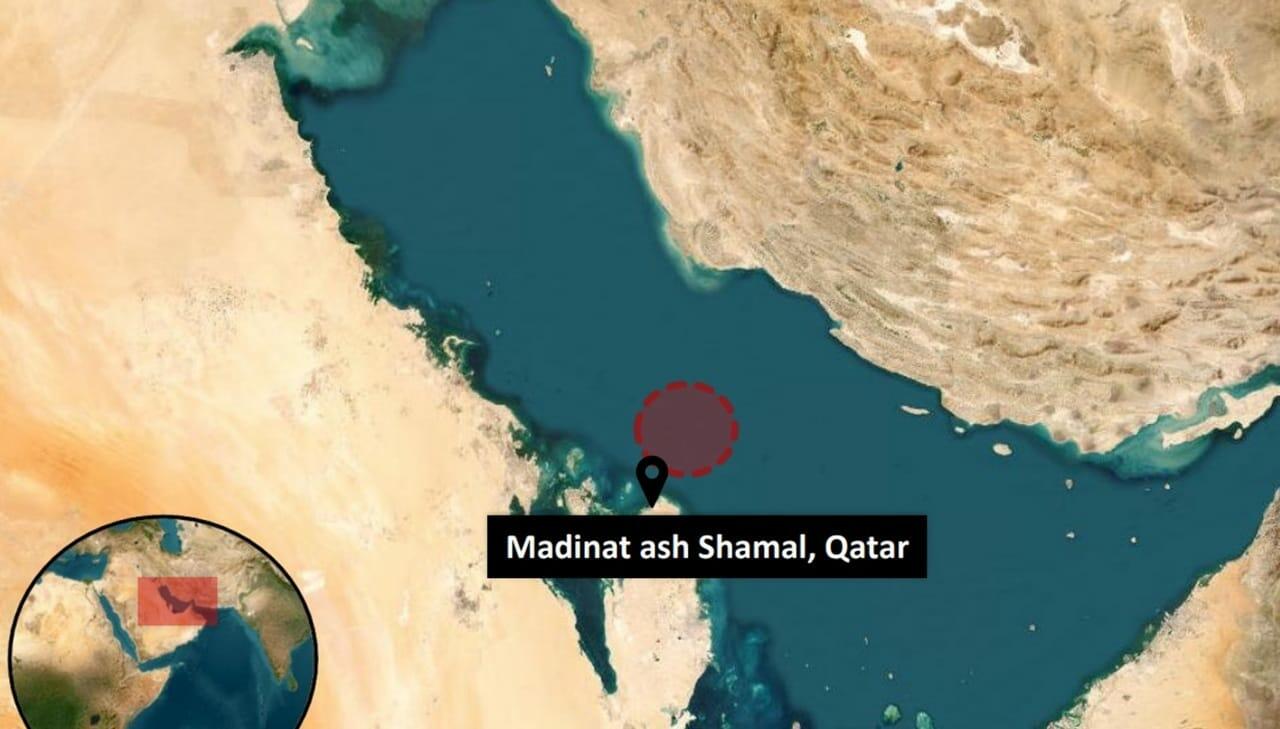
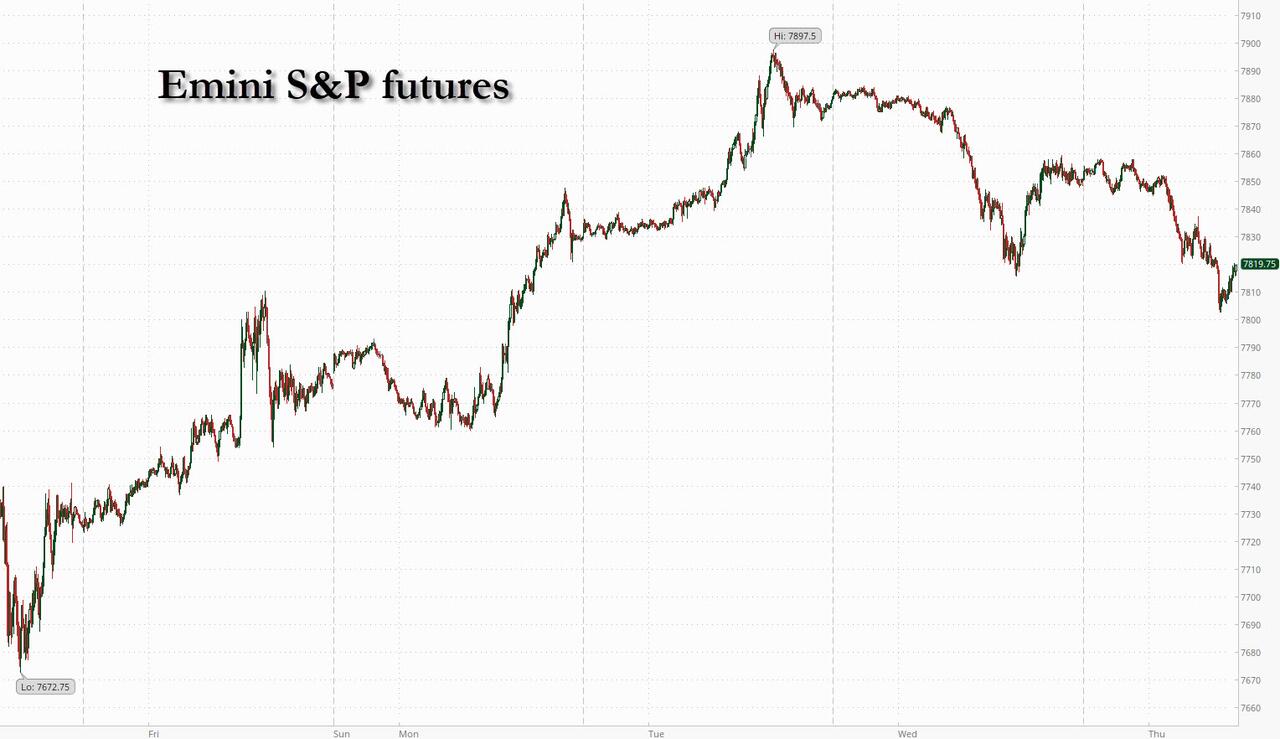
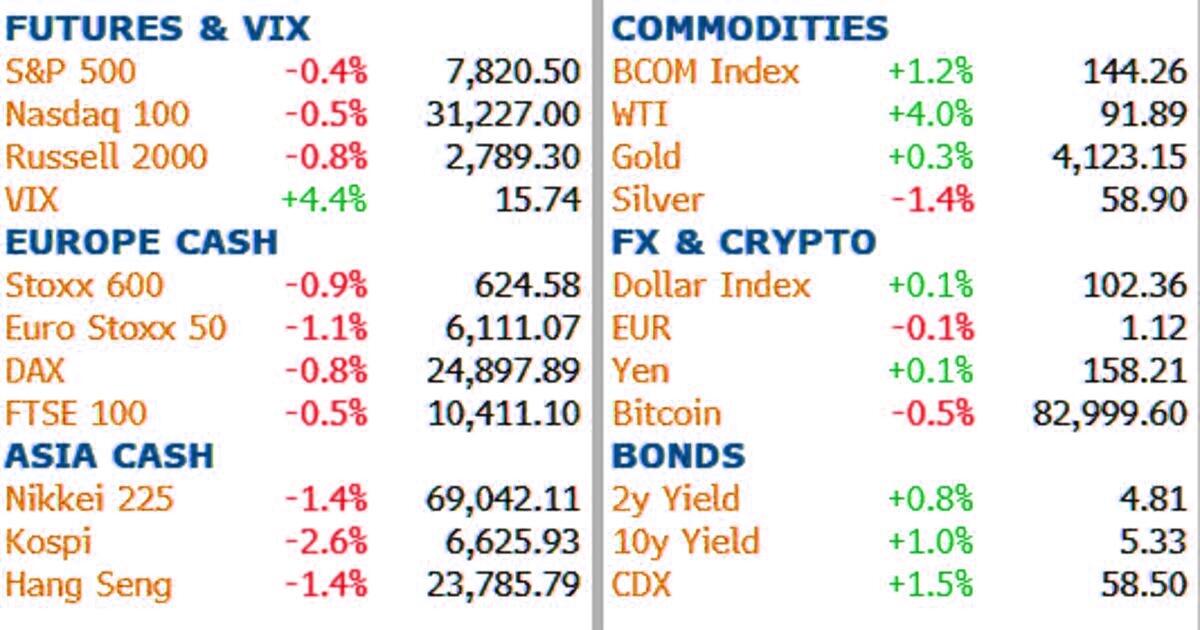
US equity futures are lower, extending Wednesday's decline, with the S&P sliding further from Tuesday's record high as oil spikes on reports that Trump may order fresh strikes on Iran before the midterms, a tanker was hit off Qatar in the first strike deep inside the Persian Gulf in about a month, and an approaching storm has shut some US output; as a result the global bond rout picks up where it left off with 10Y yields hitting 5.35%. As of 8:00 am ET, S&P futures are 0.4% lower at 7,820 and Nasdaq futures are down 0.5%, while Dow and Russell futures are both down 0.8%. This follows a session in which the S&P (-0.2%) slipped from its record, almost three-quarters of the index fell and the Russell 2000 (-1.3%) sank to a 4-month low. In premarket trading, Tesla and Nvidia underperform their Mag 7 peers as chip, growth and AI-related stocks trend lower, while Microsoft and Apple edge higher; Defensives lead Cyclicals with Energy the bright spot as hurricane Isaias forces Gulf producers to shut in wells. Wolfspeed soars 17% on a $1.5 billion DoD loan commitment and Palantir gains 2.2% on a Goldman upgrade. The day's driver is oil (again): Brent has jumped 5% to above $105 and WTI is up around 5% after The Atlantic reported the White House asked the Pentagon for Iran strike options that could be executed before November, a tanker was hit off Qatar and the Houthis fired a ballistic missile at Riyadh's airport. Treasuries are 5-7bp cheaper across the curve with the belly leading, and the 10Y is near session highs around 5.35%, a whisker from Wednesday's 24-year high of 5.36%, ahead of today's $22BN 30Y reopening. The Bloomberg dollar index is flat near a 3-month high and the DXY trades around 102.36; USDJPY is at 158.2 and EURUSD is stuck near 1.12, its lowest since May 2025. In commodities, Energy is bid while the rest of the complex is weaker: gold is up 0.3% to $4,123, silver is down 1.4% at $58.90, US natgas is up 1% to $3.24 and European TTF gas is above €80/MWh. Bitcoin is down 0.5% at around $83,000. US economic data slate includes initial jobless claims (8:30am, est. 200k) and August wholesale inventories (10am). Fed speaker slate includes Kashkari (10:40am) and Musalem (1:40pm); Waller already spoke at 4:30am. Treasury sells $22BN of 30-year bonds at 1pm.
In premarket trading, Tesla and Nvidia are underperforming Magnificent 7 peers, as chip, growth and other AI-related stocks are trending lower. Meanwhile, Microsoft and Apple edge higher: Tesla (TSLA) -1.1%, Nvidia (NVDA) -1%, Alphabet (GOOGL) -0.9%, Meta Platforms (META) -0.7%, Amazon (AMZN) -0.7%, Apple (AAPL) +0.1%, Microsoft (MSFT) unchanged
In other corporate news, Crescent Energy agreed to buy Devon's Eagle Ford assets for $4.22 billion in cash. David Ellison and his family invested approximately $17 billion to complete Paramount Skydance's acquisition of Warner Bros. Discovery. Broadcom, fresh off the launch of a $60 billion debt financing to help fund Anthropic's AI build-out, is already sketching out plans for its next blockbuster deal, and is said to be in talks to arrange about $30 billion in debt financing to help OpenAI buy the custom AI chips the two are developing together. Isomorphic Labs, spun out of Google's DeepMind, is in early talks to raise new funds at a valuation of at least $40 billion. Tencent is mulling a $5 billion bond sale. Blue Origin is likely to pursue an IPO within the next several years, Jeff Bezos said; SK Hynix's Solidigm has picked lead banks for its US IPO next year, and spinal disc maker Centinel Spine filed for an IPO. Energy Capital Partners offloaded about $890 million of Constellation Energy shares. Apollo's £5.7 billion EasyJet takeover is on track for completion early next year. The AI data center boom has ignited a bidding war for a critical TDK unit; FedEx and Advent reached a 98.49% stake in InPost. PepsiCo cut its full-year core constant currency EPS growth outlook. And Goldman's special bonus for its top brass is set to exceed $500 million (the bond market isn't the only thing hitting multi-decade highs).
The global selloff is back. Oil jumped again after a report that the White House asked the Pentagon to draw up strike options against Iran coupled with news that a tanker was hit off Qatar in the first strike deep inside the Persian Gulf in about a month, and the resulting bond selloff has been fairly uniform, with US, UK and German 10-year yields rising 4-5bps each, while the Stoxx 600 drops 0.8%. Futures point to a weaker open as the convergence of AI-fueled capex inflation, mounting energy supply pressures, and a Fed that appears far from finished with its tightening cycle weigh on sentiment, as Bloomberg's Neil Campling puts it. After stocks managed to grind higher for days even as the long end made fresh 24-year highs, the cracks are now visible above the surface too (as we noted last night in "Stocks Slide From All Time High As Gaping Cracks Form Just Below The Surface"). The FOMC minutes showed all 19 officials backed September's hike with "most" seeing another by year end, which sits awkwardly with the roughly 17-20% odds priced for October, and Fed Governor Waller this morning said further hikes will likely be needed, though there is "some flexibility" on timing and they don't need to come at consecutive meetings. Wednesday's stellar 10Y auction bought the bond market exactly one evening of peace.
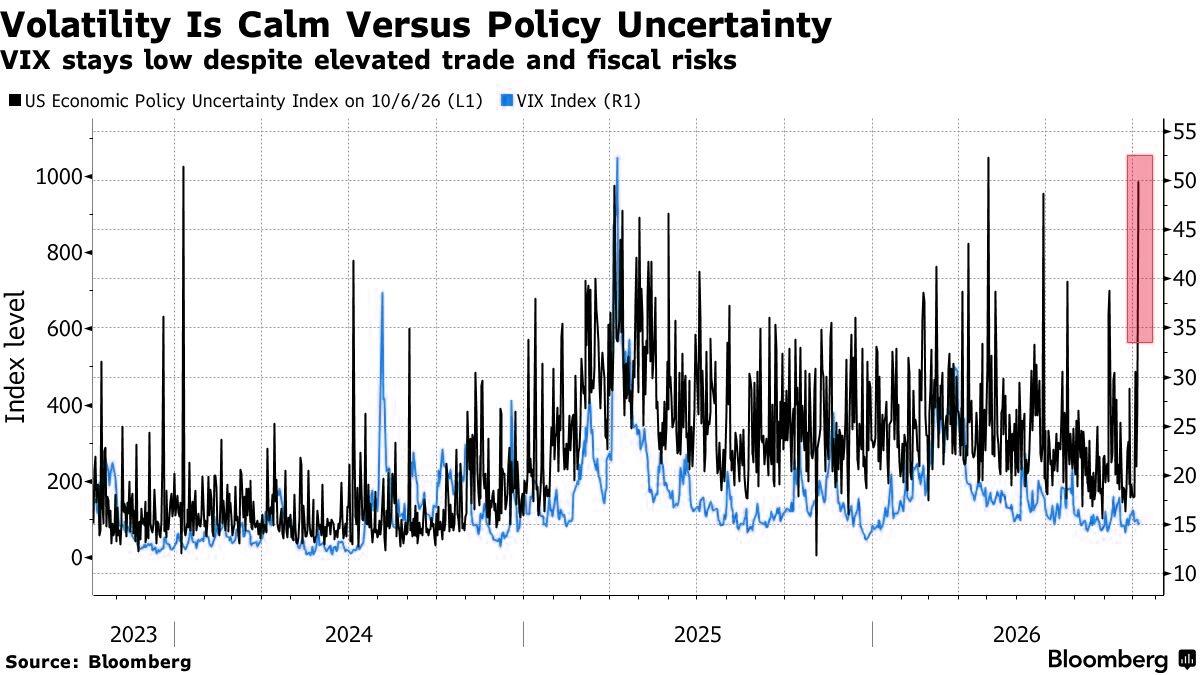
Doubts over policy have seldom been greater, with an index tracking US economic policy uncertainty registering one of its biggest spikes in three years. Yet volatility remains subdued, and the implied volatility ratio between the High Yield Corporate Bond ETF and the SPY is near year-to-date highs.
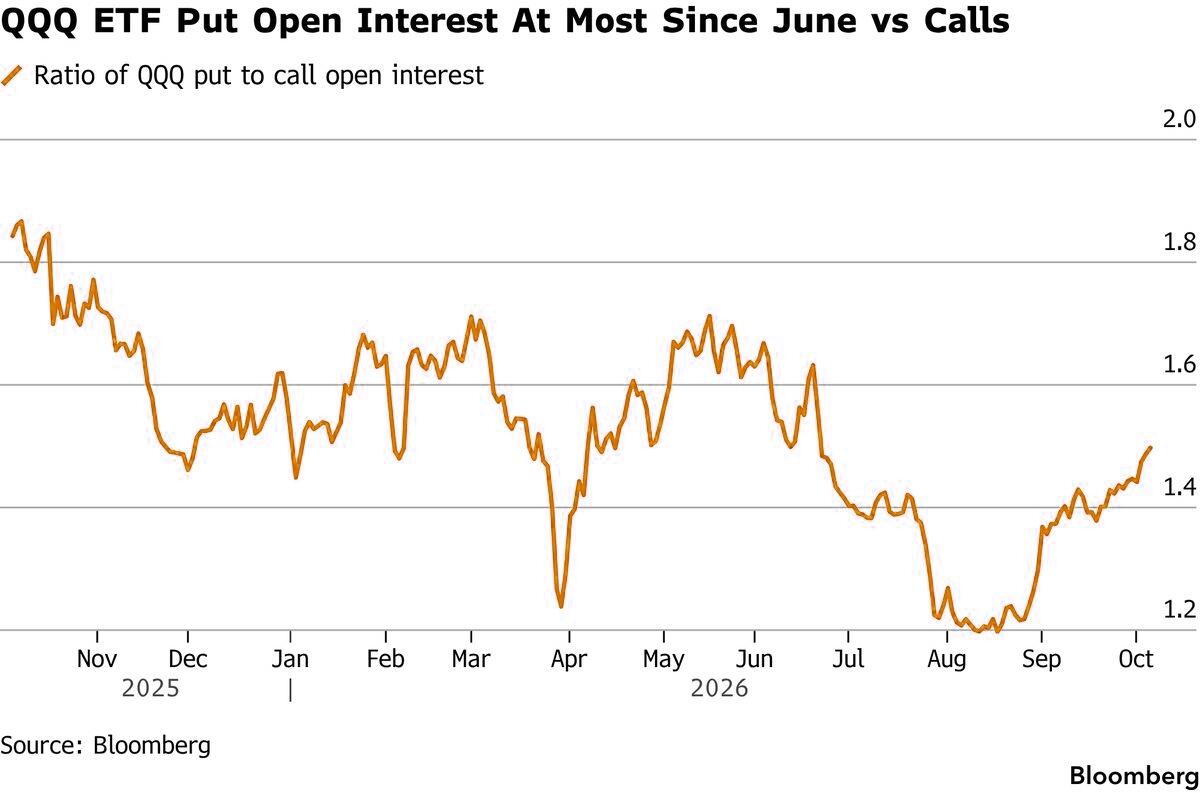
Divergent reactions to AI are showing up across the globe. Samsung's record-breaking quarterly preliminary results failed to meet the highest of expectations while TSMC posted 51% sales growth. AI angst is showing up elsewhere too: Australian data center company Firmus Grid closed the books on its IPO amid concerns the deal could be pulled due to inadequate support, hours after San Francisco passed a temporary ban on new data centers within its borders, and the head of market strategy at Panmure Liberum warns an AI bubble risk could soon trigger the most severe crash since the global financial crisis. Meanwhile, the ratio of open interest in put options on the QQQ has reached its highest level since June relative to calls, a sign investors may be increasing protection against a decline in the Nasdaq 100.
“Higher bond yields will certainly put the spotlight on the equity market, and it would put blaring lights on the emerging markets, in particular, and within emerging market sectors such as Singapore banks would be facing vulnerabilities,” said Nirgunan Tiruchelvam, an analyst at Aletheia Capital.
JPM's Market Intel desk under Andrew Tyler sums up the morning: futures are weaker as oil and bond yields move higher, with yields up 4-5bp across the curve and the USD setting a new 52-week high; Memory and Semis lag, and "in a similar pattern to yesterday, Defensives are leading Cyclicals with Energy the bright spot." The bigger warning is in positioning: JPM's Positioning Intel flags crowding in NDX longs (98th percentile) and RTY shorts (3rd percentile); in recent unwinds that pair has lost 1.9% over a month vs. gaining 80bp in a typical month. JPM's Manish Sinha says the bank's Macro Conditions indicator has tightened to above the 95th percentile, "levels last seen during the 2025 tariff escalation," leaving Momentum vulnerable either way, and recommends buying protection into year-end/earnings. On the cash desk, Matt Reiner says high-touch volumes are tracking 57% below the 5-day average because "confidence is shot," quoting a client: "I'm right one day, wrong the next." And TMT's Brian Heavey sees a "clear de-risk in Europe spilling over to US tech." Still, the team sticks with its Tactically Bullish view, with Tech the core long, and notes the biggest upside catalyst would be a US/Iran deal (which, judging by this morning's headlines, is not imminent).
Goldman's Rich Privorotsky frames the problem: "the AI micro continues to accelerate while the macro backdrop gets progressively more difficult. Strong earnings simply aren't enough to offset the pressure from rates, energy and capital supply." With SpaceX reportedly seeking $40bn and Broadcom exploring more than $50bn of financing, he warns "the crowding out effect is potentially immense," asking "why rush to buy sovereign duration when an extraordinary amount of high quality private sector paper is coming at you?" (see "SpaceX Credit Risk Hits New High As AI Debt Binge Fears Spook Bondholders"). On oil: "With the midterms approaching, I am less convinced we have a credible off ramp." He notes the Russell has underperformed the NDX in 17 of the last 20 sessions. Meanwhile, Goldman's Prime book shows net exposure to the Mag7 at ~22% of total US exposure, the highest on record since the start of 2022 (see "The Asymmetry Has Shifted"), while semis are ~12% of US exposure vs ~6% at the start of the year. On the Fed, Goldman economists still expect a second hike in December, but see "a strong chance the FOMC ultimately concludes further tightening is unnecessary," and Abhay Duggirala estimates about three-fourths of this year's core PCE overshoot is mismeasurement or one-offs.
Retail is in focus with PepsiCo earnings and a host of household names including Target, Lowe's and embattled Nike set to appear at a retail and consumer conference in New York. Costco reported 13% year-over-year net sales growth in September, supported by a 4.7% increase in traffic. Watch US insurers, utilities and home improvement retailer stocks as hurricane Isaias develops, with oil and gas producers shutting in wells and evacuating personnel as the storm tracks toward the Gulf Coast.
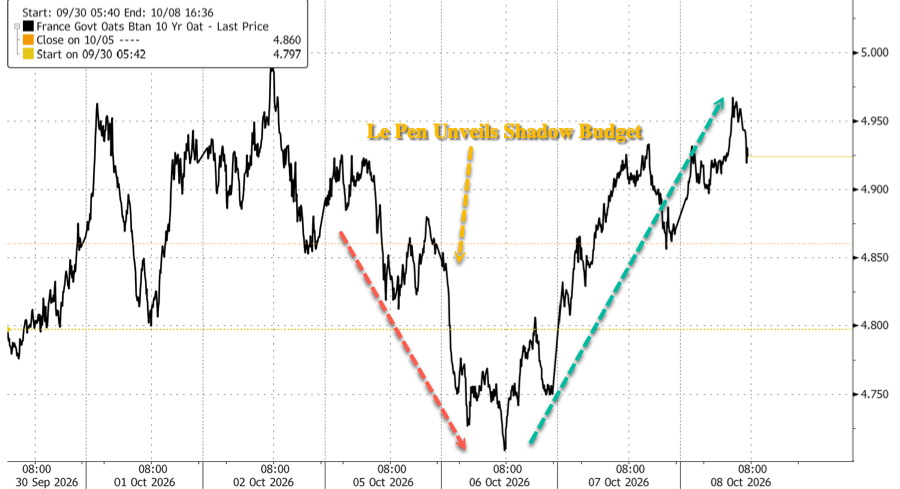
In Europe, France remains the epicenter. The Franco-German 10-year spread widened 12bps on Wednesday to almost 140bps after the WSJ reported Paris is weighing more short-dated issuance, Bank of France Governor Moulin said "the conditions are not met today for an intervention from the ECB," and this morning five-year OAT yields are up another 9bps to 4.33%. Nearly €215 billion of France's corporate bonds now trade as if they were safer than the government's, an almost 18-fold increase since the start of 2026, and the euro is pinned near $1.12, its lowest since May 2025. French banks are once again taking the sovereign hit (see "European Banks Tumble As French Bond Crash Reactivates "Doom Loop""), while Italian PM Meloni needs to win a confidence vote today to avoid further bond-market tensions, according to Citi.
In Europe, the Stoxx 600 is down 0.8% to 625.65, with 409 members down and 180 up, extending Wednesday's losses as the jump in oil fans inflation fears and puts it on course for a second straight losing week. Media, Energy and Utilities lead, while Banks, Health Care and Construction lag; JPM notes its Stagflation basket is near the top of the leaderboard alongside MidEast Escalation plays and Quality, while Growth, LT Momentum and semis underperform as "Beta is being sold alongside Momentum." The CAC 40 slid further into a correction. Morgan Stanley's Marina Zavolock says European stocks may be approaching levels where they typically stabilized in previous episodes of sharply rising bond yields. Here are the biggest European movers:
Asian stocks were set for their lowest close since mid-September as rising oil prices and elevated bond yields fueled inflation concerns, with MSCI's Asia Pacific Index dropping as much as 1.8%. South Korea's Kospi led losses, sliding 2.6% and closing below its 50dma as foreigners sold for a fourth session (about $1.1bn in tech) after Samsung's record profit, a nearly nine-fold rise, still missed lofty expectations. This is happening just as the flood of corporate buybacks is coming to an end, which we warned - correctly - would slame the index.
Japan's Nikkei fell 1.4% back below 70,000 and the Topix underperformed (TOPIX Banks -3%) after the TSE announced plans to cut the index's constituents by about 40%. The Hang Seng fell 1.4% to its lowest since July 7, and mainland Chinese shares declined as trading resumed after the Golden Week holiday, with the CSI 300 down 1.35% and the Star50 at a six-month low intraday. Singapore's Straits Times dropped 3% as banks extended losses after JPMorgan warned surging long-term yields will hurt Southeast Asian lenders' earnings, and the ASX 200 fell 0.8%. India's Nifty slid 1.6% after the RBI's hawkish shift. Goldman's Rachel Hu notes that "both the Nikkei and TOPIX surrendered all afternoon gains in the final hour as US equity futures weakened sharply."
In FX, the Bloomberg Dollar Spot Index is flat, close to its highest in more than three months, while the DXY trades in a narrow 102.13-102.39 range. The loonie leads G10 on the bid in energy, while the yen lags on widening yield differentials, with USDJPY at 158.2. EURUSD holds near recent lows just shy of 1.12, and options traders are paying a premium to hedge against euro losses versus the pound for the first time in more than two years. The PBOC said it has no intent to devalue the yuan for trade advantage ahead of EU trade talks. “With BBDXY hovering around 3-month highs, dollar bulls are likely to need a fresh catalyst to push the dollar to test the June highs,” said Sean Callow, a senior analyst at ITC Markets in Sydney.
In rates, Treasuries pressured lower over the London session, driven by sharp gains in oil prices following the bigger Middle East escalation. US yields are cheaper by 5bp to 7bp across the curve with the belly leading losses, cheapening the 2s5s30s fly by around 3bp, and the 10Y is near session highs around 5.35%. Ahead of the 30Y reopening, 30-year yields trade up almost 6bp on the day, adding some late concession: the $22 billion sale at 1pm has the WI trading around 5.725%, ~42bp cheaper than the September stop-out, which tailed by 0.4bp. Bunds are outperforming by 1bp in the 10-year sector while gilts lag, with five-year gilt yields up 7bps to 5.05%; money markets price around 23bps of BOE hikes for November and 4bps of ECB hikes this month. NatWest, meanwhile, picked a fine moment to announce it will exit as a primary dealer for US and European government bonds. The IG dollar issuance slate includes a couple of deals; this week's volume is set to significantly miss the $25 billion low end of syndicate forecasts. Fed speaker focus is on Kashkari and Musalem after Waller's hawkish-leaning comments.
JPM's Nick Panigirtzoglou, author of Flows and Liquidity, flags a bifurcated positioning picture in bonds, with quant funds benefiting from short duration exposures while discretionary managers scramble to contain long duration and spread overhangs, and says his bias is that discretionary managers "amplify the current negative momentum" in the near term.
In commodities, WTI has risen to a $92.03 high from $88.77 and Brent extended gains to 5%, trading above $105 a barrel, as US-Iran tensions escalate and Hurricane Isaias, packing 80 mph winds, makes its way across the Gulf, shutting in some output. Saudi Arabia is in talks to formalize Hormuz shuttle services, while Iraq cut November prices to Asia and ADNOC set Murban at an $11 premium to Dubai. European diesel cracks have leapt and TTF gas rose to a €80.67/MWh high. Spot gold recovered from $4,103 to $4,143 before fading, silver fell to $58.71, and LME copper trades on either side of $14,500/t. Goldman's commodity team argues China's petchem oil demand weakness, which helped shrink the deficit from the Hormuz shock, is mostly unsustainable.
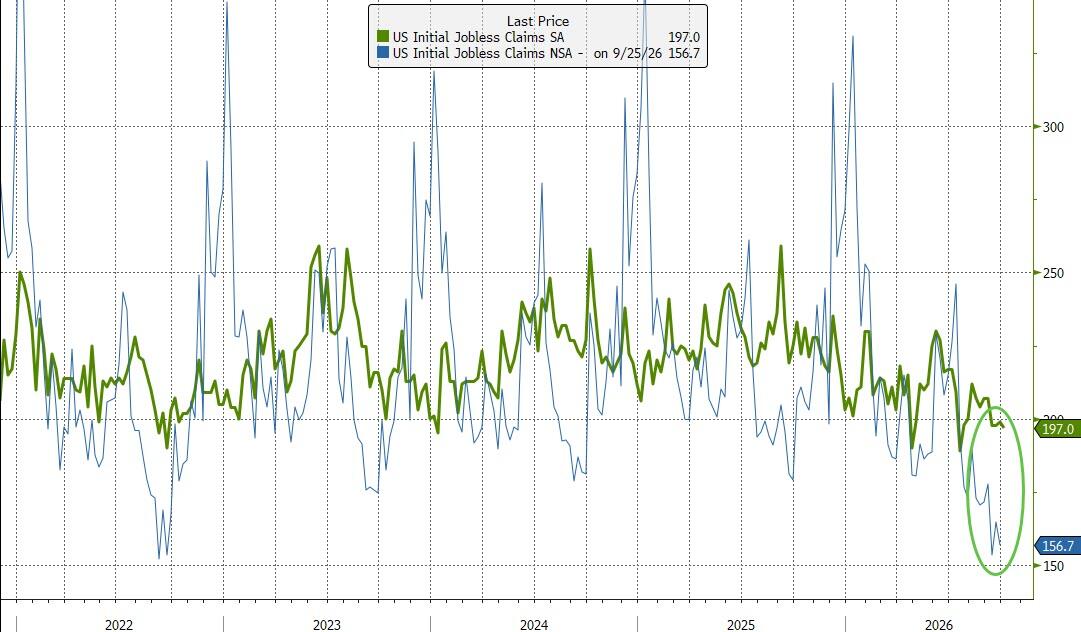
US economic data slate includes initial jobless claims (8:30am, est. 200k) and August wholesale inventories (10am). Fed speaker slate includes Kashkari (10:40am) and Musalem (1:40pm). Treasury sells $22BN in 30-year bonds at 1pm and conducts a buyback of up to $6BN of longer-dated debt.
PepsiCo is the only significant earnings report before the bell, and the ECB publishes the account of its September meeting at 7:30am ET. Target, Lowe's and Nike appear at a retail and consumer conference in New York, and JPM hosts a trading desk call at 10am covering macro, the midterms and earnings season.
Market Snapshot
Top Overnight News
A more detailed look at global markets courtesy of Newsquawk
APAC stocks were mostly on the back foot following the negative handover from Wall St, where stock markets pulled back from recent record highs amid bond market volatility, while sentiment overnight was pressured as oil rebounded amid geopolitical risks after reports that the US military has been ordered to be ready for possible Iran strikes, with President Trump weighing the timing and could resume strikes before the Midterm elections, but with no decision made. ASX 200 was dragged lower as weakness in miners, materials and resources clouded over the gains in energy and resilience in defensives, while there was also an uptick in inflation expectations. Nikkei 225 retreated back beneath the 70,000 level as it continued to fade the recent tech-driven rally, while the TOPIX underperformed following the announcement that the Tokyo Stock Exchange plans to reduce the number of constituents in the index by about 40% to 986 stocks. KOSPI was pressured alongside indecision in Samsung Electronics shares following its preliminary Q3 earnings results, which showed operating profit surged 783% Y/Y, but missed the lofty expectations. Hang Seng and Shanghai Comp were subdued despite the resumption of trading in the mainland following a week-long hiatus, with pressure seen in tech stocks and sentiment was also not helped by trade frictions as the EU is said to be preparing a temporary import cap on Chinese hybrid cars.
Top Asian News
European bourses (STOXX 600 -0.8%) are lower across the board, weighed by the upside across the energy complex amidst reports of potential US strikes on Iran before the midterms (see geopolitics section for details). Outside of the aforementioned geopolitics, Samsung Electronics and TSMC reported Q3 metrics. For the former, its revenue and operating profit missed estimates; on the other hand, the latter beat forecasts. Samsung shares fell 2.4% in Asia trade following its metrics, despite reporting a near nine-fold rise in quarterly operating profit, while TSMC (-1.4%) also slipped, although to a lesser degree. Sectors point to the negative bias. Media tops the sector pile, closely followed by Energy and Utilities. Underperformance comes from Banks, Health Care and Construction. US equity futures follow their European peers amid the rise in energy prices. Well-known investor Paulson has recently highlighted that the last time oil was above USD 100/bbl, US yields were above 5% and the USD was elevated, the S&P 500 dropped as much as 15% in the following three to five months. TSMC (2330 TT) Q3 Revenue TWD 1.49tln (exp. 1.46tln); Sept. Revenue 551.9bln (prev. 331bln Y/Y). Samsung Electronics (005930 KS) Prelim. Q3 (KRW): Operating Profit 107.4tln (exp. 108.7tln), Revenue 195tln (exp. 199tln).
Top European News
FX
Central Banks
Fixed Income
Commodities
Trade/Tariffs
Geopolitics: Middle East
Geopolitics: Ukraine
Geopolitics: Other
Crypto
US Event Calendar
Central Bank Speakers
DB's Jim Reid concludes the overnight wrap
Staying with France, it was again at the epicentre of a global bond market sell-off yesterday. In fact, at one point in the session, the Franco-German 10yr spread was on course for its biggest daily jump since the pandemic turmoil in March 2020, although it partially pulled back by the close to “only” rise +12.3bps on the day. This was around 3bps tighter than the peaks earlier in the session. Elsewhere, the UK’s 10yr gilt yield (+6.8bps) hit a post-2007 high of 5.44% while 10yr Italian yields rose by +9.7bps. US Treasuries did mostly stabilise amid a pullback in oil and a strong 10yr auction, but 30yr yields (+1.3bps) still reached a new post-2002 high of 5.67% and are back up +2.7bps this morning. The renewed stress led to mounting pressure on risk assets too. Indeed, the S&P 500 (-0.22%) slipped back from its record high on Tuesday, whilst France’s CAC 40 (-1.22%) slumped to a fresh six-month low.
Whilst there have been clear short-term catalysts for the recent move, including another round of oil price gains, there’s a long-term fundamental story of how French debt has been on an unsustainable trajectory for many years which Henry and I looked at in our note mentioned at the top with France not running a budget surplus since 1974, with its debt-to-GDP rising almost continuously in that time. One additional interesting graph in the note shows 10yr yields now being comfortably above nominal GDP after being below it for much of the last decade or so. So a worry for debt sustainability. That said, our rates strategists, after being bearish on French debt for many years, now believe it is cheap relative to fundamentals. Something we also highlight. So lots to consider.
In terms of the last 24 hours, it was clear that European contagion risk was back on the agenda, as there was a sharp widening in the spreads of multiple countries. So that marked a change in the mood relative to the last few days, as the financial market stress had generally been easing since last Friday. While there wasn’t a single driver of the renewed sell-off, the investor mood arguably wasn’t helped by comments from Bank of France Governor Moulin, who said that while the situation in France’s bond market was complicated “the conditions are not met today for an intervention from the ECB”. So in the end, the Franco-German 10yr spread (+12.3bps) was back up to 139bps by the close, and the 2yr spread (+9.7bps) also moved back up to 56bps. For now, those spreads are both beneath their peaks from last week, but it again helped push the Italian 10yr spread (+10.0bps) back up to 115bps, whilst Spain’s (+5.1bps) was up to 64bps, the widest in over a year. And it didn’t look much better in absolute terms either, with France’s 10yr yield (+11.8bps) up to 4.86%, in contrast to 10yr bunds (-0.4bps) which fell back slightly to 3.47%.
That bond market stress cascaded across multiple asset classes, with clear pressure across the board. For instance, French banks posted sharp losses again, with Société Générale (-5.01%), BNP Paribas (-3.88%) and Crédit Agricole (-3.45%) all losing significant ground. Moreover, it was another rough day for the Euro itself, which weakened -0.55% against the US Dollar to $1.1197, its lowest since May 2025. And as with last week, the moves led to growing questions about whether the ECB could even carry on hiking rates at all. Indeed, the probability of another ECB hike by December was down to just 85% by the close, which is the most dovish rates profile for 2026 in the last month. In other words, markets are increasingly pricing in a chance that the ECB press pause on the hiking cycle this year.
One of the drivers of the fresh bond selloff in Europe was a move higher in oil prices, which added to concerns given the continent’s dependence on imported energy. That said, this reversed as the session went on, with Brent crude settling around $101/bbl after trading above $102.50 shortly before Europe went home, while WTI (-1.28%) fell to its lowest level since August at $88.28/bbl. However overnight Brent is back up to $102.36 as The Atlantic reported that the White House has asked the Pentagon to draw up options on strikes against Iran prior to midterms. Back to yesterday and concerningly, European natural gas futures (+3.16%) rose to €78.08/MWh, closing back in on their recent high from September, while European diesel prices jumped by +5.96%. So overall there were few signs that the inflationary pressure was diminishing, and the Euro 1yr inflation swap (+9.9bps) was back up to 3.34%.
This backdrop of wider bond spreads and fresh inflation fears meant it was a rough day for risk assets. That was particularly clear in Europe, where the STOXX 600 (-1.00%) fell back after three consecutive gains, and there were even bigger losses for the CAC 40 (-1.22%) and Italy’s FTSE MIB (-2.51%) with European banks (-3.38%) bearing the brunt of the losses. That also carried over to the US, where the S&P 500 (-0.22%) slipped back from its record high the previous day. And while the headline decline moderated as the session went on, there were still signs of stress under the surface, with almost three-quarters of the index lower on the day as cyclical sectors including industrials (-2.14%) and materials (-1.53%) underperformed. And while relative resilience in tech stocks limited the losses for the Nasdaq (-0.22%) and Mag-7 (-0.20%), the small-cap Russell 2000 (-1.31%) sunk to a 4-month low.
As all that was happening, one asset class that did mostly stabilise was US Treasuries. The 10yr yield has been on course to rise to another post-2002 high, trading as high as 5.36% intra-day, but it was little changed on the day (+0.4bps) at 5.28% by the close. The pullback was helped by the retreat in oil prices, as well as a strong 10yr auction that saw $39bn of bonds issued -1.7bps below the pre-sale yield. That said, we did see a fresh milestone for 30yr yields (+1.3bps) which hit a post-2002 high of 5.67%. The rise in yields put fresh pressure on gold prices, reflecting how gold is a non-interest-bearing asset, with prices down -1.27% on the day to a two-month low of $4,111/oz. And as mentioned above, yields are back up 2-3bps from 10-30yrs this morning on the higher oil price.
The minutes of the September FOMC meeting offered more detail on the discussion behind the rate hike decision. “Many participants emphasized” that a higher policy rate path “would be prudent on risk-management grounds”, while others saw a higher path as “necessary based on their modal outlooks”. FOMC participants also noted that underlying momentum in the economy appeared to have increased, while the Fed staff forecasts did not see inflation hitting the 2% target until 2029. Still, with there being nothing to suggest urgency for the next hike, money markets continued to dial back the chances of an October Fed hike, which is now only 17% priced, while exactly 25bps of hikes are priced by December (-0.7bps on the day).
In Asia, the KOSPI (-1.24%) is the weakest main market, and it’s a sign of the times that Samsung reported a 9-fold increase in profits which disappointed some investors. The weakness in tech stocks is also impacting the Nikkei (-0.87%). Chinese markets reopened after the week-long Golden Week holiday on a positive note but have struggled to sustain their early gains with the CSI 300 (-0.43%) and Shanghai Composite (-0.27%) now lower. Elsewhere the Hang Sang (-0.69%) and the ASX (-0.74%) are also lower but with US and European equity futures broadly flat.
Finally, today will see the EU’s Trade Commissioner, Maroš Šefčovič, visit China for talks with Commerce Minister Wang Wentao. Our research colleagues in Frankfurt have written a note on EU-China trade relations and the talks, although they don’t think they’re likely to bring a major breakthrough. This meeting comes ahead of an EU leaders summit next week, where they expect EU leaders to continue their minimalist approach, i.e. mainly relying on established trade defence tools, whilst seeking to avoid a broader trade conflict with China.
Looking at the day ahead now, there are plenty of central bank speakers, including the Fed’s Waller, Kashkari and Musalem, the ECB’s Moulin, Sleijpen, Zigman and Stournaras, BoE Governor Bailey, and the BoE’s Greene, Pill and Lombardelli. We’ll also get the accounts of the ECB’s September meeting. Otherwise, data releases include the US weekly jobless claims.
Tyler Durden Thu, 10/08/2026 - 08:27
Continue reading...
[ H/T ZeroHedge ]
US equity futures are lower, extending Wednesday's decline, with the S&P sliding further from Tuesday's record high as oil spikes on reports that Trump may order fresh strikes on Iran before the midterms, a tanker was hit off Qatar in the first strike deep inside the Persian Gulf in about a month, and an approaching storm has shut some US output; as a result the global bond rout picks up where it left off with 10Y yields hitting 5.35%. As of 8:00 am ET, S&P futures are 0.4% lower at 7,820 and Nasdaq futures are down 0.5%, while Dow and Russell futures are both down 0.8%. This follows a session in which the S&P (-0.2%) slipped from its record, almost three-quarters of the index fell and the Russell 2000 (-1.3%) sank to a 4-month low. In premarket trading, Tesla and Nvidia underperform their Mag 7 peers as chip, growth and AI-related stocks trend lower, while Microsoft and Apple edge higher; Defensives lead Cyclicals with Energy the bright spot as hurricane Isaias forces Gulf producers to shut in wells. Wolfspeed soars 17% on a $1.5 billion DoD loan commitment and Palantir gains 2.2% on a Goldman upgrade. The day's driver is oil (again): Brent has jumped 5% to above $105 and WTI is up around 5% after The Atlantic reported the White House asked the Pentagon for Iran strike options that could be executed before November, a tanker was hit off Qatar and the Houthis fired a ballistic missile at Riyadh's airport. Treasuries are 5-7bp cheaper across the curve with the belly leading, and the 10Y is near session highs around 5.35%, a whisker from Wednesday's 24-year high of 5.36%, ahead of today's $22BN 30Y reopening. The Bloomberg dollar index is flat near a 3-month high and the DXY trades around 102.36; USDJPY is at 158.2 and EURUSD is stuck near 1.12, its lowest since May 2025. In commodities, Energy is bid while the rest of the complex is weaker: gold is up 0.3% to $4,123, silver is down 1.4% at $58.90, US natgas is up 1% to $3.24 and European TTF gas is above €80/MWh. Bitcoin is down 0.5% at around $83,000. US economic data slate includes initial jobless claims (8:30am, est. 200k) and August wholesale inventories (10am). Fed speaker slate includes Kashkari (10:40am) and Musalem (1:40pm); Waller already spoke at 4:30am. Treasury sells $22BN of 30-year bonds at 1pm.
In premarket trading, Tesla and Nvidia are underperforming Magnificent 7 peers, as chip, growth and other AI-related stocks are trending lower. Meanwhile, Microsoft and Apple edge higher: Tesla (TSLA) -1.1%, Nvidia (NVDA) -1%, Alphabet (GOOGL) -0.9%, Meta Platforms (META) -0.7%, Amazon (AMZN) -0.7%, Apple (AAPL) +0.1%, Microsoft (MSFT) unchanged
- Generac Holdings Inc. shares (GNRC) are up 1.4% outperforming amid weakness in many other industrial names, after two bullish nods on Wall Street.
- Goldman Sachs (GS -1.5%) and Wells Fargo (WFC -1%) are buys at TD Cowen, while Morgan Stanley (MS -1.2%) is rated a hold on valuations.
- Levi Strauss (LEVI) falls 3.4% after the denim retailer posted the slowest growth in its direct-to-consumer channels since late 2022.
- NXP Semiconductors NV shares (NXPI) are down 3.5% after Citi downgraded the chipmaker to neutral from buy, writing that it’s becoming “increasingly selective.”
- Palantir shares (PLTR) gain 2.6% as Goldman Sachs upgrades to buy from neutral as the stock has underperformed this year.
- PepsiCo shares (PEP) are up 2.2% after the food and beverage company reported third-quarter core earnings per share above what analysts expected.
- Shares in energy and utilities companies (CVX +1.9%, OXY +2.6%) are rising as hurricane Isaias develops in the Atlantic, with oil and gas producers shutting in wells and evacuating personnel as the storm tracks toward the Gulf Coast.
- Shares of Haemonetics (HAE) rise 18% after CSL Plasma expanded its relationship with the maker of blood-processing systems.
- Spotify Technology SA (SPOT) falls 0.5% as it is being started with a neutral rating and $540 price target at Piper Sandler, which writes that it is “looking for a catalyst” to get more excited about the audio-streaming company.
- Wolfspeed (WOLF) jumps 14% after Department of Defense announced a $1.5b conditional loan commitment to the company.
In other corporate news, Crescent Energy agreed to buy Devon's Eagle Ford assets for $4.22 billion in cash. David Ellison and his family invested approximately $17 billion to complete Paramount Skydance's acquisition of Warner Bros. Discovery. Broadcom, fresh off the launch of a $60 billion debt financing to help fund Anthropic's AI build-out, is already sketching out plans for its next blockbuster deal, and is said to be in talks to arrange about $30 billion in debt financing to help OpenAI buy the custom AI chips the two are developing together. Isomorphic Labs, spun out of Google's DeepMind, is in early talks to raise new funds at a valuation of at least $40 billion. Tencent is mulling a $5 billion bond sale. Blue Origin is likely to pursue an IPO within the next several years, Jeff Bezos said; SK Hynix's Solidigm has picked lead banks for its US IPO next year, and spinal disc maker Centinel Spine filed for an IPO. Energy Capital Partners offloaded about $890 million of Constellation Energy shares. Apollo's £5.7 billion EasyJet takeover is on track for completion early next year. The AI data center boom has ignited a bidding war for a critical TDK unit; FedEx and Advent reached a 98.49% stake in InPost. PepsiCo cut its full-year core constant currency EPS growth outlook. And Goldman's special bonus for its top brass is set to exceed $500 million (the bond market isn't the only thing hitting multi-decade highs).
The global selloff is back. Oil jumped again after a report that the White House asked the Pentagon to draw up strike options against Iran coupled with news that a tanker was hit off Qatar in the first strike deep inside the Persian Gulf in about a month, and the resulting bond selloff has been fairly uniform, with US, UK and German 10-year yields rising 4-5bps each, while the Stoxx 600 drops 0.8%. Futures point to a weaker open as the convergence of AI-fueled capex inflation, mounting energy supply pressures, and a Fed that appears far from finished with its tightening cycle weigh on sentiment, as Bloomberg's Neil Campling puts it. After stocks managed to grind higher for days even as the long end made fresh 24-year highs, the cracks are now visible above the surface too (as we noted last night in "Stocks Slide From All Time High As Gaping Cracks Form Just Below The Surface"). The FOMC minutes showed all 19 officials backed September's hike with "most" seeing another by year end, which sits awkwardly with the roughly 17-20% odds priced for October, and Fed Governor Waller this morning said further hikes will likely be needed, though there is "some flexibility" on timing and they don't need to come at consecutive meetings. Wednesday's stellar 10Y auction bought the bond market exactly one evening of peace.
Doubts over policy have seldom been greater, with an index tracking US economic policy uncertainty registering one of its biggest spikes in three years. Yet volatility remains subdued, and the implied volatility ratio between the High Yield Corporate Bond ETF and the SPY is near year-to-date highs.
Divergent reactions to AI are showing up across the globe. Samsung's record-breaking quarterly preliminary results failed to meet the highest of expectations while TSMC posted 51% sales growth. AI angst is showing up elsewhere too: Australian data center company Firmus Grid closed the books on its IPO amid concerns the deal could be pulled due to inadequate support, hours after San Francisco passed a temporary ban on new data centers within its borders, and the head of market strategy at Panmure Liberum warns an AI bubble risk could soon trigger the most severe crash since the global financial crisis. Meanwhile, the ratio of open interest in put options on the QQQ has reached its highest level since June relative to calls, a sign investors may be increasing protection against a decline in the Nasdaq 100.
“Higher bond yields will certainly put the spotlight on the equity market, and it would put blaring lights on the emerging markets, in particular, and within emerging market sectors such as Singapore banks would be facing vulnerabilities,” said Nirgunan Tiruchelvam, an analyst at Aletheia Capital.
JPM's Market Intel desk under Andrew Tyler sums up the morning: futures are weaker as oil and bond yields move higher, with yields up 4-5bp across the curve and the USD setting a new 52-week high; Memory and Semis lag, and "in a similar pattern to yesterday, Defensives are leading Cyclicals with Energy the bright spot." The bigger warning is in positioning: JPM's Positioning Intel flags crowding in NDX longs (98th percentile) and RTY shorts (3rd percentile); in recent unwinds that pair has lost 1.9% over a month vs. gaining 80bp in a typical month. JPM's Manish Sinha says the bank's Macro Conditions indicator has tightened to above the 95th percentile, "levels last seen during the 2025 tariff escalation," leaving Momentum vulnerable either way, and recommends buying protection into year-end/earnings. On the cash desk, Matt Reiner says high-touch volumes are tracking 57% below the 5-day average because "confidence is shot," quoting a client: "I'm right one day, wrong the next." And TMT's Brian Heavey sees a "clear de-risk in Europe spilling over to US tech." Still, the team sticks with its Tactically Bullish view, with Tech the core long, and notes the biggest upside catalyst would be a US/Iran deal (which, judging by this morning's headlines, is not imminent).
Goldman's Rich Privorotsky frames the problem: "the AI micro continues to accelerate while the macro backdrop gets progressively more difficult. Strong earnings simply aren't enough to offset the pressure from rates, energy and capital supply." With SpaceX reportedly seeking $40bn and Broadcom exploring more than $50bn of financing, he warns "the crowding out effect is potentially immense," asking "why rush to buy sovereign duration when an extraordinary amount of high quality private sector paper is coming at you?" (see "SpaceX Credit Risk Hits New High As AI Debt Binge Fears Spook Bondholders"). On oil: "With the midterms approaching, I am less convinced we have a credible off ramp." He notes the Russell has underperformed the NDX in 17 of the last 20 sessions. Meanwhile, Goldman's Prime book shows net exposure to the Mag7 at ~22% of total US exposure, the highest on record since the start of 2022 (see "The Asymmetry Has Shifted"), while semis are ~12% of US exposure vs ~6% at the start of the year. On the Fed, Goldman economists still expect a second hike in December, but see "a strong chance the FOMC ultimately concludes further tightening is unnecessary," and Abhay Duggirala estimates about three-fourths of this year's core PCE overshoot is mismeasurement or one-offs.
Retail is in focus with PepsiCo earnings and a host of household names including Target, Lowe's and embattled Nike set to appear at a retail and consumer conference in New York. Costco reported 13% year-over-year net sales growth in September, supported by a 4.7% increase in traffic. Watch US insurers, utilities and home improvement retailer stocks as hurricane Isaias develops, with oil and gas producers shutting in wells and evacuating personnel as the storm tracks toward the Gulf Coast.
In Europe, France remains the epicenter. The Franco-German 10-year spread widened 12bps on Wednesday to almost 140bps after the WSJ reported Paris is weighing more short-dated issuance, Bank of France Governor Moulin said "the conditions are not met today for an intervention from the ECB," and this morning five-year OAT yields are up another 9bps to 4.33%. Nearly €215 billion of France's corporate bonds now trade as if they were safer than the government's, an almost 18-fold increase since the start of 2026, and the euro is pinned near $1.12, its lowest since May 2025. French banks are once again taking the sovereign hit (see "European Banks Tumble As French Bond Crash Reactivates "Doom Loop""), while Italian PM Meloni needs to win a confidence vote today to avoid further bond-market tensions, according to Citi.
In Europe, the Stoxx 600 is down 0.8% to 625.65, with 409 members down and 180 up, extending Wednesday's losses as the jump in oil fans inflation fears and puts it on course for a second straight losing week. Media, Energy and Utilities lead, while Banks, Health Care and Construction lag; JPM notes its Stagflation basket is near the top of the leaderboard alongside MidEast Escalation plays and Quality, while Growth, LT Momentum and semis underperform as "Beta is being sold alongside Momentum." The CAC 40 slid further into a correction. Morgan Stanley's Marina Zavolock says European stocks may be approaching levels where they typically stabilized in previous episodes of sharply rising bond yields. Here are the biggest European movers:
- Argenx shares slump as much as 17%, the steepest drop since December 2023, after the biotech firm discontinued a phase 3 trial of a drug for Sjogren's disease, a chronic autoimmune disorder.
- Tesco shares rise as much as 3.9% as analysts said the company's first-half results were strong and pointed to a £200m increase in share buyback plans.
- ALK-Abello rises as much as 7.7%, the most in more than five months, after again upgrading its guidance for the year. The Danish pharmaceutical company's latest boost implies about 4% upside to consensus profit expectations, Jefferies writes in a note.
- Standard Life shares fall as much as 8.3%, the most in 18 months, after shareholder Aberdeen Group offered up to 52m shares in the insurer at a discount to Wednesday's close.
- Imperial Brands shares rise as much as 4% after the company reaffirmed its adjusted operating profit forecast for the full year.
Asian stocks were set for their lowest close since mid-September as rising oil prices and elevated bond yields fueled inflation concerns, with MSCI's Asia Pacific Index dropping as much as 1.8%. South Korea's Kospi led losses, sliding 2.6% and closing below its 50dma as foreigners sold for a fourth session (about $1.1bn in tech) after Samsung's record profit, a nearly nine-fold rise, still missed lofty expectations. This is happening just as the flood of corporate buybacks is coming to an end, which we warned - correctly - would slame the index.
Japan's Nikkei fell 1.4% back below 70,000 and the Topix underperformed (TOPIX Banks -3%) after the TSE announced plans to cut the index's constituents by about 40%. The Hang Seng fell 1.4% to its lowest since July 7, and mainland Chinese shares declined as trading resumed after the Golden Week holiday, with the CSI 300 down 1.35% and the Star50 at a six-month low intraday. Singapore's Straits Times dropped 3% as banks extended losses after JPMorgan warned surging long-term yields will hurt Southeast Asian lenders' earnings, and the ASX 200 fell 0.8%. India's Nifty slid 1.6% after the RBI's hawkish shift. Goldman's Rachel Hu notes that "both the Nikkei and TOPIX surrendered all afternoon gains in the final hour as US equity futures weakened sharply."
In FX, the Bloomberg Dollar Spot Index is flat, close to its highest in more than three months, while the DXY trades in a narrow 102.13-102.39 range. The loonie leads G10 on the bid in energy, while the yen lags on widening yield differentials, with USDJPY at 158.2. EURUSD holds near recent lows just shy of 1.12, and options traders are paying a premium to hedge against euro losses versus the pound for the first time in more than two years. The PBOC said it has no intent to devalue the yuan for trade advantage ahead of EU trade talks. “With BBDXY hovering around 3-month highs, dollar bulls are likely to need a fresh catalyst to push the dollar to test the June highs,” said Sean Callow, a senior analyst at ITC Markets in Sydney.
In rates, Treasuries pressured lower over the London session, driven by sharp gains in oil prices following the bigger Middle East escalation. US yields are cheaper by 5bp to 7bp across the curve with the belly leading losses, cheapening the 2s5s30s fly by around 3bp, and the 10Y is near session highs around 5.35%. Ahead of the 30Y reopening, 30-year yields trade up almost 6bp on the day, adding some late concession: the $22 billion sale at 1pm has the WI trading around 5.725%, ~42bp cheaper than the September stop-out, which tailed by 0.4bp. Bunds are outperforming by 1bp in the 10-year sector while gilts lag, with five-year gilt yields up 7bps to 5.05%; money markets price around 23bps of BOE hikes for November and 4bps of ECB hikes this month. NatWest, meanwhile, picked a fine moment to announce it will exit as a primary dealer for US and European government bonds. The IG dollar issuance slate includes a couple of deals; this week's volume is set to significantly miss the $25 billion low end of syndicate forecasts. Fed speaker focus is on Kashkari and Musalem after Waller's hawkish-leaning comments.
JPM's Nick Panigirtzoglou, author of Flows and Liquidity, flags a bifurcated positioning picture in bonds, with quant funds benefiting from short duration exposures while discretionary managers scramble to contain long duration and spread overhangs, and says his bias is that discretionary managers "amplify the current negative momentum" in the near term.
In commodities, WTI has risen to a $92.03 high from $88.77 and Brent extended gains to 5%, trading above $105 a barrel, as US-Iran tensions escalate and Hurricane Isaias, packing 80 mph winds, makes its way across the Gulf, shutting in some output. Saudi Arabia is in talks to formalize Hormuz shuttle services, while Iraq cut November prices to Asia and ADNOC set Murban at an $11 premium to Dubai. European diesel cracks have leapt and TTF gas rose to a €80.67/MWh high. Spot gold recovered from $4,103 to $4,143 before fading, silver fell to $58.71, and LME copper trades on either side of $14,500/t. Goldman's commodity team argues China's petchem oil demand weakness, which helped shrink the deficit from the Hormuz shock, is mostly unsustainable.
US economic data slate includes initial jobless claims (8:30am, est. 200k) and August wholesale inventories (10am). Fed speaker slate includes Kashkari (10:40am) and Musalem (1:40pm). Treasury sells $22BN in 30-year bonds at 1pm and conducts a buyback of up to $6BN of longer-dated debt.
PepsiCo is the only significant earnings report before the bell, and the ECB publishes the account of its September meeting at 7:30am ET. Target, Lowe's and Nike appear at a retail and consumer conference in New York, and JPM hosts a trading desk call at 10am covering macro, the midterms and earnings season.
Market Snapshot
Top Overnight News
- The White House has asked the Pentagon to develop strike options against Iranian targets that could be exercised ahead of the midterms, according to two administration officials. The planning underscores just how much the president wants to reduce gas prices and demonstrate progress in the conflict before the vote. The Atlantic
- The US military has been ordered to be ready for possible Iran strikes as President Trump weighs the timing, with the Pentagon said to have instructed CENTCOM several days ago to conclude preparations for resuming major combat operations in Iran; any campaign is expected to be a joint US-Israeli one including large bombing of Iranian energy, infrastructure and nuclear targets. Axios
- Attacks on tankers sailing through the Strait of Hormuz hit their highest last week of any week since the Iran war began, according to maritime security sources tracking incidents, amid a bigger export push by Gulf producers. RTRS
- The EU is taking a more assertive approach to China as it heads into talks aimed at avoiding a trade war. The meeting comes as the EU prepares to curb Chinese hybrid-car imports. BBG
- Japan’s 30-year government bond auction drew firm demand as elevated yields attracted investors. The bid-to-cover ratio at Thursday’s sale was 3.88 compared with 3.79 at the previous auction and a 12-month average of 3.56. Japan’s bonds were steady after the sale.
- The BoJ said price increases driven by higher raw material costs were spreading to consumer goods with some firms hiking prices more often, signaling its concern over broadening inflationary pressure. RTRS
- France is considering boosting issuance of shorter-term debt, as investors grow more hesitant to lend to the debt-laden country for longer periods. WSJ
- France Finance Minister Roland Lescure told the BBC that there is still investor demand for government bonds. About 38% of France’s high-grade corporate bonds now trade at lower yields than comparable sovereign debt. BBG
- Broadcom is said to be in talks to arrange about $30 billion in debt financing to help OpenAI buy custom AI chips the companies are developing together. Tencent is mulling a $5 billion bond sale, people familiar said. BBG
- The Fed’s Christopher Waller said further rate hikes will probably be needed, though officials have some flexibility on timing. BBG
- Crescent Energy to buy Devon's Eagle Ford assets for $4.22 billion in cash. BBG
- Hurricane Isaias is in the US Gulf with 80 mph winds and still strengthening, with Gulf producers shutting in wells and evacuating personnel. BBG
- Saudi Arabia is in talks to formalize Hormuz shuttle services in a fight for market share. BBG
- Germany doubled its 2026 growth outlook as manufacturing rallies. BBG
- NatWest is pulling back from dealing US and European government bonds, exiting as a primary dealer. BBG
- Goldman's special bonus for top brass is set to exceed $500 million. BBG
- US President Trump administration moves towards temporary sales of some unapproved peptides: Washington Post.
- US is set to announce commitments from AI firms to provide more than USD 1bln in computing credits: Washington Post.
- BofA Total Card Spending (w/e Oct 3rd) +3% Y/Y (prev. +5.6%); lower income spending growth continued to outpace higher income. Newsquawk
- Net exposure to the Mag7 on Goldman's Prime book is ~22% of total US exposure, the highest on record since the start of 2022; US Tech saw its largest monthly % buying since Feb '25 in September. GS Prime
- JPM Positioning Intel flags crowding in NDX longs (98th percentile) and RTY shorts (3rd percentile), warning of near-term RTY outperformance risk. JPM
A more detailed look at global markets courtesy of Newsquawk
APAC stocks were mostly on the back foot following the negative handover from Wall St, where stock markets pulled back from recent record highs amid bond market volatility, while sentiment overnight was pressured as oil rebounded amid geopolitical risks after reports that the US military has been ordered to be ready for possible Iran strikes, with President Trump weighing the timing and could resume strikes before the Midterm elections, but with no decision made. ASX 200 was dragged lower as weakness in miners, materials and resources clouded over the gains in energy and resilience in defensives, while there was also an uptick in inflation expectations. Nikkei 225 retreated back beneath the 70,000 level as it continued to fade the recent tech-driven rally, while the TOPIX underperformed following the announcement that the Tokyo Stock Exchange plans to reduce the number of constituents in the index by about 40% to 986 stocks. KOSPI was pressured alongside indecision in Samsung Electronics shares following its preliminary Q3 earnings results, which showed operating profit surged 783% Y/Y, but missed the lofty expectations. Hang Seng and Shanghai Comp were subdued despite the resumption of trading in the mainland following a week-long hiatus, with pressure seen in tech stocks and sentiment was also not helped by trade frictions as the EU is said to be preparing a temporary import cap on Chinese hybrid cars.
Top Asian News
- China is building data centres at rapid speed across its energy-rich rural areas as Beijing seeks to turn abundant electricity and cheap land into an advantage in a global race to develop AI, according to FT.
- Japan's PM Takaichi said fiscal stability is a pre-requisite to policy and said consumption tax cut won't create social security gap. Furthermore, Takaichi said that they are aiming to win markets trust by maintaining communication with the market with high transparency, and that they respect the BoJ's monetary policy. On JGBs, she said they will work to keep JGB sales around FY25's JPY 40tln level. Later, Kyodo reported that Japan PM Takaichi said that they will decide flexibly on extending tax cuts in an emergency.
- Japan reportedly plans 5.4% sales subsidy for farmers, Kyodo reported.
- A Japanese official said strengthening oil reserve capacity across Asia is a priority area in cooperation with ASEAN and a special meeting with Middle East oil-producing countries will be held on Thursday after the conclusion of the ASEAN ministerial meeting.
European bourses (STOXX 600 -0.8%) are lower across the board, weighed by the upside across the energy complex amidst reports of potential US strikes on Iran before the midterms (see geopolitics section for details). Outside of the aforementioned geopolitics, Samsung Electronics and TSMC reported Q3 metrics. For the former, its revenue and operating profit missed estimates; on the other hand, the latter beat forecasts. Samsung shares fell 2.4% in Asia trade following its metrics, despite reporting a near nine-fold rise in quarterly operating profit, while TSMC (-1.4%) also slipped, although to a lesser degree. Sectors point to the negative bias. Media tops the sector pile, closely followed by Energy and Utilities. Underperformance comes from Banks, Health Care and Construction. US equity futures follow their European peers amid the rise in energy prices. Well-known investor Paulson has recently highlighted that the last time oil was above USD 100/bbl, US yields were above 5% and the USD was elevated, the S&P 500 dropped as much as 15% in the following three to five months. TSMC (2330 TT) Q3 Revenue TWD 1.49tln (exp. 1.46tln); Sept. Revenue 551.9bln (prev. 331bln Y/Y). Samsung Electronics (005930 KS) Prelim. Q3 (KRW): Operating Profit 107.4tln (exp. 108.7tln), Revenue 195tln (exp. 199tln).
Top European News
- BoE Credit Conditions Survey Q3'26: Lenders reported that the availability of secured credit to households decreased.
- BoE Bank Liabilities Survey Q3'26: Lenders reported that total funding volumes increased in the three months.
- Italy Deputy Economy Minister said that they are in talks with banks and energy groups over the contribution to state finances as it finishes its 2027 budget plan.
FX
- G10s are mixed against the USD; the Loonie holds towards the top of the pile, given the bid in energy benchmarks, whilst the JPY lags on widening yield differentials. Oil prices have taken another leg higher following reports that President Trump could strike Iran before the midterms; moreover, a hurricane in the Gulf of Mexico has led to supply disruptions in the region. (Please see commodities for details)
- DXY is essentially flat and trades within a narrow 102.13 to 102.39 range. Rangebound trade in the aftermath of an uneventful FOMC Minutes, but despite the rise in energy prices. Most recently, the Fed’s Waller provided some hawkish-leaning comments. He mentioned that more rate hikes are likely needed to tame inflation, but there is flexibility over the pace, and hikes do not need to be consecutive. This spurred some initial two-way action, before the index climbed higher, but remained within earlier ranges.
- EUR is essentially flat this morning, and holds near recent lows just shy of the 1.12 mark. Political updates have taken a breather this morning, but still remain a key theme in the region. Germany’s coalition meeting took place in the prior session, which did not yield any significant progress, but perhaps more pertinently, a major breakdown from the coalition has to have occurred. Over in France, the OAT-Bund spread remains elevated at 142bps - with eyes now on October 13th for the start of the budget debate. Politics aside, EU-China trade relations have been shaken in recent days after reports that the EU is to impose a temporary import ban on Chinese hybrid EVs. EU Trade Commissioner Sefcovic is currently in China and is set to hold meetings with the Chinese Commerce Minister in hopes of easing tensions. Notable talking points will be on addressing the massive trade deficit with China and discussions on critical minerals.
- PBoC does not intend to devalue the CNY currency for trade advantages.
Central Banks
- Fed’s Waller (Voter, Dovish) said more rate hikes are likely needed to tame inflation, but there is flexibility over the pace and hikes do not need to be consecutive. On inflation, Waller said inflation remains too high, with AI investment and the ongoing energy shock among persistent inflationary forces. On the labour market, he said it was solid and stable in September despite weaker job creation and added that there is evidence that the economy is strengthening in H2'26. On Fed communication, Waller said communications can avoid promises of forward guidance while improving outcomes by signalling to markets about possible policy choices.
- BoJ maintained the assessment for seven of Japan's nine regions in its quarterly report, and raised assessment for two of the regions. Said many regions said firms continue to offer high wages, while some regions said firms are struggling to pass on costs could curb wage increases. Many regions said firms were passing on rising costs from Middle East conflicts, weak yen, as well as distribution and labour costs while some regions said that some firms in the areas were raising prices more frequently than in the past.
- BoE’s Pill said current price pressures are concerning and need to be addressed and that monetary policy must focus strongly on inflation.
- BoE's Greene said she thinks the UK will see some second round effects from current inflation and that there are early indications that UK wages will grow around 3.5% next year, which is worrying.
- ECB's Dolenc said inflation risks are skewed to the upside on oil, gas, food and strong growth, and added that more stable core inflation provides some reassurance that broader price pressures are contained. Dolenc reiterated a meeting-by-meeting approach and added that monetary policy is transmitted more or less homogeneously into broader financial conditions.
- ECB's Moulin said that inflation is clearly 100% energy and does not see second round effects, while adding that the geopolitical shock is transmitting into financial shock. Furthermore, Moulin said that economic growth in the Euro area has been quite resilient.
- ECB's Sleijpen said the energy shock is quite persistent and that inflation expectations are well anchored. Sleijpen added that he does not expect second-round inflation effects.
- ECB’s Zigman said the October meeting will involve intensive discussions.
- ECB's Wunsch said that the case for lifting the minimum reserve requirement is not very clear or convincing.
- SNB's Martin said inflation pressures have slightly increased since June and the recent rise is due to a lift in oil prices. Martin added that they are not observing any second round inflationary effects, which is extremely reassuring, while stating that there is no need to change monetary policy at this stage.
Fixed Income
- A bearish session thus far for fixed after the slightly firmer bias that was ultimately seen on Wednesday in USTs. Currently, USTs are lower by about 10 ticks and at the lower end of 104-04+ to 104-15+ parameter. Fed’s Waller sparked a very slight hawkish reaction, as his comments on future tightening were slightly more hawkish than what we saw from him before the September meeting; but, as he voted for a hike in September, the language today is not particularly surprising.
- Otherwise, the focus has been on geopolitics as crude posts gains in excess of USD 3/bbl after the escalation in tensions overnight on reports that the US is preparing for potential fresh action in Iran.
- Updates that have lifted yields across the curve, which is bear-steepening once again stateside while the belly is subject to the most upside in Europe.
- EGBs directionally in-fitting, though magnitudes somewhat more contained with Bunds lower by just 10 ticks or so, at a 120.61 base. However, OATs once again lag as the energy situation ties in with ongoing fiscal concern/pressures in France, sufficient so far to widen the OAT-Bund 10yr yield spread to a 142bps high for the session.
- Gilts under pressure given the energy moves and the sensitivity of the UK economy to energy prices, particularly as we get ever closer to the first Burnham/Healey budget. At an 83.26 base, looking to 83.20 from Wednesday and then last week’s 83.17 contract low.
- Japan sells JPY 450.7bln 30-yr JGBs; b/c 3.88x (prev. 3.79x), average yield 4.109% (prev. 4.079%), Tail in price 0.16 (prev. 0.28).
Commodities
- WTI Nov and Brent Dec futures are firmer, extending their rebound from yesterday's lows as US-Iran tensions continue to escalate (see below for details). WTI has risen to a USD 92.03/bbl high from USD 88.77/bbl (vs yesterday's USD 87.96-90.98/bbl range), while Brent has climbed to USD 104.44/bbl from USD 100.76/bbl (vs yesterday's USD 99.61-102.59/bbl range). Eyes are also on Hurricane Isaias which is making its way across the Gulf Coast.
- Dutch TTF is underpinned as renewed Middle Eastern escalation risks add to concerns around regional gas supplies and shipping routes. The broader energy complex has also been supported by the prospect of further military action, although the extent of any actual disruption remains uncertain. TTF has climbed from a EUR 79.31/MWh low to a EUR 80.67/MWh high.
- Precious metals are mixed, with spot gold modestly firmer as geopolitical risks provide some support, although upside remains constrained by global yields and expectations of further Fed tightening, with Fed Waller's recent hawkish-leaning remarks, alongside the upticks in the DXY, not helping. The FOMC Minutes were largely a non-event and showed all participants supported September's 25bps hike, with most expecting another increase by year-end. Spot gold has recovered from a USD 4,103/oz low to a USD 4,143/oz peak before waning again, nonetheless still well within yesterday's USD 4,067-4,170/oz range, while spot silver has underperformed, falling from a USD 60.59/oz peak to a USD 58.71/oz low.
- Base metals are mixed, with copper initially benefiting from the return of Chinese buyers following the week-long National Day holiday, although the broader risk-off tone and higher energy prices have since weighed on the complex. Reports that the EU is preparing a temporary import cap on Chinese hybrid cars have also added to trade concerns, while Goldman Sachs flagged subdued Chinese gasoline and diesel demand amid high domestic prices. 3M LME copper trades on either side of USD 14.5k/t in a USD 14,445.78-14,652.90/t range.
- US NHC noted that hurricane warnings were issued for parts of the northern Gulf Coast ahead of hurricane Isaias. NHC later said that Hurricane Hunter reconnaissance shows Hurricane Isaias is still strengthening and preparations across the Gulf Coast warning area for storm surge and destructive winds should be completed today.
- Saudi Arabia is said to be in talks to formalise Hormuz shuttle services in a push for market access, according to Bloomberg.
- Iraq's SOMO set the official November selling price for Basrah Medium crude to Asia at a USD 2.80/bbl discount to the Oman/Dubai average; to Europe at a USD 3.85/bbl discount to dated Brent; to North and South America for November at a USD 3.10/bbl premium to Argus Sour crude.
- UAE's ADNOC set November crude OSP at a premium of USD 11/bbl to Dubai quotes.
- Venezuela's Cardon refinery is resuming crude distillation after a fire, according to workers.
- Earthquake of magnitude 6.18 has struck Vanuatu Islands, according to GFZ.
- Goldman Sachs sees gasoline and diesel demand remaining depressed due to high China product prices.
Trade/Tariffs
- EU Trade Commissioner Sefcovic said EU businesses need improved access to China market; goal of trip to China is to rebalance China trade deficit.
Geopolitics: Middle East
- US President Trump stated that he doesn't think an Iran deal is something he wants to do. It was separately reported that Trump said the Iranians are ready to offer us anything to stop what's happening, even though an agreement with them is not the option he truly wants, while Trump was also reported to say that Witkoff is now working on reaching an agreement with Iran and is making very good progress, according to Al Jazeera.
- The US military has been ordered to be ready for possible Iran strikes as President Trump weighs the timing, with the Pentagon said to have instructed US CENTCOM several days ago to conclude preparations for resuming major combat operations in Iran, according to Axios. The directive didn't include a specific date for launching strikes and President Trump hasn't made any final decisions, although US and Israeli sources said it could happen before the US midterm election. Furthermore, it was stated that if major combat operations resume, they are likely to be a joint US and Israeli campaign and expected to include large bombing of Iranian energy, infrastructure and nuclear targets.
- US President Trump and his national security team have discussed possibly resuming large-scale US military operations in Iran in the coming weeks, including the option of launching strikes before the midterm elections next month, according to NBC.
- The US is stepping up preparations and has completed operational plans in case President Trump orders strikes against Iran, i24 News reported citing sources. The report added that forces at Fort Bragg are ready to deploy to any theatre within 18 hours.
- Iran's working assumption is that there will be a US attack, according to Jerusalem Post's Stein, citing two regional diplomats, while the debate in Tehran is if they should attack first.
- US CENTCOM rejected IRGC claims that the Strait of Hormuz is closed and that Iran has full control over it, while it stated that traffic is flowing through the strait carrying commercial goods and energy supplies, including 20mln bbls of crude.
- Iran's Foreign Ministry spokesperson Baghaei said Iran's considerations and conditions for ending the war on all fronts and restoring security to the Persian Gulf region and the Strait have been clearly and firmly explained, and the necessary response to US proposals will be provided through mediators. He also stated that Iran will continue its efforts to strengthen trust and interaction between regional countries, while he stated that Tehran has spared no effort, in consultation with Oman as another coastal state, to restore security to the Strait of Hormuz, and the two sides had agreed on the geographical coordinates for safe transit routes and on how the agreement will be presented internationally, while the agreement between Iran and Oman on the safe routes of Hormuz will soon be reflected in international references.
- Iranian intelligence services are reportedly targeting the US Ramstein and Spangdahlem air bases in Germany, WiWo reported. The report added that Iranian intelligence services are reportedly also targeting other US bases in Europe and planning complex attacks, with the UK also said to be a potential target.
- Pakistan's Army Chief said they are working to reduce the differences between the US and Iran, according to Nour News.
- Reports of explosions heard and fires visible in Riyadh, Saudi Arabia, according to Sabereen News. Satellite images also showed smoke rising from the Abqaiq oil facilities in Saudi Arabia, and a fire at both Abqaiq facilities and Tanjib gas plant.
- Oil tanker assembly site reportedly exploded near UAE, Mizan reported; "Ocean sources reported the detection of a fire in the Gulf of Oman, approximately 30 nautical miles east of Fujairah."
- Yemen's Houthis said they attacked King Khalid International Airport in Riyadh with a ballistic missile and stated Saudi airspace will be a target of operations except over Mecca and Medina.
- Syria officially denied reports of sending troops to Yemen, with its presidential media advisor stating the reports are lies with no truth, and affirmed that Syria stands with Saudi Arabia's security.
Geopolitics: Ukraine
- Russia's Kremlin said the exact timing of a call between Russian President Putin and US President Trump will be agreed, adding that the call may take place, TASS reported.
- Ukrainian Forces strike an oil refinery in Russia’s Bashkortostan region and Russia's Gazprom Neftekhim Salavat.
- UK Foreign Office said Foreign Secretary Miliband will say in Kyiv today that the UK remains firmly committed to supporting Ukraine.
Geopolitics: Other
- North Korea leader Kim's sister Kim Yo-jong said South Korea's preparations for sending medical aids is a political provocation and that hostile nature of inter-Korean relations and South Korea's identity cannot change.
Crypto
- Bitcoin has almost pared the losses seen in the early hours of the Asian session and has now regained the USD 83k mark.
US Event Calendar
- 8:30am: Oct 3 Initial Jobless Claims, est. 200k, prior 197k
- 8:30am: Sep 26 Continuing Claims, est. 1700k, prior 1701k
- 10:00am: Aug F Wholesale Inventories MoM, est. 0.7%, prior 0.7%
- 11:30am: US to sell $110bn 4-week bills and $105bn 8-week bills
- 1:00pm: US to sell $22bn 30-year bond reopening
Central Bank Speakers
- 4:30am: Fed’s Waller Speaks on Economic Outlook
- 10:40am: Fed’s Kashkari Moderates Q&A
- 1:40pm: Fed’s Musalem Speaks at Bloomberg Event On US Economy, Policy
DB's Jim Reid concludes the overnight wrap
Staying with France, it was again at the epicentre of a global bond market sell-off yesterday. In fact, at one point in the session, the Franco-German 10yr spread was on course for its biggest daily jump since the pandemic turmoil in March 2020, although it partially pulled back by the close to “only” rise +12.3bps on the day. This was around 3bps tighter than the peaks earlier in the session. Elsewhere, the UK’s 10yr gilt yield (+6.8bps) hit a post-2007 high of 5.44% while 10yr Italian yields rose by +9.7bps. US Treasuries did mostly stabilise amid a pullback in oil and a strong 10yr auction, but 30yr yields (+1.3bps) still reached a new post-2002 high of 5.67% and are back up +2.7bps this morning. The renewed stress led to mounting pressure on risk assets too. Indeed, the S&P 500 (-0.22%) slipped back from its record high on Tuesday, whilst France’s CAC 40 (-1.22%) slumped to a fresh six-month low.
Whilst there have been clear short-term catalysts for the recent move, including another round of oil price gains, there’s a long-term fundamental story of how French debt has been on an unsustainable trajectory for many years which Henry and I looked at in our note mentioned at the top with France not running a budget surplus since 1974, with its debt-to-GDP rising almost continuously in that time. One additional interesting graph in the note shows 10yr yields now being comfortably above nominal GDP after being below it for much of the last decade or so. So a worry for debt sustainability. That said, our rates strategists, after being bearish on French debt for many years, now believe it is cheap relative to fundamentals. Something we also highlight. So lots to consider.
In terms of the last 24 hours, it was clear that European contagion risk was back on the agenda, as there was a sharp widening in the spreads of multiple countries. So that marked a change in the mood relative to the last few days, as the financial market stress had generally been easing since last Friday. While there wasn’t a single driver of the renewed sell-off, the investor mood arguably wasn’t helped by comments from Bank of France Governor Moulin, who said that while the situation in France’s bond market was complicated “the conditions are not met today for an intervention from the ECB”. So in the end, the Franco-German 10yr spread (+12.3bps) was back up to 139bps by the close, and the 2yr spread (+9.7bps) also moved back up to 56bps. For now, those spreads are both beneath their peaks from last week, but it again helped push the Italian 10yr spread (+10.0bps) back up to 115bps, whilst Spain’s (+5.1bps) was up to 64bps, the widest in over a year. And it didn’t look much better in absolute terms either, with France’s 10yr yield (+11.8bps) up to 4.86%, in contrast to 10yr bunds (-0.4bps) which fell back slightly to 3.47%.
That bond market stress cascaded across multiple asset classes, with clear pressure across the board. For instance, French banks posted sharp losses again, with Société Générale (-5.01%), BNP Paribas (-3.88%) and Crédit Agricole (-3.45%) all losing significant ground. Moreover, it was another rough day for the Euro itself, which weakened -0.55% against the US Dollar to $1.1197, its lowest since May 2025. And as with last week, the moves led to growing questions about whether the ECB could even carry on hiking rates at all. Indeed, the probability of another ECB hike by December was down to just 85% by the close, which is the most dovish rates profile for 2026 in the last month. In other words, markets are increasingly pricing in a chance that the ECB press pause on the hiking cycle this year.
One of the drivers of the fresh bond selloff in Europe was a move higher in oil prices, which added to concerns given the continent’s dependence on imported energy. That said, this reversed as the session went on, with Brent crude settling around $101/bbl after trading above $102.50 shortly before Europe went home, while WTI (-1.28%) fell to its lowest level since August at $88.28/bbl. However overnight Brent is back up to $102.36 as The Atlantic reported that the White House has asked the Pentagon to draw up options on strikes against Iran prior to midterms. Back to yesterday and concerningly, European natural gas futures (+3.16%) rose to €78.08/MWh, closing back in on their recent high from September, while European diesel prices jumped by +5.96%. So overall there were few signs that the inflationary pressure was diminishing, and the Euro 1yr inflation swap (+9.9bps) was back up to 3.34%.
This backdrop of wider bond spreads and fresh inflation fears meant it was a rough day for risk assets. That was particularly clear in Europe, where the STOXX 600 (-1.00%) fell back after three consecutive gains, and there were even bigger losses for the CAC 40 (-1.22%) and Italy’s FTSE MIB (-2.51%) with European banks (-3.38%) bearing the brunt of the losses. That also carried over to the US, where the S&P 500 (-0.22%) slipped back from its record high the previous day. And while the headline decline moderated as the session went on, there were still signs of stress under the surface, with almost three-quarters of the index lower on the day as cyclical sectors including industrials (-2.14%) and materials (-1.53%) underperformed. And while relative resilience in tech stocks limited the losses for the Nasdaq (-0.22%) and Mag-7 (-0.20%), the small-cap Russell 2000 (-1.31%) sunk to a 4-month low.
As all that was happening, one asset class that did mostly stabilise was US Treasuries. The 10yr yield has been on course to rise to another post-2002 high, trading as high as 5.36% intra-day, but it was little changed on the day (+0.4bps) at 5.28% by the close. The pullback was helped by the retreat in oil prices, as well as a strong 10yr auction that saw $39bn of bonds issued -1.7bps below the pre-sale yield. That said, we did see a fresh milestone for 30yr yields (+1.3bps) which hit a post-2002 high of 5.67%. The rise in yields put fresh pressure on gold prices, reflecting how gold is a non-interest-bearing asset, with prices down -1.27% on the day to a two-month low of $4,111/oz. And as mentioned above, yields are back up 2-3bps from 10-30yrs this morning on the higher oil price.
The minutes of the September FOMC meeting offered more detail on the discussion behind the rate hike decision. “Many participants emphasized” that a higher policy rate path “would be prudent on risk-management grounds”, while others saw a higher path as “necessary based on their modal outlooks”. FOMC participants also noted that underlying momentum in the economy appeared to have increased, while the Fed staff forecasts did not see inflation hitting the 2% target until 2029. Still, with there being nothing to suggest urgency for the next hike, money markets continued to dial back the chances of an October Fed hike, which is now only 17% priced, while exactly 25bps of hikes are priced by December (-0.7bps on the day).
In Asia, the KOSPI (-1.24%) is the weakest main market, and it’s a sign of the times that Samsung reported a 9-fold increase in profits which disappointed some investors. The weakness in tech stocks is also impacting the Nikkei (-0.87%). Chinese markets reopened after the week-long Golden Week holiday on a positive note but have struggled to sustain their early gains with the CSI 300 (-0.43%) and Shanghai Composite (-0.27%) now lower. Elsewhere the Hang Sang (-0.69%) and the ASX (-0.74%) are also lower but with US and European equity futures broadly flat.
Finally, today will see the EU’s Trade Commissioner, Maroš Šefčovič, visit China for talks with Commerce Minister Wang Wentao. Our research colleagues in Frankfurt have written a note on EU-China trade relations and the talks, although they don’t think they’re likely to bring a major breakthrough. This meeting comes ahead of an EU leaders summit next week, where they expect EU leaders to continue their minimalist approach, i.e. mainly relying on established trade defence tools, whilst seeking to avoid a broader trade conflict with China.
Looking at the day ahead now, there are plenty of central bank speakers, including the Fed’s Waller, Kashkari and Musalem, the ECB’s Moulin, Sleijpen, Zigman and Stournaras, BoE Governor Bailey, and the BoE’s Greene, Pill and Lombardelli. We’ll also get the accounts of the ECB’s September meeting. Otherwise, data releases include the US weekly jobless claims.
Tyler Durden Thu, 10/08/2026 - 08:27
Continue reading...
[ H/T ZeroHedge ]