



:max_bytes(150000):strip_icc()/GettyImages-2030238083-7e6963ad50074c1b89e0d0930cc71d91.jpg)




Le Pen Seen As Most Credible Presidential Candidate As French Bonds Suffer Worst Decade Since 1803
France's politicians seem to be getting a dire warning from the bond market: rein in reckless spending or risk a fiscal crisis as borrowing costs skyrocket.
UBS strategist Julien Conzano, head of European macro credit strategy in London, sees bond market pressure pushing both the crisis-stricken Macron government and Marine Le Pen's National Rally toward greater fiscal discipline, reducing the risk of an expansionary 2027 budget.
Deutsche Bank strategists Jim Reid and Henry Allen wrote in a note that French 10-year government bonds have posted their worst rolling decade of nominal returns since 1803, dating back to the Reign of Terror during the French Revolution.
The French welfare state's bill is finally coming due: France's budget deficit is forecast to be 5.4% of GDP this year, well above the EU's 3% ceiling. The country has not balanced its budget since 1974.
On Tuesday, Le Pen unveiled her shadow budget for next year, should she win the presidential elections in mid-April. In it, she proposed steep deficit cuts.
Le Pen's plan would shrink the deficit to 3.7% of economic output next year, well below the government's 5% target, before bringing it to 2.2% by 2032. Savings would come largely from spending cuts, lower transfers to the EU and reduced migrant spending.
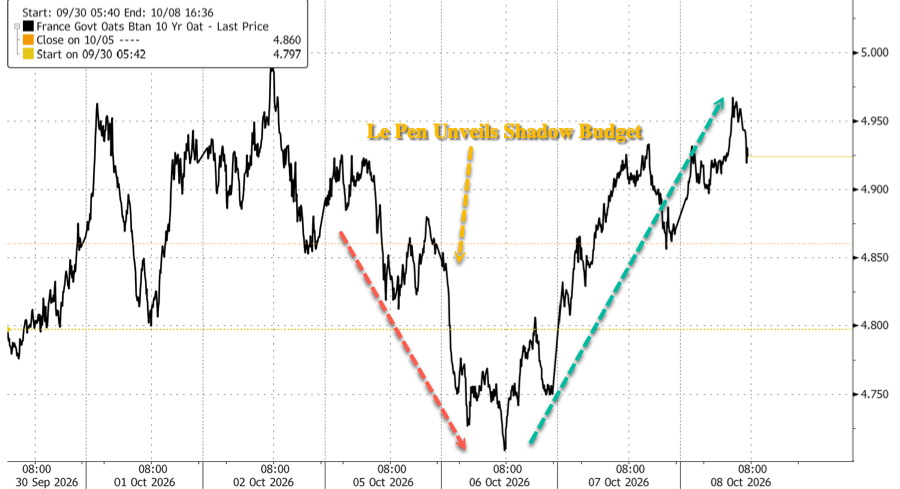
French 10-year bond yields rose sharply at the beginning of the week towards 5% before sliding to nearly 4.7% after Le Pen's shadow budget reveal on Tuesday. But by the end of the week, the government debt yield rocketed back to nearly 4.96%.
To save France from the brink of what we described as a "triple crisis", which consists of far-left riots, a ticking debt bomb and mass migration all colliding at once, a new Verian survey conducted for local outlet Le Figaro Magazine found that 39% of respondents believe Le Pen has a clear vision to contain the crisis.
Le Pen's 39% compared with just 27% for center-right rival Edouard Philippe and 18% for far-left candidate Jean-Luc Mélenchon.
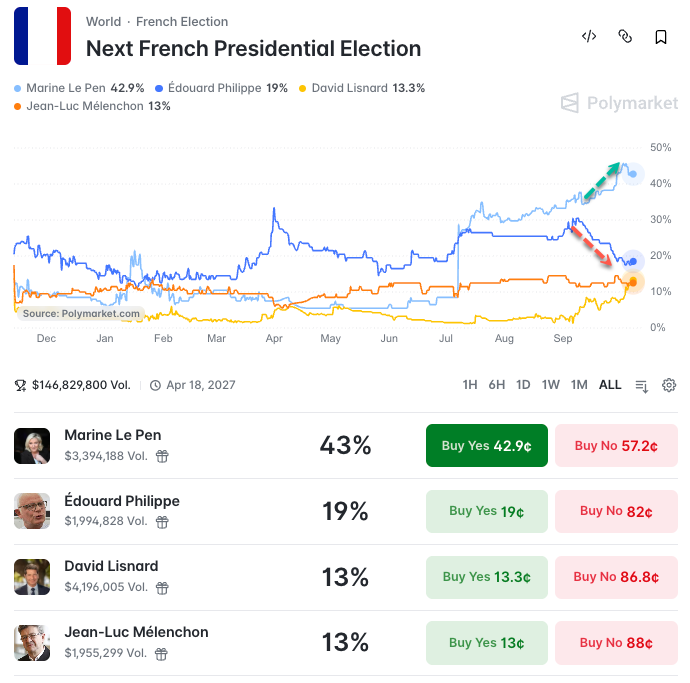
The ongoing social unrest by the far-left, weaponizing young kids who have burned down schools and torched buses, has been the extra fuel to propel Le Pen, as her Polymarket odds of winning the "Next French Presidential Election" have skyrocketed over the last week to 43%.
A consensus appears to be forming that Le Pen's proposed fiscal discipline to rescue France from the brink of what she describes as a looming default, if the current trajectory continues, is a welcome relief for the market and voters. Nomura analysts described this theme in late August (read report), and they see Europe "lurching" right over the next 18-month election cycle.
Principal Asset Management's Howe Chung Wan noted that one accelerator of France's bond rout was the unwinding of carry positions, which helped drive the selloff and amplified pressure that sent yields soaring.
"You can see this time around in France, it took France and Italy ... but it did not take Spain," Howe said, adding, "So it tells you it's about positioning. It tells you about who is on the trades."
What's happened so far this week:
Le Pen has tailwinds here as the spending bill for the failed progressive experiment and unfettered spending comes due. Nomura is correct: the market no longer fears right-wing candidates; it fears left-wing candidates and unhinged socialists.
Tyler Durden Thu, 10/08/2026 - 08:20
Continue reading...
[ H/T ZeroHedge ]
France's politicians seem to be getting a dire warning from the bond market: rein in reckless spending or risk a fiscal crisis as borrowing costs skyrocket.
UBS strategist Julien Conzano, head of European macro credit strategy in London, sees bond market pressure pushing both the crisis-stricken Macron government and Marine Le Pen's National Rally toward greater fiscal discipline, reducing the risk of an expansionary 2027 budget.
Deutsche Bank strategists Jim Reid and Henry Allen wrote in a note that French 10-year government bonds have posted their worst rolling decade of nominal returns since 1803, dating back to the Reign of Terror during the French Revolution.
The French welfare state's bill is finally coming due: France's budget deficit is forecast to be 5.4% of GDP this year, well above the EU's 3% ceiling. The country has not balanced its budget since 1974.
On Tuesday, Le Pen unveiled her shadow budget for next year, should she win the presidential elections in mid-April. In it, she proposed steep deficit cuts.
Le Pen's plan would shrink the deficit to 3.7% of economic output next year, well below the government's 5% target, before bringing it to 2.2% by 2032. Savings would come largely from spending cuts, lower transfers to the EU and reduced migrant spending.
French 10-year bond yields rose sharply at the beginning of the week towards 5% before sliding to nearly 4.7% after Le Pen's shadow budget reveal on Tuesday. But by the end of the week, the government debt yield rocketed back to nearly 4.96%.
To save France from the brink of what we described as a "triple crisis", which consists of far-left riots, a ticking debt bomb and mass migration all colliding at once, a new Verian survey conducted for local outlet Le Figaro Magazine found that 39% of respondents believe Le Pen has a clear vision to contain the crisis.
Le Pen's 39% compared with just 27% for center-right rival Edouard Philippe and 18% for far-left candidate Jean-Luc Mélenchon.
The ongoing social unrest by the far-left, weaponizing young kids who have burned down schools and torched buses, has been the extra fuel to propel Le Pen, as her Polymarket odds of winning the "Next French Presidential Election" have skyrocketed over the last week to 43%.
A consensus appears to be forming that Le Pen's proposed fiscal discipline to rescue France from the brink of what she describes as a looming default, if the current trajectory continues, is a welcome relief for the market and voters. Nomura analysts described this theme in late August (read report), and they see Europe "lurching" right over the next 18-month election cycle.
Principal Asset Management's Howe Chung Wan noted that one accelerator of France's bond rout was the unwinding of carry positions, which helped drive the selloff and amplified pressure that sent yields soaring.
"You can see this time around in France, it took France and Italy ... but it did not take Spain," Howe said, adding, "So it tells you it's about positioning. It tells you about who is on the trades."
What's happened so far this week:
- Spain Joins The Party: Snap Election Adds Madrid To Europe's "Red October" Bond Crisis
- French Bonds Rally As Le Pen Unveils Shadow Budget To Pull France Back From Fiscal Brink
- France's Triple Crisis: Far-Left Riots, A Ticking Debt Bomb, And Mass Migration Collide
Le Pen has tailwinds here as the spending bill for the failed progressive experiment and unfettered spending comes due. Nomura is correct: the market no longer fears right-wing candidates; it fears left-wing candidates and unhinged socialists.
Tyler Durden Thu, 10/08/2026 - 08:20
Continue reading...
[ H/T ZeroHedge ]