







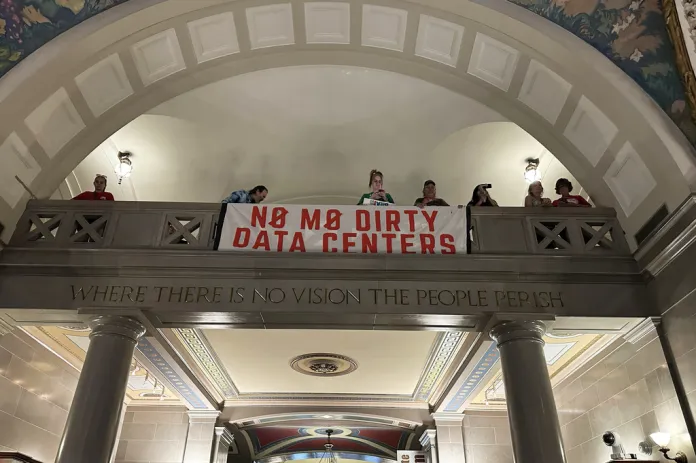
Senate candidates are facing growing pressure from voters to address the rapid expansion of data centers.
Some candidates have responded by backing a moratorium on data center construction, as favored by Sen. Bernie Sanders (I-VT) and other congressional Democrats. Others have called for restrictions on data centers, such as requiring that their energy consumption does not add to others’ utility bills. And some have said that decisions about data centers should be left to local officials.
Earlier this year, the House of Representatives passed the Ratepayer Protection Act, requiring states to consider standards for new data centers to cover the costs of new generation, transmission, and infrastructure upgrades.
However, Senate Democrats blocked the bill from passing last month, arguing it did not go far enough because compliance is voluntary.
Here are the stances laid out by all the major party Senate candidates for the 13 states deemed to have competitive races.
GEORGIA
Jon Ossoff (Democrat)
Data center moratorium: Ossoff has not advocated or proposed a data center moratorium.
Other restrictions: Ossoff has said data centers should cover their energy costs.
Sen. Jon Ossoff has not advocated or proposed any type of moratorium on data centers.
In April, the senator sent a letter to the Federal Energy Regulatory Commission announcing that his office would investigate whether data centers increased power bills in the state.
Ossoff said those in Georgia have been “suffering from sky-high power bills” due to large-load customers like data centers.
“Since 2019, Georgia has seen over $4.5 billion in AI-related venture capital investments, and this booming growth in computing power creates massive new demand for electricity,” he wrote.
The senator was also one of four Democrats who voted in favor of the Ratepayer Protection Act.
Mike Collins (Republican)
Data center moratoriums: Collins opposes a federal moratorium.
Other restrictions: Collins supports localities making decisions related to data centers.
Georgia’s Republican Senate candidate, Rep. Mike Collins, has opposed a federal moratorium on data centers. Instead, he has argued that data centers should be addressed on a local level.
In August, Collins told reporters that “at the end of the day this should be a local decision.”
“The people of each locality — they know what they can and can’t handle,” Collins said. “Do we need data centers? We sure do. We certainly do. We are in a race in AI against China. But if it is going to go in and hurt local infrastructure, then those people don’t deserve to have that happen to them.”
NORTH CAROLINA
Roy Cooper (Democrat)
Data center moratoriums: Cooper has said local communities should have the final say on data center development, including with respect to a moratorium.
Other restrictions: Cooper has said developers should pay the full cost of power use.
Data centers have been a focus in the North Carolina Senate race.
Former Gov. Roy Cooper, the Democratic nominee, has said that communities should have the final say on data center projects, including imposing moratoriums. Dozens of communities in North Carolina have implemented data center moratoriums.
He released a plan called “Make Stuff Cost Less,” calling for data centers to pay the full cost of all the power they use and for preventing costs from being passed down to consumers.
Cooper’s spokesperson criticized his Republican opponent, Michael Whatley, telling the Washington Examiner that it has been reported that he has “secretly consulted for a data center company while campaigning for Senate and personally profited as its stocks have spiked.”
Michael Whatley (Republican)
Data center moratorium: Whatley does not support a moratorium.
Other restrictions: Whatley supports data centers covering their own energy costs and opposes subsidies.
Michael Whatley supports the expansion of data centers to win the AI race against China, a stance in alignment with that of the Trump administration.
Whatley, who has worked for decades as an energy lobbyist, said data center developers need to work with communities to ensure adequate infrastructure is in place to support the projects. However, he has said that there should not be a “blanket no” to data center development.
A campaign spokesman told the Washington Examiner that Cooper has “bankrolled the data center boom, hid it in the fine print, and stuck North Carolina families with a 30 percent rate hike to pay for it.”
He added that Whatley’s position is that data centers should “pay their own way, families pay nothing, and communities decide. That means Big Tech builds or buys every megawatt it needs and covers every dime of the grid upgrades to deliver it, with zero costs shifted onto residential ratepayers.”
The spokesperson noted that there should be “no special subsidies and no sweetheart deals cut over the heads of taxpayers. And it means the people of North Carolina’s counties and towns, not bureaucrats in Raleigh or Washington, decide what gets built in their communities. North Carolina should win the AI economy, and it should win it on terms that protect the families who live here.”
ALASKA
Mary Peltola (Democrat)
Data center moratorium: Peltola has not advocated or proposed a data center ban.
Other restrictions: Peltola has said data centers should not strain the grid or raise costs for ratepayers.
Data centers have not taken center stage in the Alaska Senate race. However, former Rep. Mary Peltola said last month about data centers that “I really take my cue from the people of that region where the proposed development is happening.”
She said if a data center is supported by the community, then “who am I to stop it?”
Peltola did note that there is a broad concern about the effects of construction on utility ratepayers.
“I know there is so much stress across Alaska about the price of energy right now and making sure we have enough for the people and the projects that we currently have,” she said.
Dan Sullivan (Republican)
Data center moratorium: Sullivan does not support data center bans.
Other restrictions: Sullivan supports data center expansion.
Republican Sen. Dan Sullivan has petitioned to bring data centers onto Alaska’s military installations.
In February, when addressing the Alaska legislation, Sullivan said that data centers on military bases “will help increase domestic demand for our gas and lower the costs of building and financing the pipeline.”
IOWA
Josh Turek (Democrat)
Data center moratorium: Turek does not support a blanket moratorium on data centers.
Other restrictions: Turek supports federal regulations on data centers.
Josh Turek is the Democratic candidate running to fill the vacant Iowa Senate seat. Turek told reporters last month that Congress has a role to play in regulating artificial intelligence.
Turek said he doesn’t believe there are enough protections in place for data centers, particularly when it comes to ensuring that large corporations pay their fair share, preventing companies from receiving tax breaks, and setting guardrails to prevent data centers from driving up costs.
“More importantly in a state with a cancer crisis and a water quality crisis is making sure that they’re not using and abusing our natural resources like water and requiring closed-loop circuits to make sure that they’re not doing that,” Turek said.
Many Iowa communities have passed moratoriums on data centers.
Ashley Hinson (Republican)
Data center moratorium: Hinson does not support a data center ban.
Other restrictions: Hinson supports local-level decision-making and standards.
Rep. Ashley Hinson, a member of the House Select Committee on China, has emphasized the need for the United States to lead in AI development.
Hinson’s campaign communications director told the Washington Examiner that “Any decision to open a data center should be made by the Iowans who live and work in the local community.”
“Ashley believes there must be strong guardrails and oversight in place to protect Iowa ratepayers, strengthen energy reliability, ensure clean water, and prevent families from seeing higher utility bills because of new development,” they added.
Hinson also voted for the Ratepayer Protection Act in the House.
MAINE
Troy Jackson (Democrat)
Data center moratorium: Jackson supports a moratorium.
Other restrictions: Jackson has said data centers should pay for their own power and infrastructure upgrades.
Troy Jackson has supported temporary bans on data center construction. He released a plan called “Agency over AI,” requiring companies to pay for their own power sources and upgrades. It also proposed safeguards to ensure that AI does not replace workers and is subject to environmental rules.
Earlier this year, Maine Gov. Janet Mills vetoed a bill that would have enacted a temporary statewide ban on data centers. Jackson has said he would have signed the bill.
“AI may be new, it certainly is new to a lot of us, but the political question is old,” Jackson said. “Who benefits, who pays, and who decides? Under the Jackson administration, I can assure you that tech billionaires will not be deciding this alone and not be getting their way.”
Susan Collins (Republican)
Data center moratorium: Collins has said moratoriums should be considered on a case-by-case basis.
Other restrictions: Collins supports federal guardrails on data center development.
Sen. Susan Collins backed Mills’s veto of a bill that would have imposed a temporary ban on data centers. Mills did not sign the bill because it did not exempt a data center project that was being built at a closed paper mill.
At an event in August, Collins said she understands the concerns tied to data centers raising energy costs, but that the facilities have to be addressed on a “case-by-case basis.”
A spokesperson for Collins told the Washington Examiner that “Maine families and small businesses are already paying some of the highest electricity costs in the nation as a result of policies supported by Troy Jackson.”
“Senator Collins shares the worry that data centers could drive energy costs even higher. That’s why she supported the Ratepayer Protection Act in the Senate, which would help shield Mainers from paying the cost for these facilities,” the spokesperson added.
NEW HAMPSHIRE
Chris Pappas (Democrat)
Data center moratorium: Pappas has not advocated or proposed data center moratoriums.
Other restrictions: Pappas has advocated strong local control, increased regulation, and the elimination of federal tax incentives.
Rep. Chris Pappas last month introduced legislation to stop tech companies from receiving federal tax breaks for data center development.
“Big Tech and data center developers should be paying their fair share in taxes, and they shouldn’t be receiving huge tax breaks footed by the American people that raise costs for the rest of us,” Pappas said in a statement. “Shutting off this giveaway is a commonsense step.”
Pappas also voted in favor of the Ratepayer Protection Act. He has also supported the Water Resources Development Act, which would require commercial users like data centers to report the impact of development on local water resources.
John Sununu (Republican)
Data center moratorium: Sununu has not advocated or proposed data center moratoriums.
Other restrictions: Sununu has said that decisions about data centers should be made on the local level.
Former Sen. John Sununu is looking to return to Congress, where he served as senator from 2003 to 2009 and as representative from 1997 to 2003.
Sununu told WKBK that AI and data center decisions should involve the New Hampshire governor and local governments, particularly when it comes to energy and water infrastructure.
He has noted that Congress does have a role to play in AI when it comes to protecting children and older adults from exploitation and fraud.
Sununu has a background in working in the high tech and broadband related industries.
OHIO
Sherrod Brown (Democrat)
Data center moratorium: Brown has not advocated or proposed data center moratoriums.
Other restrictions: Brown favors local-level restrictions on data centers and no tax breaks for tech companies.
Former Sen. Sherrod Brown has centered his campaign on taking down “big corporations” that are raising utility bills and to defend communities and resources. Brown said data centers should pay the full cost of their utility use.
“Ohioans shouldn’t be forced to subsidize these costs,” Brown says on his website.
Brown has said that data centers should safely process water by using closed-loop water systems. He has also called for an end to data center tax breaks.
Brown has spent millions on ads attacking his opponent, Republican Sen. Jon Husted, over his support for data centers, arguing that he promoted them when he was lieutenant governor.
Jon Husted (Republican)
Data center moratorium: Husted does not support data center moratoriums.
Other restrictions: Husted backs local-level restrictions.
Sen. Jon Husted sponsored the Ratepayer Protection Act in the Senate.
In a statement to the Washington Examiner, Husted said: “Data centers are, and should remain, a local decision. Every community has different priorities, and local leaders are best equipped to decide what’s right for their residents.”
Amy Natoce, a spokesperson for the campaign, told the Washington Examiner that, “After failing Ohio families during his 32 years in Washington, Sherrod Brown is once again resorting to lies instead of facing his abysmal record head-on.”
Natoce noted that the House passed the Ratepayer Protection Act with bipartisan support.
“Sherrod Brown and his friends would rather play politics and stick Ohio families with higher electric bills than pass a commonsense solution. It’s despicable,” she added.
Over the summer, Axios obtained a memo from the National Republican Senatorial Committee warning tech companies that data centers were becoming extremely unpopular and Democrats have made it a “centerpiece” of their campaigns, specifically pointing to the Ohio Senate race.
TEXAS
James Talarico (Democrat)
Data center moratorium: Talarico does not support data center moratoriums.
Other restrictions: Talarico backs federal and local-level restrictions on data centers.
James Talarico released the “Hold Data Centers Accountable Plan,” which would set a minimum federal requirements for new data centers to protect the grid, the environment, and jobs. It would repeal the state’s data center sales tax exemption.
The plan would require data centers to pay for their own infrastructure and grid interconnection costs and to use closed-loop water systems. It would grant local communities the power to approve and reject data center development. The plan would also release government records detailing individual tax break information for data center facilities in the state.
“Texas should be a leader when it comes to innovation and technology, but that only works if Texans get a say and get a share of that economic growth — and that’s not what’s happening right now,” Talarico said at a news conference in Austin.
“We’re often told in our politics that we have to choose between policies that are pro-growth and pro-people. I reject that choice, and the plan that we’re outlining today to hold data centers accountable, I think, strikes a balance between welcoming those investments while also protecting working people,” he added.
Ken Paxton (Republican)
Data center moratorium: Paxton does not support a total data center ban.
Other restrictions: Paxton favors certain restrictions on technology.
Attorney General Ken Paxton released a four-point plan, called “Texas first data center plan,” that would restrict data center construction in rural neighborhoods, require noise and light controls, and improve traffic planning and emergency coordination. It would also repeal sales tax exemptions and require data centers to fund their own energy infrastructure.
It would prohibit the use of Chinese technology in U.S. data centers and related infrastructure and hold companies criminally liable if their facilities power AI chatbots that undermine children’s safety.
Paxton has also backed Sen. Tom Cotton’s (R-AR) DATA Act, which would let data centers build off-the-grid power systems, exempt from federal regulations.
MICHIGAN
Abdul el Sayed (Democrat)
Data center moratorium: El Sayed supports state and local moratoriums.
Other restrictions: El Sayed backs federal restrictions on data centers.
Data centers are playing a significant role in the Senate race in Michigan. Abdul el Sayed has said that, until there are standards on data centers, local and state moratoriums should be put in place.
“I believe that we need local and state moratoriums to protect people,” el Sayed told Detroit Fox 2 last month. “This cannot continue to be a race to the bottom while the richest people in society make robots that could ultimately end humanity.”
Earlier this year, el Sayed proposed terms of engagement for data centers if they want to build in Michigan.
The terms require that data centers fund their own energy demands, offer community engagement, guarantee energy reliability, create jobs, commit to protecting water, and make community benefit agreements.
El Sayed has also used the data center issue to attack Rogers in a recent ad, accusing him of investing millions in companies that profit from data centers.
Mike Rogers (Republican)
Data center moratorium: Rogers supports temporary moratoriums, but not on the federal level.
Other restrictions: Rogers favors stronger guardrails to protect communities.
Former Rep. Mike Rogers has shifted his stance on data centers throughout the campaign.
At the beginning of the year, Rogers would not answer questions regarding data centers. Later, though, he began to express support for requiring the AI facilities to cover their own electricity costs.
Then, in August, he called for a yearlong ban on new data centers to set strong guardrails.
“While I don’t support a federal ban, Michigan needs stronger guardrails to protect community control, prevent utility price hikes, protect our water, and stop pay-to-play schemes,” Rogers said.
MINNESOTA
Peggy Flanagan (Democrat)
Data center moratorium: Flanagan does not support data center bans.
Other restrictions: Flanagan is against tax breaks for data centers and supports decisions made at the local level.
Lt. Gov. Peggy Flanagan has called for nondisclosure agreements to be banned from data center developments. Flanagan has also said that data centers should be built by union labor and follow state environmental standards.
“I think that this is an existential threat to us if it gets out of control,” Flanagan said.
“When it comes to data centers, I think it’s clear that people have big concerns all across Minnesota and all across this country. It absolutely is troubling to me that we seem to be moving at the speed of corporate interests and not of community, and we have to determine who benefits,” she added.
Michele Tafoya (Republican)
Data center moratorium: Tafoya has not expressed support for or proposed a data center moratorium.
Other restrictions: Tafoya supports leaving decisions to the local level.
Former NFL reporter Michele Tafoya told Twin Cities newspaper that Minnesota should welcome new projects to help boost economic growth.
But she added that “Local residents, farmers, and businesses deserve a real say in how a data center project will affect their power, water, roads, and property, and they certainly shouldn’t be left paying the bill.”
Tafoya has noted that developers should be upfront about what incentives they are receiving and how they plan to cover project costs.
“I’m all for bringing new investment to Minnesota, but it has to be done responsibly and with the people who live there at the table,” Tafoya said.
KANSAS
Adam Hamilton (Democrat)
Data center moratorium: Hamilton has not expressed support for a data center moratorium.
Other restrictions: Hamilton supports local decisions on data centers.
Rev. Adam Hamilton has said that communities should decide whether a project gets built in their neighborhood. He has noted that data centers should cover energy costs and protect local communities’ water resources.
In a statement to the Washington Examiner, Hamilton said: “We shouldn’t be giving tax breaks to massive corporations building data centers in our communities that can drive up energy costs and drain our water supply.”
“That money should be used to pay down our national debt or restore support for critical programs such as Medicaid and SNAP,” he added. “While Roger Marshall supports these tax breaks for big out of state corporations, I will support what’s in the best interest for Kansas, not big tech companies.”
Roger Marshall (Republican)
Data center moratorium: Marshall supports local moratoriums.
Other restrictions: Marshall opposes tax incentives for data centers and supports local control over construction decisions.
Sen. Roger Marshall told Semafor in an interview over the summer that he supports local communities’ decisions to place moratoriums on data centers.
“People in Kansas are on fire” over data centers, Marshall said.
Marshall also noted that he opposes tax incentives for data centers, arguing that they do not bring jobs after they are built. He pointed out that some communities in the state have seen higher electricity rates due to data centers.
“Kansas isn’t going to hand over our land, water, or power grid to Big Tech companies that turn a profit while local families foot the bill with taxpayer giveaways. I support the counties in Kansas who are standing up and saying NO to data centers,” Marshall said in a statement to the Kansas City Star.
NEBRASKA
Dan Osborn (independent)
Data center moratorium: Osborn does not support data center moratoriums.
Other restrictions: Osborn supports federal restrictions on data centers and AI.
Dan Osborn, who is running as an independent, said on the campaign trail that “I think the moratorium could be a mistake because, like I said, we’re still competing with China.”
Last month in Washington, D.C., Osborn called on senators and representatives to pass guardrails needed to address AI and data centers.
“We need the protections in place. Like my colleagues said here, it’s moving at the speed of light,” Osborn said. “They’re warning us. They’re telling us human extinction-level events, and so the fact that you’re going home right now, I got a problem.”
Osborn, along with 17 other candidates, signed a pledge vowing to support stringent policies on data centers.
Pete Ricketts (Republican)
Data center moratorium: Ricketts has not expressed support for data center moratoriums.
Other restrictions: Ricketts supports localities making decisions related to data centers.
Sen. Pete Ricketts co-sponsored the Ratepayer Protection Act.
“We do hear issues with regard to data centers, and this is why I’m co-sponsoring the Ratepayer Protection Act to make sure the data centers are providing their own power, not increasing the rates for Nebraskans or Americans across the country through data centers,” Ricketts said on a Fox News podcast.
He said it is important that communities make their own decisions on data centers, adding that communities could ask data centers for more than just not raising electricity rates and conserving water.
“You can ask for other things, right? There’s communities in Georgia that have to pay their entire property taxes,” Ricketts said. “You can ask data centers to be in place to build roads, bridges. I mean, you can ask for more than just the table stakes of ‘Don’t jack up my power rates. Make sure you conserve water.’”
SOUTH CAROLINA
Annie Andrews (Democrat)
Data center moratorium: Andrews called for statewide two-year moratorium.
Other restrictions: Andrews has called for ending tax breaks for data centers.
Annie Andrews last month spoke outside of the Colleton County Courthouse in Walterboro, South Carolina, calling for a two-year moratorium on data centers in the state.
“People in this community and all across South Carolina are fed up with the data centers that are being built, and they deserve a say in what gets built in their own backyard,” Andrews said. “People are worried about what this means for their land, their water, their power bills, and their way of life.”
She added that she wants new investment and good paying jobs in South Carolina, but “not when projects threaten our farmers, our communities, our property rights, and our quality of life.”
Andrews argued that communities should not foot the bill on electricity costs tied to data centers, adding that South Carolinians need more of a say on what’s being built in their communities.
She also called to end special tax breaks for data centers.
Andrews called out her opponent, Sen. Darline Graham, stating she has called for more data centers to be built. She then launched datacenterdarline.com to illustrate where the senator stands on data centers.
BOTTOMS AND JACKSON CLASH OVER TRUMP AND DATA CENTERS AT GEORGIA GOVERNOR DEBATE
Darline Graham (Republican)
Data center moratorium: Graham does not support moratoriums.
Other restrictions: Graham supports leaving decisions about data centers to localities.
Sen. Darline Graham has said data centers are important but that they must be subject to restrictions, including having local involvement and ensuring they don’t raise utility costs.
A spokesperson told the Washington Examiner that “Senator Graham believes local communities and states should decide where data centers go, how they operate, and make sure taxpayers don’t end up footing the bill.”
“Her opponent, Annie Andrews, has again joined with Bernie Sanders and AOC in supporting a moratorium. Whether it’s data centers, sex changes for minors, or boys in girls’ sports, Annie Andrews always chooses the liberal Washington-knows-best agenda over South Carolina values,” the spokesperson added.
Continue reading...
[ H/T Washington Examiner ]