




The cost of the Iran war continues to rise as President Donald Trump publicly weighs additional military action following next week’s midterm elections.
Pentagon officials informed Congress on Oct. 16 that the cost of the war had surpassed $47 billion. The price tag continues to incrementally tick up as the department has maintained a significant force posture in the region to carry out the ongoing blockade of Iranian ports, even if the kinetic attacks between the United States and Iran have halted.
This most recent estimate notes that the department has used $29 billion worth of munitions, which has been a key discussion point throughout the war. The U.S. military uses expensive offensive and defensive munitions that each cost millions of dollars and take a long time to replace.
Secretary of War Pete Hegseth has acknowledged that it will take years to refill U.S. stockpiles following the war, though he’s noted that the department is looking to not only replace the expended munitions, but significantly increase them. Hegseth has also disputed the media’s coverage of the issue.
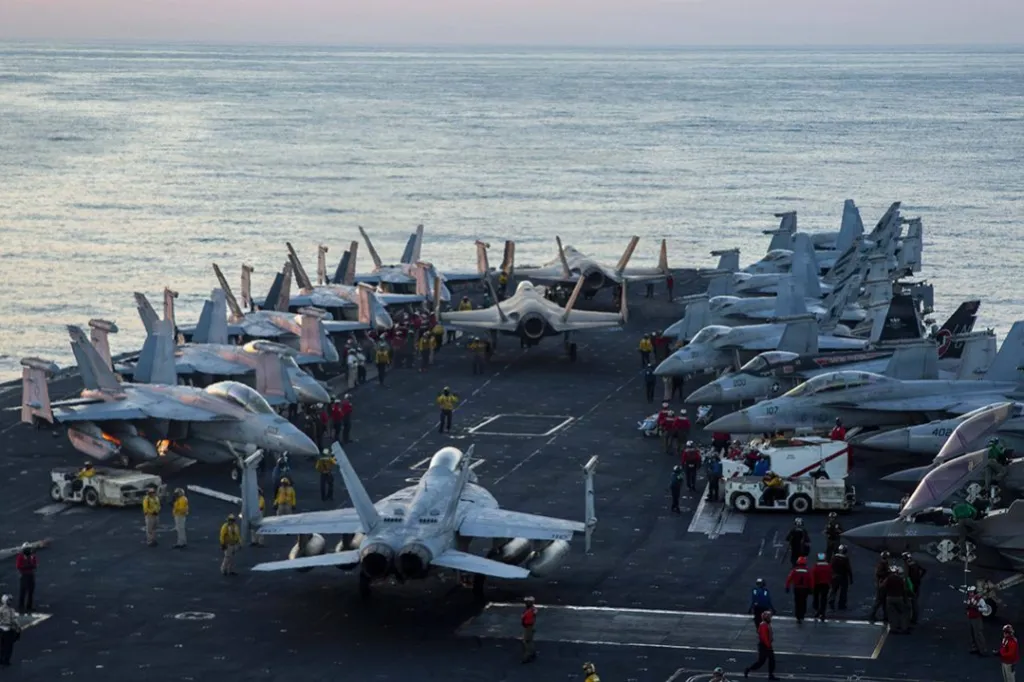
The military has also accrued roughly $6 billion worth of damage to equipment that was damaged or lost, most of which is aircraft.
A recent Congressional Research Service report found that 81 U.S. aircraft — both ones that require a human pilot and large drones — have been damaged or destroyed since the start of the war, more than half of which are MQ-9 Reaper drones. The MQ-9 drones are unmanned intelligence, surveillance, and reconnaissance aircraft that can be deployed in ways that are too dangerous for U.S. troops.
The CRS report notes that eight F-15s sustained limited damage while an A-10 had more extensive damage in an Iranian strike on Muwaffaq Salti Air Base in Jordan in September, seemingly while they were on the ground. Similarly, an Iranian attack in mid-March damaged five KC-135 aircraft at Prince Sultan Air Base, Saudi Arabia, and two weeks later, in a subsequent attack on the same base, an E-3 Sentry early warning-and-control system aircraft was destroyed.
The Air Force’s role in the war, according to the estimate document provided to Congress, which the Washington Examiner obtained, has cost roughly $7.6 billion primarily for support to deployed personnel, airlift, base and communication support, and transportation. The Navy has accrued a little under $1.5 billion in deployment costs for operational forces and ship and flight operations, while the Army has incurred an estimated $2 billion for operational force readiness and basic life support.
Secretary of War Pete Hegseth visits U.S. Navy Sailors aboard the USS Abraham Lincoln (CVN-72) near San Diego, Calif., Oct. 7, 2026. (DoW photo by U.S. Air Force Staff Sgt. Madelyn Keech)
" data-image-caption="
Secretary of War Pete Hegseth visits U.S. Navy Sailors aboard the USS Abraham Lincoln (CVN-72) near San Diego, Calif., Oct. 7, 2026. (DoW photo by U.S. Air Force Staff Sgt. Madelyn Keech)
" data-large-file="https://www.washingtonexaminer.com/wp-content/uploads/2026/10/Hegseth-on-the-Lincoln.jpg?w=700" src="https://www.washingtonexaminer.com/wp-content/uploads/2026/10/Hegseth-on-the-Lincoln.jpg?w=700" alt="Secretary of War Pete Hegseth visits U.S. Navy sailors aboard the USS Abraham Lincoln." class="wp-image-4767172" srcset="https://www.washingtonexaminer.com/wp-content/uploads/2026/10/Hegseth-on-the-Lincoln.jpg 700w, https://www.washingtonexaminer.com/.../10/Hegseth-on-the-Lincoln.jpg?resize=300,200 300w" sizes="(max-width: 700px) 100vw, 700px">
Secretary of War Pete Hegseth visits U.S. Navy sailors aboard the USS Abraham Lincoln (CVN-72) near San Diego, Calif., Oct. 7, 2026. (DOW photo by U.S. Air Force Staff Sgt. Madelyn Keech)
The $47 billion cost estimate does not include damages to U.S. bases in the region that may or may not be rebuilt. The Pentagon is considering its long-term Middle East footprint, and there are also questions of whether host countries would contribute to rebuilding these facilities.
“In terms of what’s going on in the Middle East, what I could share there is jump simply that we’re meeting with CENTCOM and doing the assessments right now form an installation perspective,” a senior defense official told reporters earlier this month. “Part of this is what will the global posture be in the future, and what does that require us to have?”
Trump has publicly discussed the possibility of resuming military operations in Iran following the midterm elections, though it’s unclear what exactly the goals of the renewed operations would be and how the Iranians would retaliate.
“You’ll see Iran in a couple of weeks, if you don’t mind,” Trump told a crowd on Tuesday during a rally in Lubbock, Texas.
The war began over Iran’s nuclear ambitions, but the focus has largely been on the vital Strait of Hormuz for months. Following the start of the war, Iran’s Revolutionary Guard began attacking vessels transiting the waterway off its coast, which has led to increased energy prices across the globe. The Guard also began firing drones and missiles at several countries in the region, both at U.S. bases and also at civilian and public spaces.
THE MILITARY’S $1 BILLION DRON PLAN TO TAKE ON CHINA — AND HOW IT HOPES IT NEVER HAS TO USE THEM
To date, more than 20 U.S. service members have lost their lives since the war began.
In the opening hours of the war, an Iranian drone made a direct impact at a U.S. facility in Kuwait that resulted in the deaths of six service members, marking the deadliest Iranian attack during the war. Another U.S. service member died days later from injuries sustained in a separate Iranian attack that occurred on the same day, while three others were killed in a similar attack in Jordan in July.
A Congressional Budget Office estimate released in September found that if the war continues with the relatively quietness that took place in May and June, it would cost roughly $2 billion a month. If it’s a slightly higher tempo like in July, when there was about a two-week period of daily U.S. bombings and Iranian retaliation, it would cost approximately $3 billion.
Should Trump go through with restarting the war, the cost will rise at a much faster pace.
Trump and Hegseth have touted the administration’s $1.5 trillion defense budget request as a generational investment to transform the military through the rapid adoption of artificial intelligence, autonomy, and robotics. However, the administration split the request up into its normal base budget of roughly $1.15 trillion and $350 billion in reconciliation.
“We’re lockstep on that with the White House,” Hegseth said earlier this month at the Association of the U.S. Army convention. “We will ensure, regardless of what happens in the midterms, we’re running fast immediately with the committees to ensure that [the] reconciliation bill, at a minimum of 350 [billion dollars], potentially more, ultimately fills up what this department needs.”
Simultaneously, Hegseth is also facing the possibility of a House impeachment effort if the Democrats retake control in the midterm elections.
Continue reading...
[ H/T Washington Examiner ]