Maria Corina Machado returned to Venezuela on Sunday, appearing at a church in the state of Lara after ten months abroad. On Dec. 11, the National Assembly is scheduled to receive the names of 32 new Supreme Court magistrates who could determine the rules governing Venezuela’s next election. Machado’s return threatens to turn what might have been a controlled institutional exercise into a national political confrontation.
Venezuelans understand the importance of the Tribunal Supremo de Justicia. In January 2024, the court upheld Machado’s 15-year disqualification from public office. Seven months later, its electoral chamber validated Nicolas Maduro’s disputed presidential victory without publicly producing the underlying tally sheets. With magistrates serving 12-year terms, the new court could adjudicate Machado’s eligibility, electoral disputes, and the next presidential election.
The selection timetable is tight. Applications run from Oct. 28 to Nov. 11, challenges from Nov. 23 to 26, and interviews conclude before Dec. 11. The process emerged from negotiations between National Assembly President Jorge Rodriguez and an opposition faction associated with the 2015 legislature. Its structure offers broader participation, but its safeguards remain untested.
An appointments committee of 11 deputies and 12 civil society representatives will screen candidates, with support from seven jurists, four of whom are reportedly trusted by the opposition. Yet Chavista deputy Giuseppe Alessandrello chairs the committee, and Transparencia Venezuela identifies 10 members as government-aligned. Applicants must declare no party membership, a requirement that former party officials could satisfy by resigning. Dual nationals are excluded, potentially eliminating qualified Venezuelan lawyers living abroad.
Candidates from an earlier May-June application process reportedly remain eligible without reapplying. Their identities and qualifications deserve scrutiny. A process can satisfy procedural requirements while preserving the political relationships it was supposed to change.
The appointments expose competing interests within the governing coalition. Acting President Delcy Rodriguez needs institutions credible enough to sustain Washington’s cooperation and Venezuela’s economic reopening. On Monday, she expressed hope that dialogue would continue providing opportunities for political participation. Her government has an incentive to demonstrate progress without surrendering control.
Interior Minister Diosdado Cabello faces a different calculation. With a longstanding U.S. indictment hanging over him, an independent judiciary could pose risks that a Chavista-controlled court would not. On Oct. 1, he challenged Machado to return, dismissing her campaign as a show. The late-November challenge period may reveal whether his allies seek to preserve Chavista influence over the appointments.
Machado’s return changes the political environment. Vente Venezuela did not participate in negotiating the selection process, and Machado has little reason to accept a tribunal that reproduces the existing political balance. From inside Venezuela, she can scrutinize candidates, support formal challenges, and mobilize supporters. What was intended as an institutional negotiation could become a contest for political legitimacy.
That creates a potentially dangerous confrontation. Large demonstrations are plausible as the selection deadline approaches, particularly if opposition supporters believe the appointments are predetermined. Counterdemonstrations, clashes between rival groups, and intervention by security forces could follow. Violence is not inevitable, but Venezuela’s history provides reason to take the possibility seriously.
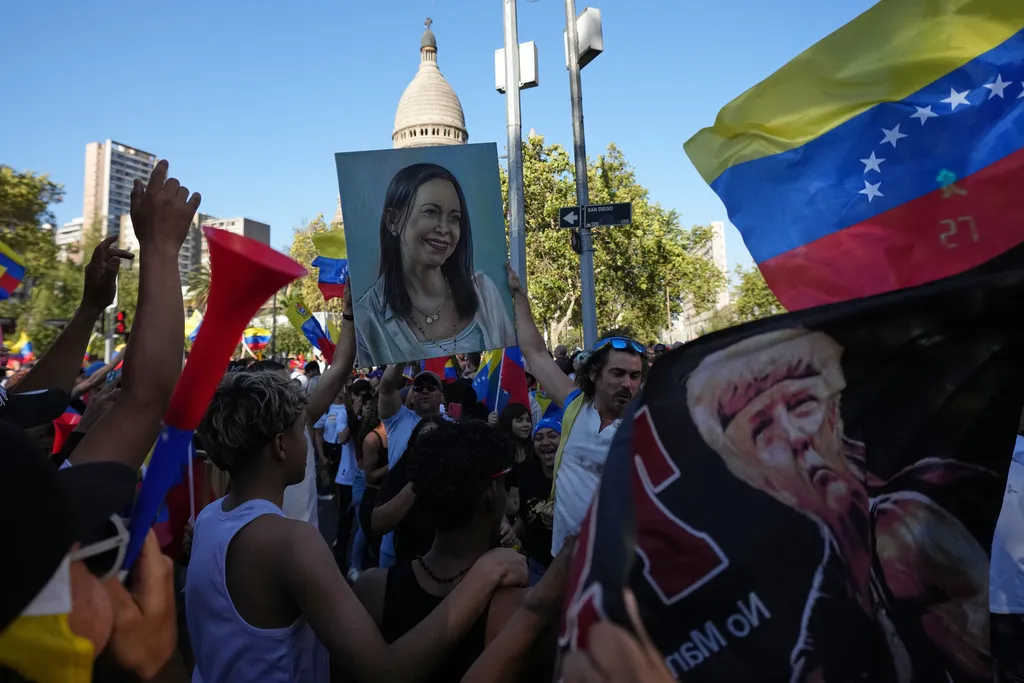
Venezuelans celebrate with a painting depicting opposition leader and Nobel Peace Prize winner Maria Corina Machado in Santiago, Chile.
" data-image-caption="
Venezuelans celebrate with a painting depicting opposition leader and Nobel Peace Prize winner Maria Corina Machado in Santiago, Chile, Saturday, Jan. 3, 2026, after President Donald Trump announced that President Nicolas Maduro was captured and flown out of Venezuela. (AP Photo/Esteban Felix)
" data-large-file="https://www.washingtonexaminer.com/wp-content/uploads/2026/01/AP26004026956748_059a57.jpg?w=1024" src="https://www.washingtonexaminer.com/wp-content/uploads/2026/01/AP26004026956748_059a57.jpg?w=1024" alt="Venezuelans celebrate with a painting depicting opposition leader and Nobel Peace Prize winner Maria Corina Machado in Santiago, Chile." class="wp-image-4407925" srcset="https://www.washingtonexaminer.com/wp-content/uploads/2026/01/AP26004026956748_059a57.jpg 1024w, https://www.washingtonexaminer.com/...01/AP26004026956748_059a57.jpg?resize=300,200 300w, https://www.washingtonexaminer.com/...01/AP26004026956748_059a57.jpg?resize=768,512 768w" sizes="(max-width: 1024px) 100vw, 1024px">
Venezuelans celebrate with a painting depicting opposition leader and Nobel Peace Prize winner Maria Corina Machado in Santiago, Chile, Saturday, Jan. 3, 2026, after President Donald Trump announced that President Nicolas Maduro was captured and flown out of Venezuela. (AP Photo/Esteban Felix)
Machado herself faces greater risks. Her return places her within reach of the institutions she is challenging. Authorities could restrict her movements, impose house arrest, revive legal proceedings, or detain her under the pretext of maintaining public order. Such measures would carry diplomatic costs, but that does not make them impossible.
History offers more disturbing precedents. Opposition leaders confronting entrenched authoritarian governments have faced imprisonment, forced exile, disappearance, and assassination. There is no evidence such an outcome is planned for Machado. But international prominence and American support cannot guarantee her protection if the confrontation escalates.
This is where Washington’s economic strategy encounters its limits. Secretary of State Marco Rubio said Monday that the United States had informed Venezuela’s interim authorities that Machado belonged in her country and should be permitted to return without interference. He also warned against attempts to derail the political process. A senior State Department official reportedly expects a new tribunal by year’s end, followed by a new electoral council.
That establishes a sequence, but not necessarily a standard for success.
President Donald Trump has emphasized progress in relations with Venezuela while suggesting elections would be premature. His administration has relied on Rodríguez as its principal governing counterpart. That arrangement may provide economic stability, but it raises a question Washington cannot avoid: How much institutional reform must occur before an election can be considered credible?
Washington’s oil agreements and sanctions leverage provide influence, but economic incentives do not automatically restrain officials who believe their political survival or freedom is threatened. An agreement protecting oil production while leaving opposition leaders vulnerable to detention or intimidation would expose a serious weakness in the transition.
The U.S. could demand public judicial interviews, published candidate evaluations, meaningful opposition challenges, and scrutiny of magistrates involved in validating the disputed 2024 results. It could also make clear that politically motivated restrictions on Machado or violence against peaceful demonstrators would carry consequences. These measures cannot guarantee judicial independence, but they establish standards against which the government’s conduct can be judged.
The larger issue extends beyond Machado’s eligibility. A credible election requires more than accurate vote counting. The losing side must accept the result, and the institutions responsible for enforcing it must recognize the winner’s authority. Courts, armed forces, intelligence services, police, and electoral authorities must operate under rules that survive a change in government.
The Supreme Court sits near the center of that problem. It can resolve disputes and protect constitutional procedures, or provide legal justification for preserving existing power. Its composition matters to both the opposition and officials who fear what a transition might mean for them. Judicial independence must be credible to both sides if the court is to serve as an arbiter rather than another participant.
During my years in Caracas, I watched Chavismo consolidate power through institutions as well as elections. Appointments, procedural rules, and judicial decisions could accomplish what direct confrontation might make politically costly. Control over the institutions interpreting the rules can be as consequential as control over the ballot box.
Venezuela faces that institutional test again, but Machado’s return adds an unpredictable element. Rodríguez is managing a transition under American scrutiny, Cabello retains substantial influence over the security apparatus, and an opposition leader challenging the regime’s legitimacy is back inside the country. The December appointments could become a flashpoint well before Venezuelans vote.
Washington should not mistake economic cooperation for political reconciliation. Oil agreements may create incentives for restraint; they cannot guarantee it. Nor should anyone assume Machado’s visibility protects her from dangers historically faced by opposition leaders confronting entrenched power.
VENEZUELA’S OPPOSITION LEADER MACHADO RETURNS AFTER MONTHS IN EXILE, AS DOUBTS OVER DEMOCRACY DEEPEN
If the December tribunal reproduces the political loyalties of its predecessor, Venezuela could enter its next election with the central question unresolved: whether the institutions will recognize and enforce a result that changes who holds power.
An election may be months away. The struggle over who will judge it has already begun, and Machado’s return could move that struggle from the committee room into the streets.
Continue reading...
[ H/T Washington Examiner ]