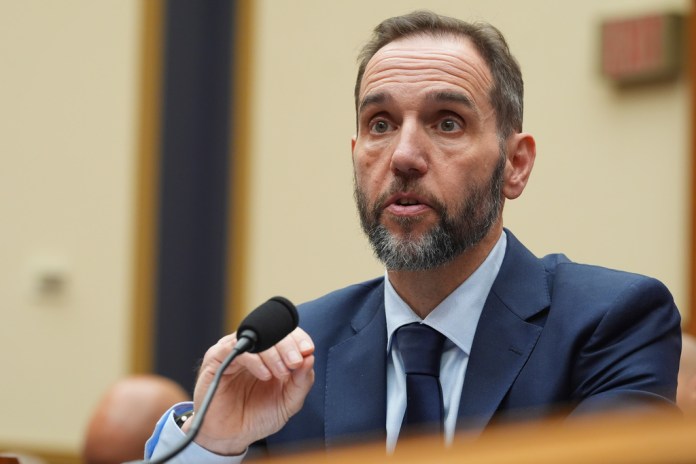
The Department of Justice operates under a foundational principle: prosecutors pursue justice, not political outcomes. That’s the official story, at least. The House Judiciary Committee’s 57-page interim staff report, released Wednesday and titled “How Jack Smith and the Biden-Harris Department of Justice Disregarded the Separation of Powers to Spy on Their Political Opposition,” suggests the reality under special counsel Jack Smith’s operation was considerably more complicated.
The report’s most direct allegation on the election front is this: Smith’s prosecutors released a massive trove of purported evidence in the final weeks before Nov. 5, 2024, the presidential election date. That timing placed the release squarely inside the window the DOJ’s own election-sensitivity guidance identifies as the highest-risk period for any government action that could appear to influence a vote. The committee characterizes it as a violation of department protocol.
That guidance has been DOJ policy for decades. The principle behind it traces to Attorney General Robert Jackson, who warned in a 1940 address to U.S. Attorneys that “the prosecutor has more control over life, liberty, and reputation than any other person in America.” The men and women who held the office after Jackson understood the warning and built the election-sensitivity policy around it. That framework wasn’t designed for a fringe case. Smith’s office apparently treated it as a suggestion.
Buried deeper in the report is a separate and, in some ways, more alarming set of allegations. Investigators in Smith’s office, operating under the code-named “Arctic Frost” investigation into the 2020 election dispute, allegedly obtained toll records from at least 17 Republican members of Congress and acquired communications involving 44 members of the House and Senate. They sought nondisclosure orders that kept the surveilled lawmakers unaware that the subpoenas had been issued.
The speech or debate clause, enshrined in Article I, Section 6, exists because the framers understood what executive surveillance of the legislature could do to a republic. It insulates members from intimidation while they’re doing the people’s work. The report says Smith’s office failed to run the collected material through filtering procedures designed to screen out constitutionally protected communications. Skipping those filters is a conscious decision, not an administrative lapse.
I’ve spent over a decade as a designated expert witness in fiduciary litigation. The central question in every fiduciary case is the same: Did you act for your principal, or for yourself? Smith’s principal was the American public, and his obligation was a lawful prosecution conducted within institutional boundaries. The record now suggests his office served an additional agenda that the rules were specifically designed to prevent.
Some will downplay this as Rep. Jim Jordan’s (R-OH) committee witch hunt. Fair enough. Jordan is not known for understatement. But the committee obtained documents to support its claims, and the Justice Department confirmed receipt of his criminal referral under 18 U.S.C. § 1001, the federal false-statements statute. The referral argues that Smith’s December 2025 closed-door testimony created a false impression about whether his office had accessed lawmakers’ text message content, and that documents obtained afterward directly contradict that impression. A referral is not a conviction. A deposition answer that can’t survive a subsequent document review is a different category of problem.
TRUMP IS RIGHT. BIG TECH DOESN’T NEED MORE CONTROL OVER YOUR CAR
This matters beyond the political fortunes of Smith or President Donald Trump. The DOJ’s authority rests on public confidence that it investigates crimes rather than opponents. When a special counsel’s office sweeps up communications from 44 members of Congress, releases a document trove in the final weeks before a presidential vote, and then arguably misleads Congress about what it did, the institution absorbs the kind of credibility damage that doesn’t repair quickly.
Marcus Aurelius observed that character is revealed by choices made under pressure, not speeches. The choices made within that special counsel’s operation are now under scrutiny by Congress, the DOJ, and a public that noticed. Congress should complete the investigation. The Justice Department should follow the referral wherever the evidence leads. The rest of us should stop treating a badge and a mandate as substitutes for impartiality.
Jay Rogers is a financial professional with more than 30 years of experience in private equity, private credit, hedge funds, and wealth management. He has a Bachelor of Science in criminal justice from Northeastern University and has completed postgraduate studies at UCLA, the University of Pennsylvania, and Harvard. He writes about issues in finance, constitutional law, national security, human nature, and public policy.
Continue reading...
[ H/T Washington Examiner ]