The Houthis‘ advance doesn’t mean Iran is winning. It means President Donald Trump is.
This might sound crazy compared to the popular Western narrative. In fact, the escalation exposes a decaying regime. Contrary to the complacent belief that the Houthis are mere puppets, like Hezbollah, the alliance has always been one of limited influence.
This sudden escalation is not a show of strength. It is the act of a panicked, paralyzed regime on the brink of falling.
Recent Trump-era blockades and sanctions have drained Iran of hundreds of millions of dollars daily, pushing the regime to increase its support for the Houthis despite its previously skeptical and limited backing. This sudden cash injection has enabled the Houthis to block Red Sea ports and shipping lanes, effectively preventing Saudi Arabia from diverting oil to Yanbu Port after the Strait of Hormuz was closed.
This is no typical Iranian tentacle wrapping itself further around the Middle East. It is a panicked plot by a cornered regime calling on a faction that should be its last resort.
In an interview with France 24, Thomas Juneau, a University of Ottawa professor and leading researcher on the Houthi-Iran relationship, explained, “I’ve written a lot over the years to reject the view that the Houthis are a puppet of Iranian foreign policy, that the Houthis are an arm of Iranian foreign policy that merely obeys or executes Iran’s orders. I think the relationship is much more complicated than that.”
Asked about recent events, Juneau said, “What we’ve been seeing in the last few days in Yemen has absolutely been done in close coordination with Iran and has to be seen in the context of developments in the Persian Gulf.”
Although the Houthis may now look like a proxy, coordination does not mean control.
In Iran’s eyes, the Houthis offer a poor return on investment compared with other regional militant groups, particularly because Tehran does not want to risk a direct, costly escalation with Saudi Arabia.
The gap in scale tells the true story. Saudi Arabia poured at least $4 billion into Yemen from 2012 to 2022 alone. By contrast, a 2015 U.N. Security Council report traced Iranian arms shipments to the Houthis back to 2009, including a 2011 seizure of 900 Iranian rockets. It found that American officials estimated Iran’s historical assistance consisted merely of small arms and “several million dollars in cash.”
The backing was so minimal that in 2014, both the United Nations and the United States explicitly stated that the Houthis were not an Iranian proxy but a group receiving limited support.
Michael Mulroy, a former deputy assistant secretary of defense for the Middle East and co-founder of the Lobo Institute, offers the sharpest counter.
“The Houthis are the most effective proxy for Iran,” Mulroy said. “They have essentially pledged allegiance to the new supreme leader and have actively joined this conflict, compounding the economic pressure Iran is putting on the world energy market. The U.S. will have to deal with them decisively if this conflict is to come to an end favorably to the U.S. and the region.”
Although the Houthis’ expansion has negative ramifications for the world energy market, it also raises a question about how they should be treated: If the Houthis are truly Iran’s proxy arm, the only viable outcome for the U.S. is direct intervention to clamp down on Iran.
That doesn’t fully add up, however, given that U.S. officials met directly with the Houthis in Oman on Sunday. Trump said of the secret meeting, “The Houthis called us, and they don’t want to fight with us. They don’t want me to go after them.”
When asked for further comment on the recent escalation, a State Department spokesperson said, “Iran’s support for the Houthis is nothing new — it has armed, funded, and trained the terrorist group for over a decade, enabling the Houthis to sow chaos in Yemen and beyond and interfere with freedom of navigation in the Red Sea.”
Asked how the Trump administration plans to tackle the Houthis, the spokesperson added, “The Trump administration has clearly demonstrated its resolve and commitment to confront Iran and its proxies throughout the region, and we will not hesitate to use all available tools to counter the full range of Iran’s destabilizing actions.”
This puts the U.S. in a position of ultimate strength. Washington is twisting Iran’s hand toward imminent economic collapse, and Tehran’s financial ability to feed its regional network will naturally evaporate. That will weaken its hold on the Houthis, particularly against Trump’s peace-through-strength pragmatism.
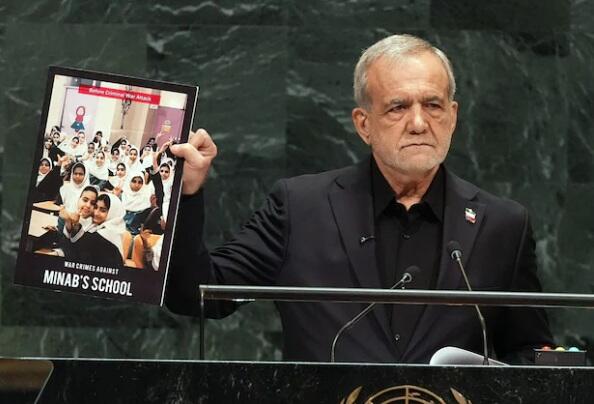
BLOOD ON THE UN PODIUM: IRAN’S PRESIDENT JUST DEFENDED GENOCIDE TO AN EMPTY ROOM
The result is a far more favorable strategic environment for Washington. As Iran’s economy deteriorates, its ability to sustain the Houthis weakens, allowing Yemen’s internationally recognized government, which actively combats the group, to deal with the aftermath rather than the U.S.
Tehran thought deploying the Houthis would be a smart last-ditch effort, a counterpunch to inflict harm on the U.S. and its allies. What it forgot is who it is facing, and the message this sends: Iran is losing, and not just slightly. Big time!
William Nye is a Brisbane-based Australian student and op-ed columnist covering global and domestic politics, culture, economics, and international affairs, with a strong focus on U.S. politics. His work has appeared in the Spectator Australia and the Washington Examiner.
Continue reading...
[ H/T Washington Examiner ]